15 Results for "

plant protection

" in MedChemExpress (MCE) Product Catalog:
Products (15)

15 Results for "plant protection" in MCE Product Catalog:

5
5 Cited Publications
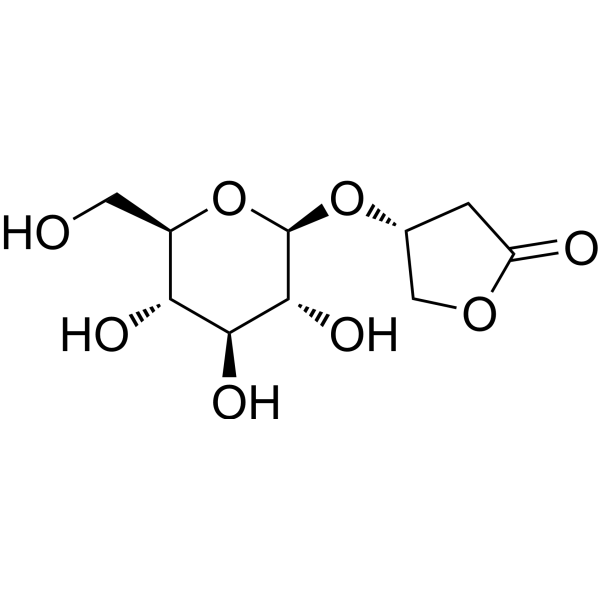
Cat. No.: HY-N2292
CAS No.: 151870-74-5
Kinsenoside is the main active ingredient of the genus plant, and has various biological activities. Kinsenoside and Nrf2 depend on the protection of nuclear cells (NPCs), which significantly reduces their ability to survive. Kinsenoside Active NPC Medium AKT-ERK1/2-Nrf2 Signal passage, Prevent physical decline, aging, harmonious physical function impairment. Kinsenoside can improve the puncture guide model for intermediate vertebral wall discharge (IDD).
loading...
    loading...
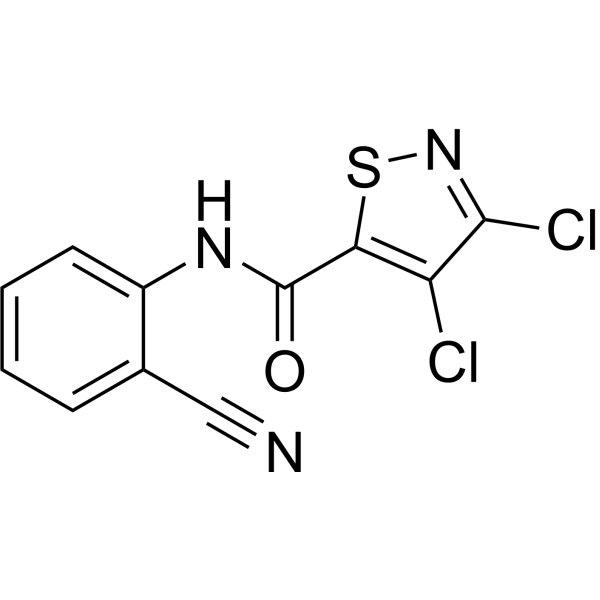
Cat. No.: HY-W075256
CAS No.: 224049-04-1
Research Areas:  

Others

Isotianil is a plant defense inducer that has no direct antimicrobial effect but instead activates typical plant defense responses. Isotianil can be used as a plant protection agent for controlling rice blast .
loading...
    loading...
Cat. No.: HY-W774934
CAS No.: 881685-58-1
Target:  

Fungal

Isopyrazam is a plant protection product with fungal activity. Isopyrazam exhibits excellent disease resistance on crops and effectively inhibits the growth of multiple plant pathogenic fungi. The application of Isopyrazam can significantly improve the yield and quality of crops.
loading...
    loading...
Cat. No.: HY-180433
CAS No.: 2377084-09-6
Target:  

Parasite

Research Areas:  

Infection

Sulfiflumin (compound I) is a thiazolidine acaricide. Sulfiflumin can be used as a plant protection agent .
loading...
    loading...
Cat. No.: HY-P2742B
CAS No.: 9029-44-1
Target:  

Endogenous Metabolite

Research Areas:  

Metabolic Disease

Ascorbate oxidase, acremonium sp is a member of the multicopper blue oxidase family and primarily exists in plants as a free enzyme in the cytoplasm or bound to the cell wall. Ascorbate oxidase, acremonium sp has a high activity in catalyzing the oxidation of ascorbic acid to dehydroascorbic acid, regulating various cellular processes related to plant growth, protection, and development. Ascorbate oxidase, acremonium sp can be used to detect hydrogen peroxide .
loading...
    loading...
Cat. No.: HY-167814
CAS No.: 14317-07-8
Trimethylsilyl-D-(+)-mannitol is a compound with osmoprotective activity that can effectively scavenge reactive oxygen species (ROS) and provide protection for plants and microorganisms.
loading...
    loading...
Cat. No.: HY-N15356
CAS No.: 2489590-40-9
9-Oxooctadecanedioic acid is an α,ω-dicarboxylic fatty acid monomer found in the cork suberin of Quercus suber. It contributes to the formation of the hydrophobic barrier structure in plant cell walls and may play an important role in functions such as water resistance and protection against microbial penetration .
loading...
    loading...
Cat. No.: HY-162488
Target:  

Fungal

Research Areas:  

Infection

Laccase-IN-3 (Compound 2b) is a laccase inhibitor (IC50 = 1.02= μM) with significant antifungal activity. Laccase-IN-3 shows superior inhibitory effect on Botryosphaeria dothidea (EC50 = 0.17 mg/L). Laccase-IN-3 effectively blocks the catalytic function of laccase by binding to its active center. Laccase-IN-3 also disrupts pathogen cell membrane integrity and increases ROS .
loading...
    loading...
Cat. No.: HY-168066
Target:  

Fungal

Research Areas:  

Infection

Antifungal agent 117 is a bis-pyrazole carboxamide derivative with antifungal activity, exhibiting an EC50 value of 11.58 mg/L against Sclerotinia sclerotiorum. Antifungal agent 117 increases cell membrane permeability, causing an imbalance in osmotic pressure inside and outside the cell, and induces the accumulation of reactive oxygen species (ROS), leading to oxidative damage to the cell membrane, resulting in leakage of cellular contents and eventually cell death. RNA sequencing analysis reveals that Antifungal agent 117 downregulates catalase genes and upregulates neutral ceramidase genes, disrupting cell membrane structure, accelerating sphingolipid metabolism, and promoting cell death. Antifungal agent 117 shows great potential in the fields of plant protection and antifungal infection .
loading...
    loading...
Cat. No.: HY-L0105V
485,000 compounds
InterBioScreen Synthetic Compounds Library contains about 485,000 immediately available compounds. The library is generated by very rigorously selecting the most interesting classes of compounds that are most likely to become new drugs or plant protection agents or veterinary preparations.
Cat. No.: HY-177428
CAS No.: 120330-90-7
Synonyms: JA-Val
Target:  

Drug Derivative

Research Areas:  

Others

Jasmonoyl-valine (JA-Val) is one of the amino acid conjugates of jasmonic acid. Jasmonoyl-valine can be extracted from the alpine plant Saxifraga longifolia. Jasmonoyl-valine may participate in light protection or regulation of photosynthetic mechanisms .
loading...
    loading...
Cat. No.: HY-W714300
CAS No.: 63284-71-9
Target:  

Fungal

Research Areas:  

Infection

Nuarimol is a fungicide used for plant protection in agriculture. Nuarimol is a phenobarbital-type inducer of hepatic drug-metabolizing enzymes. It triggers transient but robust regenerative hepatocyte proliferation accompanied by hepatomegaly by causing reversible hepatocellular injury .
loading...
    loading...
Cat. No.: HY-W169645
CAS No.: 924-41-4
Synonyms: NSC 102761
1,5-Hexadien-3-ol is a green leaf volatile (GLV) alcohol that can be found in tomato plants. 1,5-Hexadien-3-ol contributes to protection against Botrytis cinerea. 1,5-Hexadien-3-ol can be used for the research of grey mould disease .
loading...
    loading...
Cat. No.: HY-L183
531 compounds

Pesticide is a single substance or mixture that can be used to prevent, mitigate, iminate pests or as a plant conditioner, defoliant or desiccant. In recent years, scientists have proposed the concept of "Molecules to Ecosystems", bringing the concept of molecular biology to understand the impact of pesticides, degradation and relationship with the environment or organisms. MCE integrates effective compounds approved as pesticides by agencies such as the Environmental Protection Agency (EPA), China Pesticide Information Network and some insecticidal compounds with potential for agricultural applications.

MCE can provide a library of 531 pesticide compounds that are tool compounds for relevant research.

Cat. No.: HY-N21814
CAS No.: 128826-89-1
Salbostatin is a competitive Trehalase inhibitor, with an IC50 of 8.3 μM against silkworm trehalase and a Ki of 180 nM against porcine trehalase. Salbostatin is isolated from Streptomyces albus. Salbostatin shows no antibacterial activity, and does not inhibit porcine intestinal mucosa sucrase (EC 3.2.1.26) or maltase (EC 3.2.1.20). Salbostatin can be used in studies related to the development of plant protectants .
loading...
    loading...
  • 1

