
1. Search Result
Search Result
Results for "

rat DRG neurons

" in MedChemExpress (MCE) Product Catalog:

10

Inhibitors & Agonists

1

Peptides

1

Natural
Products

Cat. No. Product Name Target Research Areas Chemical Structure
  • HY-121119
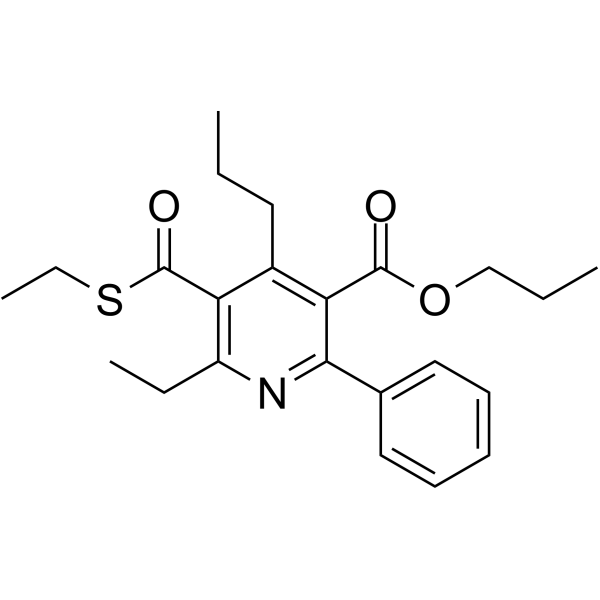
    MRS 1523
    5 Publications Verification

    Adenosine Receptor Calcium Channel Cardiovascular Disease Neurological Disease Inflammation/Immunology
    MRS 1523 is a potent and selective adenosine A3 receptor antagonist with Ki values of 18.9 nM and 113 nM for human and rat A3 receptors, respectively. In rat this corresponds to selectivities of 140- and 18-fold vs A1 and A2A receptors, respectively. MRS 1523 can exert antihyperalgesic effect through N-type Ca channel block and action potential inhibition in isolated rat dorsal root ganglion (DRG) neurons .
    MRS 1523
  • HY-111560

    Potassium Channel Neurological Disease
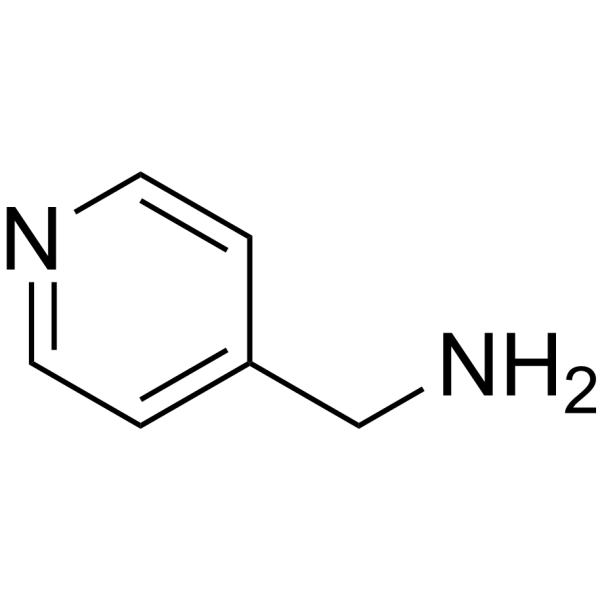
    IQM-266 is a Downstream Regulatory Element Antagonist Modulator (DREAM) ligand with a KD of 4.63 μM. IQM-266 inhibits the KV4.3/DREAM current in a concentration-, voltage-, and time-dependent-manner. IQM-266 also modulates A-type outward potassium currents (IA) from rat dorsal root ganglia (DRG) neurons. IQM-266 can be used for neurological disease research, such as Alzheimer’s disease and Huntington's disease (HD) .
    IQM-266
  • HY-N14827

    SM-216289

    Drug Derivative Neurological Disease
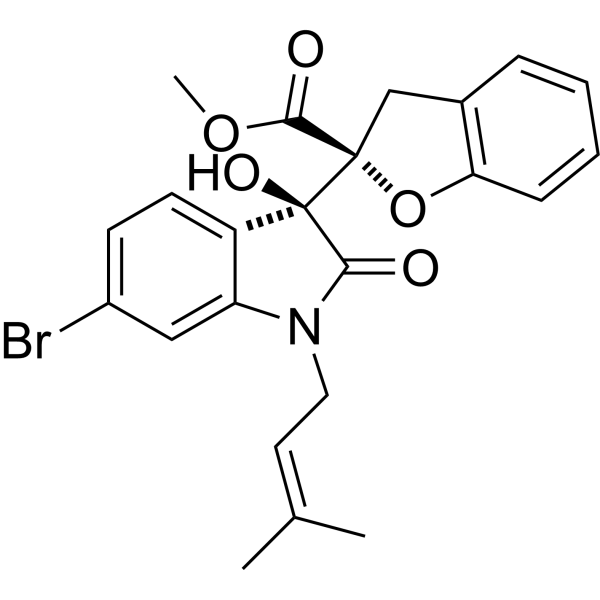
    Xanthofulvin (SM-216289) is an inhibitor of semaphorin 3A. Xanthofulvin blocks its binding to receptors, inhibits growth cone collapse, and accelerates olfactory nerve regeneration in rats in vivo. Xanthofulvin can be used in studies related to traumatic neuronal injury .
    Xanthofulvin
  • HY-12914

    TRP Channel Neurological Disease Inflammation/Immunology
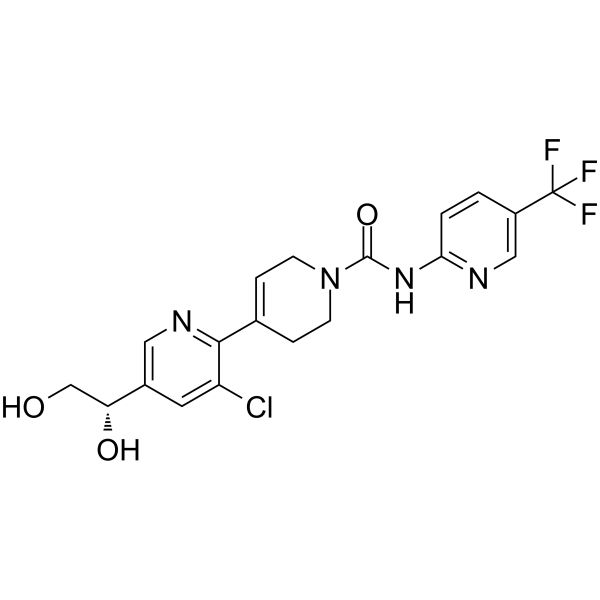
    V116517 is a potent, orally active transient receptor potential vanilloid (TRPV1) antagonist. V116517 shows potent activity in inhibiting both capsaicin (CAP)- and acid (pH 5)-induced currents in rat DRG neurons expressing native TRPV (IC50=423.2 nM for CAP; IC50=180.3 nM for acid). V116517 can be used for the research of pain .
    V116517
  • HY-121119R

    Adenosine Receptor Calcium Channel Cardiovascular Disease Neurological Disease Inflammation/Immunology
    MRS 1523 (Standard) is the analytical standard of MRS 1523. This product is intended for research and analytical applications. MRS 1523 is a potent and selective adenosine A3 receptor antagonist with Ki values of 18.9 nM and 113 nM for human and rat A3 receptors, respectively. In rat this corresponds to selectivities of 140- and 18-fold vs A1 and A2A receptors, respectively. MRS 1523 can exert antihyperalgesic effect through N-type Ca channel block and action potential inhibition in isolated rat dorsal root ganglion (DRG) neurons .
    MRS 1523 (Standard)
  • HY-162347

    Sodium Channel Neurological Disease
    Nav1.7-IN-13 (compound 3g) is a sodium channel inhibitor that significantly inhibits Veratridine (HY-N6691)-induced neuronal activity. Nav1.7-IN-13 inhibits total Na+ current in DRG neurons in a concentration-dependent manner; slows down the activation of Navs. Nav1.7-IN-13 significantly alleviated mechanical pain behavior in a rat model of nerve injury (SNI) and had analgesic activity .
    Nav1.7-IN-13
  • HY-P5782

    Sodium Channel Neurological Disease
    δ-Theraphotoxin-Hm1a toxin is a selective Nav1.1 activator. δ-Theraphotoxin-Hm1a toxin elicits pain and touch sensitivity. δ-Theraphotoxin-Hm1a toxin can be used for the research of irritable bowel syndrome .
    δ-Theraphotoxin-Hm1a toxin
  • HY-185007

    GABA Receptor Neurological Disease
    LI-633 is a selective and orally active GABAA receptor positive allosteric modulator (PAM) with a Ki of 21 nM. LI-633 produces robust potentiation of GABA-induced inward current, with EC50 values ranging from 8 nM (α5β2γ2) to 128 nM (α3β2γ2). LI-633 potentiates muscimol-induced GABAergic currents in rat dorsal root ganglion (DRG) neurons with an EC50 of 70.4 nM. LI-633 can be used for the study of visceral pain .
    LI-633
  • HY-182940

    Toll-like Receptor (TLR) Neurological Disease
    SARM1-IN-10 is an orally active SARM1 inhibitor with a pIC50 of 7.1 and a pKd of 8.3. As a base-exchange inhibitor, SARM1-IN-10 forms a NAD + adduct at the active site of the TIR domain of SARM1, blocks enzymatic function, and induces a unique rotameric state of W662 at the catalytic site of SARM1. SARM1-IN-10 acts as a paradoxical neurodegeneration inducer at low doses and an inhibitor at high doses, and it can exacerbate or protect against SARM1-mediated neurodegeneration depending on concentration. SARM1-IN-10 can be used in studies of peripheral neurodegeneration .
    SARM1-IN-10
  • HY-181662

    MAP3K Neurological Disease
    DLK-IN-2 is a selective inhibitor of DLK and neuroprotective agent. DLK-IN-2 shows no significant inhibition against CYPs 3A4, 2D6 and 2C9. DLK-IN-2 inhibits acute axonal palmitoylation of DLK, blocks DLK-dependent pro-degenerative axon-to-soma retrograde signaling and suppresses c-Jun phosphorylation. DLK-IN-2 can be used for the mechanistic study of neurodegenerative diseases .
    DLK-IN-2

Inquiry Online

Your information is safe with us. * Required Fields.

Salutation


Country or Region *

Applicant Name *


Organization Name *

Department *


Email Address *


Product Name *

Cat. No.


Requested quantity *

Phone Number *


Remarks

Inquiry Online

Inquiry Information

Product Name:
Cat. No.:
Quantity:
MCE Japan Authorized Agent:

