

14 Results for "

room temperature

" in MedChemExpress (MCE) Product Catalog:
Products (14)

14 Results for "room temperature" in MCE Product Catalog:

7
7 Cited Publications
Cat. No.: HY-128692
CAS No.: 67769-47-5
Purity:  99.67%
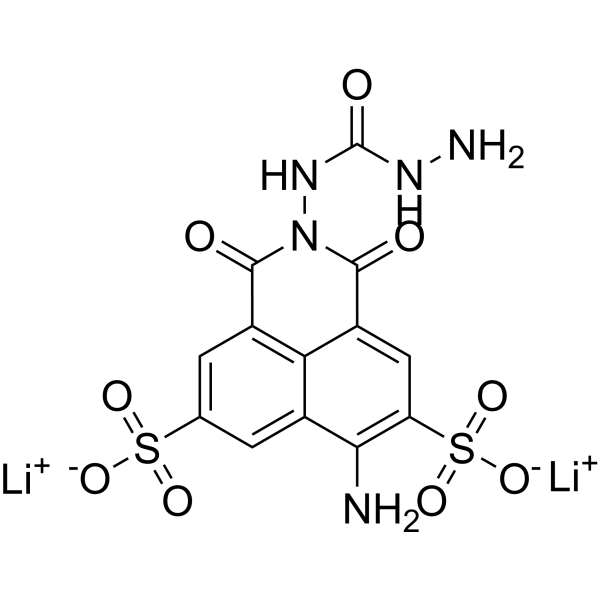
Luc Yellow CH dilithium is a high-intensity fluorescent probe containing free hydrazyl groups. Luc Yellow CH can react with fatty aldehydes at room temperature. Luc Yellow CH serves as a biological tracer to monitor neuronal branching, regeneration, gap junction detection and characterization, and selective ablation of cells after aldehyde fixation. Luc Yellow CH displays the maximum excitation/emission of 430 nm/540 nm, respectively .
loading...
    loading...
7
7 Cited Publications
Cat. No.: HY-W127715
CAS No.: 71206-95-6
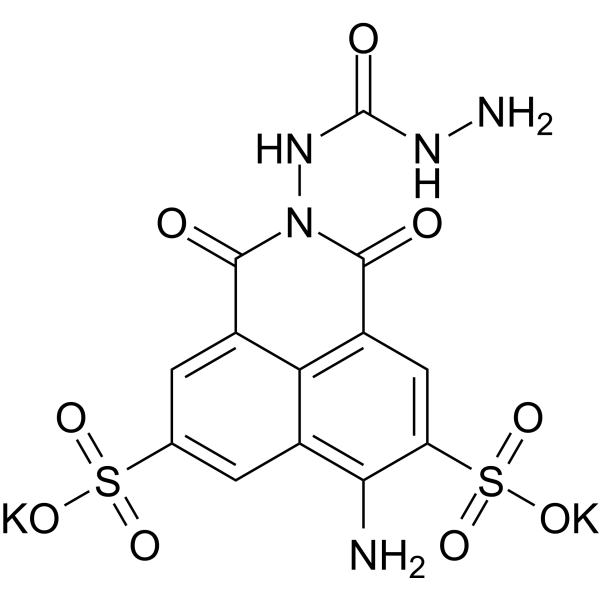
Lucifer Yellow CH dipotassium is a high-intensity fluorescent probe containing free hydrazyl groups. Lucifer Yellow CH can react with fatty aldehydes at room temperature. Lucifer Yellow CH serves as a biological tracer to monitor neuronal branching, regeneration, gap junction detection and characterization, and selective ablation of cells after aldehyde fixation. Lucifer yellow CH displays the maximum excitation/emission of 430 nm/540 nm, respectively .
loading...
    loading...
Cat. No.: HY-129047B
CAS No.: 9002-07-7
Research Areas:  

Others

Recombinant Trypsin Solution is an animal-free trypsin solution used to digest cells or tissues. Recombinant Trypsin Solution has high stability at room temperature and gentle digestion, and can be used to digest weakly adherent cells or stem cells under low serum or serum-free culture conditions. Compared with traditional trypsin digestion solution, Recombinant Trypsin Solution does not contain any animal-derived ingredients, is gentle and effective, and can replace the application of animal-derived trypsin in cell digestion .
loading...
    loading...
Cat. No.: HY-W010929
CAS No.: 223437-11-4
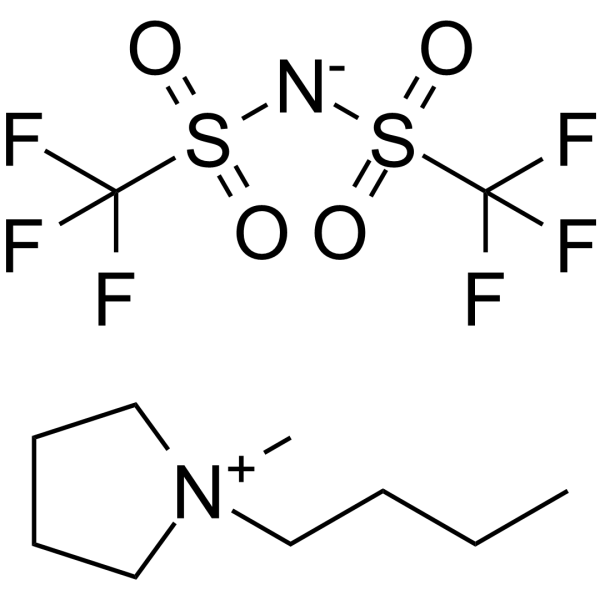
PYR14-TFSI is a room temperature ionic liquid (RTIL) with a wide electrochemical window (5.5V) and a high viscosity, making it a useful candidate for electrochemical energy applications .
loading...
    loading...
Cat. No.: HY-W001952
CAS No.: 15231-91-1
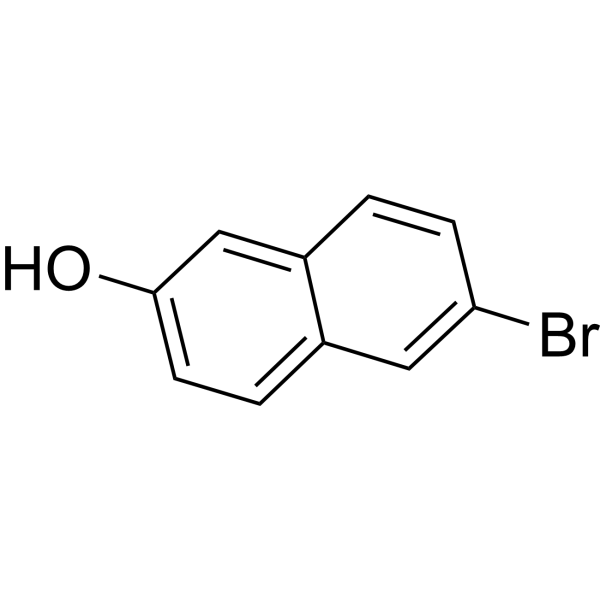
6-Bromo-2-naphthol is an RTP (real-time polymerase chain reaction) probe that forms a 1:1 or 2:1 complex with β-cyclodextrin (β-CD). 6-Bromo-2-naphthol is capable of real-time monitoring of PCR reactions and quantification of specific nucleic acid sequences. RTP probes are a class of small DNA or RNA sequences labeled with fluorescent dyes and quencher molecules, which can be widely used in gene expression analysis, SNP genotyping, and pathogen detection. 6-Bromo-2-naphthol embeds into the cyclodextrin cavity through hydrophobic interactions, inhibits the oxygen quenching effect, and emits a phosphorescent signal at room temperature. 6-Bromo-2-naphthol can also be used as an intermediate for the synthesis of antibacterial azo dyes, and its derivatives show antibacterial activity against Staphylococcus aureus, Escherichia coli and other bacteria .
loading...
    loading...
Cat. No.: HY-D1005A7
CAS No.: 9003-11-6
Synonyms: PEG-PPG-PEG, 2400 (Average)
Poloxamer 125 (L45) (PEG-PPG-PEG, 2400 (Average)) is a block polymer of polyoxyethylene and polyoxypropylene, belonging to water-soluble non-ionic biosurfactants with properties such as emulsification and wetting. Poloxamer 125 (L45) has thermosensitive characteristics and can form thermoreversible hydrogels in aqueous solutions, presenting a fluid state at room temperature and transforming into a viscous gel under body temperature conditions; when its concentration is higher than the critical micelle concentration, it can also self-assemble into micelles in aqueous systems. Poloxamer 125 (L45) enables controlled drug release, prolongs the local retention time of drugs, and is often used as a drug delivery carrier. Poloxamer 125 (L45) can be applied in the fields of cosmetics, biomedicine and tissue engineering .
loading...
    loading...
Cat. No.: HY-151638
CAS No.: 1016163-79-3
Target:  

Drug Intermediate

Research Areas:  

Others

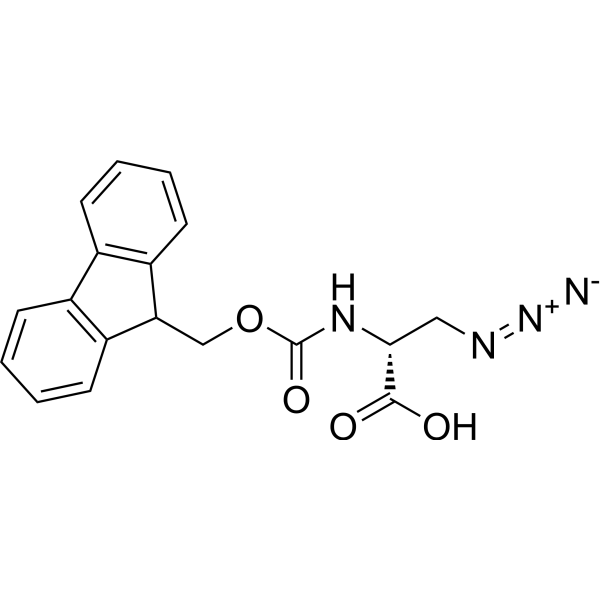
FMOC-3-azido-D-alanine is an Fmoc-protected azido amino acid derivative. FMOC-3-azido-D-alanine acts as a model substance in copper(I)-catalysed alkyne-azide cycloaddition reactions to test click chemistry conditions on solid support for ligation to alkyne-functionalized lysine dendrons .
loading...
    loading...
Cat. No.: HY-141642
CAS No.: 2438-40-6
Purity:  ≥98.0%
Synonyms: Glycerol triheptadecanoate; Trimargarin
Research Areas:  

Others

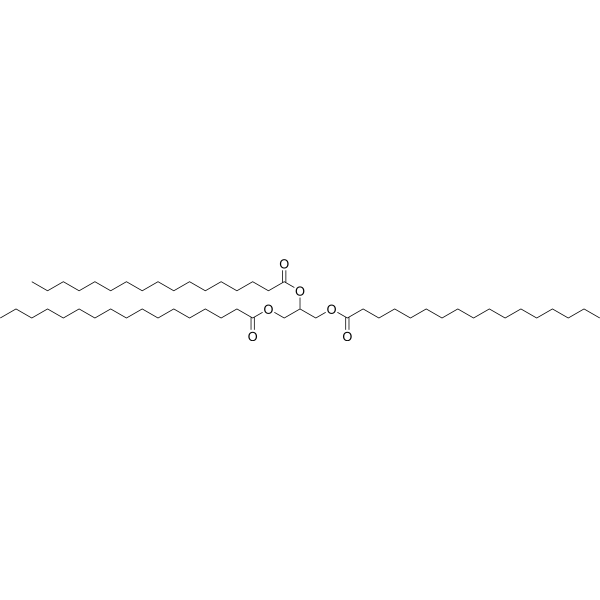
Triheptadecanoin (Glycerol triheptadecanoate) is an internal standard for the rapid GC analysis of fatty acid methyl esters in edible fats and oils. Triheptadecanoin enables the quantitative analysis of trans-fatty acid content in edible fats and oils via a rapid GC method. Triheptadecanoin smoothly undergoes methylation with m-TFPTAH in toluene solution at room temperature .
loading...
    loading...
Cat. No.: HY-141720
CAS No.: 2315-63-1
Purity:  99.87%
Target:  

HCV

Research Areas:  

Others

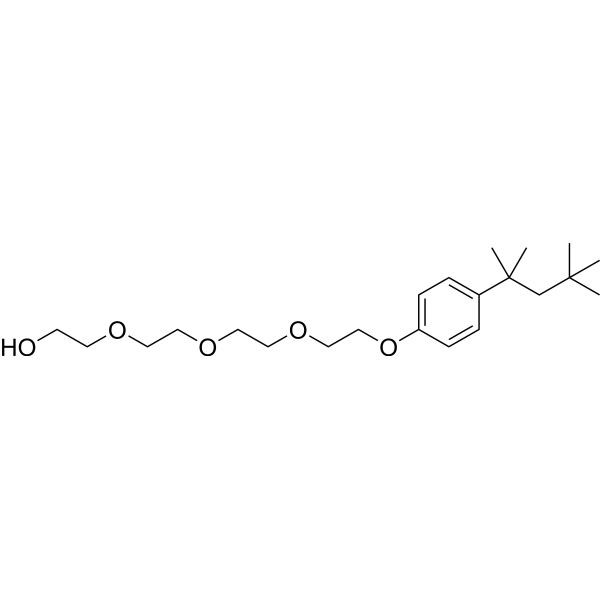
4-(2,4,4-Trimethylpentan-2-yl)benzene-PEG4-OH, a nonionic surfactant with a low hydrophile-lypophile balance (HLB) value and dispersible in aqueous solution at room temperature, has a Krafft point above the room temperature. 4-(2,4,4-Trimethylpentan-2-yl)benzene-PEG4-OH has the potential for the research of the hepatitis C virus (HCV) .
loading...
    loading...
Cat. No.: HY-W048502
CAS No.: 3001-45-4
Synonyms: 8-Thioadenosine
Target:  

Drug Intermediate

Research Areas:  

Others

8-Mercaptoadenosine is a nucleoside derivative that can be synthesized in DMF-aqueous solution at room temperature using NaSH via the corresponding 8-bromo compounds, and it is an intermediate in the synthesis of the substrate for RNA pyrophosphorylase .
loading...
    loading...
Cat. No.: HY-W011060R
CAS No.: 23978-09-8
Synonyms: 4,7,13,16,21,24-Hexaoxa-1,10-diazabicyclo[8.8.8]hexacosane (Standard)
Research Areas:  

Others

Cryptand 2.2.2 (Standard) is the analytical standard of Cryptand 2.2.2 (HY-W011060). This product is intended for research and analytical applications. Cryptand 2.2.2 is a metal ion chelating agent that can selectively form complexes with metal ions. At room temperature, Cryptand 2.2.2 can serve as a host molecule, using the chelation effect to selectively bind desired ions (such as Zn 2+, Co 2+, Ni 2+, Cu 2+). Cryptand 2.2.2 can be used in the preparation of nanoparticles, transition metal compounds, and so on .
loading...
    loading...
Cat. No.: HY-D3570
Target:  

Fluorescent Dye

Research Areas:  

Others

AF405 DBCO is a blue fluorescent dye derivative containing a dibenzocyclooctyne (DBCO) group. AF405 DBCO reacts rapidly with azide-labeled biomolecules at room temperature without the need for a metal catalyst, enabling copper-free click chemistry (SPAAC) for applications in live-cell imaging, flow cytometry, super-resolution microscopy, and other research fields .
loading...
    loading...
Cat. No.: HY-131920
CAS No.: 27416-86-0
Synonyms: Polyuridylic acid
Poly (U) (Polyuridylic acid) is an RNA chain that exists in a disordered extended state at room temperature and serves as a TLR7 ligand. Poly (U) produces distinguishable blocking effects when transported through α-hemolysin nanopores. Poly (U) forms a triple helix with adenosine or adenosine monophosphate, thereby significantly promoting the nucleotide bond condensation reaction between adenosine monophosphate and adenosine, while exerting minimal effects on other nucleosides. When conjugated with cationic lipids, Poly (U) specifically stimulates plasmacytoid dendritic cells to produce type I interferons .
loading...
    loading...
Cat. No.: HY-D3577
Target:  

Fluorescent Dye

Research Areas:  

Others

AF555 Picolyl Azide is a Fluorescent dye that enables site-specific fluorescent labeling via click chemistry. AF555 Picolyl Azide conjugates with the non-canonical amino acid N-propargyl-L-lysine introduced through ochre stop codon suppression via the copper (I)-catalyzed azide-alkyne cycloaddition (CuAAC) reaction, achieving labeling of hyperpolarization-activated cyclic nucleotide-gated HCN channels; its picolyl group accelerates the CuAAC reaction rate, thus completing labeling rapidly at room temperature and minimizing copper-induced cytotoxicity. AF555 Picolyl Azide forms covalent bonds with the alkynyl groups of nucleotide analogs through its azide moiety, labeling viral genomes containing 5-ethynyl-2'-deoxyuridine for visualization via fluorescence microscopy .
loading...
    loading...
  • 1

