



Poly(U)
Poly (U) (Polyuridylic acid) is an RNA chain that exists in a disordered extended state at room temperature and serves as a TLR7 ligand. Poly (U) produces distinguishable blocking effects when transported through α-hemolysin nanopores. Poly (U) forms a triple helix with adenosine or adenosine monophosphate, thereby significantly promoting the nucleotide bond condensation reaction between adenosine monophosphate and adenosine, while exerting minimal effects on other nucleosides. When conjugated with cationic lipids, Poly (U) specifically stimulates plasmacytoid dendritic cells to produce type I interferons.
For research use only. We do not sell to patients.
- CAS No.: 27416-86-0
- Formula: (C9H13N2O9P)x
-
Storage:
Please store the product under the recommended conditions in the Certificate of Analysis.


To place orders, for customer services and technical support, please contact: MedChemExpress USA
Tel: 609-228-6898 E-mail: [email protected] [email protected]


-
 Biological Activity
-
Chemical Information
- Protocols
- Purity & Documentation
- References
-
 Help & FAQs


-
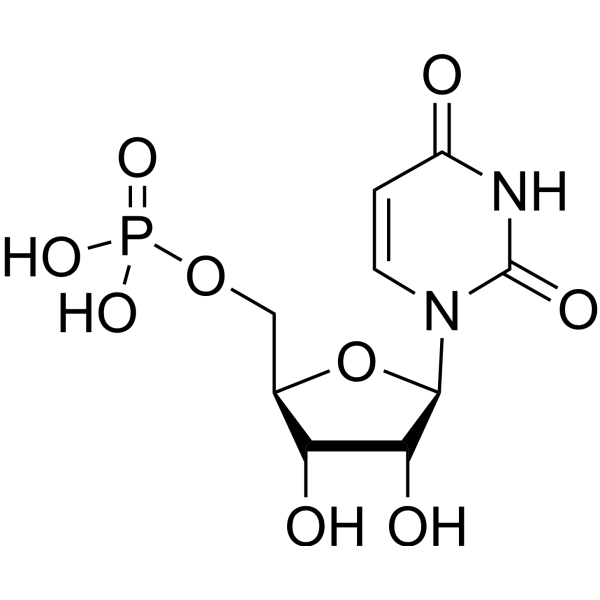
HY-101981
Uridine 5'-monophosphateNucleotide Analogue -
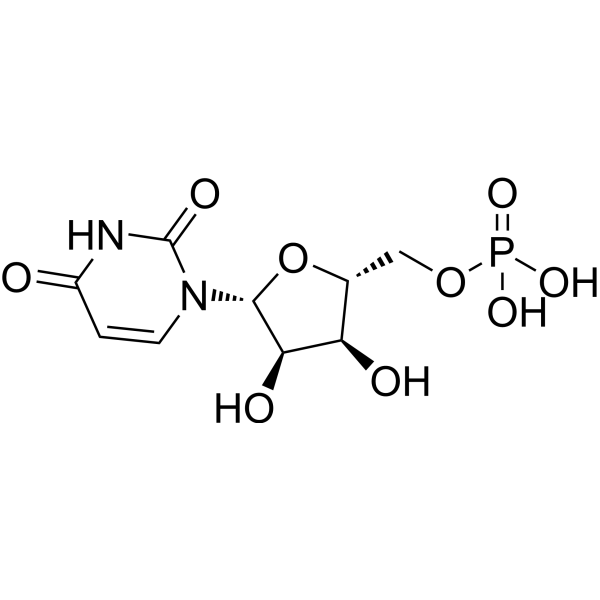
HY-101981R
Uridine 5'-monophosphate (Standard)Nucleotide Analogue -

HY-W416291
Polyadenylic acid potassiumPolyribonucleotide -
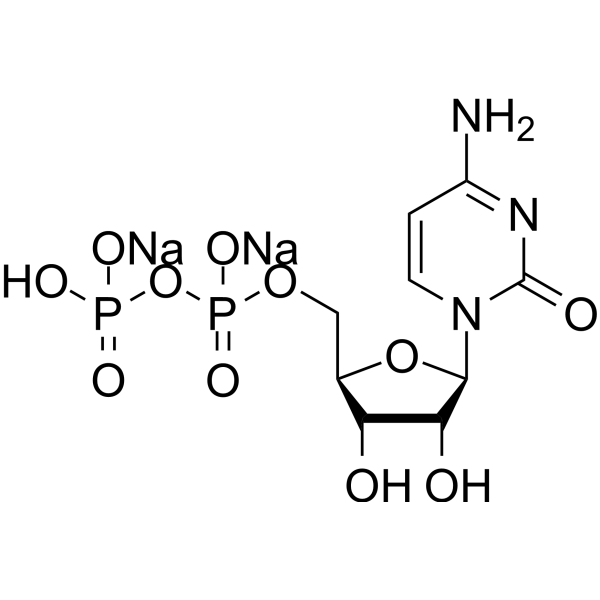
HY-W008940
Cytidine 5'-diphosphate disodium saltNucleotide -

HY-W008940R
Cytidine 5'-diphosphate disodium salt (Standard)Nucleotide -
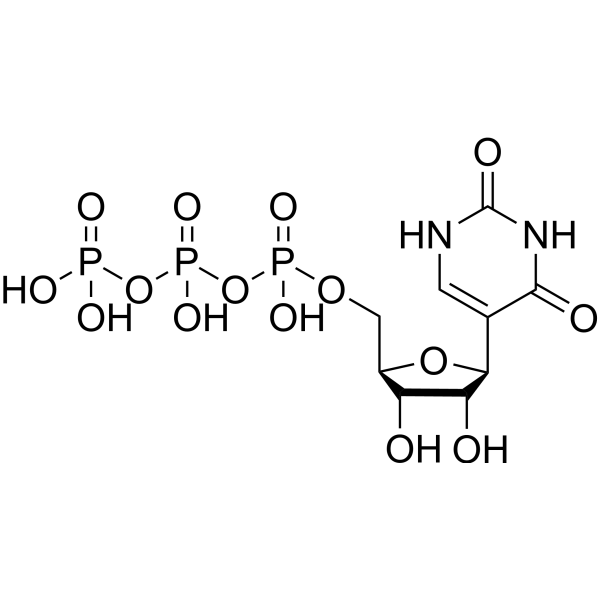
HY-141567
Pseudouridine 5'-triphosphateUTP Derivative


Biological Activity
Description
IC50 & Target
[1]|
TLR7 |
In Vitro
Poly(U) (10 μg/mL) enabled α-hemolysin nanopores to distinguish 150 nt poly(U) from poly(A) via shorter translocation durations (centered at 1.4 μs/nt and 6 μs/nt) and absence of 55% amplitude blockade shoulders[1].
Poly(U) (30 μg/mL; 24 h) does not induce IFN-α or IL-12p40 production from Flt3L-induced murine bone marrow dendritic cells alone, but does induce both cytokines when mixed with Lipofectamine 2000, with IFN-α levels reaching ~10 ng/mL and IL-12p40 levels reaching ~4 ng/mL after 24 hours[2].
MedChemExpress (MCE) has not independently confirmed the accuracy of these methods. They are for reference only.


Chemical Information
-
CAS No. 27416-86-0
-
Formula (C9H13N2O9P)x
-
SMILES
O=C(C=CN1[C@H]2[C@H](O)[C@H](O)[C@@H](COP(O)(O)=O)O2)NC1=O.[n]
-
Synonyms
Polyuridylic acid
-
Shipping
Room temperature in continental US; may vary elsewhere.
-
Storage
Please store the product under the recommended conditions in the Certificate of Analysis.


Purity & Documentation
References
[1]. Akeson M, et al. Microsecond time-scale discrimination among polycytidylic acid, polyadenylic acid, and polyuridylic acid as homopolymers or as segments within single RNA molecules[J]. Biophysical journal, 1999, 77(6): 3227-3233. [Content Brief]
[2]. Sugiyama T, et al. Immunoadjuvant effects of polyadenylic: polyuridylic acids through TLR3 and TLR7[J]. International immunology, 2008, 20(1): 1-9. [Content Brief]

Calculators
Concentration (start) × Volume (start) = Concentration (final) × Volume (final)


Poly(U) Related Classifications
HY-131920 Related Classifications
 Powered by Bioz
Keywords