
10 Results for "

sphingolipid signaling

" in MedChemExpress (MCE) Product Catalog:
Products (10)

10 Results for "sphingolipid signaling" in MCE Product Catalog:

1
1 Cited Publications
Cat. No.: HY-113498
CAS No.: 85187-10-6
Purity:  ≥98.0%
Sphingomyelin is a eukaryotic sphingolipid and one of the major constituents of cell membranes and particularly abundant in the myelin sheath that surrounds neuronal axons. Sphingomyelin plays an important role in cell processes, the regulation of inflammatory responses, and signal transduction. Sphingomyelin metabolism is associated with various central nervous system diseases and Niemann–Pick disease .
loading...
    loading...
Cat. No.: HY-121683
CAS No.: 22644-96-8
Synonyms: 16:1 Aldehyde; trans-2-Hexadecenal
Research Areas:  

Cancer

(E)-2-Hexadecenal (trans-2-Hexadecenal) is an MLK3 activator that induces cytoskeletal remodeling, leading to cell rounding, detachment, and ultimately apoptosis in human and mouse cells. (E)-2-Hexadecenal activates the MLK3 signaling pathway, phosphorylating MKK4/7 and JNK, subsequently activating downstream targets of JNK, such as c-Jun phosphorylation, cytochrome c release, Bax activation, Bid cleavage, and Bim translocation to mitochondria. (E)-2-Hexadecenal has potential applications in research related to sphingolipid signaling pathways .
loading...
    loading...
Cat. No.: HY-165550
CAS No.: 134053-67-1
Synonyms: C22-D-erythro-Sphingosine
Sphingosine (C22-D-erythro-Sphingosine) is a metabolite of sphingolipid and a pro-Apoptotic signaling messenger. Sphingosine induces apoptosis via Caspase-dependent, mitochondria-dependent and lysosomal affinity detergent pathways, downregulates Bcl-2 and Bcl-xL, and truncates Bid and Bax. Sphingosine is used for cancer research .
loading...
    loading...
Cat. No.: HY-142032
CAS No.: 2407372-42-1
Target:  

LPL Receptor

Research Areas:  

Inflammation/Immunology

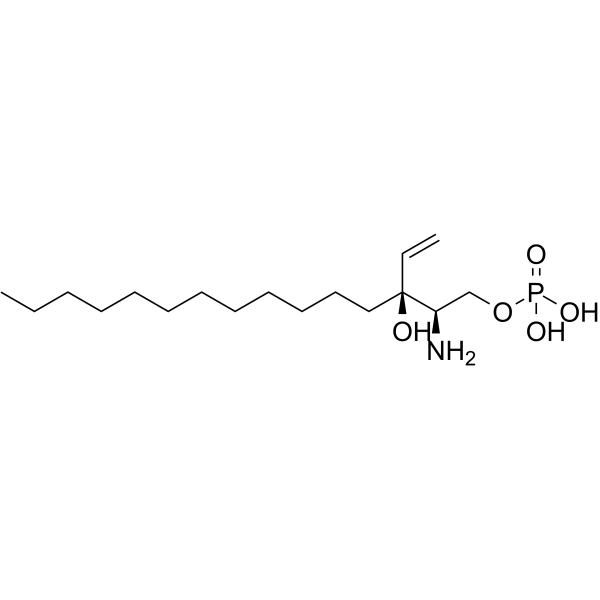
RBM10-8 is irreversible inhibitor of recombinant  human sphingosine-1-phosphate lyase (hS1PL) . Sphingosine-1-phosphate (S1P) is a sphingolipid (SL) that acts as a signaling molecule regulating diverse cellular processes such as cell proliferation and differentiation, angiogenesis, immune function, inflammation, and development .
loading...
    loading...
Cat. No.: HY-173540
Synonyms: C22:1(13Z) 1-Deoxyceramide
Target:  

Ceramidase

Research Areas:  

Neurological Disease

C22:1 1-Deoxyceramide (m18:1/22:1) (C22:1(13Z) 1-Deoxyceramide) is a deoxyceramide lipid that lacks the 1-hydroxyl group and is a ceramide variant. C22:1 1-Deoxyceramide (m18:1/22:1) has potential neurotoxicity and is involved in mitochondrial stress and cell death signaling. It can be used to study abnormal sphingolipid metabolism and neurodegenerative diseases .
loading...
    loading...
Cat. No.: HY-139281
CAS No.: 1246298-54-3
Synonyms: N-C12-Deoxysphingosine
Target:  

Drug Derivative

Research Areas:  

Others

C12 1-Deoxyceramide (m18:1/12:0), a synthetic sphingolipid containing a 12-carbon chain, is widely employed in scientific investigations focusing on the intricate mechanisms underlying sphingolipid-mediated cellular signaling pathways.
loading...
    loading...
Cat. No.: HY-D3198
CAS No.: 2351937-34-1
Research Areas:  

Cancer

NIR-fluorescent ceramide is a neutral near-infrared (NIF) fluorescent probe (λem=650 nm) based on the C-bridged nitrobenzoxadiazole SCOTfluor core, which enables visualization of lipid metabolic processes such as sphingolipid trafficking. The emission signal of NIR-fluorescent ceramide increases significantly in liposomal environments. NIR-fluorescent ceramide acts as an intracellular trafficking tracer, localizing to regions surrounding the endoplasmic reticulum and Golgi apparatus within a short period, and then translocating to recycling lysosomes over a longer period, thus enabling real-time visualization of sphingolipid trafficking and biological lipid functions in living cells. NIR-fluorescent ceramide also generates metabolic uptake profiles and provides multiple metabolic readouts in human cancer cell lines .
loading...
    loading...
Cat. No.: HY-148747
CAS No.: 138749-26-5
Research Areas:  

Neurological Disease Cancer

Ganglioside GD3 (d18:1/12:0) is a type of glycosphingolipid, the d18:1 indicates the sphingosine base, and the 12:0 represents the fatty acid part which is lauric acid. Ganglioside GD3 (d18:1/12:0) is a crucial intermediate in the biosynthesis pathway of gangliosides and is mainly found in the brain tissues of mammals. Ganglioside GD3 (d18:1/12:0) plays significant roles in development, cell signal transduction, and various diseases .
loading...
    loading...
Cat. No.: HY-L043
2,028 compounds

Lipids are a diverse and ubiquitous group of compounds which have many key biological functions, such as acting as structural components of cell membranes, serving as energy storage sources and participating in signaling pathways. Several studies suggest that bioactive lipids have effects on the treatment of some mental illnesses and metabolic syndrome. For example, DHA and EPA are important for monoaminergic neurotransmission, brain development and synaptic functioning, and are also correlated with a reduced risk of cancer and cardiovascular disease in clinical and animal studies.

MCE supplies a unique collection of 2,028 lipid and lipid derivative related compounds including triglycerides, phospholipids, sphingolipids, steroids and their structural analogues or derivatives. MCE lipid compound library can be used for research in bioactive lipids, and high throughput screening (HTS) and high content screening (HCS).

Cat. No.: HY-188099
CAS No.: 2376783-79-6
Research Areas:  

Cancer

CeY-B1 is a ceramide analog. CeY-B1 inhibits the proliferation, migration and invasion of cervical cancer cells, induces apoptosis and cell cycle arrest. CeY-B1 upregulates ASK1, promotes the phosphorylation of JNK, downregulates Bcl‑2, and inhibits the PI3K/AKT pathway. CeY-B1 suppresses tumor growth in cervical cancer xenograft mouse models. CeY-B1 can be used for relevant research on cervical cancer .
loading...
    loading...

