10004 Results for "

miRNA

" in MedChemExpress (MCE) Product Catalog:
Products (10004)

10004 Results for "miRNA" in MCE Product Catalog:

18
18 Publications Verification
Cat. No.: HY-K2017

MCE siRNA/miRNA Transfection Reagent is a novel cationic polymer transfection reagent for siRNA and miRNA transfection. The 1 mL is defined as the base specification. All larger sizes correspond to incremental volumes of this base.

loading...
    loading...
4
4 Cited Publications
Cat. No.: HY-K0512

MCE microRNA RT Master Mix for qPCR Ⅲ (poly A) uses poly(A)-tailing method to perform reverse transcription from miRNA first-strand to cDNA.

loading...
    loading...
3
3 Cited Publications
Cat. No.: HY-RI00449
Target:  

MicroRNA

Research Areas:  

Cancer

hsa-miR-21-5p inhibitors are chemically-modified oligonucleotides that hybridize with mature miRNAs. The miRNA inhibitors have full-length nucleotide 2'-methoxy modification. The miRNA inhibitors strongly compete with mature miRNAs to prevent the complementary pairing of miRNAs and their target genes, thereby inhibiting miRNAs from functioning.
loading...
    loading...
3
3 Cited Publications
Cat. No.: HY-RI00449A
Target:  

MicroRNA

Research Areas:  

Cancer

hsa-miR-21-5p antagomirs are chemically-modified oligonucleotides that hybridize with mature miRNAs. The miRNA antagomirs have 2 phosphorothioates at the 5' end, 4 phosphorothioates at the 3' end, 1 cholesterol group at the 3' end, and full-length nucleotide 2'-methoxy modification. The miRNA antagomirs strongly compete with mature miRNAs to prevent the complementary pairing of miRNAs and their target genes, thereby inhibiting miRNAs from functioning. Stability of miRNA antagomirs appears to be significantly higher than miRNA inhibitors, they exhibits enhanced cellular uptake, stability and regulatory activity in vivo.
loading...
    loading...
3
3 Cited Publications
Cat. No.: HY-RI00714A
Target:  

MicroRNA

Research Areas:  

Cancer

hsa-miR-34a-5p antagomirs are chemically-modified oligonucleotides that hybridize with mature miRNAs. The miRNA antagomirs have 2 phosphorothioates at the 5' end, 4 phosphorothioates at the 3' end, 1 cholesterol group at the 3' end, and full-length nucleotide 2'-methoxy modification. The miRNA antagomirs strongly compete with mature miRNAs to prevent the complementary pairing of miRNAs and their target genes, thereby inhibiting miRNAs from functioning. Stability of miRNA antagomirs appears to be significantly higher than miRNA inhibitors, they exhibits enhanced cellular uptake, stability and regulatory activity in vivo.
loading...
    loading...
1
1 Cited Publications
Cat. No.: HY-RI00500
Target:  

MicroRNA

Research Areas:  

Cancer

hsa-miR-27b-3p inhibitors are chemically-modified oligonucleotides that hybridize with mature miRNAs. The miRNA inhibitors have full-length nucleotide 2'-methoxy modification. The miRNA inhibitors strongly compete with mature miRNAs to prevent the complementary pairing of miRNAs and their target genes, thereby inhibiting miRNAs from functioning.
loading...
    loading...
1
1 Cited Publications
Cat. No.: HY-K0513

MCE MCE Reverse Transcription Kit III is suitable for the conventional synthesis of cDNA from RNA and the stem-loop method for the synthesis of cDNA from microRNA (miRNA).

loading...
    loading...
Cat. No.: HY-177531
CAS No.: 2796227-17-1
S-Ac7-DOG is a cationic lipid with biodegradability, low immunogenicity and high nucleic acid transfection capacity, which is commonly used to construct lipid nanoparticles for nucleic acid molecule delivery. S-Ac7-DOG can bind to mRNA, microRNA and self-amplifying RNA through electrostatic interaction. Lipid nanoparticles formed by S-Ac7-DOG enter cells via an energy-dependent endocytic pathway, release nucleic acid cargos, induce antigen-specific CD8 + T cell responses, promote the generation of precursor memory T cells, and regulate neuroinflammatory pathways. S-Ac7-DOG can be used in the research of retinal diseases, neuroinflammation and cancer .
loading...
    loading...
Cat. No.: HY-RI00144
Target:  

MicroRNA

Research Areas:  

Cancer

hsa-miR-1246 inhibitors are chemically-modified oligonucleotides that hybridize with mature miRNAs. The miRNA inhibitors have full-length nucleotide 2'-methoxy modification. The miRNA inhibitors strongly compete with mature miRNAs to prevent the complementary pairing of miRNAs and their target genes, thereby inhibiting miRNAs from functioning.
loading...
    loading...
Cat. No.: HY-RI00212
Target:  

MicroRNA

Research Areas:  

Cancer

hsa-miR-1290 inhibitors are chemically-modified oligonucleotides that hybridize with mature miRNAs. The miRNA inhibitors have full-length nucleotide 2'-methoxy modification. The miRNA inhibitors strongly compete with mature miRNAs to prevent the complementary pairing of miRNAs and their target genes, thereby inhibiting miRNAs from functioning.
loading...
    loading...
Cat. No.: HY-RI00057
Target:  

MicroRNA

Research Areas:  

Cancer

hsa-miR-107 inhibitors are chemically-modified oligonucleotides that hybridize with mature miRNAs. The miRNA inhibitors have full-length nucleotide 2'-methoxy modification. The miRNA inhibitors strongly compete with mature miRNAs to prevent the complementary pairing of miRNAs and their target genes, thereby inhibiting miRNAs from functioning.
loading...
    loading...
Cat. No.: HY-177731
Research Areas:  

Cancer

MG-Lin1 is a Lin28/Lin28A molecular glue degrader with a DC50 of approximately 0.7 μM. It induces Lin28 degradation via the ubiquitin-proteasome pathway by forming a ternary complex, thereby upregulating the levels of let-7 miRNA and reducing the expression of its downstream oncogenic targets KRAS and PDK1, and inhibiting cancer cell migration. MG-Lin1 can be used in studies of ovarian cancer and choriocarcinoma .
loading...
    loading...
Cat. No.: HY-177733
Research Areas:  

Cancer

MG-Lin3 is a Lin28 molecular glue degrader. MG-Lin3 recruits the E3 ubiquitin ligase RNF126 to form a ternary complex, induces the degradation of Lin28 via the ubiquitin-proteasome pathway, and restores the levels of mature let-7 miRNA. MG-Lin3 can be used in research on ovarian cancer, ovarian teratocarcinoma, and uterine cancer .
loading...
    loading...
Cat. No.: HY-177782
Research Areas:  

Neurological Disease Cancer

SB1349 is a potent Lin28 molecular glues degrader, with DC50 values of 1.594 µM and 0.777 µM for Lin28A and Lin28B, respectively. SB1349 induces proteasome-dependent degradation by directly binding and recruiting the E3 ubiquitin ligase RNF126. SB1349 can be used for the study of neuroblastoma .
loading...
    loading...
Cat. No.: HY-RI00161
Target:  

MicroRNA

Research Areas:  

Cancer

hsa-miR-1257 inhibitors are chemically-modified oligonucleotides that hybridize with mature miRNAs. The miRNA inhibitors have full-length nucleotide 2'-methoxy modification. The miRNA inhibitors strongly compete with mature miRNAs to prevent the complementary pairing of miRNAs and their target genes, thereby inhibiting miRNAs from functioning.
loading...
    loading...
Cat. No.: HY-172885
Research Areas:  

Cancer

TRBP-IN-1 (Compound 13j) is an orally active TAR RNA binding protein 2 (TRBP) inhibitor (IC50: 12.72 μM). TRBP-IN-1 has significant anti-hepatocellular carcinoma (HCC) activity and can inhibit the proliferation and metastasis of HCC cells (HCCLM3 cells (IC50: 18.96 μM); SK-Hep-1 cells (IC50: 16.45 μM)). TRBP-IN-1 regulates miRNA biogenesis and inhibits oncogenic miRNA expression by targeting TRBP. TRBP-IN-1 induces apoptosis and pyroptosis in HCC cells by inhibiting the level of miRNA. TRBP-IN-1 can be used for targeted therapy research of HCC .
loading...
    loading...
Cat. No.: HY-152173
CAS No.: 3026728-28-6
Research Areas:  

Cancer

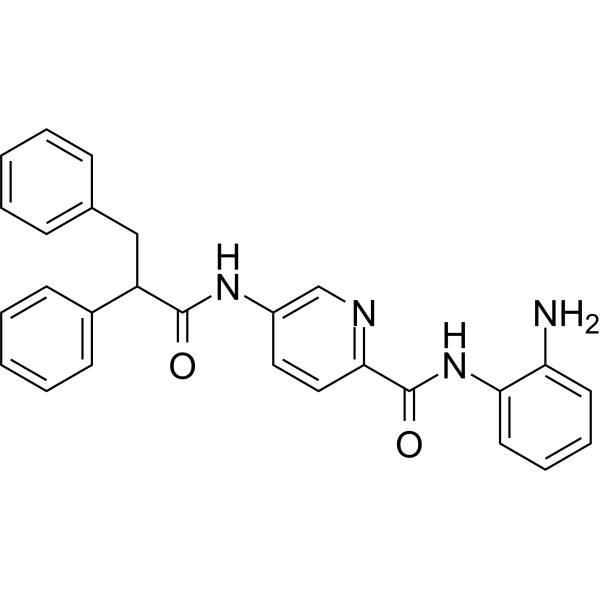
HDAC-IN-51 is a potent histone deacetylase (HDAC) inhibitor with IC50 values of 0.32, 0.353, 0.431, 0.515, and 85.4 μM for HDAC10, HDAC1, HDAC2, HDAC3 and HDAC11, respectively. HDAC-IN-51 induces cell cycle arrest and apoptosis, modulating cell cycle-/apoptosis-related miRNAs expression. HDAC-IN-51 can be used in research of cancer .
loading...
    loading...
Cat. No.: HY-155237
Target:  

MicroRNA

Research Areas:  

Cancer

LIN28-IN-1 (compound 5) is an inhibitor of the RNA-binding and regulatory protein LIN28 and binds to the LIN28 cold shock domain (CSD). LIN28-IN-1 effectively inhibits the interaction between LIN28 and let-7 miRNA (IC50: 5.4 μM), blocking the negative impact of LIN28 on epigenetic gene regulation. LIN28-IN-1 significantly inhibits the proliferation of JAR cancer cells expressing LIN28 (IC50: 6.4 μM) .
loading...
    loading...
Cat. No.: HY-120269
CAS No.: 139141-12-1
Purity:  ≥97.0%
CAY10512 is a NF-κB inhibitor. CAY10512 can suppress the upregulation of NF-κB-sensitive proinflammatory miRNAs (miRNA-9, miRNA-125b, miRNA-146a, miRNA-155) in cerebrospinal fluid and extracellular fluid. CAY10512 significantly reduces the release of pro-inflammatory cytokines (such as TNF-α, MCP-1, IL-8, IL-6). CAY10512 can be used for researchs on neuroinflammation, islet transplantation and microRNA regulation .
loading...
    loading...
Cat. No.: HY-RI00066
Target:  

MicroRNA

Research Areas:  

Cancer

hsa-miR-11401 inhibitors are chemically-modified oligonucleotides that hybridize with mature miRNAs. The miRNA inhibitors have full-length nucleotide 2'-methoxy modification. The miRNA inhibitors strongly compete with mature miRNAs to prevent the complementary pairing of miRNAs and their target genes, thereby inhibiting miRNAs from functioning.
loading...
    loading...

