



VU6001966

Based on 1 Customer Validation
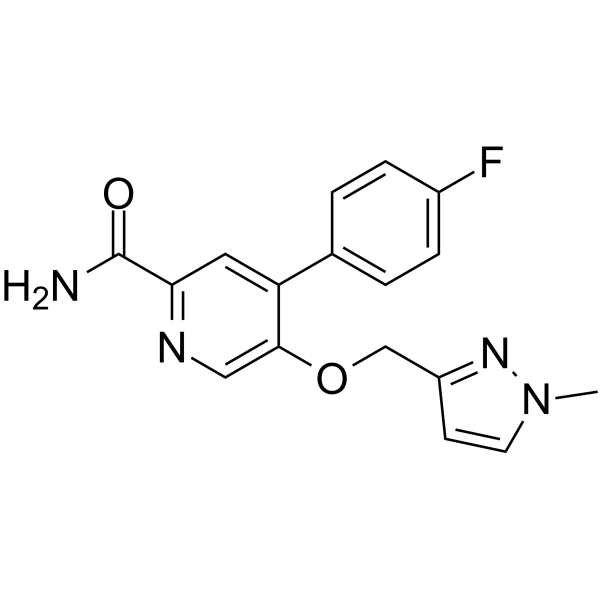
VU6001966 is a brain-penetrant and selective mGlu2 receptor inhibitor. VU6001966 blocks mGlu2 receptor activity, counteracts LY379268 (HY-103558)-mediated blood-brain barrier protection and inflammatory cytokine dampening in microglia under inflammatory conditions. VU6001966 enhances antidepressant effects when combined with Scopolamine (HY-N0296). VU6001966 can be used for the research of major depressive disorder.
연구목적의 판매만을 진행합니다. 환자를 대상으로 한 판매는 하지 않습니다.
- Purity : 99.89%
- CAS No.: 2009052-76-8
- 화학식: C17H15FN4O2
- 분자량:326.33
-
보관:Powder -20°C, 3 years ; In solvent -80°C, 6 months , -20°C, 1 month

To place orders, for customer services and technical support, please contact: MedChemExpress USA
Tel: 609-228-6898 E-mail: [email protected] [email protected]


-
 Biological Activity
-
Chemical Information
-
용액&용해도
- Protocol
- 순도&문서
- References
-
 Help & FAQs




Biological Activity
제품 설명
IC50 & Target
[4]|
mGluR2 78 nM (IC50) |
mGluR3 >30 μM (IC50) |
CYP1A2 3.1 μM (IC50) |
In Vitro
VU6001966 (3 μM; 24-36 h) does not interfere with the protective effects of LY379268 on TNF-α&IFNγ (T&I)-impaired blood-brain barrier properties, including permeability, TEER, tight junction protein localization in TY-10 human brain microvascular endothelial cell monocultures and permeability, TEER, and claudin-5 expression in TY-10 human brain microvascular endothelial + hAST human astrocyte co-cultures[1].
VU6001966 (3 μM; 36 h) significantly attenuates the protective effects of LY379268 on T&I-impaired blood-brain barrier permeability and claudin-5 expression in TY-10 human brain microvascular endothelial + hAST human astrocyte + HMC3 human microglial triple co-cultures[1].
VU6001966 (3 μM; 5 h) significantly reverses the anti-inflammatory effects of LY379268 on T&I-induced cytokine/chemokine expression and blocks the LY379268-induced increase in BDNF expression in HMC3 human microglial cell monocultures[1].
VU6001966 potently inhibits rmGlu2 in rmGlu2/TREx/Ga15-HEK cells with an IC50 of 78 nM and shows no activity against rmGlu3 in rmGlu3/TREx/Ga15-HEK cells at concentrations up to 30 μM[4].
VU6001966 does not inhibit CYP3A4, CYP2D6, or CYP2C9 at concentrations up to 30 μM, but inhibits CYP1A2 with an IC50 of 3.1 μM[4].
MedChemExpress (MCE) has not independently confirmed the accuracy of these methods. They are for reference only.
-
Cell Line:human microglial (HMC3) monocultures
-
Concentration:3 μM
-
Incubation Time:5 h
-
Result:Significantly reversed the LY379268-induced reduction in T&I-increased IL-6, IL-1β, and CCL2 mRNA expression.
Significantly blocked the LY379268-induced increase in BDNF mRNA expression in resting microglia.
In Vivo
VU6001966 (1 mg/kg; i.p.; daily; 4 days) and Scopolamine alleviates UCMS-induced anhedonia- and apathy-like behaviors in mice without affecting non-stressed animals[2].
Coadministration of VU6001966 (1 mg/kg; i.p.; daily; 4 days) and Scopolamine produces antidepressant-like effects in UCMS-exposed mice that are not blocked by AMPA receptor antagonism, without impairing locomotor activity[2].
Coadministration of VU6001966 (1 mg/kg; i.p.; daily; 4 days) and Scopolamine produces antidepressant-like effects in UCMS-exposed mice that are dependent on TrkB receptor activation, without impairing locomotor activity[2].
Coadministration of VU6001966 (1 mg/kg; i.p.; daily; 4 days) and Scopolamine reverses UCMS-induced deficits in TrkB phosphorylation in the mouse prefrontal cortex[2].
Coadministration of VU6001966 (1 mg/kg; i.p.; daily; 4 days) and Scopolamine does not significantly reverse UCMS-induced impairments in mPFC glutamatergic transmission or synaptic plasticity in mice[2].
Coadministration of VU6001966 (1 mg/kg; i.p.; daily; 4 days) and Scopolamine does not impair spatial or non-spatial cognitive function in either non-stressed or UCMS-exposed mice[2].
VU6001966 (1-10 mg/kg; i.p.; single dose) exerts dose-dependent antidepressant-like effects in the rat forced swim test, with the 10 mg/kg dose significantly reducing immobility time without affecting locomotor activity[3].
VU6001966 (3 mg/kg; i.p.; single dose) significantly enhances antidepressant-like effects in the rat forced swim test, reducing immobility and increasing climbing behavior when coadministered with Scopolamine[3].
VU6001966 (3 mg/kg; i.p.; single dose) modulates frontal cortex neurotransmitter levels in freely moving rats, increasing serotonin and dopamine while decreasing glutamate, and enhances Scopolamine-induced elevations of these neurotransmitters when coadministered with Scopolamine[3].
MedChemExpress (MCE) has not independently confirmed the accuracy of these methods. They are for reference only.
-
Animal Model:C57BL/6J (male, 6-7 weeks old, 23-25 g, unpredictable chronic mild stress model)[2]
-
Dosage:1 mg/kg; 3 mg/kg; 10 mg/kg
-
Administration:i.p.; daily; 4 days
-
Result:Dose-dependently alleviated UCMS-induced depressive-like behaviors.
Significantly increased grooming time in the splash test (P = 0.0423) at 3 mg/kg compared to vehicle-treated UCMS mice.
Significantly increased grooming time (P < 0.0001) and sucrose preference (P < 0.0001) at 10 mg/kg compared to vehicle-treated UCMS mice.
Did not affect immobility time in the tail suspension test at 10 mg/kg.
Showed no significant effect on any measured behavioral parameter at 1 mg/kg.
-
Animal Model:C57BL/6J (male, 6-7 weeks old, 23-25 g, unpredictable chronic mild stress model)[2]
-
Dosage:1 mg/kg
-
Administration:i.p.; daily; 4 days
-
Result:Significantly reversed UCMS-induced reductions in grooming time in the splash test (P < 0.0001) and sucrose preference in the sucrose preference test (P = 0.0044) compared to vehicle-treated UCMS mice.
Had no effect in non-stressed mice.
Did not significantly affect immobility time in the tail suspension test in either UCMS or non-stressed mice.
Significantly increased grooming time in the splash test (P = 0.0019) and decreased immobility time in the tail suspension test (P = 0.0235) compared to vehicle-treated UCMS mice.
Did not significantly affect locomotor activity at any time point compared to vehicle-treated UCMS mice.
Significantly increased grooming time in the splash test (P = 0.0007) and decreased immobility time in the tail suspension test (P = 0.0039) compared to vehicle-treated UCMS mice.
Had no significant effect on sucrose preference in the sucrose preference test in UCMS mice.
Did not significantly affect locomotor activity at any time point compared to vehicle-treated UCMS mice.
Significantly reversed UCMS-induced reductions in the phospho-TrkB(Tyr816)/TrkB ratio in the PFC (P = 0.0492) compared to vehicle-treated UCMS mice.
Did not significantly affect peEF2/eEF2, pmTOR/mTOR, or BDNF levels in the PFC, nor any measured protein ratios or levels in the hippocampus.
Did not significantly reverse UCMS-induced increases in FP amplitude or UCMS-induced decreases in LTP amplitude in the mPFC, though a non-significant trend toward alleviating the FP amplitude increase was observed.
Did not significantly affect sEPSC frequency or amplitude in either UCMS or non-stressed mice.
Did not significantly affect moved object investigation time in the OLT or novel object investigation time in the NORT in either UCMS or non-stressed mice, indicating no impairment of spatial or non-spatial cognitive function.
-
Animal Model:Sprague-Dawley (male, 250-350 g)[3]
-
Dosage:1 mg/kg; 3 mg/kg; 10 mg/kg
-
Administration:i.p.; single dose
-
Result:Induced a dose-dependent reduction in immobility time in the forced swim test.
Produced a statistically significant decrease in immobility time at 10 mg/kg (P = 0.037 vs. vehicle).
Had no effect on immobility, climbing, or swimming times at 1 mg/kg and 3 mg/kg.
Did not alter spontaneous locomotor activity at 3 mg/kg.
-
Animal Model:Sprague-Dawley (male, 250-350 g)[3]
-
Dosage:3 mg/kg
-
Administration:i.p.; single dose
-
Result:Produced a significant decrease in immobility time (F(1,22) = 4.35, P = 0.049) compared to individual treatments or vehicle.
Produced a significant increase in climbing time (F(1, 26) = 11.00, P = 0.003) compared to individual treatments or vehicle.
-
Animal Model:Sprague-Dawley (male, 250-350 g)[3]
-
Dosage:3 mg/kg
-
Administration:i.p.; single dose
-
Result:Elevated extracellular serotonin levels to approximately 300% of baseline, dopamine levels to approximately 200% of baseline, and decreased extracellular glutamate levels when administered alone.
Had no effect on GABA levels when administered alone.
Elevated serotonin levels to approximately 400% of baseline, dopamine levels to approximately 400% of baseline, glutamate levels to approximately 220% of baseline when coadministered with Scopolamine 0.3 mg/kg.
Had no significant effect on GABA levels compared to control when coadministered with Scopolamine 0.3 mg/kg.


Chemical Information
-
CAS No. 2009052-76-8
-
Appearance Solid
-
분자량 326.33
-
화학식 C17H15FN4O2
-
Color White to off-white
-
SMILES
O=C(C1=NC=C(OCC2=NN(C)C=C2)C(C3=CC=C(F)C=C3)=C1)N
-
선적
Room temperature in continental US; may vary elsewhere.
-
보관
Powder -20°C 3 years In solvent -80°C 6 months -20°C 1 month


용액&용해도
In Vitro:
DMSO : 10 mg/mL (30.64 mM; Need ultrasonic; Hygroscopic DMSO has a significant impact on the solubility of product, please use newly opened DMSO)
Please refer to the solubility information to select the appropriate solvent. Once prepared, please aliquot and store the solution to prevent product inactivation from repeated freeze-thaw cycles.
Storage method and period of stock solution: -80°C, 6 months; -20°C, 1 month. When stored at -80°C, please use it within 6 months. When stored at -20°C, please use it within 1 month.
Please refer to the solubility information to select the appropriate solvent. Once prepared, please aliquot and store the solution to prevent product inactivation from repeated freeze-thaw cycles.
Storage method and period of stock solution: -80°C, 6 months; -20°C, 1 month. When stored at -80°C, please use it within 6 months. When stored at -20°C, please use it within 1 month.
Concentration (start) × Volume (start) = Concentration (final) × Volume (final)
In Vivo:
Select the appropriate dissolution method based on your experimental animal and administration route.
- For the following dissolution methods, please ensure to first prepare a clear stock solution using an In Vitro approach and then sequentially add co-solvents:
- To ensure reliable experimental results, the clarified stock solution can be appropriately stored based on storage conditions. As for the working solution for In Vivo experiments, it is recommended to prepare freshly and use it on the same day.
- The percentages shown for the solvents indicate their volumetric ratio in the final prepared solution. If precipitation or phase separation occurs during preparation, heat and/or sonication can be used to aid dissolution.
In Vivo Dissolution Calculator
Please enter the basic information of animal experiments:
-
-
-
-
Recommended: Prepare an additional quantity of animals to account for potential losses during experiments.
Please enter your animal formula composition:
-
%DMSO +
Recommended: Keep the proportion of DMSO in working solution below 2% if your animal is weak.
-
%+
-
+%Tween-80 + +
-
%Saline +
The co-solvents required include: DMSO, . All of co-solvents are available by MedChemExpress (MCE). , Tween 80. All of co-solvents are available by MedChemExpress (MCE).
Working solution concentration: 0.22 mg/mL
Method for preparing stock solution: mg drug dissolved in μL DMSO. Stock solution concentration: mg/mL.
1. Take μL DMSO stock solution;
2. Add μL .
μL , mix evenly;
3. Then add μL Tween 80, mix evenly;
4. Then add μL
Please ensure that the stock solution in the first step is dissolved to a clear state, and add co-solvents in sequence. You can use ultrasonic heating (ultrasonic cleaner, recommended frequency 20-40 kHz), vortexing, etc. to assist dissolution.


순도&문서
-
Data Sheet (286 KB)
-
SDS (252 KB)
- English - EN (252 KB)
- Français - FR (252 KB)
- Deutsch - DE (252 KB)
- Norwegian - NO (252 KB)
- Español - ES (252 KB)
- Swedish - SV (252 KB)
- Italian - IT (252 KB)
- Korean - KR (252 KB)
- Portuguese - PT (252 KB)
-
Handling Instructions (2659 KB)
References
[1]. Costantino G, et al. Group II metabotropic glutamate receptors modulate blood brain barrier function: direct and indirect effect through astrocytes and microglia. Eur J Pharmacol. 2025 Sep 15;1003:177893. [Content Brief]
[2]. Babii Y, et al. Coadministration of scopolamine and mGlu2 NAM VU6001966 as a novel antidepressant approach: Lowering effective dose and reducing cognitive side effects. Psychopharmacology (Berl). Published online October 13, 2025. [Content Brief]
[3]. Babii Y, et al. Coadministration of scopolamine and mGlu2 receptor negative allosteric modulator VU6001966 as a potential therapeutic approach for depression: Rat frontal cortex neurochemistry and behavior. Pharmacol Biochem Behav. 2025 May;250:173996. [Content Brief]
[4]. Bollinger KA, et al. Design and Synthesis of mGlu2 NAMs with Improved Potency and CNS Penetration Based on a Truncated Picolinamide Core. ACS Med Chem Lett. 2017;8(9):919-924. Published 2017 Aug 3. [Content Brief]


Complete Stock Solution Preparation Table
Please refer to the solubility information to select the appropriate solvent. Once prepared, please aliquot and store the solution to prevent product inactivation from repeated freeze-thaw cycles.
Storage method and period of stock solution: -80°C, 6 months; -20°C, 1 month. When stored at -80°C, please use it within 6 months. When stored at -20°C, please use it within 1 month.
| Optional Solvent | Concentration Solvent Mass | 1 mg | 5 mg | 10 mg | 25 mg |
|---|---|---|---|---|---|
| DMSO | 1 mM | 3.0644 mL | 15.3219 mL | 30.6438 mL | 76.6096 mL |
| 5 mM | 0.6129 mL | 3.0644 mL | 6.1288 mL | 15.3219 mL | |
| 10 mM | 0.3064 mL | 1.5322 mL | 3.0644 mL | 7.6610 mL | |
| 15 mM | 0.2043 mL | 1.0215 mL | 2.0429 mL | 5.1073 mL | |
| 20 mM | 0.1532 mL | 0.7661 mL | 1.5322 mL | 3.8305 mL | |
| 25 mM | 0.1226 mL | 0.6129 mL | 1.2258 mL | 3.0644 mL | |
| 30 mM | 0.1021 mL | 0.5107 mL | 1.0215 mL | 2.5537 mL |


VU6001966 Related Classifications
HY-120717 Related Classifications
 Powered by Bioz
Keywords
- VU6001966
- 2009052-76-8
- VU 6001966
- VU-6001966
- mGluR
- Cytochrome P450
- rat frontal cortex
- TY-10 human brain microvascular endothelial cells
- HMC3 human microglial cells
- hAST human astrocytes
- TrkB receptor
- rmGlu2/TREx/Ga15-HEK cells
- major depressive disorder
- blood-brain barrier
- mGlu2 receptor
- microglia
- Inhibitor
- inhibitor
- inhibit