



β-Amyloid (1-40) (human) TFA
Based on 3 publication(s) in Google Scholar
β-Amyloid (1-40) TFA is a primary protein in plaques found in the brains of patients with Alzheimer's disease.
For research use only. We do not sell to patients.
- Purity : 99.95%
- Formula: C194H295N53O58S.C2HF3O2
- Molecular Weight:4443.84
-
Storage:
Sealed storage, away from moisture and light.
Powder -80°C, 2 years , -20°C, 1 year* The compound is unstable in solutions, freshly prepared is recommended.

To place orders, for customer services and technical support, please contact: MedChemExpress USA
Tel: 609-228-6898 E-mail: [email protected] [email protected]


-
 Biological Activity
-
Chemical Information
-
Solvent & Solubility
- Purity & Documentation
- References
-
 Help & FAQs





Publications Citing Use of MedChemExpress (MCE) β-Amyloid (1-40) (human) TFA
More

Biological Activity
Description
In Vitro
β-Amyloid (1-40) and (1-42) are major components of senile plaque amyloids, are physiological peptides present in the brain, cerebrospinal fluid (CSF) and plasma. The levels of CSF β-Amyloid (1-40) and (1-42) show a U-shaped natural course in normal aging[1]. The further aggregation of β-Amyloid (1-40) 1. Solid Aβ peptide was dissolved in cold hexafluoro-2-propanol (HFIP). The peptide was incubated at room temperature for at least 1h to establish monomerization and randomization of structure. 2. The HFIP was removed by evaporation, and the resulting peptide was stored as a film at -20 or -80°C. 3. The resulting film was dissolved in anhydrous DMSO at 5 mM and then diluted into the appropriate concentration and buffer (serum- and phenol red-free culture medium) with vortexing. 4. Next, the solution was age 48h at 4-8°C. The sample was then centrifuged at 14000g for 10 min at 4-8°C; the soluble oligomers were in the supernatant. The supernatant was diluted 10-200-fold for experiments. Methods vary depends on the downstream applications.
MedChemExpress (MCE) has not independently confirmed the accuracy of these methods. They are for reference only.
Induced Disease Models
Please do not refer to only one article to determine the experimental conditions. It is recommended to determine the optimal experimental conditions (animal strain, age, dosage, frequency and cycle, detection time and indicators, etc.) through preliminary experiments before the formal experiment.
β-Amyloid (1-40) can be used in animal modeling to create Alzheimer's disease models.
Administration: 0, 3, 30, 300 pmol • connection of cannulae to modified micro-osmotic pumps for infusion • 2 weeks
(2) In each group of 7 rats, a catheter was placed into the left ventricle on day 1. A water maze task was performed on days 9-13 after the start of infusion. At the end of the behavioural experiments, 4 rats from each group were taken from each group and processed by severing their heads for ChAT activity assay. Three rats were taken for histochemical studies.
(3) In histochemical studies, rats were anaesthetised and executed by transaortic perfusion fixation, first in cold saline and then in 4% paraformaldehyde and 0.1 M sodium phosphate buffer. Brains were removed and fixed in the same fixative for 12 hours. Frozen brain tissue was cut at 20 μm using a cryostat and the periventricular region was collected.
Organizational changes: Accumulation of β-Amyloid in the hippocampus and cerebral cortex.
Phenotypic observation: Memory impairment occurs.
MedChemExpress (MCE) has not independently confirmed the accuracy of these methods. They are for reference only.


Chemical Information
-
Appearance Solid
-
Molecular Weight 4443.84
-
Formula C194H295N53O58S.C2HF3O2
-
Color White to off-white
-
Synonyms
Amyloid β-Peptide (1-40) (human) TFA; Aβ40 (human) TFA; Aβ(1-40) (human) TFA
-
Sequence
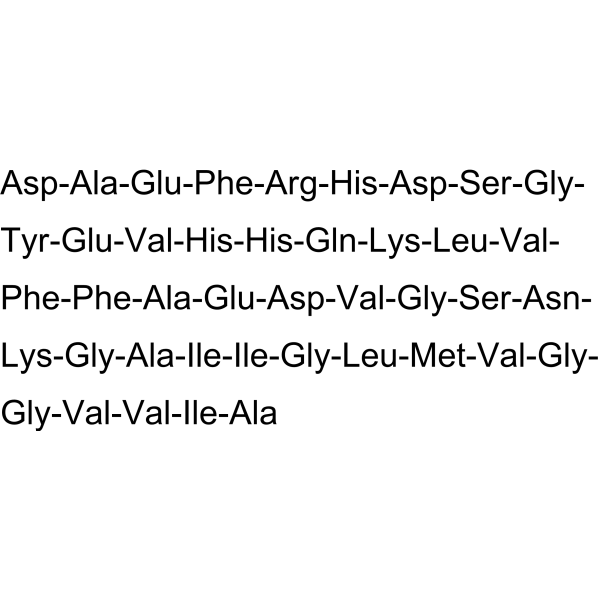
Asp-Ala-Glu-Phe-Arg-His-Asp-Ser-Gly-Tyr-Glu-Val-His-His-Gln-Lys-Leu-Val-Phe-Phe-Ala-Glu-Asp-Val-Gly-Ser-Asn-Lys-Gly-Ala-Ile-Ile-Gly-Leu-Met-Val-Gly-Gly-Val-Val
-
Sequence Shortening
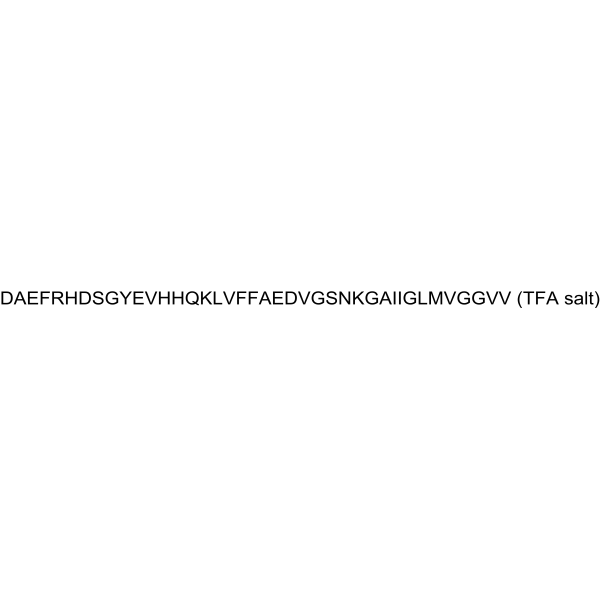
DAEFRHDSGYEVHHQKLVFFAEDVGSNKGAIIGLMVGGVV
-
Shipping
Room temperature in continental US; may vary elsewhere.
-
Storage
Sealed storage, away from moisture and light
Powder -80°C 2 years -20°C 1 year * The compound is unstable in solutions, freshly prepared is recommended.


Publications (3)
-
Journal Impact Factor
-
Most Recent
-
Adv Sci (Weinh)
2023 Dec;10(36):e2303402. PMID: 37949676 -
Neurol Int
Cognitive and Histological Methodological Framework for an Intrahippocampal Aβ1-42 Rat Model of Alzheimer's Disease. [Abstract]2026 Apr 24;18(5):79. PMID: 42188679 -
Korean J Physiol Pharmacol
Analysis of the mechanism of fibrauretine alleviating Alzheimer's disease based on transcriptomics and proteomics. [Abstract]2024 Jul 1;28(4):361-377. PMID: 38926843


Solvent & Solubility
In Vitro:
H2O : 100 mg/mL (22.50 mM; Need ultrasonic)
Please refer to the solubility information to select the appropriate solvent. The compound is unstable in solutions, freshly prepared is recommended.
* Note: If you choose water as the stock solution, please dilute it to the working solution, then filter and sterilize it with a 0.22 μm filter before use.
Please refer to the solubility information to select the appropriate solvent. The compound is unstable in solutions, freshly prepared is recommended.
* Note: If you choose water as the stock solution, please dilute it to the working solution, then filter and sterilize it with a 0.22 μm filter before use.
Concentration (start) × Volume (start) = Concentration (final) × Volume (final)


Purity & Documentation
-
Data Sheet (294 KB)
-
SDS (252 KB)
- English - EN (252 KB)
- Français - FR (252 KB)
- Deutsch - DE (252 KB)
- Norwegian - NO (252 KB)
- Español - ES (252 KB)
- Swedish - SV (252 KB)
- Italian - IT (252 KB)
- Korean - KR (252 KB)
- Portuguese - PT (252 KB)
-
Handling Instructions (2659 KB)
References


Complete Stock Solution Preparation Table
Please refer to the solubility information to select the appropriate solvent. The compound is unstable in solutions, freshly prepared is recommended.
| Optional Solvent | Concentration Solvent Mass | 1 mg | 5 mg | 10 mg | 25 mg |
|---|---|---|---|---|---|
| H2O | 1 mM | 0.2250 mL | 1.1252 mL | 2.2503 mL | 5.6258 mL |
| 5 mM | 0.0450 mL | 0.2250 mL | 0.4501 mL | 1.1252 mL | |
| 10 mM | 0.0225 mL | 0.1125 mL | 0.2250 mL | 0.5626 mL | |
| 15 mM | 0.0150 mL | 0.0750 mL | 0.1500 mL | 0.3751 mL | |
| 20 mM | 0.0113 mL | 0.0563 mL | 0.1125 mL | 0.2813 mL |
* Note: If you choose water as the stock solution, please dilute it to the working solution, then filter and sterilize it with a 0.22 μm filter before use.


β-Amyloid (1-40) (human) TFA Related Classifications
HY-P0265A Related Classifications
 Powered by Bioz
Keywords