



19-Hydroxyandrost-4-ene-3,17-dione

Based on 1 Customer Validation
19-Hydroxyandrost-4-ene-3,17-dione is an endogenous adrenal C19 steroid and also an agonist of the olfactory receptor OR51E2, with an EC50 of 0.15 nM. 19-Hydroxyandrost-4-ene-3,17-dione activates G protein-coupled receptor signaling pathways, drives neuroendocrine transdifferentiation, induces G0/G1 cell cycle arrest, reduces apoptosis and anabolic signaling, decreases cell viability, and reprograms cell metabolic profiles. 19-Hydroxyandrost-4-ene-3,17-dione induces sodium retention and hypertension, and its secretion is regulated by ACTH and the renin-angiotensin system. 19-Hydroxyandrost-4-ene-3,17-dione can be used in research related to prostate cancer, metastatic breast cancer, and hypertension.
For research use only. We do not sell to patients.
- Purity : 99.11%
- CAS No.: 510-64-5
- Formula: C19H26O3
- Molecular Weight:302.41
-
Storage:Powder -20°C, 3 years , 4°C, 2 years ; In solvent -80°C, 6 months , -20°C, 1 month


To place orders, for customer services and technical support, please contact: MedChemExpress USA
Tel: 609-228-6898 E-mail: [email protected] [email protected]


-
 Biological Activity
-
Chemical Information
-
Solvent & Solubility
- Purity & Documentation
- References
-
 Help & FAQs



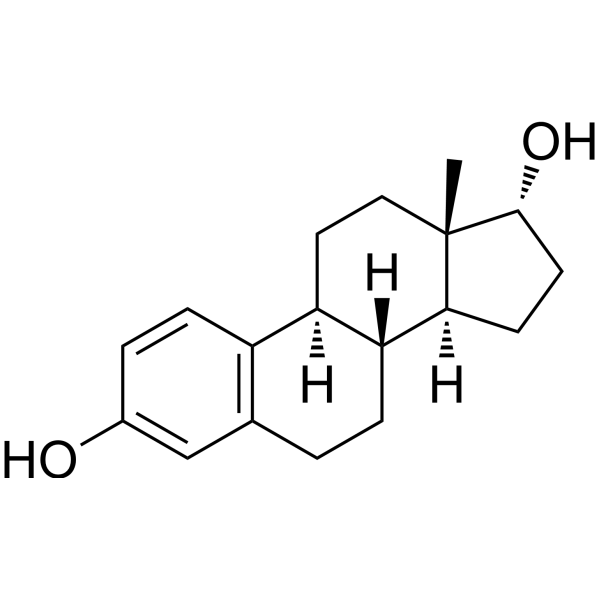
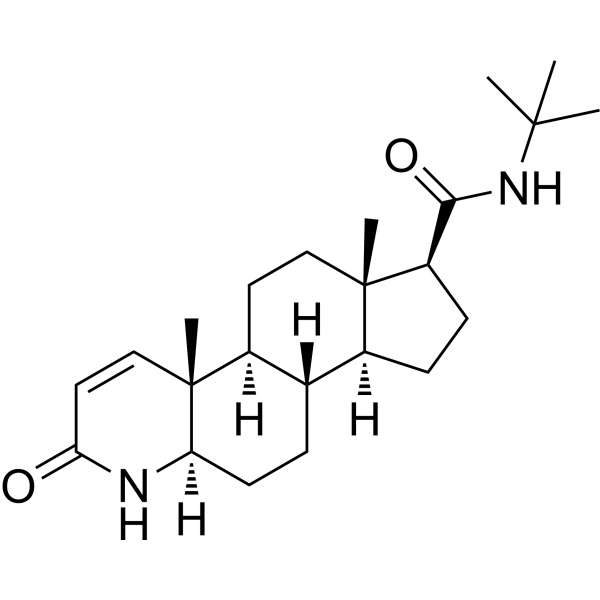

All Endogenous Metabolite Isoforms
More

Biological Activity
Description
In Vitro
19-Hydroxyandrost-4-ene-3,17-dione (Up to 10 μM; 3.5 h) potently activates OR51E2 in transfected HANA3A cells with an EC50 of 1.5×10⁻¹⁰ M[1].
19-Hydroxyandrost-4-ene-3,17-dione (100 nM-1 μM; 3-12 days) induces increased expression of neuroendocrine markers NSE and AMACR, and decreased expression of epithelial and androgen receptor markers, in LNCaP human prostate cancer cells after 3 or 12 days of treatment[1].
19-Hydroxyandrost-4-ene-3,17-dione (1 μM; 3 days) induction of neuroendocrine marker NSE is mediated by OR51E2 in LNCaP human prostate cancer cells[1].
19-Hydroxyandrost-4-ene-3,17-dione (100 nM; 3 days) induces metabolic reprogramming consistent with a non-proliferative phenotype in LNCaP human prostate cancer cells, with key changes in amino acid and glycolytic pathways[1].
19-Hydroxyandrost-4-ene-3,17-dione (100 nM-10 μM; 4 days) reduces cell viability in LNCaP human prostate cancer cells after 4 days of treatment[1].
19-Hydroxyandrost-4-ene-3,17-dione (100 nM; 4 days) induces G0/G1 cell cycle arrest in LNCaP human prostate cancer cells after 4 days of treatment[1].
MedChemExpress (MCE) has not independently confirmed the accuracy of these methods. They are for reference only.
-
Cell Line:LNCaP human prostate cancer cells
-
Concentration:100 nM, 1 μM, 10 μM
-
Incubation Time:1, 2, 3, 4 days
-
Result:Significantly reduced viable cell number compared to untreated controls by day 4, as indicated by decreased luminescence signal.
-
Cell Line:LNCaP human prostate cancer cells
-
Concentration:100 nM
-
Incubation Time:4 days
-
Result:Increased the fraction of cells in the G0/G1 phase and decreased the fraction of cells in the S phase, with no significant change in apoptotic cell fraction.
-
Cell Line:LNCaP human prostate cancer cells
-
Concentration:100 nM, 1 μM (3 days incubation)
100 nM (12 days incubation) -
Incubation Time:3 days, 12 days
-
Result:Increased transcript levels of neuron-specific enolase (NSE) and α-methylacyl-CoA racemase (AMACR), while decreased OR51E2 transcript levels after 3 days of treatment with 100 nM or 1 μM.
Maintained elevated NSE and AMACR transcript levels, decreased androgen receptor (AR) and keratin 18 (K18) transcript levels, and decreased OR51E2 transcript levels after 12 days of treatment with 100 nM.
-
Cell Line:OR51E2-knockout (KO) LNCaP human prostate cancer cells
-
Concentration:1 μM
-
Incubation Time:3 days
-
Result:Reduced the increase in NSE transcript levels induced by 19-Hydroxyandrost-4-ene-3,17-dione significantly compared to control LNCaP cells.
In Vivo
19-Hydroxyandrost-4-ene-3,17-dione enhances aldosterone activity in adrenalectomized rats[2].
MedChemExpress (MCE) has not independently confirmed the accuracy of these methods. They are for reference only.


Chemical Information
-
CAS No. 510-64-5
-
Appearance Solid
-
Molecular Weight 302.41
-
Formula C19H26O3
-
Color White to off-white
-
SMILES
C[C@]1([C@](CC2)([H])[C@]3([H])CCC4=CC(CC[C@]4(CO)[C@@]3([H])CC1)=O)C2=O
-
Structure Classification
-
Initial Source
-
Shipping
Room temperature in continental US; may vary elsewhere.
-
Storage
Powder -20°C 3 years 4°C 2 years In solvent -80°C 6 months -20°C 1 month


Solvent & Solubility
In Vitro:
DMSO : 100 mg/mL (330.68 mM; Need ultrasonic; Hygroscopic DMSO has a significant impact on the solubility of product, please use newly opened DMSO)
Please refer to the solubility information to select the appropriate solvent. Once prepared, please aliquot and store the solution to prevent product inactivation from repeated freeze-thaw cycles.
Storage method and period of stock solution: -80°C, 6 months; -20°C, 1 month. When stored at -80°C, please use it within 6 months. When stored at -20°C, please use it within 1 month.
Please refer to the solubility information to select the appropriate solvent. Once prepared, please aliquot and store the solution to prevent product inactivation from repeated freeze-thaw cycles.
Storage method and period of stock solution: -80°C, 6 months; -20°C, 1 month. When stored at -80°C, please use it within 6 months. When stored at -20°C, please use it within 1 month.
Concentration (start) × Volume (start) = Concentration (final) × Volume (final)
In Vivo:
Select the appropriate dissolution method based on your experimental animal and administration route.
- For the following dissolution methods, please ensure to first prepare a clear stock solution using an In Vitro approach and then sequentially add co-solvents:
- To ensure reliable experimental results, the clarified stock solution can be appropriately stored based on storage conditions. As for the working solution for In Vivo experiments, it is recommended to prepare freshly and use it on the same day.
- The percentages shown for the solvents indicate their volumetric ratio in the final prepared solution. If precipitation or phase separation occurs during preparation, heat and/or sonication can be used to aid dissolution.
Add each solvent one by one: 10% DMSO 40% PEG300 5% Tween-80 45% Saline
Solubility: ≥ 2.5 mg/mL (8.27 mM); Clear solution
This protocol yields a clear solution of ≥ 2.5 mg/mL (saturation unknown).
Taking 1 mL working solution as an example, add 100 μL DMSO stock solution (25.0 mg/mL) to 400 μL PEG300, and mix evenly; then add 50 μL Tween-80 and mix evenly; then add 450 μL Saline to adjust the volume to 1 mL.
Preparation of Saline: Dissolve 0.9 g sodium chloride in ddH₂O and dilute to 100 mL to obtain a clear Saline solution.
Add each solvent one by one: 10% DMSO 90% (20% SBE-β-CD in Saline)
Solubility: ≥ 2.5 mg/mL (8.27 mM); Clear solution
This protocol yields a clear solution of ≥ 2.5 mg/mL (saturation unknown).
Taking 1 mL working solution as an example, add 100 μL DMSO stock solution (25.0 mg/mL) to 900 μL 20% SBE-β-CD in Saline, and mix evenly.
Preparation of 20% SBE-β-CD in Saline (4°C, storage for one week): 2 g SBE-β-CD powder is dissolved in 10 mL Saline, completely dissolve until clear.
In Vivo Dissolution Calculator
Please enter the basic information of animal experiments:
-
-
-
-
Recommended: Prepare an additional quantity of animals to account for potential losses during experiments.
Please enter your animal formula composition:
-
%DMSO +
Recommended: Keep the proportion of DMSO in working solution below 2% if your animal is weak.
-
%+
-
+%Tween-80 + +
-
%Saline +
The co-solvents required include: DMSO, . All of co-solvents are available by MedChemExpress (MCE). , Tween 80. All of co-solvents are available by MedChemExpress (MCE).
Working solution concentration: 0.22 mg/mL
Method for preparing stock solution: mg drug dissolved in μL DMSO. Stock solution concentration: mg/mL.
1. Take μL DMSO stock solution;
2. Add μL .
μL , mix evenly;
3. Then add μL Tween 80, mix evenly;
4. Then add μL
Please ensure that the stock solution in the first step is dissolved to a clear state, and add co-solvents in sequence. You can use ultrasonic heating (ultrasonic cleaner, recommended frequency 20-40 kHz), vortexing, etc. to assist dissolution.


Purity & Documentation
-
Data Sheet (296 KB)
-
SDS (396 KB)
- English - EN (396 KB)
- Français - FR (396 KB)
- Deutsch - DE (396 KB)
- Norwegian - NO (396 KB)
- Español - ES (396 KB)
- Swedish - SV (396 KB)
- Italian - IT (396 KB)
- Korean - KR (396 KB)
- Portuguese - PT (396 KB)
-
Handling Instructions (2659 KB)
References


Complete Stock Solution Preparation Table
Please refer to the solubility information to select the appropriate solvent. Once prepared, please aliquot and store the solution to prevent product inactivation from repeated freeze-thaw cycles.
Storage method and period of stock solution: -80°C, 6 months; -20°C, 1 month. When stored at -80°C, please use it within 6 months. When stored at -20°C, please use it within 1 month.
| Optional Solvent | Concentration Solvent Mass | 1 mg | 5 mg | 10 mg | 25 mg |
|---|---|---|---|---|---|
| DMSO | 1 mM | 3.3068 mL | 16.5338 mL | 33.0677 mL | 82.6692 mL |
| 5 mM | 0.6614 mL | 3.3068 mL | 6.6135 mL | 16.5338 mL | |
| 10 mM | 0.3307 mL | 1.6534 mL | 3.3068 mL | 8.2669 mL | |
| 15 mM | 0.2205 mL | 1.1023 mL | 2.2045 mL | 5.5113 mL | |
| 20 mM | 0.1653 mL | 0.8267 mL | 1.6534 mL | 4.1335 mL | |
| 25 mM | 0.1323 mL | 0.6614 mL | 1.3227 mL | 3.3068 mL | |
| 30 mM | 0.1102 mL | 0.5511 mL | 1.1023 mL | 2.7556 mL | |
| 40 mM | 0.0827 mL | 0.4133 mL | 0.8267 mL | 2.0667 mL | |
| 50 mM | 0.0661 mL | 0.3307 mL | 0.6614 mL | 1.6534 mL | |
| 60 mM | 0.0551 mL | 0.2756 mL | 0.5511 mL | 1.3778 mL | |
| 80 mM | 0.0413 mL | 0.2067 mL | 0.4133 mL | 1.0334 mL | |
| 100 mM | 0.0331 mL | 0.1653 mL | 0.3307 mL | 0.8267 mL |


19-Hydroxyandrost-4-ene-3,17-dione Related Classifications
HY-113302 Related Classifications
 Powered by Bioz