



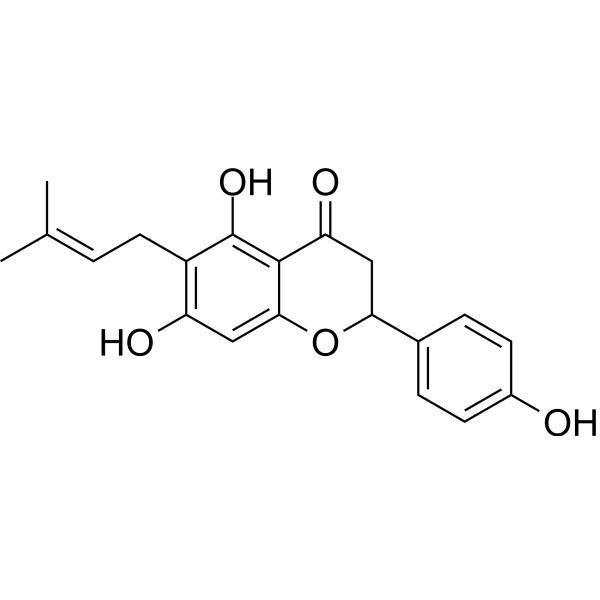
(2R/S)-6-PNG
Based on 1 publication(s) in Google Scholar
(2R/S)-6-PNG (6-Prenylnaringenin) is a potent and reversible Cav3.2 T-type Ca2+ channels (T-channels) blocker. (2R/S)-6-PNG can penetrate the blood-brain barrier (BBB). (2R/S)-6-PNG suppresses neuropathic and visceral pain in mice.
For research use only. We do not sell to patients.
- Purity : 99.96%
- CAS No.: 68682-01-9
- Formula: C20H20O5
- Molecular Weight:340.37
-
Storage:Powder -20°C, 3 years ; In solvent -80°C, 6 months , -20°C, 1 month

To place orders, for customer services and technical support, please contact: MedChemExpress USA
Tel: 609-228-6898 E-mail: [email protected] [email protected]


-
 Biological Activity
-
Chemical Information
-
Solvent & Solubility
- Purity & Documentation
- References
-
 Help & FAQs




Publications Citing Use of MedChemExpress (MCE) (2R/S)-6-PNG
MoreAll Calcium Channel Isoforms
More

Biological Activity
Description
IC50 & Target
|
T-type calcium channel |
Cellular Effect
|
Cell Line

|
Type | Value | Description | References |
|---|---|---|---|---|
| Ishikawa | IC50 |
>5 μM
Compound: 6-PN
|
Cytotoxicity against human Ishikawa cells after 96 hrs by SRB assay
Cytotoxicity against human Ishikawa cells after 96 hrs by SRB assay
|
[PMID: 28812892] |
In Vitro
(2R/S)-6-PNG (6-Prenylnaringenin) potently blocks Cav3.2, but exhibits minor effect on high-voltage-activated Ca2+ channels and voltage-gated Na+ channels in differentiated NG108-15 cells[1].
On the basis of IC50 values, the proportion (Cav3.2/HVA) of the inhibition potency of (2R/S)-6-PNG on Cav3.2 and HVA-currents is 5.20, and that (Cav3.2/Nav) on Cav3.2 and Nav-currents is 3.54[1].
MedChemExpress (MCE) has not independently confirmed the accuracy of these methods. They are for reference only.
In Vivo
(2R/S)-6-PNG (30 mg/kg; i.p.) prevents the increased number of phosphorylated ERK-positive cells following i.col. Na2S in laminae I-II, V-VI and X to which the primary afferent neurons project, and the Na2S-induced increase in the phosphorylated ERK-positive cell number[1].
(2R/S)-6-PNG (0.01-1 and 0.1-10 nmol/paw; intraplantar administration) restores the mechanical allodynia induced by partial sciatic nerve ligation (PSNL) and by i.p. administration of Oxaliplatin (OHP) a, respectively, in a dose-dependent manner[1].
(2R/S)-6-PNG (20-30 mg/kg; i.p.) significantly reverses the PSNL-induced allodynia. (2R/S)-6-PNG (10-20 mg/kg; i.p.) significantly reverses the OHP-induced allodynia (5 mg/kg; i.p.; single dose)[1].
MedChemExpress (MCE) has not independently confirmed the accuracy of these methods. They are for reference only.
Clinical Trial
| NCT Number | Sponsor | Condition | Start Date |
Phase
|
|---|---|---|---|---|
| NCT01329991 | Plexxikon| | 2011-05 | PHASE1 |


Chemical Information
-
CAS No. 68682-01-9
-
Appearance Solid
-
Molecular Weight 340.37
-
Formula C20H20O5
-
Color White to off-white
-
SMILES
O=C1CC(C2=CC=C(O)C=C2)OC3=CC(O)=C(C/C=C(C)\C)C(O)=C13
-
Synonyms
6-Prenylnaringenin; (±)-6-Prenylnaringenin
-
Shipping
Room temperature in continental US; may vary elsewhere.
-
Storage
Powder -20°C 3 years In solvent -80°C 6 months -20°C 1 month


Publications (1)
-
Journal Impact Factor
-
Most Recent
-
Front Neurol
Change in Cav3.2 T-Type Calcium Channel Induced by Varicella-Zoster Virus Participates in the Maintenance of Herpetic Neuralgia. [Abstract]2021 Nov 30;12:741054. PMID: 34917013


Solvent & Solubility
In Vitro:
DMSO : 125 mg/mL (367.25 mM; Need ultrasonic; Hygroscopic DMSO has a significant impact on the solubility of product, please use newly opened DMSO)
Please refer to the solubility information to select the appropriate solvent. Once prepared, please aliquot and store the solution to prevent product inactivation from repeated freeze-thaw cycles.
Storage method and period of stock solution: -80°C, 6 months; -20°C, 1 month. When stored at -80°C, please use it within 6 months. When stored at -20°C, please use it within 1 month.
Please refer to the solubility information to select the appropriate solvent. Once prepared, please aliquot and store the solution to prevent product inactivation from repeated freeze-thaw cycles.
Storage method and period of stock solution: -80°C, 6 months; -20°C, 1 month. When stored at -80°C, please use it within 6 months. When stored at -20°C, please use it within 1 month.
Concentration (start) × Volume (start) = Concentration (final) × Volume (final)
In Vivo:
Select the appropriate dissolution method based on your experimental animal and administration route.
- For the following dissolution methods, please ensure to first prepare a clear stock solution using an In Vitro approach and then sequentially add co-solvents:
- To ensure reliable experimental results, the clarified stock solution can be appropriately stored based on storage conditions. As for the working solution for In Vivo experiments, it is recommended to prepare freshly and use it on the same day.
- The percentages shown for the solvents indicate their volumetric ratio in the final prepared solution. If precipitation or phase separation occurs during preparation, heat and/or sonication can be used to aid dissolution.
Add each solvent one by one: 10% DMSO 40% PEG300 5% Tween-80 45% Saline
Solubility: ≥ 2.08 mg/mL (6.11 mM); Clear solution
This protocol yields a clear solution of ≥ 2.08 mg/mL (saturation unknown).
Taking 1 mL working solution as an example, add 100 μL DMSO stock solution (20.8 mg/mL) to 400 μL PEG300, and mix evenly; then add 50 μL Tween-80 and mix evenly; then add 450 μL Saline to adjust the volume to 1 mL.
Preparation of Saline: Dissolve 0.9 g sodium chloride in ddH₂O and dilute to 100 mL to obtain a clear Saline solution.
Add each solvent one by one: 10% DMSO 90% (20% SBE-β-CD in Saline)
Solubility: ≥ 2.08 mg/mL (6.11 mM); Clear solution
This protocol yields a clear solution of ≥ 2.08 mg/mL (saturation unknown).
Taking 1 mL working solution as an example, add 100 μL DMSO stock solution (20.8 mg/mL) to 900 μL 20% SBE-β-CD in Saline, and mix evenly.
Preparation of 20% SBE-β-CD in Saline (4°C, storage for one week): 2 g SBE-β-CD powder is dissolved in 10 mL Saline, completely dissolve until clear.
In Vivo Dissolution Calculator
Please enter the basic information of animal experiments:
-
-
-
-
Recommended: Prepare an additional quantity of animals to account for potential losses during experiments.
Please enter your animal formula composition:
-
%DMSO +
Recommended: Keep the proportion of DMSO in working solution below 2% if your animal is weak.
-
%+
-
+%Tween-80 + +
-
%Saline +
The co-solvents required include: DMSO, . All of co-solvents are available by MedChemExpress (MCE). , Tween 80. All of co-solvents are available by MedChemExpress (MCE).
Working solution concentration: 0.22 mg/mL
Method for preparing stock solution: mg drug dissolved in μL DMSO. Stock solution concentration: mg/mL.
1. Take μL DMSO stock solution;
2. Add μL .
μL , mix evenly;
3. Then add μL Tween 80, mix evenly;
4. Then add μL
Please ensure that the stock solution in the first step is dissolved to a clear state, and add co-solvents in sequence. You can use ultrasonic heating (ultrasonic cleaner, recommended frequency 20-40 kHz), vortexing, etc. to assist dissolution.


Purity & Documentation
-
Data Sheet (273 KB)
-
SDS (393 KB)
- English - EN (393 KB)
- Français - FR (393 KB)
- Deutsch - DE (393 KB)
- Norwegian - NO (393 KB)
- Español - ES (393 KB)
- Swedish - SV (393 KB)
- Italian - IT (393 KB)
- Korean - KR (393 KB)
- Portuguese - PT (393 KB)
-
Handling Instructions (2659 KB)
References


Complete Stock Solution Preparation Table
Please refer to the solubility information to select the appropriate solvent. Once prepared, please aliquot and store the solution to prevent product inactivation from repeated freeze-thaw cycles.
Storage method and period of stock solution: -80°C, 6 months; -20°C, 1 month. When stored at -80°C, please use it within 6 months. When stored at -20°C, please use it within 1 month.
| Optional Solvent | Concentration Solvent Mass | 1 mg | 5 mg | 10 mg | 25 mg |
|---|---|---|---|---|---|
| DMSO | 1 mM | 2.9380 mL | 14.6899 mL | 29.3798 mL | 73.4495 mL |
| 5 mM | 0.5876 mL | 2.9380 mL | 5.8760 mL | 14.6899 mL | |
| 10 mM | 0.2938 mL | 1.4690 mL | 2.9380 mL | 7.3449 mL | |
| 15 mM | 0.1959 mL | 0.9793 mL | 1.9587 mL | 4.8966 mL | |
| 20 mM | 0.1469 mL | 0.7345 mL | 1.4690 mL | 3.6725 mL | |
| 25 mM | 0.1175 mL | 0.5876 mL | 1.1752 mL | 2.9380 mL | |
| 30 mM | 0.0979 mL | 0.4897 mL | 0.9793 mL | 2.4483 mL | |
| 40 mM | 0.0734 mL | 0.3672 mL | 0.7345 mL | 1.8362 mL | |
| 50 mM | 0.0588 mL | 0.2938 mL | 0.5876 mL | 1.4690 mL | |
| 60 mM | 0.0490 mL | 0.2448 mL | 0.4897 mL | 1.2242 mL | |
| 80 mM | 0.0367 mL | 0.1836 mL | 0.3672 mL | 0.9181 mL | |
| 100 mM | 0.0294 mL | 0.1469 mL | 0.2938 mL | 0.7345 mL |


(2R/S)-6-PNG Related Classifications
HY-115681 Related Classifications
 Powered by Bioz