



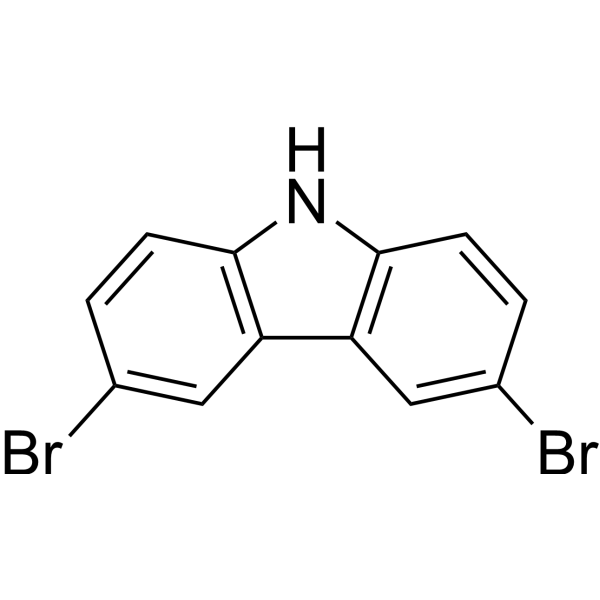
3,6-Dibromocarbazole

Based on 1 Customer Validation
3,6-Dibromocarbazole is a glucocorticoid receptor (GR) inhibitor and Environmental pollutant. 3,6-Dibromocarbazole induces abnormal development of zebrafish embryos and disrupts the neurohormonal function of the hypothalamic-pituitary-adrenal axis in zebrafish larvae. 3,6-Dibromocarbazole increases the α-diversity of soil bacteria, alters community structure, enhances interspecific competition, regulates metabolic functions, and changes the abundance of genes related to nitrogen fixation, nitrification and carbon cycling. 3,6-Dibromocarbazole exerts endocrine-disrupting potential by interfering with the gluconeogenesis pathway.
For research use only. We do not sell to patients.
- Purity : 99.94%
- CAS No.: 6825-20-3
- Formula: C12H7Br2N
- Molecular Weight:325.00
-
Storage:Powder -20°C, 3 years , 4°C, 2 years ; In solvent -80°C, 6 months , -20°C, 1 month

To place orders, for customer services and technical support, please contact: MedChemExpress USA
Tel: 609-228-6898 E-mail: [email protected] [email protected]


-
 Biological Activity
-
Chemical Information
-
Solvent & Solubility
- Purity & Documentation
- References
-
 Help & FAQs


-
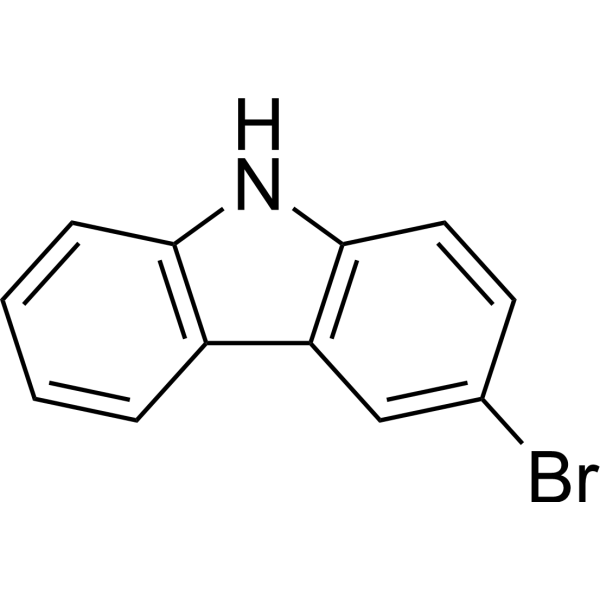
HY-33798
3-Bromocarbazole -

HY-W022224
3,6-Diiodo-9H-carbazole -
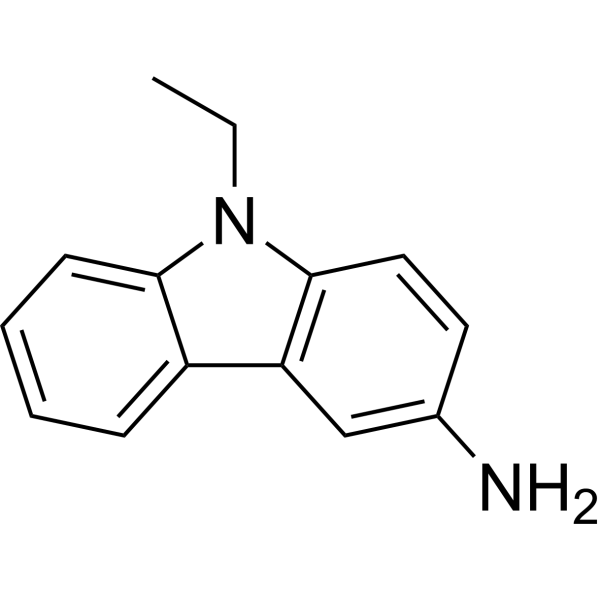
HY-W014386
3-Amino-9-ethylcarbazole -
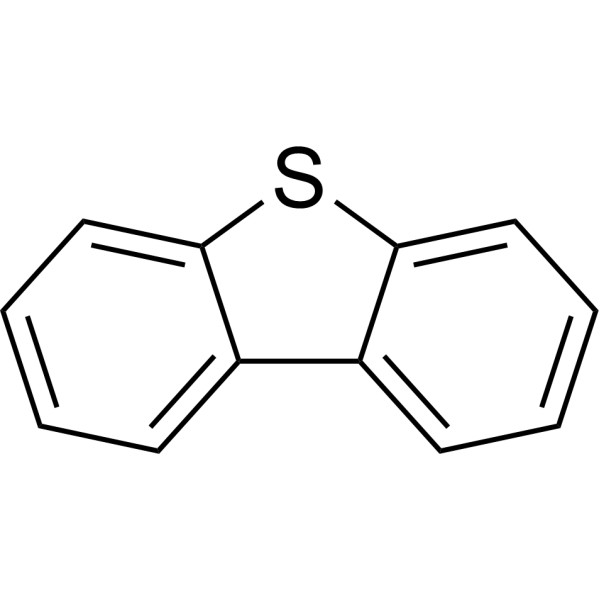
HY-B0973
Dibenzothiophene -

HY-W016331
9H-Carbazol-4-ol -

HY-B0973R
Dibenzothiophene (Standard) -

HY-W011208
9,10-Dibromoanthracene -

HY-W100287
Murrayafoline A -
![4-Chloro-7H-pyrrolo[2,3-d]pyrimidine](https://file.medchemexpress.com/product_pic/hy-40351.gif)
HY-40351
4-Chloro-7H-pyrrolo[2,3-d]pyrimidine -
![7H-Dibenzo[c,g]carbazole](https://file.medchemexpress.com/product_pic/hy-119983.gif)
HY-119983
7H-Dibenzo[c,g]carbazole -
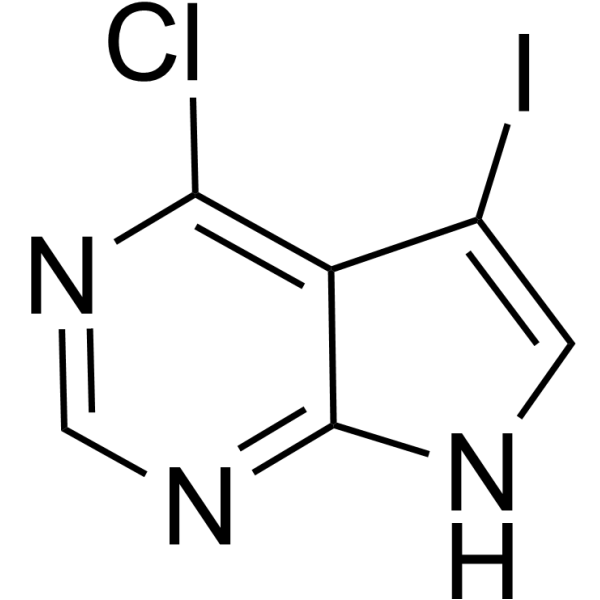
HY-77336
6-Chloro-7-iodo-7-deazapurine


Biological Activity
Description
In Vitro
3,6-Dibromocarbazole (10-1000 μM; 24 h) inhibits the viability of HeLa cells in a concentration-dependent manner, and significant cytotoxicity is observed at concentrations ≥10 μM[1].
3,6-Dibromocarbazole (10-1000 μM; 24 h) potently inhibits the viability of HepG2 cells in a concentration-dependent manner, with significant cytotoxicity observed at concentrations ≥10 μM[1].
3,6-Dibromocarbazole (0.1-10 μM; 24 h) acts as a concentration-dependent glucocorticoid receptor (GR) antagonist in HeLa cells, with significant antagonistic activity observed at 1 μM and strong activity exhibited at 10 μM[1].
3,6-Dibromocarbazole (0.1-10 μM; 24 h) inhibits Dexamethasone (HY-14648)-induced GR nuclear translocation in HeLa cells, with a significant effect observed at the concentration of 10 μM[1].
3,6-Dibromocarbazole (0.1-10 μM) reverses DEX-induced G0/G1 phase arrest by increasing the proportion of S-phase cells in HepG2 cells, suggesting that it can inhibit cell cycle progression[1].
MedChemExpress (MCE) has not independently confirmed the accuracy of these methods. They are for reference only.
-
Cell Line:HeLa cells
-
Concentration:10-1000 μM
-
Incubation Time:24 h
-
Result:Reduced HeLa cell viability to ~95% at 10 μM, ~85% at 50 μM, ~75% at 100 μM, and ~40% at 1000 μM.
Showed statistically significant differences from the control group (**** p < 0.0001 for 50, 100, 1000 μM; *** p < 0.001 for 10 μM).
-
Cell Line:HepG2 cells
-
Concentration:10-1000 μM
-
Incubation Time:24 h
-
Result:Reduced HepG2 cell viability to ~70% at 10 μM, ~15% at 50 μM, ~10% at 100 μM, ~10% at 500 μM, and ~8% at 1000 μM.
Showed statistically significant differences from the control group (**** p < 0.0001 for all concentrations).
-
Cell Line:HeLa cells
-
Concentration:0.1-10 μM (co-treated with 1 μM DEX)
-
Incubation Time:24 h
-
Result:Inhibited DEX-induced GR nuclear translocation.
Significantly increased cytoplasmic GR expression compared to the DEX-only group at 10 μM.
Significantly decreased nuclear GR expression compared to the DEX-only group at 10 μM (** p < 0.01 for nuclear GR comparisons between DEX-only and 10 μM 3,6-dibromocarbazole groups).
In Vivo
3,6-Dibromocarbazole (0.1-1 μM; 96 hpf) acts as a glucocorticoid receptor antagonist in zebrafish larvae, and interferes with the expression of key genes related to the hypothalamic-pituitary-adrenal axis at doses of 0.1 μM and 1 μM[1].
MedChemExpress (MCE) has not independently confirmed the accuracy of these methods. They are for reference only.
-
Animal Model:unspecified strain (embryos/larvae)[1]
-
Dosage:0.1 μM; 1 μM; 10 μM
-
Administration:aqueous exposure; continuous; 120 h
-
Result:Induced maximum malformation and mortality rates in zebrafish larvae at 96 hpf.
Caused dose-dependent mortality of zebrafish embryos at 96 hpf and 120 hpf.
Resulted in the lowest hatchability across 60-120 hpf in the 0.1 μM group.
-
Animal Model:unspecified strain (larvae)[1]
-
Dosage:0.1 μM; 1 μM
-
Administration:aqueous exposure; continuous; 96 hpf (in presence of 1 μM DEX)
-
Result:Inhibited mRNA expression levels of glucocorticoid receptor (*gr*) and mineralocorticoid receptor (*mr*).
Downregulated transcript levels of *crh*, *mc2r*, and *pomc*, and interfered with *star* transcript levels at the 1 μM dose.


Chemical Information
-
CAS No. 6825-20-3
-
Appearance Solid
-
Molecular Weight 325.00
-
Formula C12H7Br2N
-
Color Light brown to brown
-
SMILES
BrC1=CC(C2=C3C=CC(Br)=C2)=C(N3)C=C1
-
Shipping
Room temperature in continental US; may vary elsewhere.
-
Storage
Powder -20°C 3 years 4°C 2 years In solvent -80°C 6 months -20°C 1 month


Solvent & Solubility
In Vitro:
DMSO : 200 mg/mL (615.38 mM; Need ultrasonic; Hygroscopic DMSO has a significant impact on the solubility of product, please use newly opened DMSO)
Please refer to the solubility information to select the appropriate solvent. Once prepared, please aliquot and store the solution to prevent product inactivation from repeated freeze-thaw cycles.
Storage method and period of stock solution: -80°C, 6 months; -20°C, 1 month. When stored at -80°C, please use it within 6 months. When stored at -20°C, please use it within 1 month.
Please refer to the solubility information to select the appropriate solvent. Once prepared, please aliquot and store the solution to prevent product inactivation from repeated freeze-thaw cycles.
Storage method and period of stock solution: -80°C, 6 months; -20°C, 1 month. When stored at -80°C, please use it within 6 months. When stored at -20°C, please use it within 1 month.
Concentration (start) × Volume (start) = Concentration (final) × Volume (final)


Purity & Documentation
-
Data Sheet (282 KB)
-
SDS (394 KB)
- English - EN (394 KB)
- Français - FR (394 KB)
- Deutsch - DE (394 KB)
- Norwegian - NO (394 KB)
- Español - ES (394 KB)
- Swedish - SV (394 KB)
- Italian - IT (394 KB)
- Korean - KR (394 KB)
- Portuguese - PT (394 KB)
-
Handling Instructions (2659 KB)
References
[1]. Zou H, et al. In vitro, in vivo, and in silico evaluation of the glucocorticoid receptor antagonist activity of 3,6-dibromocarbazole. Food and chemical toxicology : an international journal published for the British Industrial Biological Research Association. 2023 Oct;180:114048. [Content Brief]
[2]. Shi B, et al. 3,6-dibromocarbazole have a significant effect on diversity, community and function of soil microorganisms. Journal of hazardous materials. 2025 Sep 05;495:138962. [Content Brief]


Complete Stock Solution Preparation Table
Please refer to the solubility information to select the appropriate solvent. Once prepared, please aliquot and store the solution to prevent product inactivation from repeated freeze-thaw cycles.
Storage method and period of stock solution: -80°C, 6 months; -20°C, 1 month. When stored at -80°C, please use it within 6 months. When stored at -20°C, please use it within 1 month.
| Optional Solvent | Concentration Solvent Mass | 1 mg | 5 mg | 10 mg | 25 mg |
|---|---|---|---|---|---|
| DMSO | 1 mM | 3.0769 mL | 15.3846 mL | 30.7692 mL | 76.9231 mL |
| 5 mM | 0.6154 mL | 3.0769 mL | 6.1538 mL | 15.3846 mL | |
| 10 mM | 0.3077 mL | 1.5385 mL | 3.0769 mL | 7.6923 mL | |
| 15 mM | 0.2051 mL | 1.0256 mL | 2.0513 mL | 5.1282 mL | |
| 20 mM | 0.1538 mL | 0.7692 mL | 1.5385 mL | 3.8462 mL | |
| 25 mM | 0.1231 mL | 0.6154 mL | 1.2308 mL | 3.0769 mL | |
| 30 mM | 0.1026 mL | 0.5128 mL | 1.0256 mL | 2.5641 mL | |
| 40 mM | 0.0769 mL | 0.3846 mL | 0.7692 mL | 1.9231 mL | |
| 50 mM | 0.0615 mL | 0.3077 mL | 0.6154 mL | 1.5385 mL | |
| 60 mM | 0.0513 mL | 0.2564 mL | 0.5128 mL | 1.2821 mL | |
| 80 mM | 0.0385 mL | 0.1923 mL | 0.3846 mL | 0.9615 mL | |
| 100 mM | 0.0308 mL | 0.1538 mL | 0.3077 mL | 0.7692 mL |


3,6-Dibromocarbazole Related Classifications
HY-W009154 Related Classifications
 Powered by Bioz
Keywords
- 3,6-Dibromocarbazole
- 6825-20-3
- Environmental Pollutants
- Glucocorticoid Receptor
- Bacterial
- HepG2 cells
- zebrafish embryo
- glucocorticoid receptor
- GR-LBD
- gluconeogenesis pathway
- zebrafish larvae
- soil bacterial communities
- nitrogen fixation
- HeLa cells
- hypothalamic-pituitary-adrenocortical axis
- Inhibitor
- inhibitor
- inhibit