



3-Bromocarbazole

Based on 1 Customer Validation
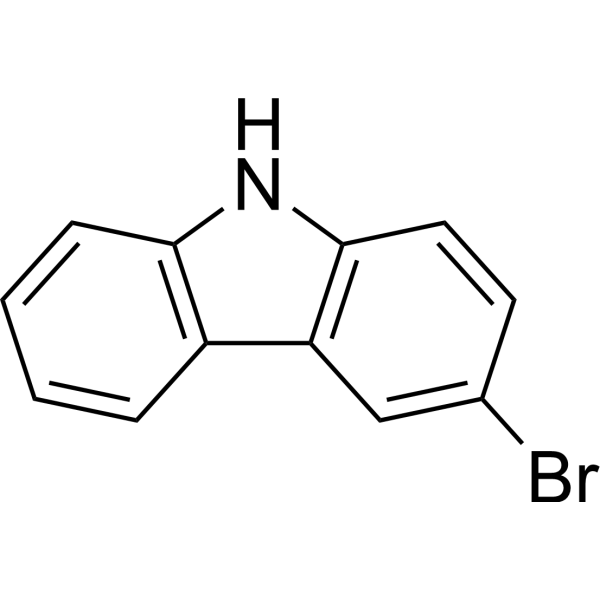
3-Bromocarbazole is an inhibitor of the aryl hydrocarbon receptor (AHR). 3-Bromocarbazole induces the mRNA expression of CYP1A1 and CYP1B1, with EC50 values of 2500 nM and 1100 nM, respectively. 3-Bromocarbazole inhibits motor neuron axon length by downregulating the mRNA transcription levels of α1-tubulin, Gap43, Syn2a and shha in zebrafish larvae. 3-Bromocarbazole reduces central nervous system neurogenesis by downregulating the mRNA transcription levels of elavl3, nrd, mbp and gfap in zebrafish larvae. 3-Bromocarbazole induces developmental neurotoxicity and decreases body length in zebrafish larvae or embryos; at high concentrations, it also reduces hatching rate, and increases mortality and malformation rate. 3-Bromocarbazole can be used in studies related to developmental neurotoxicity and breast cancer.
연구목적의 판매만을 진행합니다. 환자를 대상으로 한 판매는 하지 않습니다.
- Purity : 99.70%
- CAS No.: 1592-95-6
- 화학식: C12H8BrN
- 분자량:246.11
-
보관:
RT, protect from light.
In solvent -80°C, 1 year , -20°C, 6 months

To place orders, for customer services and technical support, please contact: MedChemExpress USA
Tel: 609-228-6898 E-mail: [email protected] [email protected]


-
 Biological Activity
-
Chemical Information
-
용액&용해도
- Protocol
- 순도&문서
- References
-
 Help & FAQs


-
HY-W009154
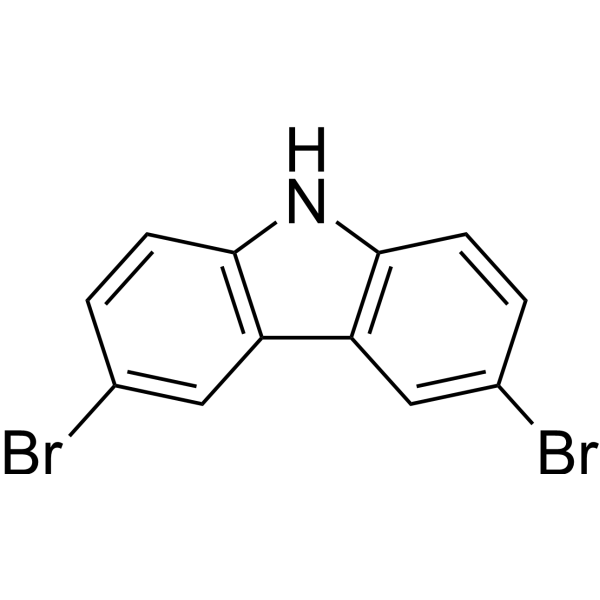
3,6-DibromocarbazoleGlucocorticoid Receptor Inhibitor -
HY-34464
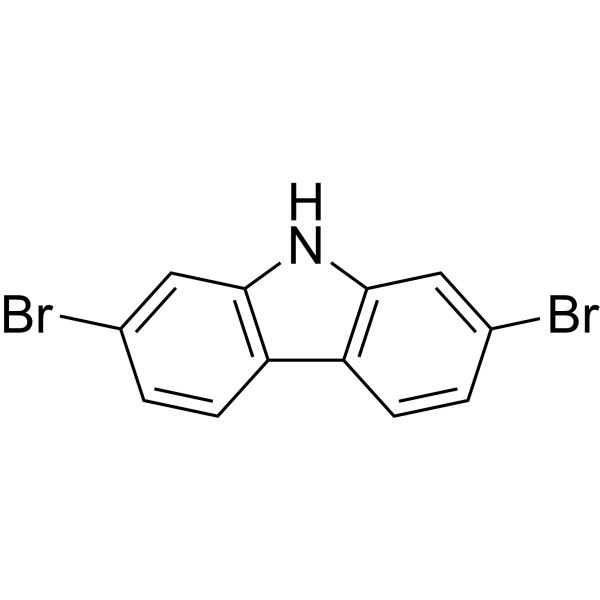
2,7-DibromocarbazoleAhR Agonist -

HY-W022224
3,6-Diiodo-9H-carbazoleOrganic Compound -

HY-W016331
9H-Carbazol-4-olAromatic Heterocycle -
HY-B0973
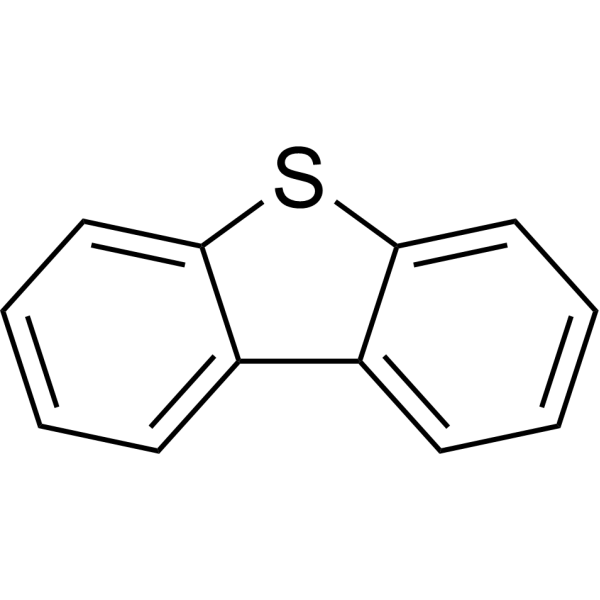
DibenzothiopheneCYP1A Inhibitor -

HY-33672R
9-Phenylcarbazole (Standard) -
HY-W014386
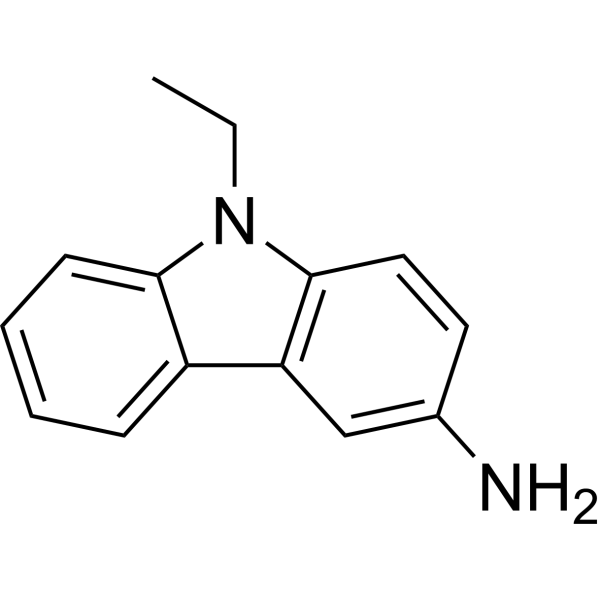
3-Amino-9-ethylcarbazoleBiochemical Assay Reagent -

HY-W100287
Murrayafoline AAnti-neuroinflammatory Agent -

HY-W011208
9,10-DibromoanthracenePlant Agglutinin -

HY-W002468
Ondansetron impurity 5Drug Impurity -

HY-W013429
4-Glycidyloxycarbazole -

HY-B0973R
Dibenzothiophene (Standard)Standard of Dibenzothiophene


Biological Activity
제품 설명
IC50 & Target
[2]|
CYP1A1 2500 nM (EC50) |
CYP1B1 1100 nM (EC50) |
Cellular Effect
|
Cell Line

|
Type | Value | Description | References |
|---|---|---|---|---|
| MDA-MB-468 | EC50 |
2500 nM
|
Induction of CYP1A1 mRNA in human MDA-MB-468 breast cancer cells assessed via quantitative real-time PCR after 24 h incubation.
Induction of CYP1A1 mRNA in human MDA-MB-468 breast cancer cells assessed via quantitative real-time PCR after 24 h incubation.
|
26226543 |
| MDA-MB-468 | EC50 |
1100 nM
|
Induction of CYP1B1 mRNA in human MDA-MB-468 breast cancer cells assessed via quantitative real-time PCR after 24 h incubation.
Induction of CYP1B1 mRNA in human MDA-MB-468 breast cancer cells assessed via quantitative real-time PCR after 24 h incubation.
|
26226543 |
In Vitro
MedChemExpress (MCE) has not independently confirmed the accuracy of these methods. They are for reference only.
-
Cell Line:MDA-MB-468 human breast cancer cells
-
Concentration:0.01-10 μM
-
Incubation Time:24 h
-
Result:Induced CYP1A1 mRNA with an EC50 of 2500 nM.
Induced CYP1B1 mRNA with an EC50 of 1100 nM.
Demonstrated relative effect potencies (REPs) compared to TCDD (assigned REP = 1.0) of 1.8×10⁻⁵ for CYP1A1 induction and 2.6×10⁻⁴ for CYP1B1 induction.
Decreased cytosolic AhR protein levels at 1 μM but did not induce detectable CYP1A1 or CYP1B1 protein expression.


Chemical Information
-
CAS No. 1592-95-6
-
Appearance Solid
-
분자량 246.11
-
화학식 C12H8BrN
-
Color White to off-white
-
SMILES
BrC1=CC2=C(C=C1)NC3=C2C=CC=C3
-
선적
Room temperature in continental US; may vary elsewhere.
-
보관
RT, protect from light
In solvent -80°C 1 year -20°C 6 months


용액&용해도
In Vitro:
DMSO : 100 mg/mL (406.32 mM; Need ultrasonic; Hygroscopic DMSO has a significant impact on the solubility of product, please use newly opened DMSO)
Please refer to the solubility information to select the appropriate solvent. Once prepared, please aliquot and store the solution to prevent product inactivation from repeated freeze-thaw cycles.
Storage method and period of stock solution: -80°C, 1 year; -20°C, 6 months. When stored at -80°C, please use it within 1 year. When stored at -20°C, please use it within 6 months.
Please refer to the solubility information to select the appropriate solvent. Once prepared, please aliquot and store the solution to prevent product inactivation from repeated freeze-thaw cycles.
Storage method and period of stock solution: -80°C, 1 year; -20°C, 6 months. When stored at -80°C, please use it within 1 year. When stored at -20°C, please use it within 6 months.
Concentration (start) × Volume (start) = Concentration (final) × Volume (final)


순도&문서
-
Data Sheet (292 KB)
-
SDS (393 KB)
- English - EN (393 KB)
- Français - FR (393 KB)
- Deutsch - DE (393 KB)
- Norwegian - NO (393 KB)
- Español - ES (393 KB)
- Swedish - SV (393 KB)
- Italian - IT (393 KB)
- Korean - KR (393 KB)
- Portuguese - PT (393 KB)
-
Handling Instructions (2659 KB)
References


Complete Stock Solution Preparation Table
Please refer to the solubility information to select the appropriate solvent. Once prepared, please aliquot and store the solution to prevent product inactivation from repeated freeze-thaw cycles.
Storage method and period of stock solution: -80°C, 1 year; -20°C, 6 months. When stored at -80°C, please use it within 1 year. When stored at -20°C, please use it within 6 months.
| Optional Solvent | Concentration Solvent Mass | 1 mg | 5 mg | 10 mg | 25 mg |
|---|---|---|---|---|---|
| DMSO | 1 mM | 4.0632 mL | 20.3161 mL | 40.6322 mL | 101.5806 mL |
| 5 mM | 0.8126 mL | 4.0632 mL | 8.1264 mL | 20.3161 mL | |
| 10 mM | 0.4063 mL | 2.0316 mL | 4.0632 mL | 10.1581 mL | |
| 15 mM | 0.2709 mL | 1.3544 mL | 2.7088 mL | 6.7720 mL | |
| 20 mM | 0.2032 mL | 1.0158 mL | 2.0316 mL | 5.0790 mL | |
| 25 mM | 0.1625 mL | 0.8126 mL | 1.6253 mL | 4.0632 mL | |
| 30 mM | 0.1354 mL | 0.6772 mL | 1.3544 mL | 3.3860 mL | |
| 40 mM | 0.1016 mL | 0.5079 mL | 1.0158 mL | 2.5395 mL | |
| 50 mM | 0.0813 mL | 0.4063 mL | 0.8126 mL | 2.0316 mL | |
| 60 mM | 0.0677 mL | 0.3386 mL | 0.6772 mL | 1.6930 mL | |
| 80 mM | 0.0508 mL | 0.2540 mL | 0.5079 mL | 1.2698 mL | |
| 100 mM | 0.0406 mL | 0.2032 mL | 0.4063 mL | 1.0158 mL |


3-Bromocarbazole Related Classifications
HY-33798 Related Classifications
 Powered by Bioz