



Cholinesterase (ChE)
Cholinesterase (ChE) is a family of enzymes present in the central nervous system, particularly in nervous tissue, muscle and red cells, which catalyze the hydrolysis of the neurotransmitter acetylcholine into choline and acetic acid, a reaction necessary to allow a cholinergic neuron to return to its resting state after activation. It is one of many important enzymes needed for the proper functioning of the nervous systems of humans.
There are two types: acetylcholinesterase (AChE, acetylcholine hydrolase) and butyrylcholinesterase (BChE, acylcholine acylhydrolase), also known as nonspecific cholinesterase or pseudocholinesterase. AChE is primarily found in the blood on red blood cell membranes, in neuromuscular junctions, and in neural synapses, while BChE is produced in the liver and found primarily in plasma. The difference between the two types of cholinesterase is their relative preferences for substrates: AChE hydrolyzes acetylcholine faster while BChE hydrolyzes butyrylcholine faster.
Cholinesterase (ChE) Isoform Specific Products
All Product Categories
-
Cholinesterase (ChE) Inhibitors
(922)
View all products
-
Cholinesterase (ChE) Agonists
(5)
View all products
-
Cholinesterase (ChE) Antagonists
(10)
View all products
-
Cholinesterase (ChE) Activators
(33)
View all products
-
Cholinesterase (ChE) Modulators
(11)
View all products
-
Cholinesterase (ChE) Chemical
(1)
View all products
-
Cholinesterase (ChE) Inducer
(1)
View all products
-
Cholinesterase (ChE) Controls
(6)
View all products
-
Cholinesterase (ChE) Substrates
(2)
View all products
-
Cholinesterase (ChE) Related Products (1069)
Related Products (1069)

-
Antibodies (2)
-
Cholinesterase (ChE) Isoform Comparison
-
Omeprazole sulfone N-oxide
 0 ImagesCat. No.: HY-138199CAS No.: 158812-85-2Omeprazole sulfone N-Oxide is an Omeprazole (HY-B0113) analog with binding affinity to Nilaparvata lugens choline acetyltransferase (ChAT).
-
Triazophos-d5
 0 ImagesCat. No.: HY-B0828SCAS No.: 1773496-62-0Synonyms: Hostathion 40EC-d5; Hostathion-d5; Hostation-d5Triazophos-d5 (Hostathion 40EC-d5) is the deuterium labeled Triazophos(HY-B0828). Triazophos, a non-systemic insecticide and acaricide that acts as an acetylcholinesterase (AChE) inhibitor, covalently and irreversibly binds to the acetylcholine binding site, thus blocking the hydrolysis of acetylcholine and leading to hyperexcitability; it is effective against a variety of soil insects and mites, including aphids, thrips, midges, beetles, Lepidoptera larvae, cutworms, and spider mites in crops such as ornamentals, cotton, rice, maize, soybeans, oil palms, olives, and coffee.
-
Ganstigmine
 0 ImagesCat. No.: HY-183403CAS No.: 457075-21-7Synonyms: CHF 2819 free baseGanstigmine (CHF 2819 free base) is a potent, orally active, blood-brain barrier-permeable acetylcholinesterase (AChE) inhibitor, with an IC50 value of 65 nM against human AChE, 310 nM against human butyrylcholinesterase (BChE), and 5.12 μM against Torpedo californica AChE. Ganstigmine increases extracellular acetylcholine levels in the brain of rodents without altering the concentrations of other neurotransmitters, stimulates cholinergic transmission, and induces the release of soluble non-amyloidogenic amyloid precursor protein. Ganstigmine exhibits neuroprotective activity independent of cholinesterase inhibition, prevents neuronal death, alleviates β-amyloid-induced neurodegeneration, rescues cholinergic neuron loss, and reverses Scopolamine (HY-N0296)-induced amnesia and memory deficits. Ganstigmine shows cholinesterase inhibition-independent neuroprotective effects against growth factor deprivation and Aβ25-35 toxicity. Ganstigmine can be used in research on Alzheimer's disease, cholinergic dysfunction, and neuroprotection.
-
AD-35 free base
 0 ImagesCat. No.: HY-117710ACAS No.: 1531586-58-9AD-35 free base is an orally active, blood-brain barrier-permeable acetylcholinesterase inhibitor with an IC50 of 793 nM. AD-35 free base inhibits metal-induced amyloid-β aggregation and disassembles preformed amyloid-β aggregates. In rat models of cognitive impairment, AD-35 free base attenuates Aβ25-35-induced astrocyte activation, TNF-α and IL-1β release, inhibits ERK phosphorylation, and alleviates learning and memory deficits. AD-35 free base can be used for research on Alzheimer's disease.
-
Pitofenone hydrochloride (Standard)
 0 ImagesCat. No.: HY-110389RCAS No.: 1248-42-6Pitofenone hydrochloride (Standard) is the analytical standard of Pitofenone hydrochloride (HY-110389). This product is intended for research and analytical applications. Pitofenone hydrochloride, a spasmolytic compound, inhibits the acetylcholinesterase (AChE) activity from bovine erythrocytes and from electric eel with Kis of 36 and 45 μM, respectively.

-
(-)-Carvone (Standard)
 0 Images(-)-Carvone (Standard) is the analytical standard of (-)-Carvone. This product is intended for research and analytical applications. (-)-Carvone is an insect neurotoxin and a irreversible acetylcholinesterase (AChE) inhibitor. (-)-Carvone can be used as a bird repellent, inhibits larval growth, decreases pupatation rate, and increases mortality of larvae.
-
Acephate-d6
 0 ImagesCat. No.: HY-W749948CAS No.: 2109699-73-0
-
Arisugacin F
 0 ImagesCat. No.: HY-N13926CAS No.: 261951-44-4Arisugacin F, a microbial metabolite, is a structural analog of Arisugacin A (HY-N13901). Arisugacin F shows no activity against AChE.
-
Insecticidal agent 21
 0 ImagesCat. No.: HY-173413CAS No.: 3082443-45-3Insecticidal agent 21 (Compound 6) is an insecticide that is effective against Culex pipiens larvae (LC50: 0.4 μg/mL). Insecticidal agent 21 achieves multi-target neurotoxicity by inhibiting acetylcholinesterase (AChE) and simultaneously targeting other neural receptors (nicotinic acetylcholine receptors (nAChR), voltage-gated sodium channels (VGSC), and γ-aminobutyric acid receptors (GABAAR)). Insecticidal agent 21 has a strong insecticidal effect and can be used in the development of new insecticides to address the problem of mosquito resistance to traditional insecticides.
-
Quintiofos
 0 ImagesQuintiofos (Oxinothiofos) is an insecticide. Quintiofos inhibits the activity of acetylcholinesterase in insects, causing nerve conduction disorders, thereby achieving an insecticidal effect. Quintiofos can be used to control a variety of pests, such as aphids, whiteflies, and stem borers.
-
Protriptyline (N-methyl-d3) hydrochloride
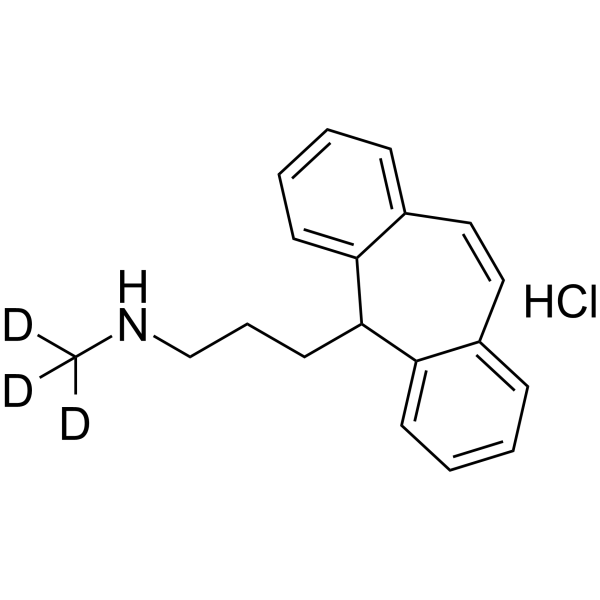 0 ImagesCat. No.: HY-B0949SCAS No.: 1435934-21-6Protriptyline (N-methyl-d3) (hydrochloride) is the deuterium labeled Protriptyline hydrochloride. Protriptyline hydrochloride is a tricyclic antidepressant (TCA), specifically a secondary amine, for the treatment of depression and ADHD. Unique among the TCAs, protriptyline tends to be energizing instead of sedating, used for narcolepsy to achieve a wakefulness-promoting effect.
-
Arisugacin C
 0 ImagesCat. No.: HY-N13923CAS No.: 261950-90-7Arisugacin C is an acetylcholinesterase (AChE) inhibitor with an IC50 of 2.5 μM.
-
4-Chlorochalcone
 0 ImagesCat. No.: HY-W325160CAS No.: 956-04-74-Chlorochalcone (Compound 3) is a monoamine oxidase inhibitor (hMAO-B: IC50 = 0.082 μM, hMAO-A: IC50 = 9.95 μM). 4-Chlorochalcone also exhibits inhibitory activity against cholinesterase (AChE: IC50 = 2.79 μM). 4-Chlorochalcone is a chalcone derivative.
-
AChE-IN-83
 0 ImagesCat. No.: HY-170775CAS No.: 2828439-12-7AChE-IN-83 (compound f1) is an inhibitor of AChE that inhibits the growth of nematodes and acetylcholinesterase in rice seeds and is safe for rice seeds. AChE-IN-83 targets Aphelenchoides oryzae with an LC50 value of 19.0 μg/mL (48 hr). AChE-IN-83 can inhibit the population and behavior of rice nematodes in rice seeds, destroy the nematode cuticle, and lead to the production of reactive oxygen species, lipofuscin, and lipids in the nematodes.
-
Acotiamide-d4
 0 ImagesCat. No.: HY-121467S1Synonyms: Z-338 free base-d4; YM443 free base-d4Acotiamide-d4 (Z-338 (free base)-d4) is deuterium labeled Acotiamide. Acotiamide is an orally active, selective and reversible acetylcholinesterase (AChE) inhibitor, with an IC50 of 1.79 μM. Acotiamide can enhance gastric contractility and accelerate delayed gastric emptying. Acotiamide has the potential for the research of functional dyspepsia involving gastric motility dysfunction and intestinal inflammatory.
-
N-Demethyl amiton oxalic
 0 ImagesN-Demethyl amiton oxalic is an irreversible cholinesterase (ChE) inhibitor. N-Demethyl amiton oxalic elicits low-level postganglionic neuronal firing in cat vesical parasympathetic ganglia by preventing the breakdown of endogenously released ChE. N-Demethyl amiton oxalic inhibits ChE activity in squid optic ganglia and induces hyperactivity, ink ejection, pigment changes, and death, with a rate of enzymatic detoxification much lower than that of DFP. N-Demethyl amiton oxalic can be used in studies related to the mechanisms of cholinergic transmission in parasympathetic ganglia and neurotoxicology.
-
Methyl ganoderate A acetonide
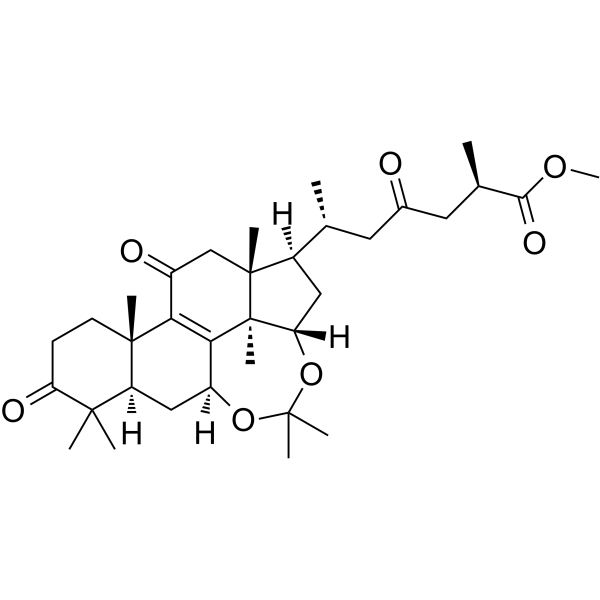 0 ImagesCat. No.: HY-N11641CAS No.: 1346453-53-9Methyl ganoderate A acetonide, a lanostane triterpene, is a natural product that could be isolated from the fruiting bodies of Ganoderma lucidum. Methyl ganoderate A acetonide is a potent AChE inhibitor with an IC50 value of 18.35 μM. Methyl ganoderate A acetonide can be used in research of Alzheimer’s disease (AD).
-
Galanthaminone (Standard)
 0 ImagesSynonyms: (-)-Narwedine (Standard); Narwedin (Standard)Galanthaminone (Standard) is the analytical standard of Galanthaminone. This product is intended for research and analytical applications. Galanthaminone (Narwedin) is a competitive and reversible cholinesterase (AChE) inhibitor; is used for the treatment of mild to moderate Alzheimer's disease and various other memory impairments.
-
Tacrine (Standard)
 0 ImagesTacrine (Standard) is the analytical standard of Tacrine. This product is intended for research and analytical applications. Tacrine is an effective oral acetylcholine (AChE) inhibitor (IC50 = 109 nM) and also acts as an active substrate for CYP1A2. Tacrine can restore cognitive dysfunction in elderly rats. Tacrine can cause liver toxicity and is used in research related to Alzheimer's disease.




