



Dual payloads
Drug-linker conjugates are central to dual-payload antibody-drug conjugate (ADC) design because they enable the controlled attachment of two distinct payloads to a single antibody while maintaining conjugate homogeneity and defined drug-to-antibody ratios (DARs)[1]. Mechanistically, dual-payload ADCs use linker architectures and orthogonal conjugation strategies to deliver two payloads with distinct mechanisms of action into the same tumor cell, creating a unified delivery platform that differs from combinations of single-payload ADCs or ADC-plus-chemotherapy approaches[1]. Site-specific conjugation methods, including multifunctional linkers, canonical and non-canonical amino acid approaches, and enzyme-mediated technologies, have been developed to precisely control payload placement and payload ratios, thereby supporting manufacturability and physicochemical stability[1]. In cancer models, dual-payload ADCs are being investigated to address low antigen expression, tumor heterogeneity, payload resistance, and disease relapse by simultaneously engaging complementary cytotoxic mechanisms within targeted cells[1]. Compared with conventional single-payload ADC formats, homogeneous dual-payload constructs provide a distinct strategy for combining mechanistically different payload classes within one molecular entity[1]. For experimental applications, advanced linker designs and site-selective conjugation technologies have enabled the synthesis of homogeneous dual-payload ADCs with defined DAR profiles, low aggregation, and stable physicochemical properties, supporting continued evaluation of next-generation ADC platforms[2].
References:
- [1]. Yamazaki CM, et al. Antibody-drug conjugates with dual payloads for combating breast tumor heterogeneity and drug resistance. Nat Commun. 2021 Jun 10;12(1):3528. [Content Brief]
- [2]. Watanabe T, et al. Homogeneous Dual-Payload Antibody-Drug Conjugates Produced by Combined Distinct Conjugation Strategies. ACS Med Chem Lett. 2025 May 30;16(7):1334-1339. [Content Brief]
-
Dual payloads Related Products (5)
Related Products (5)

-
DBCO-(PEG2-VC-PAB-MMAE)2
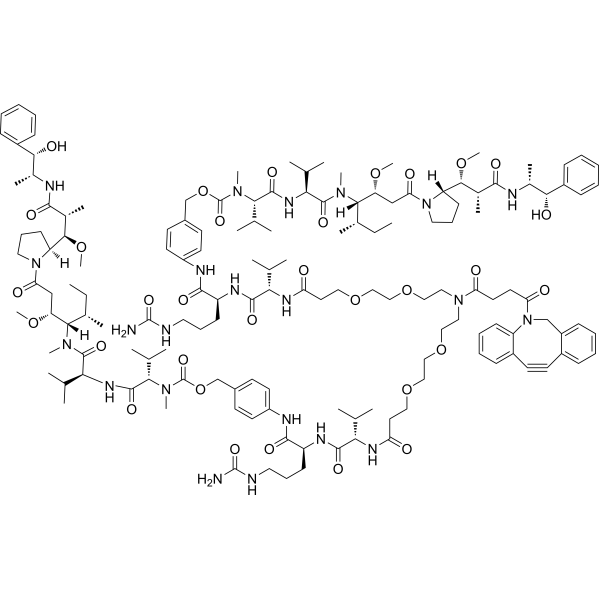 0 ImagesDBCO-(PEG2-VC-PAB-MMAE)2 is made by MMAE conjugated to the cleavable DBCO-(PEG2-VC-PAB)2 linker. Monomethyl auristatin E (MMAE), a potent tubulin inhibitor, is a toxin payload in antibody agent conjugate. DBCO-(PEG2-VC-PAB-MMAE)2 is a click chemistry reagent, it contains a DBCO group that can undergo strain-promoted alkyne-azide cycloaddition (SPAAC) with molecules containing Azide groups.

-
VcMMAE-Deruxtecan
 0 ImagesSynonyms: VcMMAE-(PAB-GGFG-AMAA)Exatecan; SMP-54418VcMMAE-Deruxtecan (VcMMAE-(PAB-GGFG-AMAA)Exatecan; SMP-54418) is a drug-linker conjugate for ADC, composed of linker-payload molecule conjugate VcMMAE (HY-15575) and linker-payload molecule conjugate Deruxtecan (PAB-GGFG-AMAA)Exatecan) (HY-13631E). VcMMAE-Deruxtecan can be used in the synthesis of ADCs.
-
Deruxtecan-Eribulin
 0 ImagesCat. No.: HY-164836Deruxtecan-Eribulin is a Drug-Linker Conjugates for ADC, which is composed of a linker and a toxic molecule Exatecan (HY-13631) (DNA topoisomerase I inhibitor) and Eribulin (HY-13442) (Microtubule inhibitor). Deruxtecan-Eribulin can be used for ADC synthesis.
-
VcMMAE-Eribulin
 0 ImagesSynonyms: SMP13432VcMMAE-Eribulin is a Drug-Linker Conjugates for ADC, which is composed of a linker and a toxic molecule MMAE (HY-15162) (Microtubule inhibitor) and Eribulin (HY-13442) (Microtubule inhibitor). VcMMAE-Eribulin can be used for ADC synthesis.



