



PKC Activator
-
Sapintoxin A
 0 ImagesCat. No.: HY-123487CAS No.: 79083-69-5
Sapintoxin A is a phorbol ester that can be isolated from the unripe fruits of Sapium indicum.
-
Kiss2 peptide
 0 ImagesCat. No.: HY-P10256CAS No.: 1111070-93-9
Kiss2 peptide is a positive regulator of reproduction. Kiss2 peptide binds with its cognate receptor Kiss2R (GPR54) in COS-7 cells, activates PKA and PKC signaling pathways through Gas and Gaq proteins, and thus enhances the activity of cAMP response element-dependent luciferase (CRE-luc) and serum response element-dependent luciferase (SRE-luc).
-
Neuropeptide DF2
 0 ImagesCat. No.: HY-P1716CAS No.: 149471-11-4
Neuropeptide DF2 is a DRNFLRFamide neuropeptide orignally isolated from crayfish. which enhances transmitter release and stimulates the amplitude of excitatory post-synaptic potentials (EPSP) through the calcium/calmodulin-dependent protein kinase.
-
Protein Kinase C (530-558)
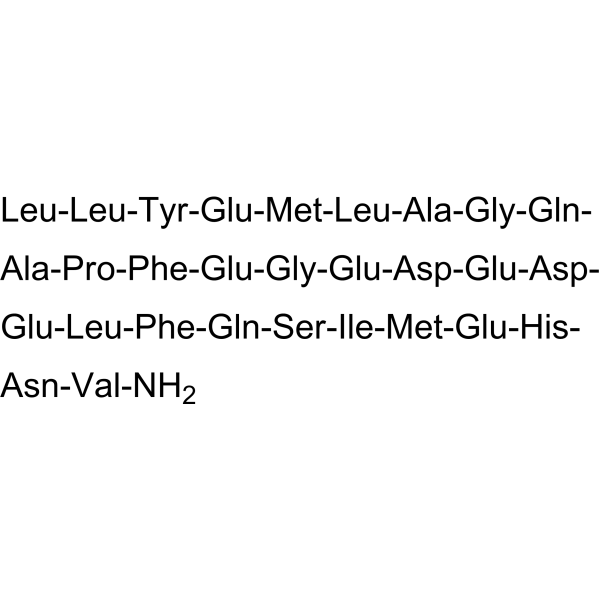 0 ImagesCat. No.: HY-P1288CAS No.: 122613-29-0Synonyms: PKC fragment (530-558)
-
Teleocidin A1
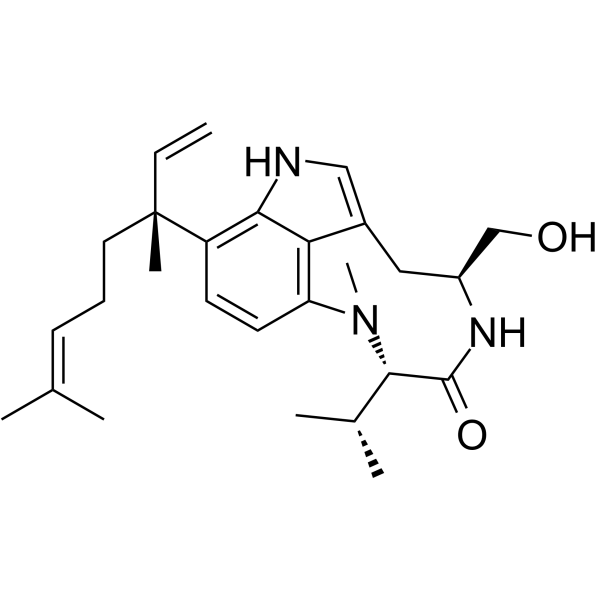 0 ImagesCat. No.: HY-118834CAS No.: 70497-14-2Synonyms: Lyngbyatoxin A
Teleocidin A1 (Lyngbyatoxin A) is a PKC activator with a Ki value of 0.11 nM for binding to the PKCδ-C1B peptide. Teleocidin A1 exhibits anticancer activity against cervical cancer and leukemia. Teleocidin A1 can induce seaweed dermatitis, food poisoning and local skin toxicity. Teleocidin A1 can be used in studies related to cervical cancer, seaweed dermatitis and food poisoning.
-
JH-131e-153
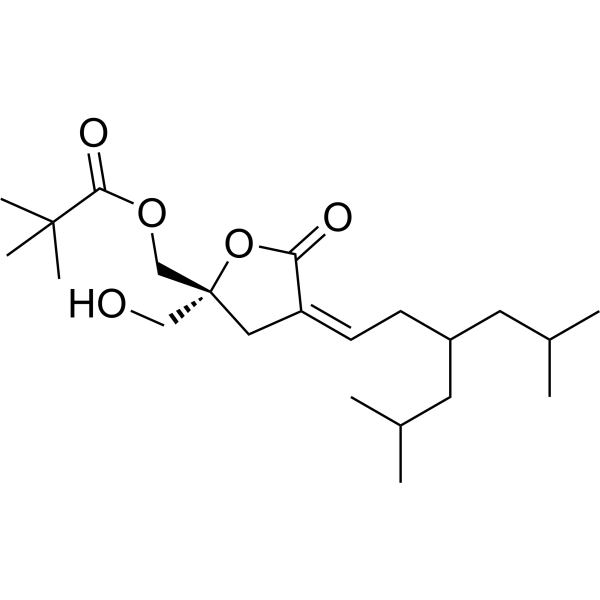 0 ImagesCat. No.: HY-149489CAS No.: 742104-91-2
JH-131e-153, a diacylglycerol (DAG)-lactone, is a small molecule activator of Munc13-1, targeting the C1 domain. The activation sequence of JH-131e-153 on Munc13-1 is WT>I590≈R592A≈W588A. The C1 domain of Munc13-1 and protein kinase C (PKC) are homologous in sequence and structure. The activation sequence of JH-131e-153 on Munc13-1 and PKC was PKCα>Munc13-1>PKCε. JH-131e-153 regulates neuronal processes through Munc13-1 and can be further used in the study of neurodegenerative diseases.
-
DCPLA-ME (Standard)
 0 ImagesCat. No.: HY-108599ARCAS No.: 56687-67-3Synonyms: DCPLA methyl ester (Standard)
DCPLA-ME (Standard) is the analytical standard of DCPLA-ME (HY-108599A). This product is intended for research and analytical applications. DCPLA-ME, the methyl ester form of DCPLA, is a potent PKCε activator for use in the treatment of neurodegenerative diseases.
-
Xaliproden free base
 0 ImagesCat. No.: HY-119820CAS No.: 135354-02-8Synonyms: SR57746A free base
Xaliproden (SR57746) free base is an orally active, highly selective 5-HT1A receptor agonist. Xaliproden free base activates pertussis toxin-sensitive G protein-coupled signaling cascades, as well as the PKC, ERK1/ERK2, Akt and p21 Ras/MEK-1 pathways. Xaliproden free base also downregulates the JNK/p66/c-Jun signaling pathway, induces phosphorylation of the shc adaptor protein, regulates extracellular dopamine and 5-HT levels, and induces [35S]GTPγS labeling in rat brain structures rich in 5-HT1A receptors. Xaliproden free base exerts neurotrophic, neuroprotective, renoprotective, anti-inflammatory, anti-apoptotic, anti-fibrotic and analgesic effects. Xaliproden free base also enhances NGF-induced neurite outgrowth, promotes motor neuron survival, attenuates renal tubular injury and inhibits chemotherapy-induced mechanical allodynia, without activating or altering NGF-induced TrkA receptor activation. Xaliproden free base can be used in the research of motor neuron disease, diabetic nephropathy, chemotherapy-induced peripheral neuropathy, amyotrophic lateral sclerosis, Alzheimer's disease, acute tonic nociceptive pain, inflammatory pain, depression and anxiety.
-
Isosalvianolic acid C
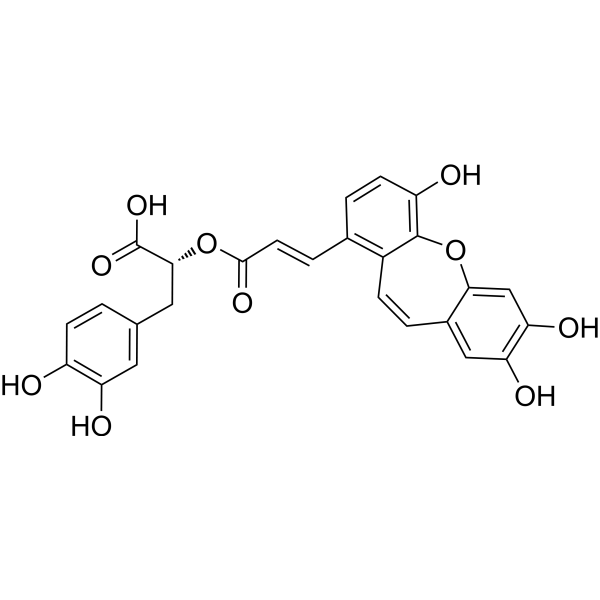 0 ImagesCat. No.: HY-122967CAS No.: 142115-17-1
Isosalvianolic acid C is a naturally derived phenolic compound that acts as a signal modulator, antioxidant, and enzyme inhibitor. Isosalvianolic acid C induces the phosphorylation of PLC-γ, IP3R, PKC, and P38, triggering Ca2+ mobilization, degranulation, and chemokine release. Isosalvianolic acid C activates MRGPRX2 and its murine homolog MrgprB2, leading to pseudo-allergic reactions in vivo. Isosalvianolic acid C inhibits Cu2+-induced LDL peroxidation. Isosalvianolic acid C can be used in studies related to pseudo-allergy, diabetes, and atherosclerosis.
-
R 59-022 hydrochloride (Standard)
 0 ImagesCat. No.: HY-107613ARCAS No.: 93076-98-3Synonyms: DKGI-I hydrochloride (Standard); Diacylglycerol kinase inhibitor I hydrochloride (Standard)
R 59-022 hydrochloride (Standard) is the analytical standard of R 59-022 (hydrochloride) (HY-107613A). This product is intended for research and analytical applications. R 59-022 (DKGI-I) hydrochloride is a DGK inhibitor (IC50: 2.8 µM). R 59-022 hydrochloride inhibits the phosphorylation of OAG to OAPA. R 59-022 hydrochloride is a 5-HT Receptor antagonist, and activates protein Kinase C (PKC). R 59-022 hydrochloride potentiates thrombin-induced diacylglycerol production in platelets and inhibits phosphatidic acid production in neutrophils.
-
Dioleyl phosphatidylserine
 0 ImagesCat. No.: HY-141613ACAS No.: 6811-55-8
Dioleyl phosphatidylserine is a phospholipid that can be used to form the cochlea. Dioleyl phosphatidylserine (100 μM) can activate PKC-γ under Ca2+ concentrations < 0.5 μM.
-
Xaliproden hydrochloride (Standard)
 0 ImagesSynonyms: SR57746A (Standard); SR57746 hydrochloride (Standard)
Xaliproden (hydrochloride) (Standard) is the analytical standard of Xaliproden (hydrochloride). This product is intended for research and analytical applications. Xaliproden (SR57746) hydrochloride (SR57746A) is an orally active, highly selective 5-HT1A receptor agonist. Xaliproden hydrochloride activates pertussis toxin-sensitive G protein-coupled signaling cascades, as well as the PKC, ERK1/ERK2, Akt and p21 Ras/MEK-1 pathways. Xaliproden hydrochloride also downregulates the JNK/p66/c-Jun signaling pathway, induces phosphorylation of the shc adaptor protein, regulates extracellular dopamine and 5-HT levels, and induces [35S]GTPγS labeling in rat brain structures rich in 5-HT1A receptors. Xaliproden hydrochloride exerts neurotrophic, neuroprotective, renoprotective, anti-inflammatory, anti-apoptotic, anti-fibrotic and analgesic effects. Xaliproden hydrochloride also enhances NGF-induced neurite outgrowth, promotes motor neuron survival, attenuates renal tubular injury and inhibits chemotherapy-induced mechanical allodynia, without activating or altering NGF-induced TrkA receptor activation. Xaliproden hydrochloride can be used in the research of motor neuron disease, diabetic nephropathy, chemotherapy-induced peripheral neuropathy, amyotrophic lateral sclerosis, Alzheimer's disease, acute tonic nociceptive pain, inflammatory pain, depression and anxiety.
-
(+)-Eudesmin (Standard)
 0 ImagesCat. No.: HY-N2180RCAS No.: 29106-36-3Synonyms: (+)-Eudesmine (Standard)
Pinoresinol dimethyl ether (Standard) is the analytical standard of Pinoresinol dimethyl ether (HY-N2180). This product is intended for research and analytical applications. Pinoresinol dimethyl ether ((+)-Eudesmin) is a non-phenolic furanoid lignin. Pinoresinol dimethyl ether can be isolated from Magnolia biondii. Pinoresinol dimethyl ether activates MAPK, PKC, and PKA upstream pathways and inhibits NO levels. Pinoresinol dimethyl ether has neuroprotective activity.
-
C8-Ceramide (Standard)
 0 ImagesCat. No.: HY-108391RCAS No.: 74713-59-0Synonyms: N-Octanoyl-D-erythro-sphingosine (Standard)
C8-Ceramide (Standard) is the analytical standard of C8-Ceramide (HY-108391). This product is intended for research and analytical applications. C8-Ceramide (N-Octanoyl-D-erythro-sphingosine) is a cell-permeable analog of naturally occurring ceramides. C8-Ceramide has anti-proliferation properties and acts as a potent chemotherapeutic agent. C8-Ceramide stimulates dendritic cells to promote T cell responses upon virus infections. C8-Ceramide induces slight activation of protein Kinase (PKC) in vitro.
-
R59949 (Standard)
 0 ImagesCat. No.: HY-108355RCAS No.: 120166-69-0
R59949 (Standard) is the analytical standard of R59949 (HY-108355). This product is intended for research and analytical applications. R59949 is a pan diacylglycerol Kinase (DGK) inhibitor with an IC50 of 300 nM. R59949 strongly inhibits the activity of type I DGK α and γ and moderately attenuates the activity of type II DGK θ and κ. R59949 activates protein Kinase C (PKC) by enhancing the levels of the endogenous ligand diacyl glycerol.
-
Daphnoretin (Standard)
 0 Images
Daphnoretin (Dephnoretin; Thymelol) (Standard) is the analytical standard of Daphnoretin (HY-N0699). This product is used for research and analytical applications. Daphnoretin is a protein kinase C (PKC) activator that can inhibit the expression of hepatitis B virus (HBV) surface antigen (HBsAg) and has antiviral activity. Daphnoretin exerts its anti-tumor effect by inhibiting the activation of the PI3K/AKT signaling pathway, triggering the mitochondrial apoptosis pathway. Daphnoretin alleviates chondrocyte apoptosis and inflammatory responses by inhibiting endoplasmic reticulum stress and the activation of the NLRP3 inflammasome. Daphnoretin can regulate the differentiation and maturation of dendritic cells, by down-regulating the phosphorylation level of JNK, inhibiting its immune stimulating function, thereby playing a protective role in skin transplant rejection reactions.
-
R 59-022 (Standard)
 0 ImagesSynonyms: DKGI-I (Standard); Diacylglycerol kinase inhibitor I (Standard)
R 59-022 (Standard) is the analytical standard of R 59-022. This product is intended for research and analytical applications. R 59-022 (DKGI-I) is a DGK inhibitor (IC50: 2.8 µM). R 59-022 inhibits the phosphorylation of OAG to OAPA. R 59-022 is a 5-HT Receptor antagonist, and activates protein kinase C (PKC). R 59-022 potentiates thrombin-induced diacylglycerol production in platelets and inhibits phosphatidic acid production in neutrophils.
-
Farnesylthiotriazole
 0 ImagesCat. No.: HY-119818CAS No.: 156604-45-4Synonyms: FTT
-
Nefiracetam (Standard)
 0 ImagesSynonyms: DM9384 (Standard); DZL-221 (Standard)
Nefiracetam (Standard) is a cognition-enhancing agent. Nefiracetam is an activator of nAChR, N-methyl-D-aspartate receptor (NMDAR), mGluR5, PKC, gamma-aminobutyric acid (GABA), and N/L-type Ca2+ channels. Nefiracetam promotes neuroplasticity and enhances neuroprotection. Nefiracetam can be used in Alzheimer's disease, epilepsy, and cerebral ischemia research.
-
1-Oleoyl-2-linoleoyl-sn-glycerol
 0 ImagesCat. No.: HY-N15340CAS No.: 91125-76-7



