



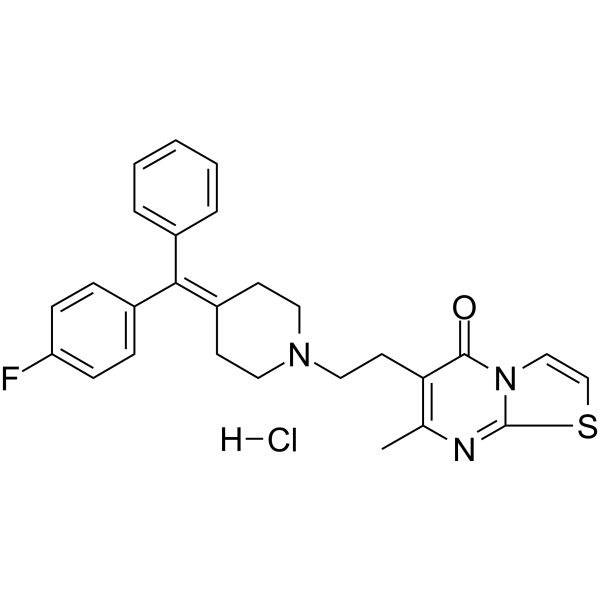
R 59-022 hydrochloride
Based on 2 publication(s) in Google Scholar
R 59-022 (DKGI-I) hydrochloride is a DGK inhibitor (IC50: 2.8 µM). R 59-022 hydrochloride inhibits the phosphorylation of OAG to OAPA. R 59-022 hydrochloride is a 5-HT Receptor antagonist, and activates protein kinase C (PKC). R 59-022 hydrochloride potentiates thrombin-induced diacylglycerol production in platelets and inhibits phosphatidic acid production in neutrophils.
For research use only. We do not sell to patients.
- Purity : 98.88%
- CAS No.: 93076-98-3
- Formula: C27H27ClFN3OS
- Molecular Weight:496.04
-
Storage:Powder -20°C, 3 years ; In solvent -80°C, 6 months , -20°C, 1 month

To place orders, for customer services and technical support, please contact: MedChemExpress USA
Tel: 609-228-6898 E-mail: [email protected] [email protected]


-
 Biological Activity
-
Chemical Information
-
Solvent & Solubility
- Purity & Documentation
- References
-
 Help & FAQs


Publications Citing Use of MedChemExpress (MCE) R 59-022 hydrochloride
MoreAll 5-HT Receptor Isoforms
More

Biological Activity
Description
IC50 & Target
[4]|
PKC |
serotonin |
DGK 2.8 μM (IC50) |
In Vitro
R 59-022 (10 μM, 1 min) hydrochloride potentiates aggregation, but not shape change induced by sub-maximal concentrations of thrombin[2].
R 59-022 (30 μM, 0-60 min) hydrochloride increases release of Noradrenaline in chromaffin cells[3].
R 59-022 (40 μM, 30 min) hydrochloride activates PKC in HeLa and U87 cells[4].
R 59-022 (0-10 μM, 4 h) hydrochloride blocks EBOV GP-mediated entry into Vero cells[5].
MedChemExpress (MCE) has not independently confirmed the accuracy of these methods. They are for reference only.
-
Cell Line:HeLa cells
-
Concentration:40 uM
-
Incubation Time:30 min
-
Result:Increased the phosphorylation of PKC downstream targets by about 2.5-fold.
In Vivo
MedChemExpress (MCE) has not independently confirmed the accuracy of these methods. They are for reference only.
-
Animal Model:SCID mice implanted with U87 GBM cells[6]
-
Dosage:10 mg/kg
-
Administration:Intraperitoneal injection (i.p.)
-
Result:Increased median survival and decreased tumor volume.


Chemical Information
-
CAS No. 93076-98-3
-
Appearance Solid
-
Molecular Weight 496.04
-
Formula C27H27ClFN3OS
-
Color Off-white to light yellow
-
SMILES
O=C1C(CCN(CC/2)CCC2=C(C3=CC=CC=C3)/C4=CC=C(F)C=C4)=C(C)N=C5N1C=CS5.[H]Cl
-
Synonyms
DKGI-I hydrochloride; Diacylglycerol kinase inhibitor I hydrochloride
-
Shipping
Room temperature in continental US; may vary elsewhere.
-
Storage
Powder -20°C 3 years In solvent -80°C 6 months -20°C 1 month


Publications (2)
-
Journal Impact Factor
-
Most Recent
-
Cancer Res
DLGAP1-AS2-Mediated Phosphatidic Acid Synthesis Activates YAP Signaling and Confers Chemoresistance in Squamous Cell Carcinoma. [Abstract]2022 Aug 16;82(16):2887-2903. PMID: 35731019 -


Solvent & Solubility
In Vitro:
DMSO : 25 mg/mL (50.40 mM; Need ultrasonic; Hygroscopic DMSO has a significant impact on the solubility of product, please use newly opened DMSO)
Please refer to the solubility information to select the appropriate solvent. Once prepared, please aliquot and store the solution to prevent product inactivation from repeated freeze-thaw cycles.
Storage method and period of stock solution: -80°C, 6 months; -20°C, 1 month. When stored at -80°C, please use it within 6 months. When stored at -20°C, please use it within 1 month.
Please refer to the solubility information to select the appropriate solvent. Once prepared, please aliquot and store the solution to prevent product inactivation from repeated freeze-thaw cycles.
Storage method and period of stock solution: -80°C, 6 months; -20°C, 1 month. When stored at -80°C, please use it within 6 months. When stored at -20°C, please use it within 1 month.
Concentration (start) × Volume (start) = Concentration (final) × Volume (final)
In Vivo:
Select the appropriate dissolution method based on your experimental animal and administration route.
- For the following dissolution methods, please ensure to first prepare a clear stock solution using an In Vitro approach and then sequentially add co-solvents:
- To ensure reliable experimental results, the clarified stock solution can be appropriately stored based on storage conditions. As for the working solution for In Vivo experiments, it is recommended to prepare freshly and use it on the same day.
- The percentages shown for the solvents indicate their volumetric ratio in the final prepared solution. If precipitation or phase separation occurs during preparation, heat and/or sonication can be used to aid dissolution.
Add each solvent one by one: 10% DMSO 40% PEG300 5% Tween-80 45% Saline
Solubility: ≥ 2.5 mg/mL (5.04 mM); Clear solution
This protocol yields a clear solution of ≥ 2.5 mg/mL (saturation unknown).
Taking 1 mL working solution as an example, add 100 μL DMSO stock solution (25.0 mg/mL) to 400 μL PEG300, and mix evenly; then add 50 μL Tween-80 and mix evenly; then add 450 μL Saline to adjust the volume to 1 mL.
Preparation of Saline: Dissolve 0.9 g sodium chloride in ddH₂O and dilute to 100 mL to obtain a clear Saline solution.
Add each solvent one by one: 10% DMSO 90% (20% SBE-β-CD in Saline)
Solubility: ≥ 2.5 mg/mL (5.04 mM); Clear solution
This protocol yields a clear solution of ≥ 2.5 mg/mL (saturation unknown).
Taking 1 mL working solution as an example, add 100 μL DMSO stock solution (25.0 mg/mL) to 900 μL 20% SBE-β-CD in Saline, and mix evenly.
Preparation of 20% SBE-β-CD in Saline (4°C, storage for one week): 2 g SBE-β-CD powder is dissolved in 10 mL Saline, completely dissolve until clear.
In Vivo Dissolution Calculator
Please enter the basic information of animal experiments:
-
-
-
-
Recommended: Prepare an additional quantity of animals to account for potential losses during experiments.
Please enter your animal formula composition:
-
%DMSO +
Recommended: Keep the proportion of DMSO in working solution below 2% if your animal is weak.
-
%+
-
+%Tween-80 + +
-
%Saline +
The co-solvents required include: DMSO, . All of co-solvents are available by MedChemExpress (MCE). , Tween 80. All of co-solvents are available by MedChemExpress (MCE).
Working solution concentration: 0.22 mg/mL
Method for preparing stock solution: mg drug dissolved in μL DMSO. Stock solution concentration: mg/mL.
1. Take μL DMSO stock solution;
2. Add μL .
μL , mix evenly;
3. Then add μL Tween 80, mix evenly;
4. Then add μL
Please ensure that the stock solution in the first step is dissolved to a clear state, and add co-solvents in sequence. You can use ultrasonic heating (ultrasonic cleaner, recommended frequency 20-40 kHz), vortexing, etc. to assist dissolution.


Purity & Documentation
-
Data Sheet (278 KB)
-
SDS (251 KB)
- English - EN (251 KB)
- Français - FR (251 KB)
- Deutsch - DE (251 KB)
- Norwegian - NO (251 KB)
- Español - ES (251 KB)
- Swedish - SV (251 KB)
- Italian - IT (251 KB)
- Korean - KR (251 KB)
- Portuguese - PT (251 KB)
-
Handling Instructions (2659 KB)
References
[1]. de Chaffoy de Courcelles, D.C., et al. R 59 022, a diacylglycerol kinase inhibitor. Its effect on diacylglycerol and thrombin-induced C kinase activation in the intact platelet. J. Biol. Chem. 260(29), 15762-15770 (1985). [Content Brief]
[2]. Nunn DL, et al. A diacylglycerol kinase inhibitor, R59022, potentiates secretion by and aggregation of thrombin-stimulated human platelets. Biochem J. 1987 May 1;243(3):809-13. [Content Brief]
[3]. Jones JA, et al. Influence of phorbol esters, and diacylglycerol kinase and lipase inhibitors on noradrenalinerelease and phosphoinositide hydrolysis in chromaffin cells. Br J Pharmacol. 1990 Nov;101(3):521-6. [Content Brief]
[4]. Boroda S, et al. Dual activities of ritanserin and R59022 as DGKα inhibitors and serotonin receptor antagonists. Biochem Pharmacol. 2017 Jan 1;123:29-39. [Content Brief]
[5]. Stewart CM, et al. A Diacylglycerol Kinase Inhibitor, R-59-022, Blocks Filovirus Internalization in Host Cells. Viruses. 2019 Mar 1;11(3). pii: E206. [Content Brief]
[6]. Dominguez CL, et al. Diacylglycerol kinase α is a critical signaling node and novel therapeutic target in glioblastoma and other cancers. Cancer Discov. 2013 Jul;3(7):782-97. [Content Brief]


Complete Stock Solution Preparation Table
Please refer to the solubility information to select the appropriate solvent. Once prepared, please aliquot and store the solution to prevent product inactivation from repeated freeze-thaw cycles.
Storage method and period of stock solution: -80°C, 6 months; -20°C, 1 month. When stored at -80°C, please use it within 6 months. When stored at -20°C, please use it within 1 month.
| Optional Solvent | Concentration Solvent Mass | 1 mg | 5 mg | 10 mg | 25 mg |
|---|---|---|---|---|---|
| DMSO | 1 mM | 2.0160 mL | 10.0798 mL | 20.1597 mL | 50.3992 mL |
| 5 mM | 0.4032 mL | 2.0160 mL | 4.0319 mL | 10.0798 mL | |
| 10 mM | 0.2016 mL | 1.0080 mL | 2.0160 mL | 5.0399 mL | |
| 15 mM | 0.1344 mL | 0.6720 mL | 1.3440 mL | 3.3599 mL | |
| 20 mM | 0.1008 mL | 0.5040 mL | 1.0080 mL | 2.5200 mL | |
| 25 mM | 0.0806 mL | 0.4032 mL | 0.8064 mL | 2.0160 mL | |
| 30 mM | 0.0672 mL | 0.3360 mL | 0.6720 mL | 1.6800 mL | |
| 40 mM | 0.0504 mL | 0.2520 mL | 0.5040 mL | 1.2600 mL | |
| 50 mM | 0.0403 mL | 0.2016 mL | 0.4032 mL | 1.0080 mL |


R 59-022 hydrochloride Related Classifications
HY-107613A Related Classifications
 Powered by Bioz