



PROTACs
PROTAC (PROteolysis-TArgeting Chimera) is a heterobifunctional nanomolecule containing two different ligands, ligand for ubiquitin E3 and ligand for target protein. The two parts are connected by linker to form a "three-unit" polymer, target protein ligand-linker-E3 ligase ligand. Building blocks of PROTAC molecules include PROTAC Linker, Ligand for Target Protein for PROTAC, Ligand for E3 Ligase, E3 Ligase Ligand-Linker Conjugate, Target Protein Ligand-Linker Conjugate, etc.
PROTACs Isoform Specific Products
All Product Categories
-
PROTACs Related Products (1353)
Related Products (1353)

-
Antibodies (1)
-
PROTACs Isoform Comparison
-
PROTAC KSP degrader 1
 0 ImagesCat. No.: HY-168725CAS No.: 3099825-86-9PROTAC KSP degrader 1 is a KSP PROTAC degrader with a DC50 of 114.8 nM. PROTAC KSP degrader 1 induces ubiquitination and degradation of KSP protein. PROTAC KSP degrader 1 induces G2/M phase arrest of the cell cycle. PROTAC KSP degrader 1 triggers Apoptosis. PROTAC KSP degrader 1 exhibits anticancer activity against colon cancer. PROTAC KSP degrader 1 can be used for the research of colon cancer, lung cancer and breast cancer.
-
FGT-4
 0 ImagesCat. No.: HY-172934FGT-4 is a folate receptor β (FR-β) targeting chimeric molecule. FGT-4 is a TLR7 agonist. FGT-4 facilitates the secretion of iNOS and proinflammatory cytokine IL-6 associated with M1 macrophages and enhances the proliferation of cytotoxic CD8+ T cells. FGT-4 has anti-tumor activity in the 4T1 breast cancer mouse model. FGT-4 can be used for the study of cancer immunity. (Pink: target protein TLR7/8 agonist 1 ligand (HY-103698); black: linker (HY-172936); blue: FR-β ligand (HY-172935)).
-
JHK-02-102-1
 0 ImagesCat. No.: HY-184913JHK-02-102-1 is a selective CDK5 degrader derived from the regorafenib kinase inhibitor scaffold. JHK-02-102-1 recruits CRL4CRBN E3 ubiquitin ligase to induce ternary complex formation between CDK5 and CRBN, triggering ubiquitin-proteasome system-dependent degradation. JHK-02-102-1 achieves selectivity redirection from CDK6 to CDK5 via subtle PROTAC architecture modifications.

-
PROTAC AR Degrader-13
 0 ImagesCat. No.: HY-184195PROTAC AR Degrader-13 is a proteolysis-targeting chimera (PROTACs) that targets the androgen receptor (AR). PROTAC AR Degrader-13 has a DC50 of 0.90 nM in LNCaP cells and a DC50 of 0.23 nM in hDPC cells. PROTAC AR Degrader-13 induces AR degradation, downregulates TGF-β1 expression, upregulates β-catenin levels, and restores the Wnt/β-catenin pro-proliferation signaling in hair follicles. In a testosterone-induced androgenetic alopecia mouse model, PROTAC AR Degrader-13 accelerates hair regeneration rate, increases hair density and hair diameter. PROTAC AR Degrader-13 can be used for the research of androgenetic alopecia.
-
PROTAC HMGCR Degrader-2
 0 ImagesCat. No.: HY-181134CAS No.: 2715104-46-2PROTAC HMGCR Degrader-2 is a HMGCR PROTAC degrader with an IC50 value of 0.25 μM. PROTAC degrades HMGCR-2 in Insig-silenced HepG2 cells with a DC50 of 0.12 μM. PROTAC HMGCR Degrader-2 takes PROTAC HMGCR Degrader-1 (HY-171823) as the oral prodrug. PROTAC HMGCR Degrader-2 degrades HMGCR by the VHL-dependent ubiquitin-proteasome system and reduces cellular cholesterol in HepG2 cells. PROTAC CDK2/4/6 Degrader-2 can be used for hyperlipidemia research.
-
NEP108
 0 ImagesCat. No.: HY-180957CAS No.: 3031840-31-7
-
PROTAC SMARCA2/4 degrader-23
 0 ImagesCat. No.: HY-163876CAS No.: 2568277-50-7SMARCA2 degrader-15 (compound I-409) is a PROTAC degrader targeting SMARCA2 and SMARCA4; it degrades SMARCA2/4 proteins in A549 cells with the DC50s <100 nM, and the maximum degradation rate (Dmax%) >90 after 24 h of treatment.

-
NUCC-0227579
 0 ImagesCat. No.: HY-184969NUCC-0227579 is a VHL-recruiting PROTAC degrader targeting CD73, with a DC50 of 0.32 μM. NUCC-0227579 synergistically mediates CD73 degradation through the ubiquitin-proteasome pathway and the lysosomal pathway. NUCC-0227579 inhibits the conversion of AMP to adenosine, abrogates adenosine-mediated immunosuppression, upregulates the activities of the NF-κB and NFAT pathways, and enhances the secretion, activation and proliferation levels of IFN-γ and TNF-α. NUCC-0227579 downregulates NAD+ synthesis in tumor cells, and inhibits the proliferation, migration and adhesion abilities of tumor cells under glutamine-deficient conditions. NUCC-0227579 significantly suppresses tumor growth in a humanized NSG mouse model of triple-negative breast cancer.
-
PROTAC BRD4 Degrader-22
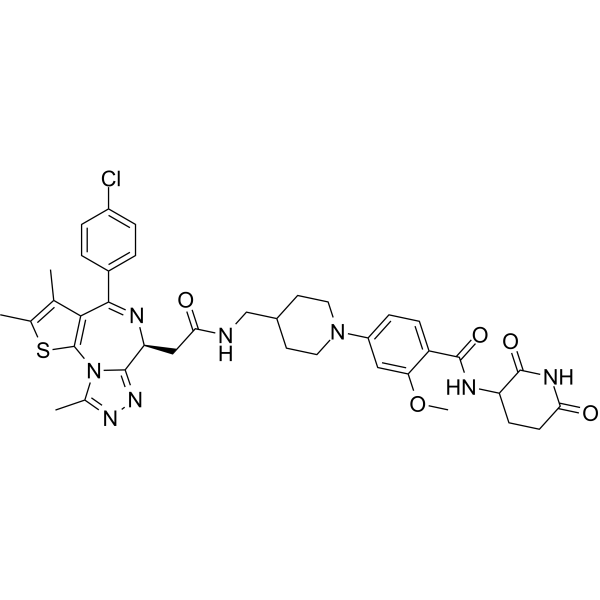 0 ImagesCat. No.: HY-155393CAS No.: 3032850-37-3
-
PROTAC SMARCA2 degrader-10
 0 ImagesCat. No.: HY-159462CAS No.: 2568279-34-3
-
Hyp-dBET1
 0 ImagesCat. No.: HY-173256Hyp-dBET1 is a hypoxia-activated BRD4 PROTAC degrader. The IC50 of Hyp-dBET1 for reducing cell viability under hypoxic conditions is approximately 153 nM to 192 nM, while it shows low activity under normoxic conditions (IC50 of approximately 2.8 μM to 3.8 μM). Hyp-dBET1 induces BRD4 degradation under hypoxic conditions, converts to dBET1 in hypoxic environments, and downregulates the expression level of ZFP-91. Hyp-dBET1 can be used in studies related to breast cancer, cervical cancer and solid tumors.


-
ERD-1233
 0 ImagesCat. No.: HY-169367ERD-1233 is an orally active ERα PROTAC degrader with a DC50 of 0.9 nM. ERD-1233 exhibits plasma stability and microsomal stability across multiple species, and shows no significant inhibitory effect on major cytochrome P450 subtypes and hERG channels. ERD-1233 inhibits tumor growth and degrades ERα protein levels in xenograft tumor models, with favorable biosafety. ERD-1233 can be used in breast cancer-related research.
-
PROTAC SARS-CoV-2 Mpro degrader-2
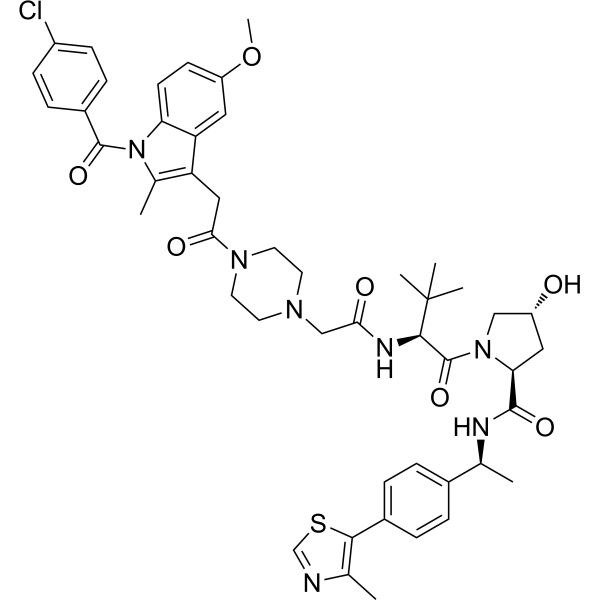 0 ImagesCat. No.: HY-157805CAS No.: 3057294-32-0PROTAC SARS-CoV-2 Mpro degrader-2 is a SARS-CoV-2 Mpro PROTAC degrader with a DC50 of 1.34 μM. PROTAC SARS-CoV-2 Mpro degrader-2 recruits the VHL E3 ligase to mediate ubiquitination and proteasomal degradation of SARS-CoV-2 Mpro, without inhibiting the catalytic activity of Mpro. PROTAC SARS-CoV-2 Mpro degrader-2 exhibits anti-SARS-CoV-2 activity in infected cells, as well as broad-spectrum antiviral activity against coronaviruses including HCoV-OC43 and HCoV-229E. PROTAC SARS-CoV-2 Mpro degrader-2 can be used in studies related to SARS-CoV-2 infection, HCoV-OC43 infection, and HCoV-229E infection.




