



PROTACs
PROTAC (PROteolysis-TArgeting Chimera) is a heterobifunctional nanomolecule containing two different ligands, ligand for ubiquitin E3 and ligand for target protein. The two parts are connected by linker to form a "three-unit" polymer, target protein ligand-linker-E3 ligase ligand. Building blocks of PROTAC molecules include PROTAC Linker, Ligand for Target Protein for PROTAC, Ligand for E3 Ligase, E3 Ligase Ligand-Linker Conjugate, Target Protein Ligand-Linker Conjugate, etc.
PROTACs Isoform Specific Products
-
PROTACs Related Products (1398)
Related Products (1398)

-
Antibodies (1)
-
PROTACs Isoform Comparison
-
YZ-17
 0 ImagesCat. No.: HY-189213YZ-17 is a PROTAC degrader targeting PRMT5, with DC50 = 2.2 μM (HCC1806 cells). YZ-17 recruits CRBN E3 ligase and induces PRMT5 degradation through the ubiquitin-proteasome system, inhibiting PRMT5-mediated symmetric dimethylarginine modification. YZ-17 co-degrades the PRMT5 adaptor protein MEP50 via a CRBN-dependent mechanism. YZ-17 induces G1 phase cell cycle arrest and inhibits colony formation in cancer cells. YZ-17 exhibits antiproliferative activity in various cancer cells. YZ-17 shows antitumor efficacy in a triple-negative breast cancer xenograft mouse model. YZ-17 can be used for research on triple-negative breast cancer.
-
Arg-PEG1-Tαsyn
 0 ImagesCat. No.: HY-180976Arg-PEG1-Tαsyn is an α-syn PROTAC degrader with a DC50 of 0.28 μM in U251 cells. Arg-PEG1-Tαsyn employs the amino acid arginine (Arg) as the E3 ligase UBR1 ligand and a benzothiazole-aniline variant as the warhead for α-syn. Arg-PEG1-Tαsyn significantly reduces α-syn aggregates and improves the dopaminergic neuronal impairment and the locomotion with safety profile in vivo.Arg-PEG1-Tαsyn shows the high degradation effect in mammalian cells for both wild-type α-syn and the α-syn (A53T) mutant. Arg-PEG1-Tαsyn can be used for Parkinson’s disease research.
-
PROTAC BTK Degrader-9
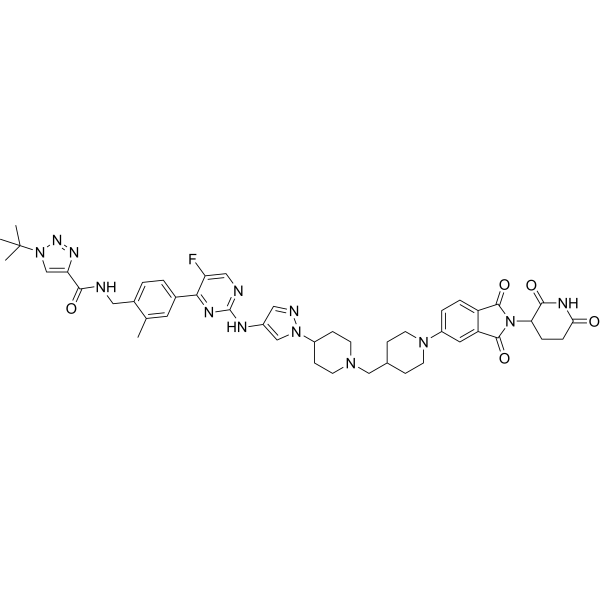 0 ImagesCat. No.: HY-162280CAS No.: 3034024-77-3PROTAC BTK Degrader-9 is a potent BTK PROTAC degrader with a DC50 of 1.29 nM (in Mino cells at 4 h). PROTAC BTK Degrader-9 induces the formation of a stable ternary complex with BTK and the CRBN E3 ubiquitin ligase, thereby mediating proteasomal degradation of BTK in a CRBN-dependent manner. PROTAC BTK Degrader-9 downregulates the RANKL-activated BTK-PLCγ2-Ca2+-NFATc1 signaling pathway. PROTAC BTK Degrader-9 alleviates alveolar bone resorption in periodontitis models of Mus musculus (house mouse). PROTAC BTK Degrader-9 can be used in research related to periodontitis.
-
PROTAC CCR9 Degrader 1
 0 ImagesCat. No.: HY-181287PROTAC CCR9 Degrader 1 is a PROTAC-based degrader targeting CCR9. PROTAC CCR9 Degrader 1 induces ubiquitination, proteasomal degradation of CCR9 and reduces intracellular CCR9 levels by recruiting the VHL E3 ligase. PROTAC CCR9 Degrader 1 has a Ki value of 78.0 nM against human CCR9. PROTAC CCR9 Degrader 1 modulates GPCR activity by binding to the intracellular allosteric binding site of CCR9. PROTAC CCR9 Degrader 1 can be used in research related to Crohn's disease.
-
Phe-PEG1-Dasa
 0 ImagesCat. No.: HY-180962CAS No.: 3037776-73-8Phe-PEG1-Dasa is a BCR-ABL PROTAC degrader, with its DC50 being 1.56 nM. Phe-PEG1-Dasa uses a single amino acid (Phe) as the E3 ligand and employs the N-end rule pathway to induce the degradation of the target protein, significantly reducing the molecular size, thus being called a mini-PROTAC. Phe-PEG1-Dasa significantly inhibits the proliferation of K562 cells. Phe-PEG1-Dasa can be used for the study of leukemia.
-
JPS014
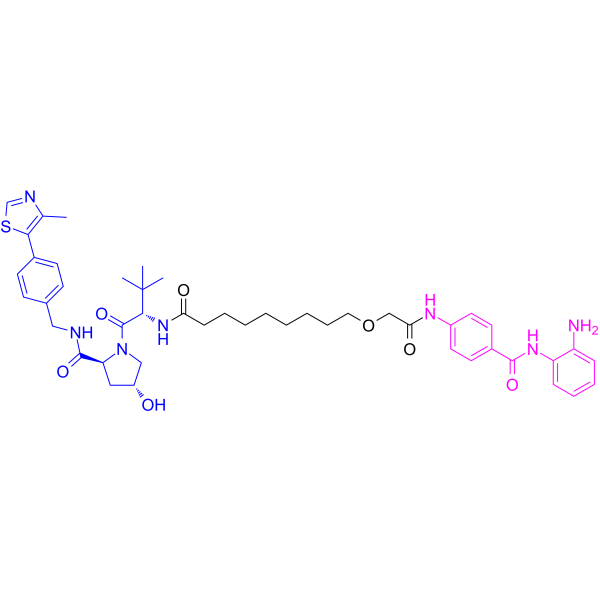 0 ImagesCat. No.: HY-145815CAS No.: 2669785-76-4JPS014 is a PROTAC degrader targeting HDAC1, HDAC2 and HDAC3, with DC50 values of 0.91 μM, 4.19 μM and 0.64 μM, respectively. JPS014 recruits the VHL E3 ligase to mediate the ubiquitination and proteasomal degradation of HDAC1, HDAC2 and HDAC3. JPS014 acts as a submicromolar inhibitor of the HDAC1-CoREST, HDAC2-CoREST and HDAC3-SMRT complexes in vitro. JPS014 increases the level of H3K56ac, reduces the stability of LSD1 and SIN3A, and induces cell apoptosis (apoptosis). JPS014 can be used for the research of colon cancer.
-
RD-23
 0 ImagesCat. No.: HY-168867CAS No.: 3053537-06-4RD-23 is an orally active and selective RET PROTAC degrader, with DC50 values of 5.6 nM and 11.7 nM against RETWT and RETG810C mutants, respectively. RD-23 inhibits purified RET kinase activity with an IC50 of 0.371 nM. RD-23 suppresses the activation of downstream Shc signaling and induces apoptosis. RD-23 can be used for the research of RET-related cancers.
-
dCE-2
 0 ImagesCat. No.: HY-161958dCE-2 is a CBP/EP300 PROTAC degrader with a DC50 of 40 nM against CBP. dCE-2 forms a ternary complex with the bromodomains of CBP/EP300 and the CRBN E3 ligase, driving proteasomal degradation of CBP/EP300 via positive cooperativity. dCE-2 is applicable to research related to multiple myeloma, prostate cancer, and neuroblastoma.
-
PROTAC BTK Degrader-13
 0 ImagesCat. No.: HY-168963PROTAC BTK Degrader-13 is a reagent targeting BTK, with a DC50 of 0.27 μM. PROTAC BTK Degrader-13 degrades BTK in a proteasome-dependent manner and inhibits BTK-mediated downstream signaling pathways by reducing the phosphorylation levels of BTK and p38 MAPK. PROTAC BTK Degrader-13 exerts selective cytotoxic effects on BTK-overexpressing lymphoma cells and ITK-positive cells. PROTAC BTK Degrader-13 can be used in studies related to B-cell lymphoma.
-
PROTAC EZH2 Degrader-29
 0 ImagesCat. No.: HY-181357CAS No.: 3093642-30-6PROTAC EZH2 Degrader-29 (compound 66) is a is a PROTAC protein degrader targeting EZH2 with an IC50 of 24.53 μM against diffuse large B-cell lymphoma cells. PROTAC EZH2 Degrader-29 can be used in studies related to diffuse large B-cell lymphoma.
-
YN14 (mixture of diastereomers)
 0 ImagesCat. No.: HY-155356ACAS No.: 3053689-54-3YN14 mixture of diastereomers is a diastereomer mixture of YN14 (HY-155356). YN14 is a KRASG12C PROTAC degrader that recruits E3 ubiquitin ligase to induce the polyubiquitination and proteasomal degradation of KRASG12C. YN14 induces tumor cell apoptosis, cell cycle arrest, and cell migration inhibition. YN14 exhibits in vivo antitumor proliferative activity in tumor cell xenograft nude mice. YN14 can be used in cancer-related research.
-
PROTAC FLT3/CHK1 Degrader-1
 0 ImagesCat. No.: HY-178858PROTAC FLT3/CHK1 Degrader-1 is a PROTAC FLT3/CHK1 degrader, with DC50 values of 5.88 nM (FLT3) and 4.17 nM (CHK1), respectively. PROTAC FLT3/CHK1 Degrader-1 can inhibit the phosphorylation of FLT3 downstream signaling effectors STAT5 (Tyr694), AKT (Ser473), and ERK (Tyr204), downregulate the protein level of c-Myc and maintain the expression of p53 protein. PROTAC FLT3/CHK1 Degrader-1 induces Apoptosis in cells. PROTAC FLT3/CHK1 Degrader-1 shows significant anti-tumor efficacy in mice bearing MV-4-11 subcutaneous xenografts. PROTAC FLT3/CHK1 Degrader-1 can be used for the study of acute myeloid leukemia (AML).
-
MS40
 0 ImagesCat. No.: HY-148829CAS No.: 2407449-49-2MS40 is a WDR5 PROTAC degrader with a DC50 of 42 nM in MV4;11 MLL-rearranged acute myeloid leukemia (AML) cells. MS40 induces WDR5 degradation dependent on WDR5, CRBN and the proteasome, dissociates the MLL/KMT2A complex from chromatin, reduces H3K4me2 levels, degrades IKZF1/IKZF3, the novel substrates of CRBN, inhibits the transcription of WDR5/MLL and IKZF target genes, and suppresses cancer cell growth. MS40 can be used in the research of MLL-rearranged acute myeloid leukemia, breast cancer, Burkholderia infection and cystic fibrosis-associated bacterial infections.
-
PROTAC SHP2 degrader-1
 0 ImagesCat. No.: HY-189468CAS No.: 3128784-74-4PROTAC SHP2 degrader-1 is a potent SHP2 PROTAC degrader with a DC50 of 7.406 μM. PROTAC SHP2 degrader-1 recruits DCAF16 E3 ligase to induce ubiquitination and proteasomal degradation of SHP2, thereby inhibiting the RAS/MAPK and PI3K/AKT/mTOR signaling pathways while simultaneously inducing IFN-γ/JAK/STAT1, apoptosis, and cell cycle arrest. PROTAC SHP2 degrader-1 can be used for cancer research.
-
PROTAC BET Degrader-18
 0 ImagesCat. No.: HY-184335CAS No.: 3097564-20-7PROTAC BET Degrader-18 is a PROTAC targeting BET, with a DC50 of 0.676 nM in HEK293-BRD4-HiBiT-KI cells. PROTAC BET Degrader-18 mainly targets and degrades BRD4 (EC50 = 59.91 nM), and exhibits weak degradation activity against BRD2. PROTAC BET Degrader-18 inhibits the expression of downstream oncoprotein c-Myc, thereby inducing cell cycle arrest and apoptosis, while suppressing oncoprotein expression. PROTAC BET Degrader-18 shows antiproliferative activity against acute myeloid leukemia cells and triple-negative breast cancer cells. PROTAC BET Degrader-18 demonstrates antitumor efficacy in xenograft mouse models. PROTAC BET Degrader-18 can be used for the research of acute myeloid leukemia and triple-negative breast cancer.
-
PROTAC TEAD1/IAP degrader-2
 0 ImagesCat. No.: HY-181537PROTAC TEAD1/IAP degrader-2 is an IAP-harnessing TEAD1 PROTAC degrader, with a DC50 of 170 nM against TEAD1 in NCI-H2052 cells. PROTAC TEAD1/IAP degrader-2 exhibits moderate antiproliferative activity in Hippo pathway-dependent mesothelioma cells. PROTAC TEAD1/IAP degrader-2 inhibits the expression of CTGF, but with a weaker effect than the TEAD inhibitor VT-107 (HY-134957). PROTAC TEAD1/IAP degrader-2 can be used in mesothelioma-related research.
-
PROTAC SGK3 degrader-2
 0 ImagesCat. No.: HY-176823CAS No.: 2381196-78-5PROTAC SGK3 degrader-2 is the cis epimer of PROTAC SGK3 degrader-1 (SGK3-PROTAC1) (HY-125878). PROTAC SGK3 degrader-2 exhibits inhibitory activity against SGK3, SGK1 and S6K1, with IC50 values of 0.6 μM, 1.4 μM and 1.7 μM, respectively, but fails to degrade SGK3. PROTAC SGK3 degrader-2 can serve as a control compound to investigate the specific effects of SGK3 degradation mediated by SGK3-PROTAC1.
-
PROTAC MDM2 Degrader-8
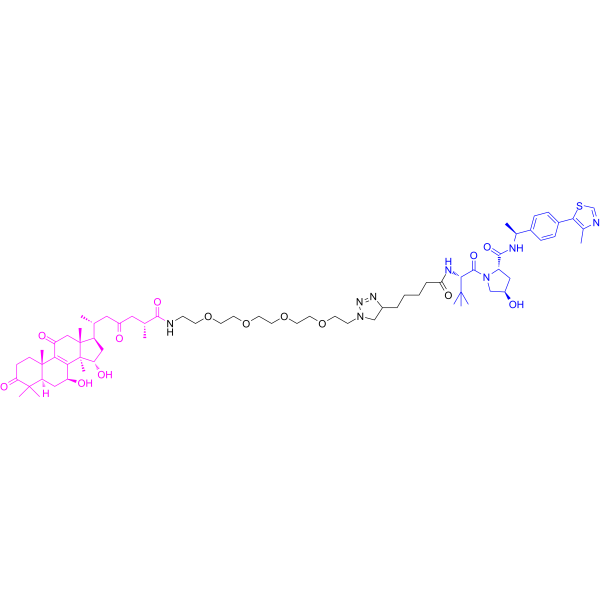 0 ImagesCat. No.: HY-162450PROTAC MDM2 Degrader-8 is a PROTAC degrader that induces the degradation of the MDM2 protein by recruiting VHL. PROTAC MDM2 Degrader-8 directly binds to MDM2 with a KD of 38.2 μM; the proteasome inhibitor MG-132 (HY-13259) reverses this degradation effect, supporting that it induces MDM2 degradation via the ubiquitin-proteasome system. PROTAC MDM2 Degrader-8 also upregulates p21, induces apoptosis and cell cycle arrest, and inhibits the migration of MDA-MB-231 cells. PROTAC MDM2 Degrader-8 can be used in studies related to MDM2-targeted protein degradation and triple-negative breast cancer.
-
PCC16 chloride
 0 ImagesCat. No.: HY-169232PCC16 chloride is a dual PROTAC degrader targeting DHHC3 and PD-L1, with a DC50 of 0.103 μM for PD-L1 degradation. PCC16 chloride induces DHHC3 degradation via the ubiquitin-proteasome pathway by recruiting the CRBN E3 ubiquitin ligase (E3 ubiquitin ligase). By targeting DHHC3-which is essential for PD-L1 palmitoylation and membrane stability-PCC16 chloride reduces PD-L1 levels, decreases PD-L1 membrane retention time, and impairs its immunosuppressive function. PCC16 chloride enhances anti-tumor immunity by disrupting PD-L1-mediated immunosuppression. PCC16 chloride can be used in the research of immune checkpoint blockade-resistant cancers.
-
XZ8078
 0 ImagesCat. No.: HY-184967XZ8078 is a potent, selective dual-target PROTAC degrader against PARP1 and IKZF3. In Capan-1 cells, XZ8078 exhibits a DC50 of 23.01 nM for PARP1 degradation and a DC50 of 23.20 nM for IKZF3 degradation. XZ8078 upregulates DNA damage markers in a concentration-dependent manner, induces cell cycle arrest, upregulates activated caspases and triggers apoptosis. XZ8078 inhibits tumor growth in both AZD5305-sensitive and AZD5305-resistant xenograft models. XZ8078 can be used for cancer-related research.




