



SGK3
SGK3 (serum- and glucocorticoid-induced kinase 3) is a serine/threonine kinase of the AGC family that integrates phosphoinositide-dependent signaling with cellular growth and survival programs through its unique phosphoinositide-binding PX domain, which targets the kinase to PI(3)P-enriched endosomal membranes[1][2]. Mechanistically, SGK3 is activated downstream of PI3K, PDK1, and mTORC2, and binding of its PX domain to PI(3)P promotes endosomal localization, phosphorylation, and kinase activation, thereby linking lipid signaling to intracellular signal transduction[1][3][4]. This endosome-centered signaling mechanism distinguishes SGK3 from closely related SGK isoforms and from AKT, which primarily relies on a pleckstrin homology domain for membrane recruitment[2][5]. Through PI3K-dependent pathways, SGK3 regulates processes associated with cell proliferation, survival, and downstream mTORC1 signaling[3][6]. In disease models, SGK3 has been implicated in breast cancer biology, where its activity depends on oncogenic PI3K signaling and can support tumor cell growth under conditions in which AKT signaling is limited[3][5]. Experimental studies further demonstrate that SGK3 can function as an AKT-independent effector of PI3K signaling and contribute to adaptive responses following PI3K or AKT pathway inhibition[5][6]. Therefore, SGK3 represents a biologically distinct signaling node within the PI3K network and serves as a valuable experimental target for investigating endosomal signaling, kinase pathway compensation, and therapeutic resistance mechanisms[3][5][6].
References:
- [1]. Pokorny D, et al. In vitro reconstitution of Sgk3 activation by phosphatidylinositol 3-phosphate. J Biol Chem. 2021 Aug;297(2):100919. [Content Brief]
- [2]. Bruhn MA, et al. AKT-independent PI3-K signaling in cancer - emerging role for SGK3. Cancer Manag Res. 2013 Aug 26;5:281-92. [Content Brief]
- [3]. Gasser JA, et al. SGK3 mediates INPP4B-dependent PI3K signaling in breast cancer. Mol Cell. 2014 Nov 20;56(4):595-607. [Content Brief]
- [4]. Tessier M, et al. Role of the Phox homology domain and phosphorylation in activation of serum and glucocorticoid-regulated kinase-3. J Biol Chem. 2006 Aug 18;281(33):23978-89. [Content Brief]
- [5]. Tovell H, et al. Design and Characterization of SGK3-PROTAC1, an Isoform Specific SGK3 Kinase PROTAC Degrader. ACS Chem Biol. 2019 Sep 20;14(9):2024-2034. [Content Brief]
- [6]. Bago R, et al. The hVps34-SGK3 pathway alleviates sustained PI3K/Akt inhibition by stimulating mTORC1 and tumour growth. EMBO J. 2016 Sep 1;35(17):1902-22. [Content Brief]
-
SGK3 Related Products (8)
Related Products (8)

-
HaloPROTAC-E
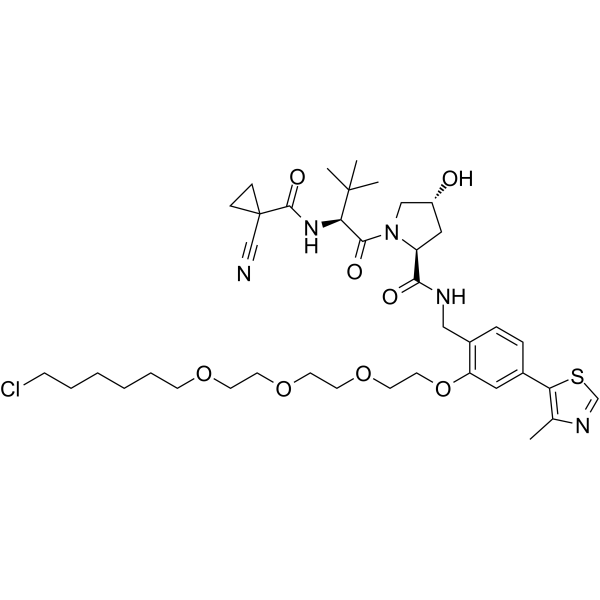 0 ImagesHaloPROTAC-E is a SGK3/VPS34 HaloPROTAC degrader that degrades Halo-tagged SGK3 and VPS34, with a DC50 of 3-10 nM in HEK293 cells. HaloPROTAC-E induces ubiquitination and proteasomal degradation of target proteins. HaloPROTAC-E blocks downstream phosphorylation of SGK3 substrate NDRG1. HaloPROTAC-E is applicable for cancer research.
-
PROTAC SGK3 degrader-1
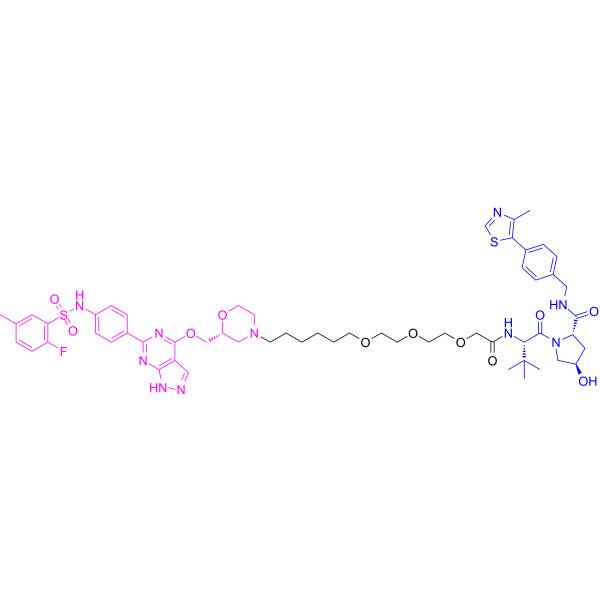 0 ImagesSynonyms: SGK3-PROTAC1PROTAC SGK3 degrader-1 (SGK3-PROTAC1), a chemical probe, is a von Hippel-Lindau ligand-based SKG3 PROTAC composed of a PEG3-C4-OBn (HY-130620) alkyl linker, an SGK3 degrader (red structure), and a VHL ligand (HY-150803, blue structure). PROTAC SGK3 degrader-1 (0.3 μM) induced 50% endogenous SGK3 degradation within 2 hours, and 80% SGK3 degradation was observed at 8 hours, accompanied by loss of phosphorylation of NDRG1 (SGK3 substrate).
-
PT109
 0 ImagesPT109 is an orally active, blood-brain barrier permeable multi-kinase inhibitor. By inhibiting PTBP1, PT109 promotes the switch of pyruvate kinase isoform from PKM2 to PKM1, thereby effectively inhibiting the proliferation and migration of glioblastoma multiforme and inducing its reprogramming into oligodendrocytes. PT109 also targets and regulates key signaling molecules such as JNK, SGK1, GSK3β to exert neuroprotective effects including promoting neurogenesis, inducing synapse formation and alleviating neuroinflammation. In Alzheimer's disease models, PT109 exhibits significant efficacy in improving spatial learning ability, along with excellent in vivo pharmacokinetic properties. PT109 can be used to investigate metabolic reprogramming of glioblastoma multiforme and neuroprotective mechanisms of Alzheimer's disease.
-
CKRPRAASFAE
 0 ImagesCat. No.: HY-P12209CAS No.: 312773-04-9CKRPRAASFAE is a glycogen synthase kinase 3-β-derived PKB/Akt peptide substrate that is used for in vitro kinase activity assays.
-
1-Chloro-6-methoxyhexane
 0 ImagesCat. No.: HY-W260045CAS No.: 22692-46-21-Chloro-6-methoxyhexane is a target protein ligand for PROTAC. 1-Chloro-6-methoxyhexane can be used to synthesize the PROTAC HaloPROTAC-E (HY-145752).
-
308-R
 0 ImagesCat. No.: HY-151009CAS No.: 2376724-98-8308-R is a SGK3/SGK1/S6K1 inhibitor. 308-R exhibits an IC50 of 5 nM against human SGK3, an IC50 of 10 nM against human SGK1, and an IC50 of 1 nM against human S6K1. 308-R can be used in breast cancer research. It is also applicable to studies related to PROTAC synthesis, such as serving as the target protein ligand for PROTAC SGK3 degrader-2 (HY-176823).
-
SGK1-IN-6
 0 ImagesCat. No.: HY-170933CAS No.: 3046378-98-4SGK1-IN-6 is a selective SGK1 inhibitor with an IC50 of 0.39 μM, showing selectivity over SGK2/3. SGK1-IN-6 inhibits cancer cell migration and invasion, improves SGK1 protein thermal stability. SGK1-IN-6 decreases SGK1 protein levels in tumor tissues, suppresses tumor growth in mouse xenograft models. SGK1-IN-6 can be used for the research of prostate cancer.
-
PROTAC SGK3 degrader-2
 0 ImagesCat. No.: HY-176823CAS No.: 2381196-78-5PROTAC SGK3 degrader-2 is the cis epimer of PROTAC SGK3 degrader-1 (SGK3-PROTAC1) (HY-125878). PROTAC SGK3 degrader-2 exhibits inhibitory activity against SGK3, SGK1 and S6K1, with IC50 values of 0.6 μM, 1.4 μM and 1.7 μM, respectively, but fails to degrade SGK3. PROTAC SGK3 degrader-2 can serve as a control compound to investigate the specific effects of SGK3 degradation mediated by SGK3-PROTAC1.



