



Fluorescent Dye
Fluorescence is a phenomenon of photoluminescence in luminescence. When an atom is irradiated by light, some electrons around the nucleus jump from their original orbitals to higher energy orbitals under the influence of light energy, i.e., from the ground state to the first or second excited single-line state, etc. Due to the instability of the first or second excited singlet state, the electron returns from the excited singlet state to the ground state accompanied by released energy, resulting in fluorescence.
Fluorescent dyes can be covalently bound or physically adsorbed in the structure of the substance. The fluorescence properties allow for the characterization, localization and quantitative analysis of the labeled object. Fluorescent dyes have shown great potential for the detection of proteins, nucleic acids, cells, and immunoassays, attributed to the advantages in non-radioactive contamination, simple experimental operation and easy observation.
Fluorescent dyes have penetrated many fields such as pharmacology, physiology, environmental science, and information science, as well as functional studies of proteins and drug screening.
All Product Categories
-
Fluorescent Dye Related Products (4888)
Related Products (4888)

-
Antibodies (4)
-
DiD 4-chlorobenzenesulfonate
 0 ImagesCat. No.: HY-D3305CAS No.: 362596-00-7DiD is a long-chain carbocyanine dye. Carbocyanine dyes are widely used as Di to label cells, organelles, liposomes, viruses and lipoproteins (Ex/Em = 633/665 nm) .
-
Janelia Fluor® 549, Maleimide TFA
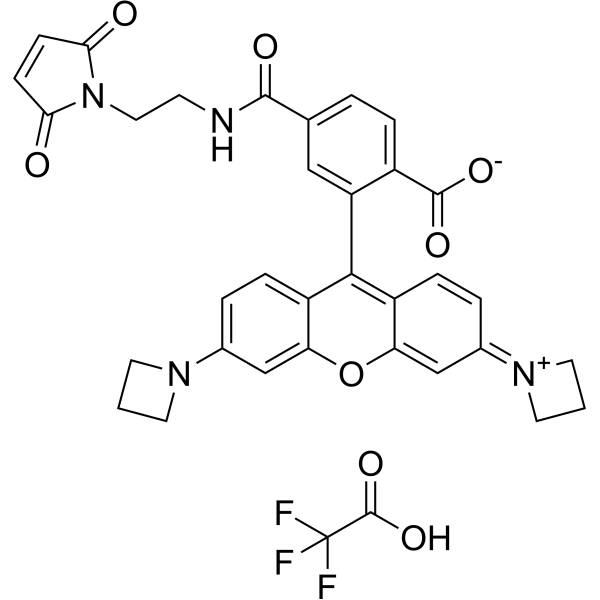 0 ImagesCat. No.: HY-131023Synonyms: JF549, Maleimide TFAJanelia Fluor 549, Maleimide TFA (JF549, Maleimide TFA) is a fluorescent dye with the absorption maximum (λab (max)) of 549 nm and emission maximum (λem (max)) of 571 nm. Janelia Fluor fluorescent dyes can be chemically conjugated to the specific HaloTag substrate (a chloroalkane ligand) to form a fluorescent ligand, rather than binding directly to the HaloTag protein itself. Janelia Fluor products are licensed under U.S. Pat. Nos. 9,933,417, 10,018,624 and 10,161,932 and other patents from Howard Hughes Medical Institute.
-
6-TET
 0 ImagesCat. No.: HY-114290CAS No.: 155911-14-16-TET is a fluorinated fluorescein dye that serves as a label in molecular biology, DNA fragment size analysis, and DNA sequencing. Ex/Em = 521/536 nm.

-
4-Azidophlorizin
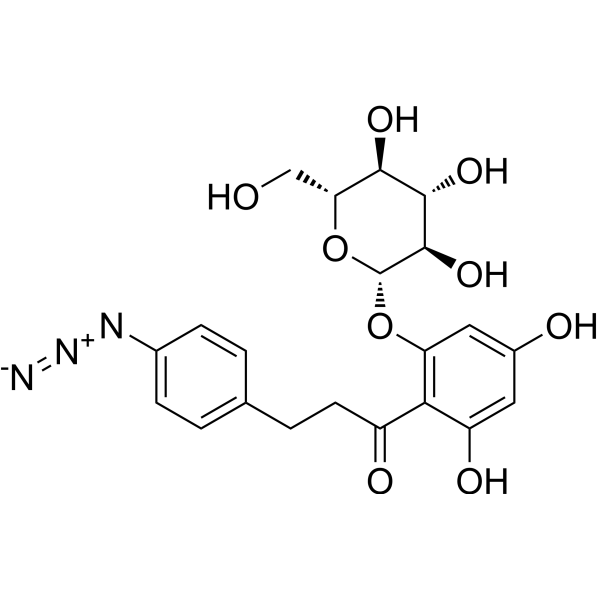 0 ImagesCat. No.: HY-147115CAS No.: 79541-46-14-Azidophlorizin is a high affinity probe and photoaffinity label for the glucose transporter in brush border membranes. 4-Azidophlorizin is a click chemistry reagent, it contains an Azide group and can undergo copper-catalyzed azide-alkyne cycloaddition reaction (CuAAc) with molecules containing Alkyne groups. It can also undergo strain-promoted alkyne-azide cycloaddition (SPAAC) reactions with molecules containing DBCO or BCN groups.
-
Cy3 labled Bevasiranib sodium
 0 ImagesCat. No.: HY-153484ECy3-labeled Bevasiranib sodium is Bevasiranib sodium conjugated with the Cy3 fluorophore. Bevasiranib sodium is an siRNA that targets and silences VEGF-A. Bevasiranib sodium activates the RNA-induced silencing complex (RISC) to degrade VEGF-A mRNA and can be used in research related to macular degeneration.
-
Cy3 labled BT101 sodium
 0 ImagesCat. No.: HY-156501ECy3 labled BT101 sodium is a Cy3 labled BT101 sodium.
-
C.I. Reactive yellow 86
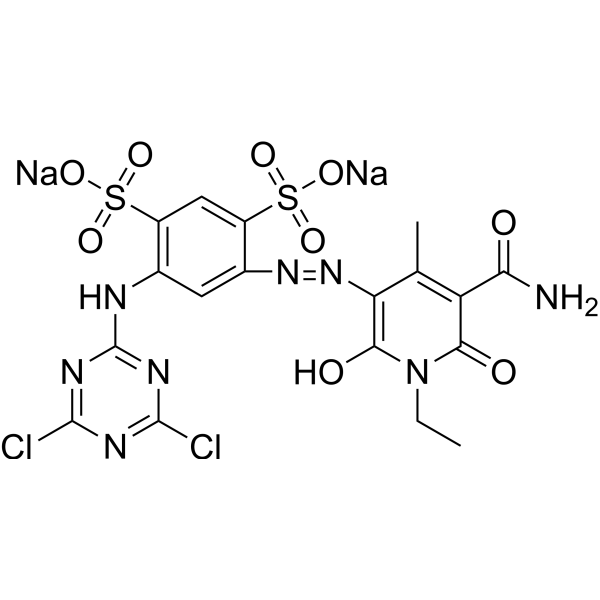 0 ImagesCat. No.: HY-D0678CAS No.: 70865-29-1C.I. Reactive yellow 86 is a multifunctional dye. Dyes are important tools in biological experiments. They can help researchers observe and analyze cell structures, track biomolecules, evaluate cell functions, distinguish cell types, detect biomolecules, study tissue pathology and monitor microorganisms. Their applications range from basic scientific research to clinical A wide range of diagnostics. Dyes are also widely used in traditional fields such as textile dyeing, as well as in emerging fields such as functional textile processing, food pigments and dye-sensitized solar cells.
-
FAM labled Gatuzosiran sodium
 0 ImagesCat. No.: HY-177634CFAM labled Gatuzosiran sodiumis a FAM labled Gatuzosiran sodium.
-
FAM labled S2.2 aptamer sodium
 0 ImagesCat. No.: HY-160062BFAM labled S2.2 aptamer sodiumis a FAM labled S2.2 aptamer sodium.
-
Cy5.5-PEG5000-N3
 0 ImagesCat. No.: HY-D2562Cy5.5-PEG5000-N3 is a Cy5.5 (HY-D0924)-azide fluorescent dye used to label for protein and nucleic acid. Cy5.5-PEG5000-N3 is a click chemistry reagent, it contains an Azide group and can undergo copper-catalyzed azide-alkyne cycloaddition reaction (CuAAc) with molecules containing Alkyne groups. It can also undergo strain-promoted alkyne-azide cycloaddition (SPAAC) reactions with molecules containing DBCO or BCN groups.
-
RB-PEG1000-N3
 0 ImagesCat. No.: HY-D2886BSynonyms: Rhodamine B-PEG1000-N3RB-PEG1000-N3 (Rhodamine B-PEG1000-N3) is a fluorescent dye composed of Rhodamine B (HY-Y0016), PEG and azide group (N3). RB-PEG1000-N3 is a click chemistry reagent, it contains an Azide group and can undergo copper-catalyzed azide-alkyne cycloaddition reaction (CuAAc) with molecules containing Alkyne groups. It can also undergo strain-promoted alkyne-azide cycloaddition (SPAAC) reactions with molecules containing DBCO or BCN groups (Ex/Em=546/610 nm).
-
4-arm-PEG2000-FITC
 0 ImagesCat. No.: HY-D28454-Arm-PEG2000-FITC is a fluorescent dye composed of polyethylene glycol (PEG) and 4 FITC (HY-66019) groups. 4-Arm-PEG2000-FITC can be used for fluorescent labeling and imaging.

-
NIR dye-1
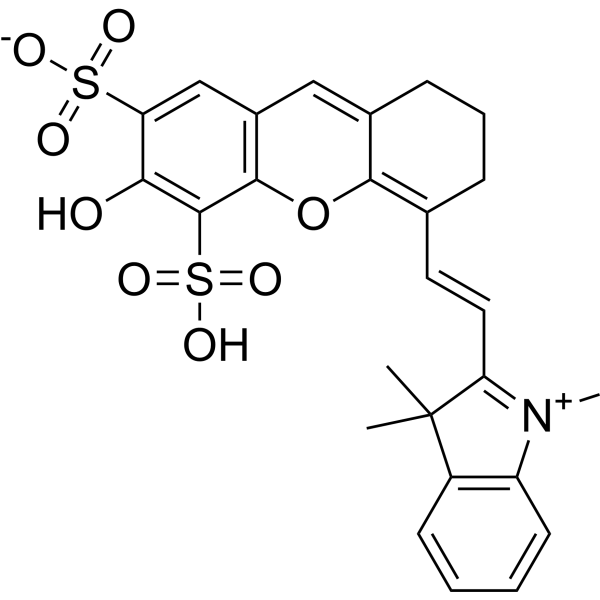 0 ImagesCat. No.: HY-D1067CAS No.: 1392488-07-1NIR dye-1 (Compound 1h) is a near-infrared (NIR) fluorescent dye. NIR dye-1 has absorption and emission in the NIR region, while retaining an optically tunable hydroxyl group.
-
RB-PEG400-OH
 0 ImagesCat. No.: HY-D2882Synonyms: Rhodamine B-PEG400-OHRB-PEG400-OH (Rhodamine B-PEG400-OH) is a fluorescent dye composed of Rhodamine B (HY-Y0016), PEG and a Hydroxyl group. RB-PEG400-OH can be used for fluorescent labeling and imaging (Ex/Em=546/610 nm).
-
AF488 C5 Maleimide
 0 ImagesCat. No.: HY-D3573AF488 C5 Maleimide is a thiol-reactive Fluorescent dye used to label target proteins and bacterial structures. AF488 C5 Maleimide irreversibly forms covalent thioether conjugates with cysteine thiol groups. AF488 C5 Maleimide stabilizes pre-formed globular low-molecular-weight Tau protein oligomers by blocking cysteine-dependent tau protein aggregation, allowing observation of the internalization process of tau protein oligomers into neuronal cells via confocal microscopy. AF488 C5 Maleimide can label cysteine-modified pili; the outer membrane permeability varies among different bacterial species, allowing imaging via epifluorescence microscopy using a FITC filter set.
-
DCA
 0 ImagesCat. No.: HY-D3105DCA is a Fluorescent probe for visualization of phase behavior in ER membranes. DCA is an ER-targeting, polarity-responsive NIR ratiometric probe, with its p-toluenesulfonamide group responsible for ER localization; its sensitivity to polarity relies on its donor-π-acceptor (D-π-A) structure, where aniline acts as the donor and dicyanomethylene acts as the acceptor, driving an intramolecular charge transfer (ICT) process upon excitation. In environments with low polarity, such as the closely packed, low water content ERₒ phase of ER membranes, DCA emits at a shorter wavelength, while in high polarity environments like the loosely packed, higher water content ERd phase, ICT leads to a red-shifted emission, allowing discrimination of the two phases via dual NIR emission colors and ratiometric imaging. Ex/Em = 488/570–620 nm and 488/665–735 nm; additional excitation/emission pairs include Ex/Em = 488/631 nm in low polarity 1,4-dioxane and Ex/Em = 488/677 nm in 1,4-dioxane with 30% water, the higher polarity condition. It shows a large Stokes shift of ~170 nm, and pH, viscosity, and biologically relevant species including Cys, GSH, H₂O₂, and metal ions do not exert marked interference on its fluorescence spectra[1].
-
Glut-Phe-AMC
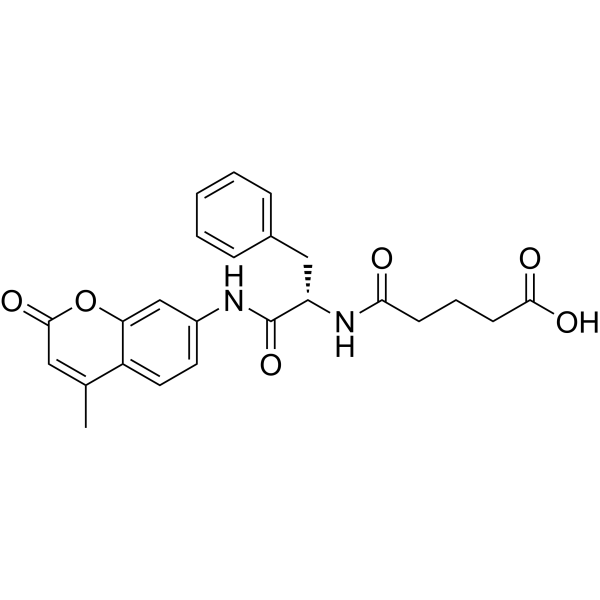 0 ImagesCat. No.: HY-D1503CAS No.: 58632-47-6Glut-Phe-AMC is a fluorescent dye.




