



Fluorescent Dye
Fluorescence is a phenomenon of photoluminescence in luminescence. When an atom is irradiated by light, some electrons around the nucleus jump from their original orbitals to higher energy orbitals under the influence of light energy, i.e., from the ground state to the first or second excited single-line state, etc. Due to the instability of the first or second excited singlet state, the electron returns from the excited singlet state to the ground state accompanied by released energy, resulting in fluorescence.
Fluorescent dyes can be covalently bound or physically adsorbed in the structure of the substance. The fluorescence properties allow for the characterization, localization and quantitative analysis of the labeled object. Fluorescent dyes have shown great potential for the detection of proteins, nucleic acids, cells, and immunoassays, attributed to the advantages in non-radioactive contamination, simple experimental operation and easy observation.
Fluorescent dyes have penetrated many fields such as pharmacology, physiology, environmental science, and information science, as well as functional studies of proteins and drug screening.
All Product Categories
-
Fluorescent Dye Related Products (4891)
Related Products (4891)

-
Antibodies (4)
-
Concanavalin A-AF546
 0 ImagesCat. No.: HY-NP164ISynonyms: Con A-AF546Concanavalin A-AF546 (Con A-AF546) is an AF546-labled Concanavalin A (HY-P2149). Concanavalin A is a Ca2+/Mn2+-dependent and mannose/glucose-binding plant lectin. Concanavalin A binds the N- and O-glycosylated proteins of head and neck carcinoma cells glycoproteins.
-
MitoLumina 680
 0 ImagesCat. No.: HY-D3514MitoLumina 680 is a mitochondria-targeting fluorescent probe used to label mitochondria in live cells. MitoLumina 680 contains a chloromethyl group that allows for covalent binding to mitochondrial thiol-containing proteins. MitoLumina 680 is primarily used for mitochondrial imaging, live-cell mitochondrial tracking, and multicolor fluorescence microscopy (Ex/Em = 678/700 nm).
-
DiOC3(3)
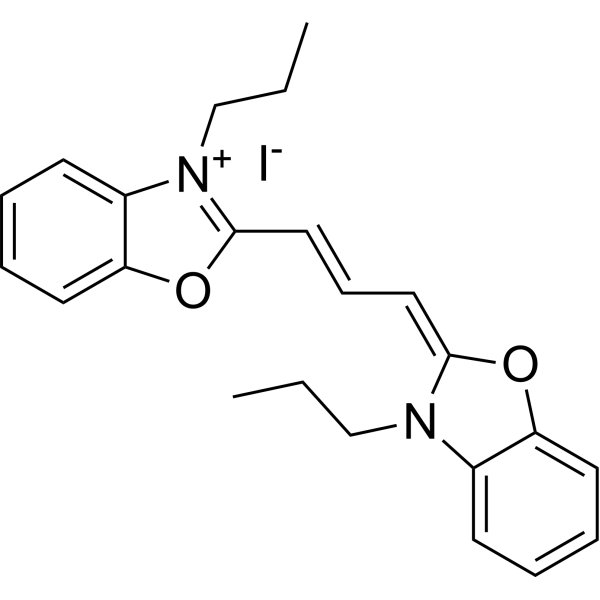 0 ImagesCat. No.: HY-D1074CAS No.: 53213-79-9Synonyms: 3,3'-Dipropyloxacarbocyanine iodideDiOC3(3) (3,3'-Dipropyloxacarbocyanine iodide) is a green fluorescent lipophilic dye with cell membrane permeability. DiOC3(3) can be used to stain cell membranes and other lipid-soluble biological structures.
-
Sambucus Nigra Lectin-AF647
 0 ImagesCat. No.: HY-NP080HSynonyms: SNA-AF647Sambucus Nigra Lectin-AF647 (SNA-AF647) is a phytohemagglutinin labeled with AF647, which can be used as a probe to specifically bind to biomolecules (such as polysaccharides and peptides). Sambucus Nigra Lectin-AF647 precisely locates the distribution of glycan chains on the cell surface through stable fluorescence signals, and can be used for glycobiology research (Ex/Em = 650/665 nm).
-
PROTAC ERα Degrader-11
 0 ImagesCat. No.: HY-174870PROTAC ERα Degrader-11 is a selective and intrinsically fluorescent (Ex: 366 nm, Em: 440 nm) ERα PROTAC degrader. PROTAC ERα Degrader-11 shows good antiproliferative activity, selective ERα degradation and imaging capabilities in MCF-7 breast cancer cell lines. PROTAC ERα Degrader-11 induces G2/M phase arrest and induces apoptosis in MCF-7 cells. PROTAC ERα Degrader-11 is well-tolerated up to a dose of 500 mg/ kg with no acute toxicity in athymic nude mice. PROTAC ERα Degrader-11 can be used for the study of breast cancer.(Pink: ERα ligand (HY-167701), Blue: CRBN Ligand (HY-150831), Black: Linker, E3 ligase ligand-linker conjugate (HY-174880)).
-
TAMRA-PEG3-Alkyne
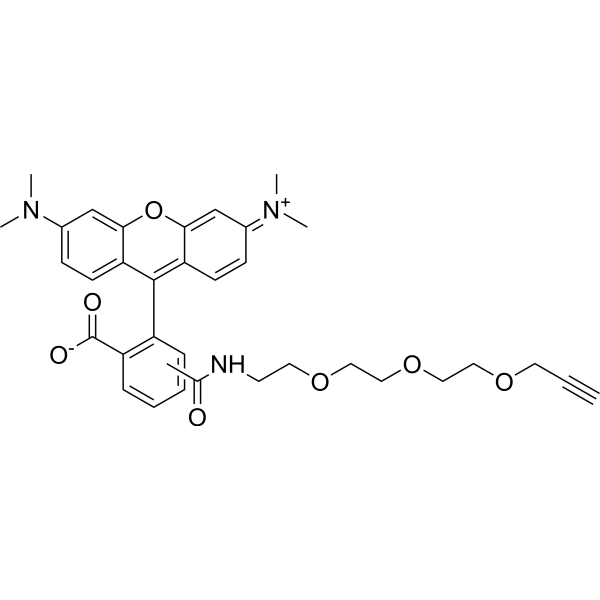 0 ImagesCat. No.: HY-D2113TAMRA-PEG3-Alkyne is a TAMRA dye derivative (HY-135640) containing three PEG units and can be applied for bioorthogonal labeling. TAMRA-PEG3-Alkyne bears alkyne groups capable of undergoing copper-catalyzed azide-alkyne cycloaddition (CuAAC) with azide-bearing molecules. TAMRA-PEG3-Alkyne has an excitation wavelength of approximately 547 nm and an emission wavelength of around 575 nm.
-
ATTO 488 streptavidin
 0 ImagesCat. No.: HY-D2004CAS No.: 1430816-27-5ATTO 488 streptavidin is a fluorescent reagent that specifically targets and binds to biotin (biotin), formed by the conjugation of ATTO 488 with streptavidin (HY-P3152). ATTO 488 streptavidin enables visualization of the activity of streptavidin immobilized on the surface of polymeric nanoparticles, or acts as a fluorescent probe to detect the selective binding and internalization process of anti-HB-EGF/NA with cells expressing HB-EGF (with no such effect on cells that do not express this receptor). ATTO 488 streptavidin effectively verifies the function of streptavidin conjugated to the surface of nanoparticles and is suitable for research related to atherosclerotic cardiovascular diseases.

-
TMR-DN
 0 ImagesCat. No.: HY-D3416Synonyms: TAMRA-2,4-dinitroanilineTMR-DN (TAMRA-2,4-dinitroaniline) is a fluorescent probe for RNA imaging that consists of a covalently coupled fluorophore (5-carboxy tetramethylrhodamine (TMR)) and quencher (dinitroaniline (DN)). The Kd value of TMR-DN with SRB-2 is 35 nM, and its Kd value with RhoBAST is approximately 30 nM. TMR-DN has a contact quenching function and forms a non-fluorescent intramolecular ground-state dimer in the free state; the excitation/emission wavelengths of the free probe are Ex/Em = 557/579 nm, those of the complex formed by binding to SRB-2 are Ex/Em = 561/587 nm, and those of the probe bound to the DNB aptamer are Ex/Em = 555/582 nm. TMR-DN reduces non-specific binding to genomic nucleic acids via negatively charged carboxyl-functionalized aromatic rings. Fluorescence dequenching occurs when TMR-DN specifically binds to SRB-2, RhoBAST or the DNB aptamer, among which the binding of RhoBAST requires Mg2+ for proper folding.
-
Mca-VDQVDGW-Lys(Dnp)-NH2
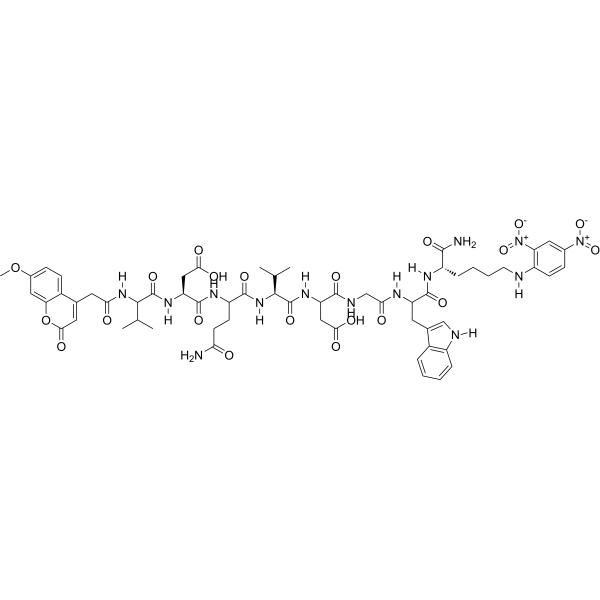 0 ImagesCat. No.: HY-P3476Mca-VDQVDGW-Lys(Dnp)-NH2 is a fluorogenic substrate of caspase-7. Mca-VDQVDGW-K(Dnp)-NH2 can be used to quantify caspase-7 activity.
-
Omocianine
 0 ImagesCat. No.: HY-19503CAS No.: 154082-13-0Synonyms: OmocyanineOmocianine (Omocyanine) is a fluorescence imaging agent and has the potential to detect malignant breast lesions.
-
10-(4-(Bis(2-hydroxyethyl)amino)phenyl)-5,5-difluoro-1,3,7,9-tetramethyl-5H-dipyrrolo[1,2-c:2',1'-f][1,3,2]diazaborinin-4-ium-5-uide
![10-(4-(Bis(2-hydroxyethyl)amino)phenyl)-5,5-difluoro-1,3,7,9-tetramethyl-5H-dipyrrolo[1,2-c:2',1'-f][1,3,2]diazaborinin-4-ium-5-uide](https://file.medchemexpress.com/product_pic/hy-d1551.gif "Click to View 10-(4-(Bis(2-hydroxyethyl)amino)phenyl)-5,5-difluoro-1,3,7,9-tetramethyl-5H-dipyrrolo[1,2-c:2',1'-f][1,3,2]diazaborinin-4-ium-5-uide Product Detail") 0 ImagesCat. No.: HY-D1551CAS No.: 886212-86-810-(4-(Bis(2-hydroxyethyl)amino)phenyl)-5,5-difluoro-1,3,7,9-tetramethyl-5H-dipyrrolo[1,2-c:2',1'-f][1,3,2]diazaborinin-4-ium-5-uide, a BODIPY derivative, is a fluorescent indicator for detecting Pb2+ (Ex=504 nM, Em=510 nM).
0 ImagesCat. No.: HY-D1551CAS No.: 886212-86-810-(4-(Bis(2-hydroxyethyl)amino)phenyl)-5,5-difluoro-1,3,7,9-tetramethyl-5H-dipyrrolo[1,2-c:2',1'-f][1,3,2]diazaborinin-4-ium-5-uide, a BODIPY derivative, is a fluorescent indicator for detecting Pb2+ (Ex=504 nM, Em=510 nM).

-
Cy3 labled ISIS 626112 sodium
 0 ImagesCat. No.: HY-159693DCy3 labled ISIS 626112 sodium is a Cy3 labled ISIS 626112 sodium.
-
Cy3 labled Avacincaptad pegol sodium
 0 ImagesCat. No.: HY-147080DCy3 labled Avacincaptad pegol sodium is a Cy3 labled Avacincaptad pegol sodium.
-
ARHB
 0 ImagesCat. No.: HY-D2983CAS No.: 2310262-15-6ARHB is a highly selective and sensitive NAT2 fluorescent probe suitable for real-time detection of NAT2 activity in various bacteria. ARHB can successfully penetrate the bacterial cells, and the fluorescence intensity is positively correlated with the expression level of NAT2. ARHB is used for high-throughput screening of natural inhibitors for tuberculosis.
-
Arg-Flipper 34
 0 ImagesCat. No.: HY-D2325CAS No.: 2804069-31-4Arg-Flipper 34 is one of the flipper probes which have been introduced as small molecule fluorophores to image membrane tension in living systems. Arg-Flipper 34 can be used to assess the mechanics of early endocytosis.
-
Lycopersicon esculentum (Tomato) Lectin-AF488
 0 ImagesCat. No.: HY-NP071CSynonyms: LEL-AF488Lycopersicon esculentum (Tomato) Lectin-AF488 (LEL-AF488) is Lycopersicon esculentum lectin (LEL) labeled with the AF488 fluorescent dye. Lycopersicon esculentum (Tomato) lectin specifically recognizes and binds to glycan structures, primarily targeting N-acetyl-β-D-glucosamine residues. Lycopersicon esculentum (Tomato) Lectin-AF488 can be used to study glycosylation and localize glycan structures on cell surfaces and in tissue sections (Ex/Em = 470/520 nm).
-
Biotin-16-dUTP
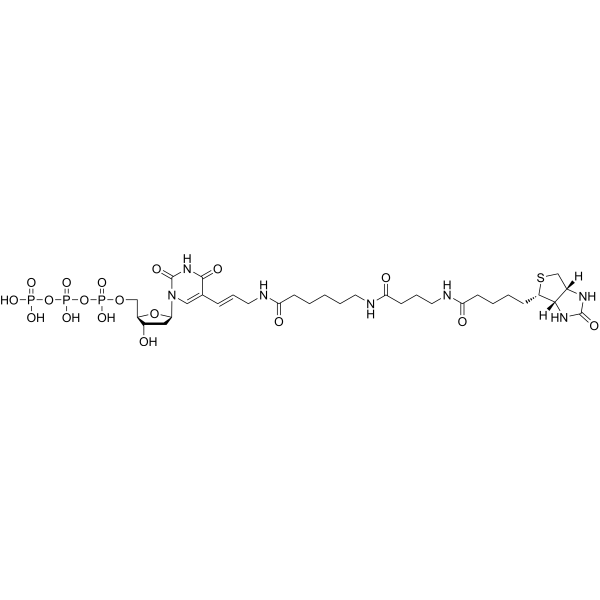 0 ImagesCat. No.: HY-D1022CAS No.: 86303-26-6Synonyms: Biotin-16-deoxyuridine-5'-triphosphateBiotin-16-dUTP (Biotin-16-deoxyuridine-5'-triphosphate) can be used to replace its natural counterpart dTTP by enzymatically incorporating it into DNA/cDNA. Biotin-16- dUTP can be used to produce biotinylated DNA probes in a variety of assay applications.




