



Fluorescent Dye
Fluorescence is a phenomenon of photoluminescence in luminescence. When an atom is irradiated by light, some electrons around the nucleus jump from their original orbitals to higher energy orbitals under the influence of light energy, i.e., from the ground state to the first or second excited single-line state, etc. Due to the instability of the first or second excited singlet state, the electron returns from the excited singlet state to the ground state accompanied by released energy, resulting in fluorescence.
Fluorescent dyes can be covalently bound or physically adsorbed in the structure of the substance. The fluorescence properties allow for the characterization, localization and quantitative analysis of the labeled object. Fluorescent dyes have shown great potential for the detection of proteins, nucleic acids, cells, and immunoassays, attributed to the advantages in non-radioactive contamination, simple experimental operation and easy observation.
Fluorescent dyes have penetrated many fields such as pharmacology, physiology, environmental science, and information science, as well as functional studies of proteins and drug screening.
All Product Categories
-
Fluorescent Dye Related Products (4891)
Related Products (4891)

-
Antibodies (4)
-
Cy3 labled Obeversen sodium
 0 ImagesCat. No.: HY-145624DCy3 labled Obeversen sodium is a Cy3 labled Obeversen sodium.

-
BTNPO
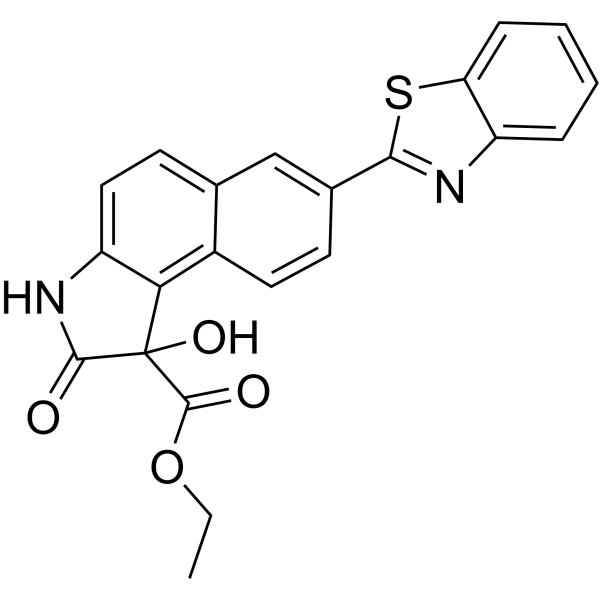 0 ImagesCat. No.: HY-139816CAS No.: 2507992-93-8BTNPO is a unimolecular two-photon fluorescent probe.
-
Sulfo-cyanine3 azide sodium
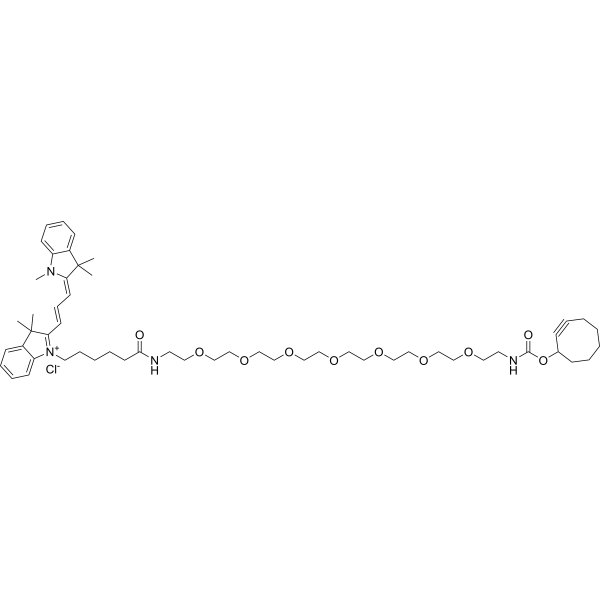
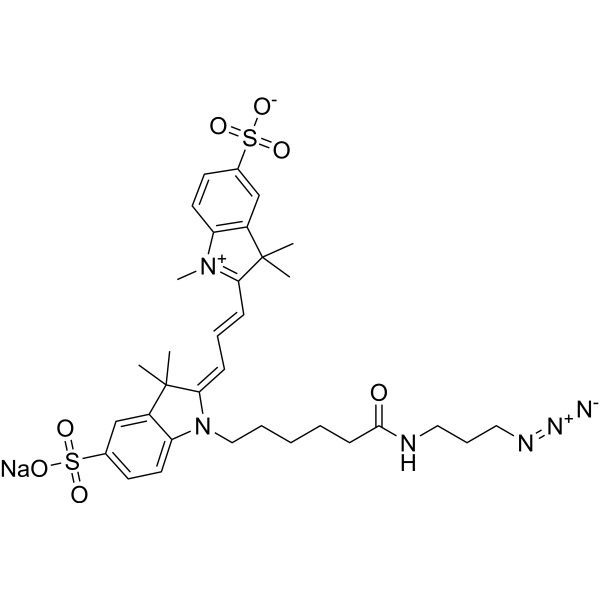 0 ImagesCat. No.: HY-D1274ACAS No.: 2055138-89-9Sulfo-cyanine3 azide sodium a water-soluble azide cyanine dye and fluorescent probe (Ex/Em=548/563 nm). Sulfo-cyanine3 azide sodium can be involved in synthesis of fused tricyclic heterocycles, produces immunostimulatory agents. It contains an azide group and can undergo copper-catalyzed azide-alkyne cycloaddition (CuAAc) with molecules containing alkyne groups. It can also undergo ring strain-promoted alkyne-azide cycloaddition (SPAAC) with molecules containing DBCO or BCN groups.

-
1-(3',6'-Bis(ethylamino)-2',7'-dimethyl-3-oxospiro[isoindoline-1,9'-xanthen]-2-yl)-3-phenylurea
![1-(3',6'-Bis(ethylamino)-2',7'-dimethyl-3-oxospiro[isoindoline-1,9'-xanthen]-2-yl)-3-phenylurea](https://file.medchemexpress.com/product_pic/hy-d1547.gif "Click to View 1-(3',6'-Bis(ethylamino)-2',7'-dimethyl-3-oxospiro[isoindoline-1,9'-xanthen]-2-yl)-3-phenylurea Product Detail") 0 ImagesCat. No.: HY-D1547CAS No.: 957493-98-01-(3',6'-Bis(ethylamino)-2',7'-dimethyl-3-oxospiro[isoindoline-1,9'-xanthen]-2-yl)-3-phenylurea (compound 1a) can be used as a fast-responsive fluorescent gold ion probe for detection of gold ions in water and synthetic products.
0 ImagesCat. No.: HY-D1547CAS No.: 957493-98-01-(3',6'-Bis(ethylamino)-2',7'-dimethyl-3-oxospiro[isoindoline-1,9'-xanthen]-2-yl)-3-phenylurea (compound 1a) can be used as a fast-responsive fluorescent gold ion probe for detection of gold ions in water and synthetic products.
-
Cy3 labled Erisonersen sodium
 0 ImagesCat. No.: HY-177630DCy3 labled Erisonersen sodium is a Cy3 labled Erisonersen sodium.
-
MitoLumina 780
 0 ImagesCat. No.: HY-D3512MitoLumina 780 is a mitochondria-targeting fluorescent probe used to label mitochondria in live cells. MitoLumina 780 contains a chloromethyl group that allows for covalent binding to mitochondrial thiol-containing proteins. MitoLumina 780 is primarily used for mitochondrial imaging, live-cell mitochondrial tracking, and multicolor fluorescence microscopy (Ex/Em = 778/805 nm).
-
FG 488 DHPE
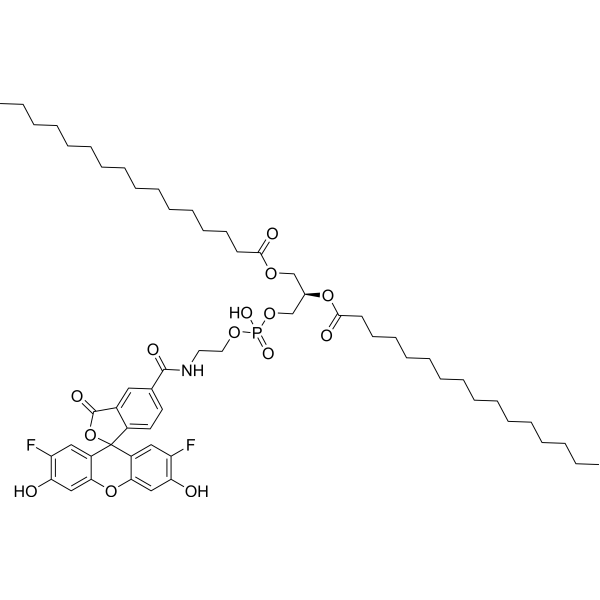 0 ImagesCat. No.: HY-D1560CAS No.: 438476-80-3FG 488 DHPE is a lipid-coupled fluorochrome, has be used as a fluorophore Oregon Green 488. FG 488 DHPE monitors acidification of lipid vesicles with λex/λem=508/534 nm.FG 488 DHPE is also used for Hv1-induced proton translocation quantificatio with λex/λem=508/534 nm as well.
-
Cy3 labled siFLUC sodium
 0 ImagesCat. No.: HY-156865CCy3 labled siFLUC sodium is a Cy3 labled siFLUC sodium.
-
Rhod-2 potassium
 0 ImagesCat. No.: HY-136784CAS No.: 663625-18-1Rhod-2 potassium is a cell impermeant, red fluorescent calcium indicator. Rhod-2 potassium exhibits a significant shift in fluorescence intensity upon calcium binding (ex max=549 nm; calcium-free v. ex/em max=552/581 nm; calcium-bound). Unlike the UV-excitable indicators Fura-2 and Indo-1 (HY-D0121), there is no accompanying spectral shift.

-
Palmitic acid-lissamine rhodamine
 0 ImagesCat. No.: HY-N15888CAS No.: 2260669-55-2

-
Z-VEID-AFC TFA
 0 ImagesCat. No.: HY-P4401AZ-VEID-AFC TFA is the trifluoroacetate salt of Z-VEID-AFC (HY-P4401). Z-VEID-AFC TFA is a fluorescent substrate for caspase-6. When Z-VEID-AFC TFA is cleaved by caspase-6, 7-amino-4-trifluoromethylcoumarin (AFC) is released, and its fluorescence can be used to quantify caspase-6 activity (Ex/Em: 400/505 nm) .
-
Malachite green isothiocyanate
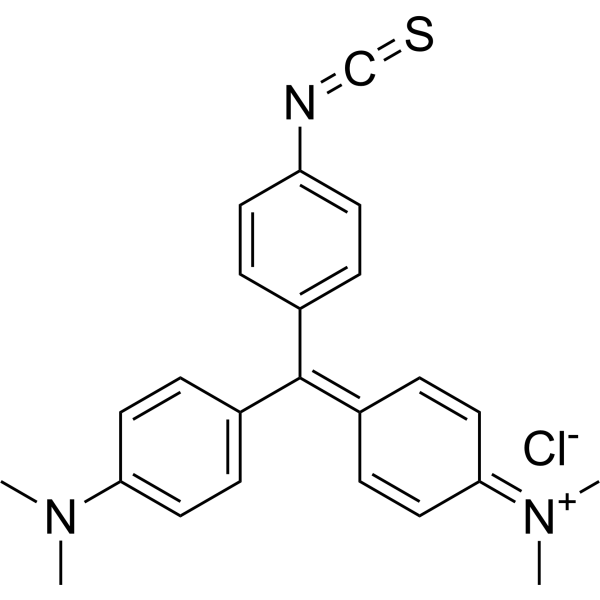 0 ImagesCat. No.: HY-131097CAS No.: 147492-82-8Malachite green isothiocyanate is an amine-reactive probe that reacts with amines to give the corresponding thiourea. Malachite green isothiocyanate is a reagent that has been used for the measurement of concentration of protein.
-
Coumarin 334
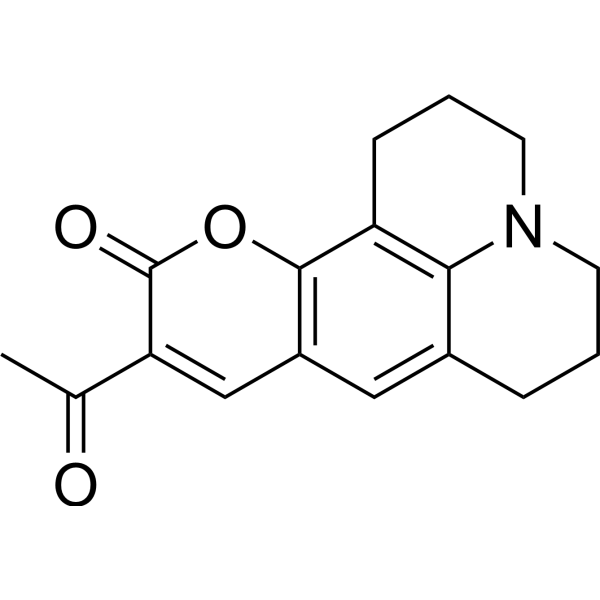 0 ImagesCat. No.: HY-W180804CAS No.: 55804-67-6Synonyms: Coumarin 521Coumarin 334 (Coumarin 521) is a laser dye with rigid structure.




