



Fluorescent Dye
Fluorescence is a phenomenon of photoluminescence in luminescence. When an atom is irradiated by light, some electrons around the nucleus jump from their original orbitals to higher energy orbitals under the influence of light energy, i.e., from the ground state to the first or second excited single-line state, etc. Due to the instability of the first or second excited singlet state, the electron returns from the excited singlet state to the ground state accompanied by released energy, resulting in fluorescence.
Fluorescent dyes can be covalently bound or physically adsorbed in the structure of the substance. The fluorescence properties allow for the characterization, localization and quantitative analysis of the labeled object. Fluorescent dyes have shown great potential for the detection of proteins, nucleic acids, cells, and immunoassays, attributed to the advantages in non-radioactive contamination, simple experimental operation and easy observation.
Fluorescent dyes have penetrated many fields such as pharmacology, physiology, environmental science, and information science, as well as functional studies of proteins and drug screening.
All Product Categories
-
Fluorescent Dye Related Products (4888)
Related Products (4888)

-
Antibodies (4)
-
Cy5.5 acetate
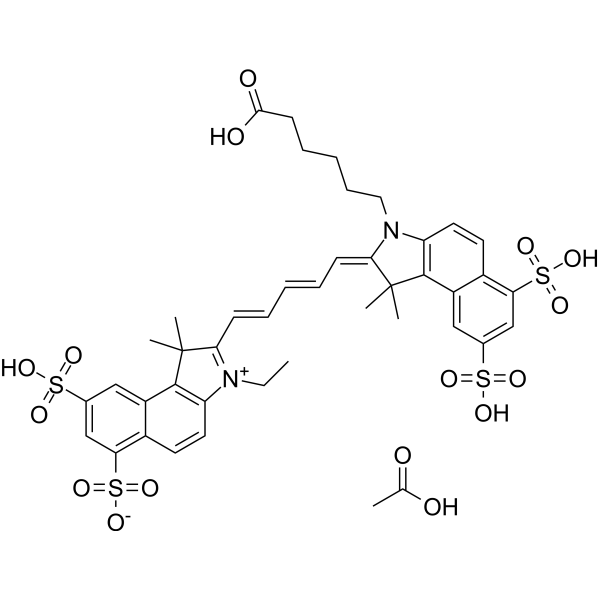 0 ImagesCat. No.: HY-D0924ASynonyms: Sulfo-Cyanine5.5 acetateCy5.5 acetate is a CY dye. CY, short for Cyanine, is a compound consisting of two nitrogen atoms connected by an odd number of methyl units. Cyanine compounds have the characteristics of long wavelength, adjustable absorption and emission, high extinction coefficient, good water solubility and relatively simple synthesis. CY dyes are of en used for the labeling of proteins, antibodies and small molecular compounds. For the labeling of protein antibodies, the combination can be completed through a simple mixing reaction. Below, we introduce the labeling method of protein antibody labeling, which has certain reference significance.
-
FAM labled Obudanersen sodium
 0 ImagesCat. No.: HY-177651CFAM labled Obudanersen sodiumis a FAM labled Obudanersen sodium.
-
2-(Benzyloxy)-2-(naphthalen-2-yl)acetonitrile
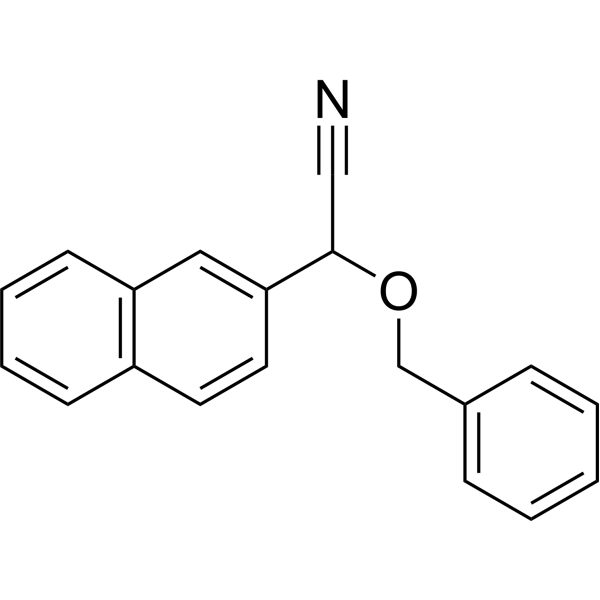 0 ImagesCat. No.: HY-D0137CAS No.: 500372-25-82-(Benzyloxy)-2-(naphthalen-2-yl)acetonitrile is a multifunctional dye. Dyes are important tools in biological experiments. They can help researchers observe and analyze cell structures, track biomolecules, evaluate cell functions, distinguish cell types, detect biomolecules, study tissue pathology and monitor microorganisms. Their applications range from basic scientific research to clinical A wide range of diagnostics. Dyes are also widely used in traditional fields such as textile dyeing, as well as in emerging fields such as functional textile processing, food pigments and dye-sensitized solar cells.
-
RB-PEG3400-Mal
 0 ImagesCat. No.: HY-D2885DSynonyms: Rhodamine B-PEG3400-MalRB-PEG3400-Mal (Rhodamine B-PEG3400-Mal) is a fluorescent dye composed of Rhodamine B (HY-Y0016), PEG and Maleimide (HY-W007324) (Mal). RB-PEG3400-Mal can be used for fluorescent labeling and imaging (Ex/Em=546/610 nm).
-
FITC-PEG1000-FA
 0 ImagesCat. No.: HY-D2844AFITC-PEG1000-FA is a fluorescent dye composed of Folic acid (HY-16637) (FA), polyethylene glycol (PEG) and FITC (HY-66019). Fluorescent dye is linked to PEG and Folic acid through a specific chemical reaction to form a molecule with special properties. FITC-PEG1000-FA can be used for fluorescent labeling and imaging.
-
Datura Stramonium Lectin-AF350
 0 ImagesCat. No.: HY-NP065ASynonyms: DSL-AF350Datura Stramonium Lectin-AF350 (DSL-AF350) is a datura lectin (DSL) labeled with the AF350 fluorescent dye. Datura Stramonium Lectin is a dimeric glycoprotein that specifically recognizes and binds to glycan structures containing N-acetylglucosamine (GlcNAc) oligomers. Datura Stramonium Lectin-AF350 can be used for glycosyl studies on cell surfaces (Ex/Em = 346/445 nm).
-
FAM labled ISIS 626112 sodium
 0 ImagesCat. No.: HY-159693CFAM labled ISIS 626112 sodiumis a FAM labled ISIS 626112 sodium.
-
Suc-YVAD-AMC
 0 ImagesCat. No.: HY-P10317CAS No.: 201860-29-9Suc-YVAD-AMC is used to measure the cysteine proteins of the proteasome.Suc-YVAD-AMC releases fluorescent AMC when cleaved by cysteine proteases to assess the enzymatic activity of the proteasome.
-
8-(2,4,6-Trimethylphenyl)-BODIPY
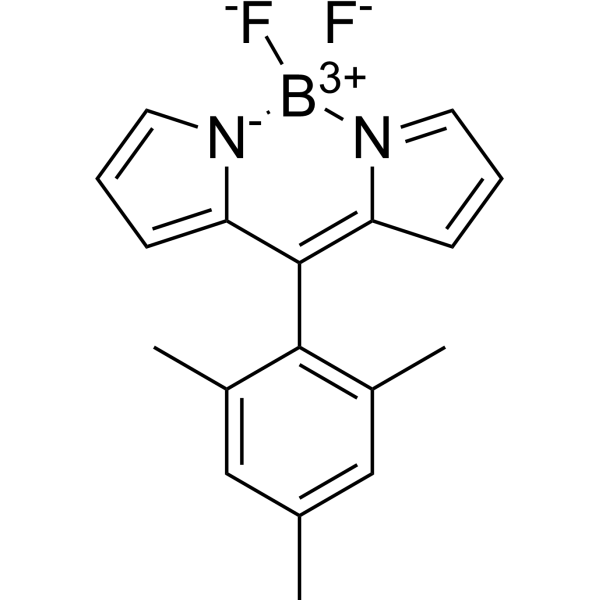 0 ImagesCat. No.: HY-D1648CAS No.: 870753-29-08-(2,4,6-Trimethylphenyl)-BODIPY is a highly fluorescent dye, can be used as photosensitizer or synthesize other BODIPY-based photosensitizer (λabs=502 nm, λem=516 nm) (*abs: main absorption maxima).
-
2-Coumaranone-1-L
 0 ImagesCat. No.: HY-115692CAS No.: 1887057-34-22-Coumaranone-1-L serves as a chemiluminescent probe. Under alkaline conditions and in the presence of oxygen, 2-Coumaranone-1-L is capable of undergoing chemiluminescence, which enables its application as a chemiluminescent substrate in biochemical assays. 2-Coumaranone-1-L exhibits its maximum emission wavelength at 442 nm. 2-Coumaranone-1-L is utilized in research within the realm of bioanalysis.
-
Fluorescent ACKR3 antagonist 1
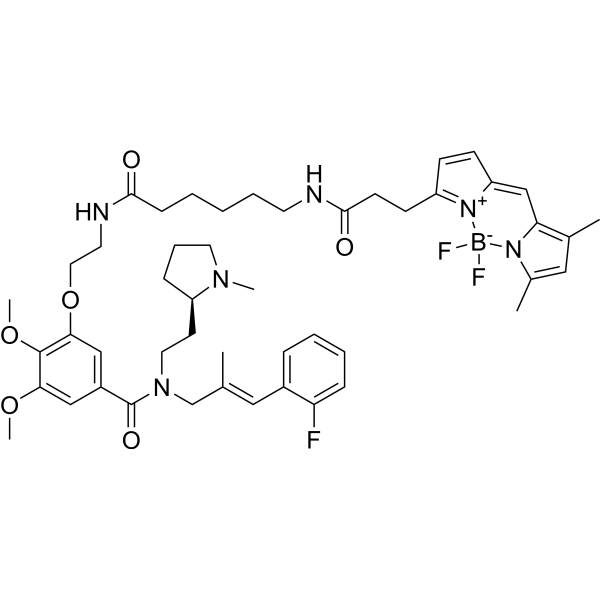 0 ImagesCat. No.: HY-D2201Fluorescent ACKR3 antagonist 1(compound 18a) is a atypical chemokine receptor 3 antagonist.
-
LD-CK
 0 ImagesCat. No.: HY-D3007LD-CK is a fluorescent probe based on a coumarin-chromone structure, specifically designed to visualize lipid droplet polarity changes and endowed with multimodal imaging capability. LD-CK contains a high-performance lipophilic coumarin moiety, which enables it to specifically target lipid droplets upon cellular entry while minimizing background fluorescence to the greatest extent. LD-CK has an excitation wavelength (Ex) of 488 nm and an emission wavelength (Em) of 540 nm (in low-polarity environments such as toluene) or 640 nm (in high-polarity environments such as glycerol), with its emission peak undergoing a redshift as solvent polarity increases.
-
FAM labled Zintevir sodium
 0 ImagesCat. No.: HY-177670CFAM labled Zintevir sodiumis a FAM labled Zintevir sodium.
-
TCM-4COOH
 0 ImagesCat. No.: HY-D3074TCM-4COOH is an AIE-active fluorescent probe for calcium ions. TCM-4COOH relies on aggregation-induced emission activity, and its carboxyl chelating group can bind to Ca2+ and Mg2+ to form insoluble aggregates, triggering fluorescence enhancement via restricting intramolecular motion (Ex/Em = 477/603 nm). TCM-4COOH shows pH independence in physiological environments (pH 4-9), can be strongly activated at Ca2+ concentrations ranging from low nM to mM, and has a stronger binding ability to Ca2+ than to Mg2+. TCM-4COOH, as its acetoxymethyl ester derivative TCM-AM, can penetrate cell membranes for intracellular detection. TCM-4COOH can be used for imaging of cellular calcium overload, detection of bone microcracks, and studies related to calcium-rich biological environments.
-
Sulfo-Cy5 carboxylic acid
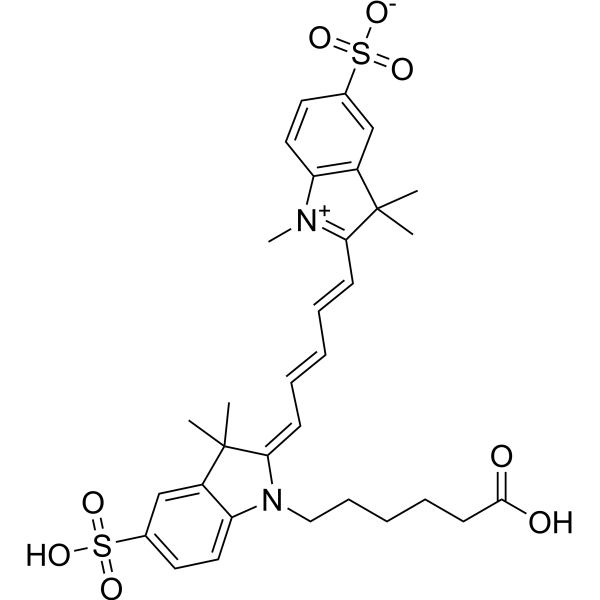 0 ImagesCat. No.: HY-D1853CAS No.: 1121756-16-8Sulfo-Cy5 carboxylic acid is a Cy5 derivative that can be used for chemical synthesis. Cy5 is a red fluorescent label dye for imaging (Ex/Em=642/670 nm).
-
ATTO 465 NHS ester
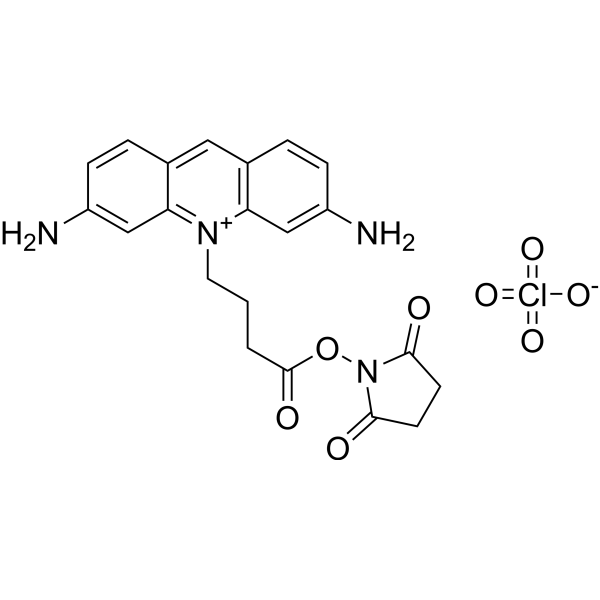 0 ImagesCat. No.: HY-D1935CAS No.: 1173020-88-6ATTO 465 NHS ester is a new fluorescent marker based on the Rhodamine structure. It has strong absorption, high fluorescence quantum yield, high thermal stability and photochemical stability, and is suitable for single molecule detection and high-resolution microscopy. ATTO 465 NHS ester is an NHS ester derivative of ATTO 465 that can be used to label proteins or antibodies.
-
Tz-IFDL
 0 ImagesCat. No.: HY-D3369CAS No.: 3114128-44-5Tz‑IFDL is a chemiluminescent probe for in vivo imaging of N‑methyl‑D‑aspartate receptors (NMDAR), which specifically binds to the NR2B subunit of NMDAR. Tz‑IFDL undergoes a bioorthogonal reaction with probe CL‑NC (HY-D3370), triggering molecular fragment release and chemiluminescence. The CL‑NC/Tz‑IFDL system composed of Tz‑IFDL exhibits a chemiluminescence emission wavelength of 710 nm. When combined with CL‑NC, Tz‑IFDL can be used for deep tissue imaging to distinguish NMDAR expression levels between Alzheimer's disease model mice and normal mice.
-
Concanavalin A-AF430
 0 ImagesCat. No.: HY-NP164ESynonyms: Con A-AF430Concanavalin A-AF430 (Con A-AF430) is an AF430-labled Concanavalin A (HY-P2149). Concanavalin A is a Ca2+/Mn2+-dependent and mannose/glucose-binding plant lectin. Concanavalin A binds the N- and O-glycosylated proteins of head and neck carcinoma cells glycoproteins.




