



Fluorescent Dye
Fluorescence is a phenomenon of photoluminescence in luminescence. When an atom is irradiated by light, some electrons around the nucleus jump from their original orbitals to higher energy orbitals under the influence of light energy, i.e., from the ground state to the first or second excited single-line state, etc. Due to the instability of the first or second excited singlet state, the electron returns from the excited singlet state to the ground state accompanied by released energy, resulting in fluorescence.
Fluorescent dyes can be covalently bound or physically adsorbed in the structure of the substance. The fluorescence properties allow for the characterization, localization and quantitative analysis of the labeled object. Fluorescent dyes have shown great potential for the detection of proteins, nucleic acids, cells, and immunoassays, attributed to the advantages in non-radioactive contamination, simple experimental operation and easy observation.
Fluorescent dyes have penetrated many fields such as pharmacology, physiology, environmental science, and information science, as well as functional studies of proteins and drug screening.
All Product Categories
-
Fluorescent Dye Related Products (4891)
Related Products (4891)

-
Antibodies (4)
-
ATTO 465 NHS ester
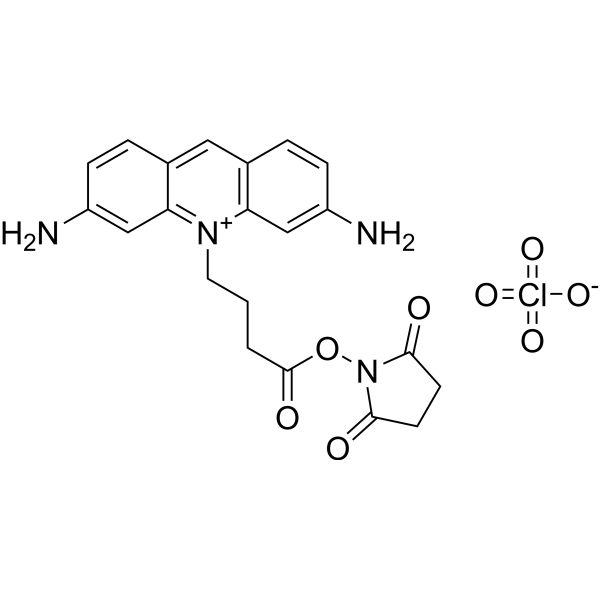 0 ImagesCat. No.: HY-D1935CAS No.: 1173020-88-6ATTO 465 NHS ester is a new fluorescent marker based on the Rhodamine structure. It has strong absorption, high fluorescence quantum yield, high thermal stability and photochemical stability, and is suitable for single molecule detection and high-resolution microscopy. ATTO 465 NHS ester is an NHS ester derivative of ATTO 465 that can be used to label proteins or antibodies.
-
Tz-IFDL
 0 ImagesCat. No.: HY-D3369CAS No.: 3114128-44-5Tz‑IFDL is a chemiluminescent probe for in vivo imaging of N‑methyl‑D‑aspartate receptors (NMDAR), which specifically binds to the NR2B subunit of NMDAR. Tz‑IFDL undergoes a bioorthogonal reaction with probe CL‑NC (HY-D3370), triggering molecular fragment release and chemiluminescence. The CL‑NC/Tz‑IFDL system composed of Tz‑IFDL exhibits a chemiluminescence emission wavelength of 710 nm. When combined with CL‑NC, Tz‑IFDL can be used for deep tissue imaging to distinguish NMDAR expression levels between Alzheimer's disease model mice and normal mice.
-
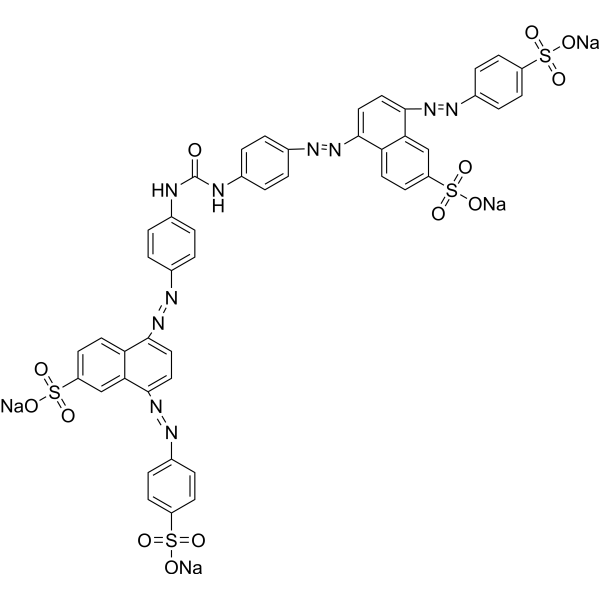
Concanavalin A-AF430
 0 ImagesCat. No.: HY-NP164ESynonyms: Con A-AF430Concanavalin A-AF430 (Con A-AF430) is an AF430-labled Concanavalin A (HY-P2149). Concanavalin A is a Ca2+/Mn2+-dependent and mannose/glucose-binding plant lectin. Concanavalin A binds the N- and O-glycosylated proteins of head and neck carcinoma cells glycoproteins.
-
Disperse red 151
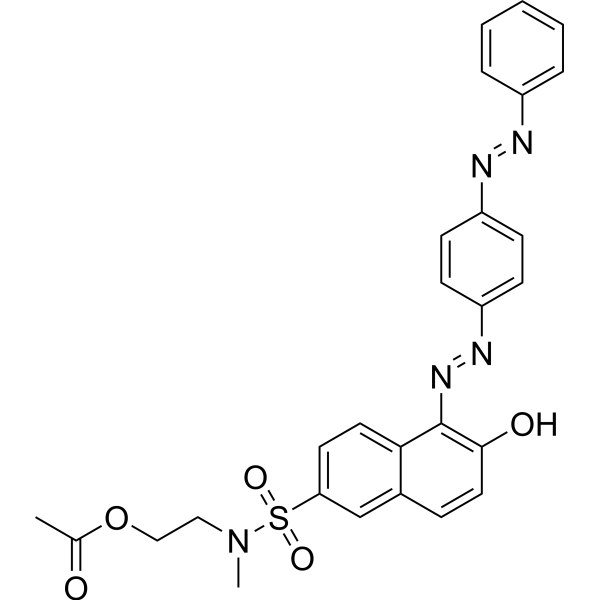 0 ImagesCat. No.: HY-D1128CAS No.: 70210-08-1Disperse red 151 is a red dye derived from anthraquinone. It is used in plastics, textiles and cosmetics.
-
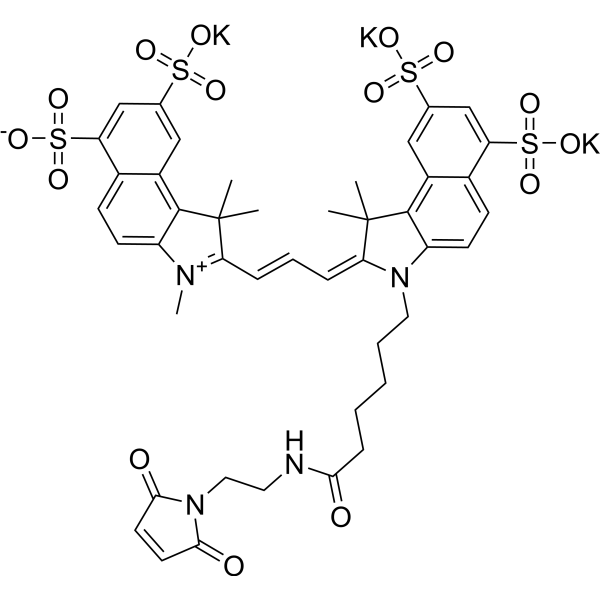
PE-VF620 Maleimide
 0 ImagesCat. No.: HY-D2090PE-VF620 Maleimide is a fluorescent dye.

-
Xanthamide 8
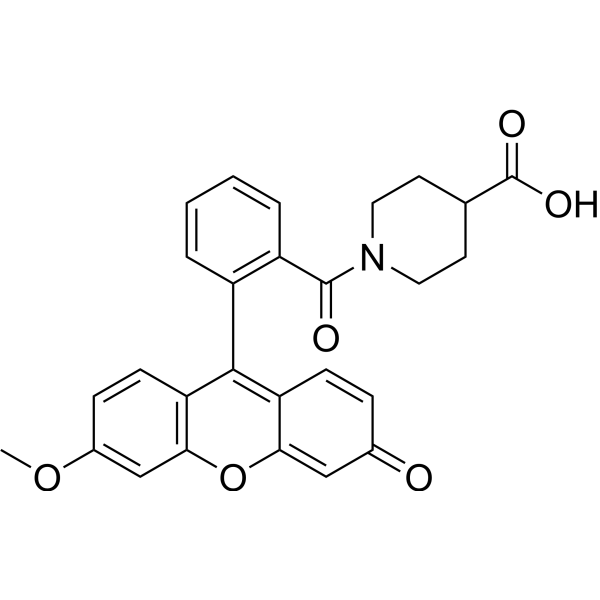 0 ImagesCat. No.: HY-D0130CAS No.: 442151-56-6Xanthamide 8 is a multifunctional dye. Dyes are important tools in biological experiments. They can help researchers observe and analyze cell structures, track biomolecules, evaluate cell functions, distinguish cell types, detect biomolecules, study tissue pathology and monitor microorganisms. Their applications range from basic scientific research to clinical A wide range of diagnostics. Dyes are also widely used in traditional fields such as textile dyeing, as well as in emerging fields such as functional textile processing, food pigments and dye-sensitized solar cells.
-
BRD-9526
 0 ImagesCat. No.: HY-116455CAS No.: 1446352-30-2BRD-9526 is a potent and selective Sonic Hedgehog (Shh) pathway inhibitor with potential anti-cancer activity. The mechanism of BRD-9526 is similar in some ways to commonly used inhibitors such as cyclopamine, but is significantly different in other ways. The discovery of BRD-9526 may provide a useful probe for studying complex signaling pathways.

-
DiOC7(3)
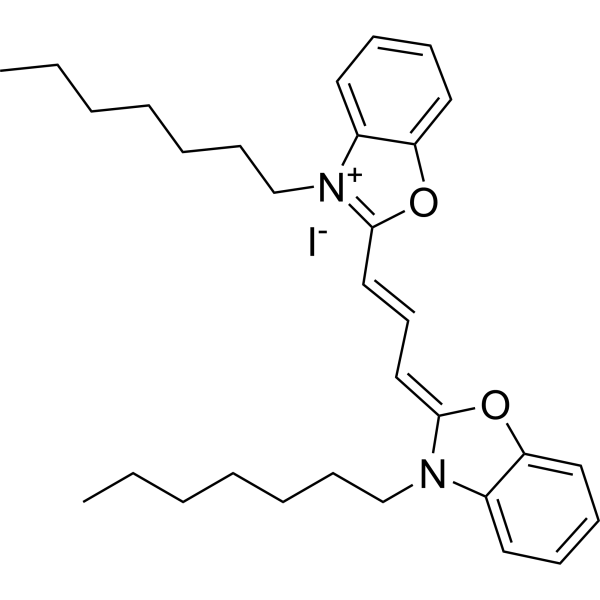 0 ImagesCat. No.: HY-D1073CAS No.: 53213-83-5Synonyms: 3,3'-Diheptyloxacarbocyanine iodideDiOC7(3) (3,3'-Diheptyloxacarbocyanine iodide) is a green membrane potential probe (Ex=450-490 nm, Em=510-520 nm). DiOC7(3) can be used to quantify the vascular densities.
-
AF405 DBCO
 0 ImagesCat. No.: HY-D3570AF405 DBCO is a blue fluorescent dye derivative containing a dibenzocyclooctyne (DBCO) group. AF405 DBCO reacts rapidly with azide-labeled biomolecules at room temperature without the need for a metal catalyst, enabling copper-free click chemistry (SPAAC) for applications in live-cell imaging, flow cytometry, super-resolution microscopy, and other research fields.
-
FITC-HA (MW 7000)
 0 ImagesCat. No.: HY-D2836HSynonyms: FITC-Hyaluronate (MW 7000)FITC-HA (MW 7000) is hyaluronic acid (HA) (HY-B0633A) labeled with FITC (HY-66019). FITC-HA retains the ability of HA to bind to receptors (such as CD44) and form extracellular matrices, while it can be detected by fluorescence microscopy or flow cytometry for tracing the localization, binding, internalization and metabolic pathways of HA in cells, tissues or living organisms (Ex/Em ≈ 490/520 nM).
-
ATTO 590 alkyne
 0 ImagesCat. No.: HY-D1946ATTO 590 alkyne is a new fluorescent marker based on the Rhodamine structure. It has strong absorption, high fluorescence quantum yield, high thermal stability and photochemical stability, and is suitable for single molecule detection and high-resolution microscopy. ATTO 590 alkyne is an alkyne derivative of ATTO 590 and can be used to label proteins or antibodies.
-
(1,1'-Dipyrenyl)dimethyl ether
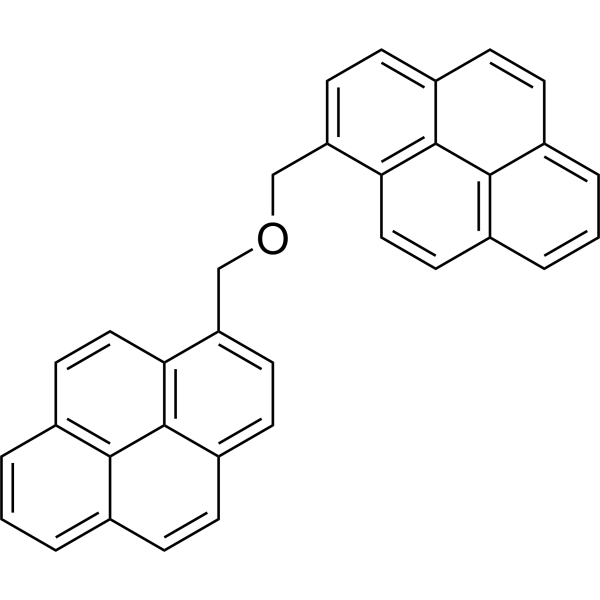 0 Images(1,1'-Dipyrenyl)dimethyl ether exhibits intramolecular excimer fluorescence in competition with fluorescence from the locally excited pyrene chromophore. (1,1'-Dipyrenyl)dimethyl ether is soluble in synthetic phospholipid membranes.
-
Cy3 labled IONIS-DGAT 2Rx sodium
 0 ImagesCat. No.: HY-159698DCy3 labled IONIS-DGAT 2Rx sodium is a Cy3 labled IONIS-DGAT 2Rx sodium.
-
FAM labled Sapablursen sodium
 0 ImagesCat. No.: HY-177662CFAM labled Sapablursen sodiumis a FAM labled Sapablursen sodium.




