



Fluorescent Dye
Fluorescence is a phenomenon of photoluminescence in luminescence. When an atom is irradiated by light, some electrons around the nucleus jump from their original orbitals to higher energy orbitals under the influence of light energy, i.e., from the ground state to the first or second excited single-line state, etc. Due to the instability of the first or second excited singlet state, the electron returns from the excited singlet state to the ground state accompanied by released energy, resulting in fluorescence.
Fluorescent dyes can be covalently bound or physically adsorbed in the structure of the substance. The fluorescence properties allow for the characterization, localization and quantitative analysis of the labeled object. Fluorescent dyes have shown great potential for the detection of proteins, nucleic acids, cells, and immunoassays, attributed to the advantages in non-radioactive contamination, simple experimental operation and easy observation.
Fluorescent dyes have penetrated many fields such as pharmacology, physiology, environmental science, and information science, as well as functional studies of proteins and drug screening.
All Product Categories
-
Fluorescent Dye Related Products (4894)
Related Products (4894)

-
Antibodies (4)


-
FAM labled Cibrigirsen sodium
 0 ImagesCat. No.: HY-177622CFAM labled Cibrigirsen sodiumis a FAM labled Cibrigirsen sodium.
-
Cy3 labled Zerlasiran sodium
 0 ImagesCat. No.: HY-147425ESynonyms: Cy3 labled SLN360 sodiumCy3 labled Zerlasiran sodium is a Cy3 labled Zerlasiran sodium (HY-147425A). Zerlasiran sodium is a siRNA targeting apolipoprotein A (ApoA). Zerlasiran sodium targets hepatic ApoA synthesis via RNA interference to degrade encoding mRNA. Zerlasiran sodium can be used for the research of atherosclerotic cardiovascular disease and elevated ApoA levels.

-
Cy3 labled Inotersen sodium
 0 ImagesCat. No.: HY-132608CCy3 labled Inotersen sodium is a Cy3 labled Inotersen sodium.
-
HOTN
 0 ImagesCat. No.: HY-D3227CAS No.: 2677830-11-2HOTN is a hypochlorous acid (HClO) Fluorescent indicator. HOTN is oxidized by HClO, causing cleavage of its Py+-N+ moiety and a change in hydrophobicity, which in turn triggers aggregation-induced emission to generate a strong fluorescent signal. HOTN is used for in vivo imaging of inflammation and hepatocellular carcinoma, as these diseases typically result in high levels of HClO.
-
Dabcyl-RGVVNASSRLA-Edans
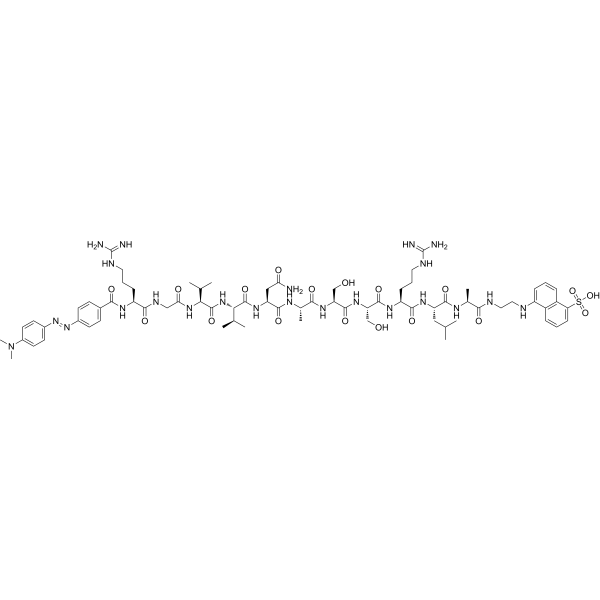 0 ImagesCat. No.: HY-P4777CAS No.: 163265-38-1Synonyms: Dabcyl-CMV-EdansDabcyl-RGVVNASSRLA-Edans (Dabcyl-CMV-Edans) is a fluorogenic substrate for human cytomegalovirus (HCMV) protease.
-
BG-JF549
 0 ImagesCat. No.: HY-D2928CAS No.: 1811539-34-0Synonyms: SNAP-JF549BG-JF549 is a Xanthene-based fluorophore. BG-JF549 has a similar affinity for SNAPC145A to BG-TMR.
-
Acid blue 260
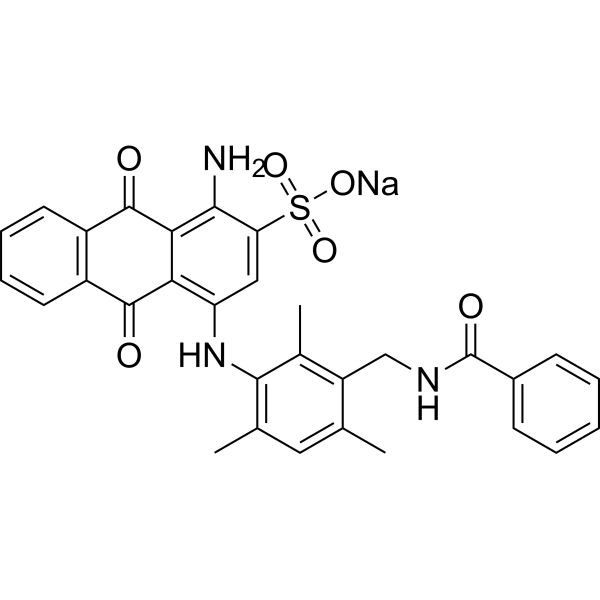 0 ImagesCat. No.: HY-D1144CAS No.: 67827-60-5Acid blue 260 is an azo dye whose staining effect is effectively removed by multi-walled carbon nanotubes (MWCNTs). At 298 K, the adsorption capacity of MWCNT is 233.34 mg/g; and increases with the increase of dye concentration and temperature.
-
FAM hydrazide, 6-isomer hydrochloride
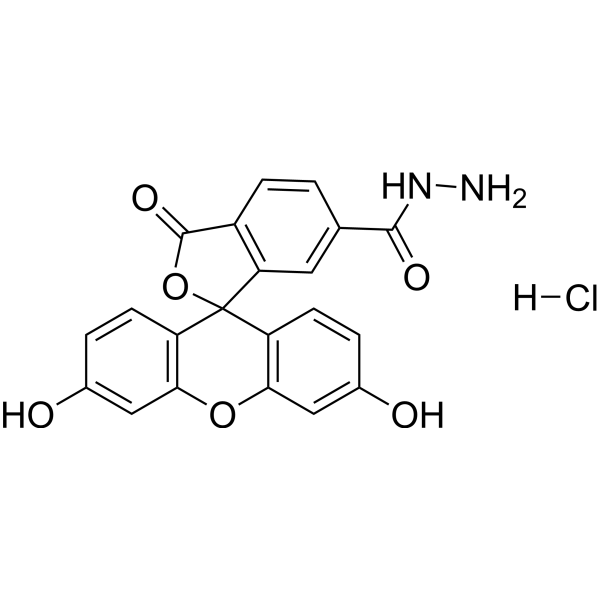 0 ImagesCat. No.: HY-132264CAS No.: 2183440-65-3FAM hydrazide, 6-isomer hydrochloride is a hydrazide derivative of fluorescein (FAM). FAM is a xanthene dye, a parent of fluorescein dye series. FAM hydrazide, 6-isomer hydrochloride can be used for the labeling of carbonyl compounds, aldehydes, and ketones.
-
JOE phosphoramidite, 6-isomer
 0 ImagesCat. No.: HY-W1061808JOE phosphoramidite (6-isomer) is a derivative of JOE (dimethoxy-dichloro-carboxyfluorescein) containing a phosphoramidite moiety, used in oligonucleotide synthesis. JOE phosphoramidite (6-isomer) is primarily employed in the synthesis of fluorescent oligonucleotide probes (Ex/Em = 520/548 nm).
-
Rhodamine B, tetramethyl-, isothiocyanate
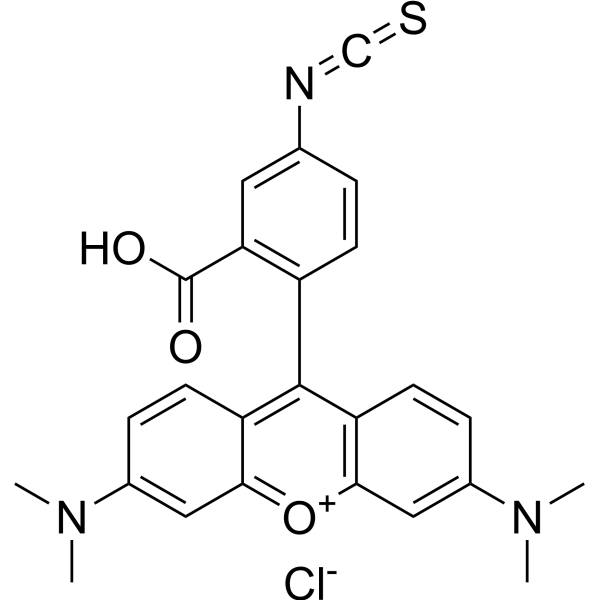 0 ImagesRhodamine B, tetramethyl-, isothiocyanate (Tetramethylrhodamine B isothiocyante) is a fluorescent dye. Rhodamine B, tetramethyl-, isothiocyanate has a strong two-photon absorption at about 830 nm.
-
RB-PEG400-NHS
 0 ImagesCat. No.: HY-D2884Synonyms: Rhodamine B-PEG400-NHSRB-PEG400-NHS (Rhodamine B-PEG400-NHS) is a fluorescent dye composed of Rhodamine B (HY-Y0016), PEG and a hydroxysuccinimide (NHS) group. The NHS group can react with amine-containing groups. RB-PEG400-NHS can be used for fluorescent labeling and imaging (Ex/Em=546/610 nm).
-
Elsinochrome A
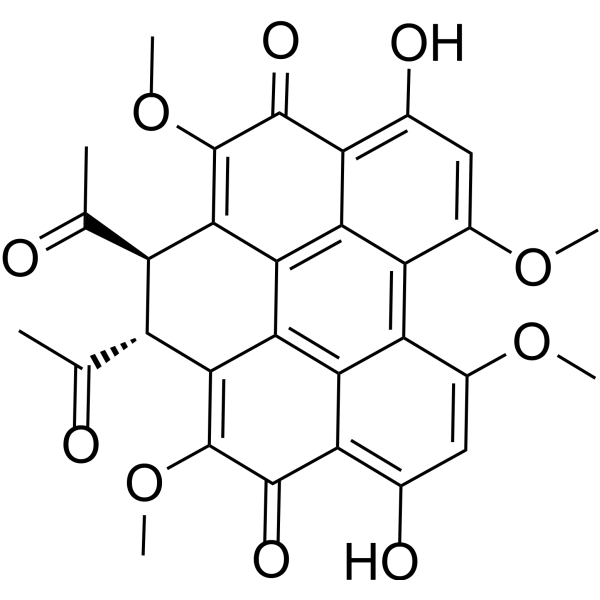 0 ImagesCat. No.: HY-N10611CAS No.: 24568-67-0Elsinochrome A is a perylene quinone photosensitizer, and can generate reactive oxygen species (ROS) to induce apoptosis and autophagy under light excitation. Elsinochrome A also shows antifungal activity against C. albicans biofilm through photodynamic antimicrobial chemotherapy (PACT). Elsinochrome A can be used for research of photodynamic therapy (PDT) (Ex: 460 nm).
-
DMTr-4'-F-5-Me-U-CED phosphoramidite
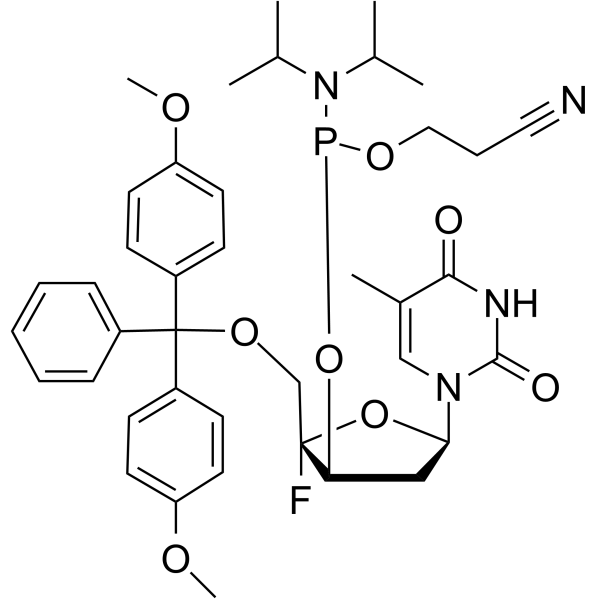 0 ImagesCat. No.: HY-D1410CAS No.: 2758388-05-3Synonyms: DMTr-4'-F-5-Methyluridine-CED phosphoramiditeDMTr-4'-F-5-Me-U-CED phosphoramidite (DMTr-4'-F-5-Methyluridine-CED phosphoramidite), a dye reagent for oligonucleotide labeling, acts as efficient as the incorporation of native deoxyribonucleoside phosphoramidites. DMTr-4'-F-5-Me-U-CED phosphoramidite is a building block.
-
Lycopersicon esculentum (Tomato) Lectin-AF594
 0 ImagesCat. No.: HY-NP071ESynonyms: LEL-AF594Lycopersicon esculentum (Tomato) Lectin-AF594 (LEL-AF594) is Lycopersicon esculentum lectin (LEL) labeled with the AF594 fluorescent dye. Lycopersicon esculentum (Tomato) lectin specifically recognizes and binds to glycan structures, primarily targeting N-acetyl-β-D-glucosamine residues. Lycopersicon esculentum (Tomato) Lectin-AF594 can be used to study glycosylation and localize glycan structures on cell surfaces and in tissue sections (Ex/Em = 590/617 nm).
-
Photoactive NTR probe
 0 ImagesCat. No.: HY-D3240CAS No.: 2375541-43-6Photoactive NTR probe (Compound 1) is a covalent crosslinker and Fluorescent indicator targeting Nitroreductase. The Photoactive NTR probe undergoes a sequential activation process: it is first activated via nitroreductase-mediated nitro-to-amino conversion, and then forms a fluorescent product upon photoactivation. The Photoactive NTR probe can form covalent adducts with the side chains of cysteine, tyrosine, lysine and histidine in adjacent proteins to reduce fluorophore diffusion. The Photoactive NTR probe enables super-resolution (STORM) imaging of active mitochondrial nitroreductase microdomains in living cells.
-
Rhodamine B-Dextran chloride (MW 3000)
 0 ImagesCat. No.: HY-D3047Rhodamine B-Dextran (MW 3000) is a Rhodamine B (HY-Y0016)-labeled dextran with a molecular weight of 3000. Rhodamine B-Chitosan (MW 3000) plays an important role in fluorescent labeling, cell imaging, vascular imaging, and drug delivery research (Ex/Em = 546/610 nm).
-
DNS-pE
 0 ImagesCat. No.: HY-125273CAS No.: 2196245-98-2DNS-pE is a 3-phosphoglycerate dehydrogenase (PHGDH) inhibitor with a Ki of 7.4 μM. DNS-pE selectively and irreversibly covalently modifies endogenous PHGDH in live mammalian cells, its vinyl sulfone moiety acts as a fluorescence quencher that becomes highly fluorescent upon covalent modification of PHGDH. DNS-pE can be used as a fluorescent dye for live-cell imaging.




