



Liposome
Liposomes (NPs typically 100–500 nm in diameter) are fabricated from the self-assembly of phospholipids, which consist of a polar phosphate head group and hydrophobic lipid tails. In aqueous environments, the hydrophobic tails self-orient, resulting in a spherical structure comprised of an aqueous core surrounded by a lipophilic bilayer membrane. Liposomes are both biocompatible and biodegradable (e.g., at certain pH and temperature), which can be controlled by modifying the lipid composition. Furthermore, liposomes are amenable to various modifications that improve their efficacy as drug delivery carriers.
All Product Categories
-
Liposome Related Products (1265)
Related Products (1265)

-
Cholesterol-PEG3400-Thiol
 0 ImagesCat. No.: HY-W440724Cholesterol-PEG3400-Thiol is an amphiphatic PEG derivative which forms micelles in water and can be used to prepare liposomes or nanoparticles for drug delivery system. The thiol moiety is reactive with maleimide to form a stable thioether bond.
-
Glucosamine Cholesterol
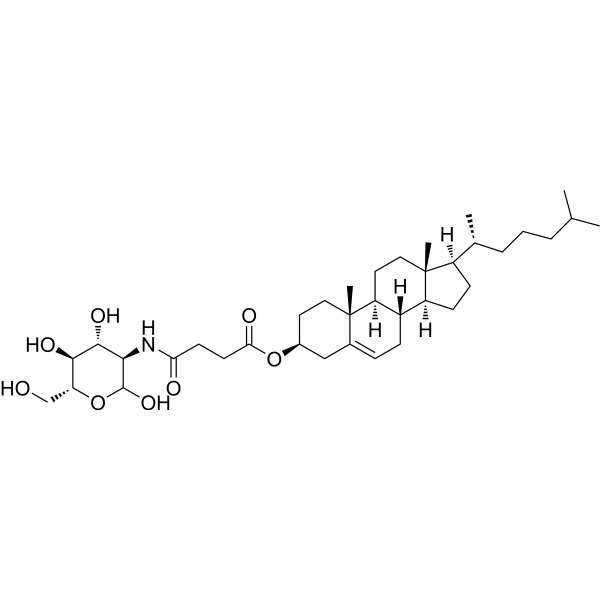 0 ImagesCat. No.: HY-160578CAS No.: 1257309-90-2Synonyms: N-Cholesteryl succinyl glucosamineGlucosamine Cholesterol (N-Cholesteryl succinyl glucosamine) is a glucosamine-based lipid conjugate, and can be used in the formation of lipid nanoparticles (LNPs).
-
Lipopeptide CPE4
 0 ImagesCat. No.: HY-P11455Lipopeptide CPE4 is a PEG-modified peptide E4 [(EIAALEK)4]. Lipopeptide CPE4 is capable of coiled-coil formation when attached to liposomes. Lipopeptide CPE4 triggers membrane fusion between liposomes and living cells with concomitant efficient cytosolic delivery of a variety of compounds such as fluorescent dyes Propidium Iodide (PI) (HY-D0815) and TO-PRO-3 iodide (HY-117070), and Doxorubicin (DOX) (HY-15142A). Lipopeptide CPE4 can be used for drug delivery research.
-
DSPE-PEG1000-TAASGVRSMH
 0 ImagesCat. No.: HY-172481DSPE-PEG1000-TAASGVRSMH is a PEG compound which composed of DSPE and TAASGVRSMH. TAASGVRSMH has a strong affinity for the NG2 proteoglycan on the PC membrane. DSPE-PEG1000-TAASGVRSMH can be used for drug delivery.
-
T Cell Lipid 15
 0 ImagesCat. No.: HY-188022CAS No.: 3024023-96-6T Cell Lipid 15 is an ionizable cationic lipid. T Cell Lipid 15 can be used to construct LNP targeting T cells. LNPs based on T Cell Lipid 15 induce reduced cytokine secretion, enable specific in vivo CD8+ T cell reprogramming, and cause minimal off-target transfection. T Cell Lipid 15 can be used for research on hematologic malignancies.
-
Lipopeptide CPK4
 0 ImagesCat. No.: HY-P11456Lipopeptide CPK4 is a Cholesterol (HY-N0322)-modified peptide K4 [(KIAALKE)3]. Lipopeptide CPK4 is capable of coiled-coil formation when attached to liposomes. Lipopeptide CPK4 triggers membrane fusion between liposomes and living cells with concomitant efficient cytosolic delivery of a variety of compounds such as fluorescent dyes Propidium Iodide (PI) (HY-D0815) and TO-PRO-3 iodide (HY-117070), and Doxorubicin (DOX) (HY-15142A). Lipopeptide CPK4 can be used for drug delivery research.
-
DSPE-PEG3400-NYZL1
 0 ImagesCat. No.: HY-172702ADSPE-PEG3400-NYZL1 is a PEG compound which composed of DSPE and a NYZL1 peptide. NYZL1 can specifically bind to bladder cancer tissues and cells. DSPE-PEG3400-NYZL1 can be used for drug delivery.
-
DSPE-PEG3000-LyP-1
 0 ImagesCat. No.: HY-172271B
-
Lipid N2-3L
 0 ImagesCat. No.: HY-169478CAS No.: 2924606-55-1Lipid N2-3L is an ionizable cationic lipid (pKa = 8.99) that can be used to generate supramolecular lipid nanoparticles (SMLNPs) for mRNA delivery. Lipid nanoparticles formed by encapsulating a luciferase reporter gene with Lipid N2-3L were detected to accumulate in the lymph nodes of mice, indicating that they can effectively enter the mouse immune system. Lipid nanoparticles formed by encapsulating ovalbumin mRNA and the TLR7/8 agonist Resiquimod (HY-13740) with Lipid N2-3L were able to reduce tumor volume and increase survival in the MC-38-OVA mouse colon cancer model. Lipid N2-3L can be used in the research of drug delivery for cancer-related therapies.
-
DSG-PEG3400-Mal
 0 ImagesCat. No.: HY-183126BDSG-PEG3400-Mal is a conjugate composed of DSG, PEG chains, and maleimide (Mal). The maleimide group in DSG-PEG3400-Mal can undergo a specific Michael addition reaction with thiol-containing (-SH) biomolecules (such as peptides, antibodies, and aptamers), enabling targeted modification of liposomes/nanoparticles.
-
DSPE-PEG1000-K237
 0 ImagesCat. No.: HY-172487DSPE-PEG1000-K237 is a PEG compound which composed of DSPE and a KDR targeting peptide (K237). K237 can functionally disrupt the interaction between VEGF and the KDR receptor and cause potent biological effects that include the inhibition of angiogenesis and tumor growth. DSPE-PEG1000-K237 can be used for drug delivery.
-
LNP Lipid-1
 0 ImagesCat. No.: HY-153136CAS No.: 2089253-13-2LNP Lipid-1 (Method B) is a lipid compound. LNP Lipid-1 is involved in the synthesis of lipid nanoparticles compositions. LNP Lipid-1 has potential applications in the transport of biologically active substances such as small molecule agents, proteins, and nucleic acids.
-
DSPE-PEG1000-CRPPR
 0 ImagesCat. No.: HY-177205ADSPE-PEG1000-CRPPR is a PEG compound which composed of DSPE and a?Heart-homing peptide?(CRPPR) (HY-P10641). CRPPR is a linear peptide containing arginine that has the ability to specifically bind to the cardiac endothelium and uses cysteine-rich protein-2 (CRIP-2) as its receptor. DSPE-PEG1000-CGKRK can be used for drug delivery.
-
DSPE-PEG13-TFP ester
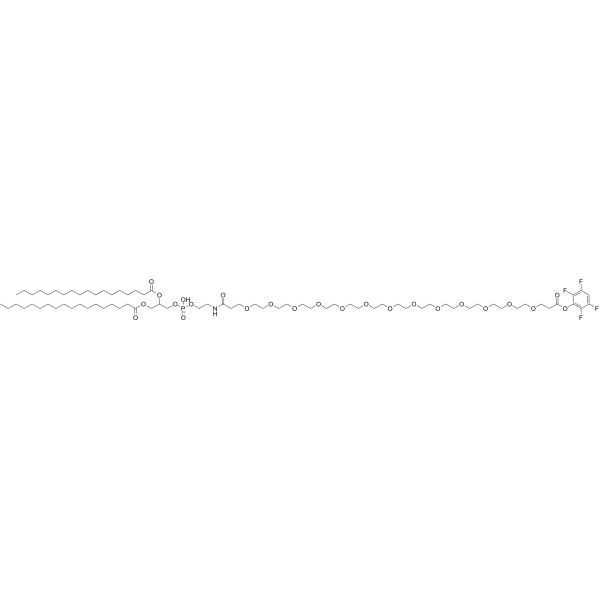 0 ImagesCat. No.: HY-140959CAS No.: 2413909-84-7
-
DSPE-PEG3400-Asp6
 0 ImagesCat. No.: HY-182092CDSPE-PEG3400-Asp6 is a PEG compound which composed of DSPE and a Asp6 peptide. DSPE-PEG3400-Asp6 achieves bone-targeted delivery of drugs or imaging agents by binding to bone tissue with the Asp6 peptide through high affinity.
-
DSPE-PEG5000-PP1
 0 ImagesCat. No.: HY-172709DSPE-PEG5000-PP1 is a PEG compound which composed of DSPE and a PP1 peptide. PP1 peptide targets the inflammatory atherosclerotic plaque. DSPE-PEG5000-PP1 can be used for drug delivery.
-
FO-35
 0 ImagesCat. No.: HY-171948FO-35 is an ionizable lipid that can be used to synthesize lipid nanoparticles (LNPs). FO-35 can be used to delivery mRNA to mouse muscle and nasal mucosa as well as ferret lungs.

-
DSG-PEG3400-Biotin
 0 ImagesCat. No.: HY-183170BDSG-PEG3400-Biotin is a conjugate composed of DSG, PEG chains, and biotin. DSG-PEG3400-Biotin combines the membrane compatibility of phospholipids with the high affinity of biotin for avidin/streptavidin, enabling applications such as targeted drug delivery systems and nanoparticle modification.
-
DSPE-PEG5000-CREKA
 0 ImagesCat. No.: HY-172498DSPE-PEG5000-CREKA is a PEG compound which composed of DSPE and a fibrin-targeting peptide (CREKA). CREKA peptide can be used to target tumor cells and tumor vasculature, exhibiting antitumor activity. DSPE-PEG5000-CREKA can be used for drug delivery.



