



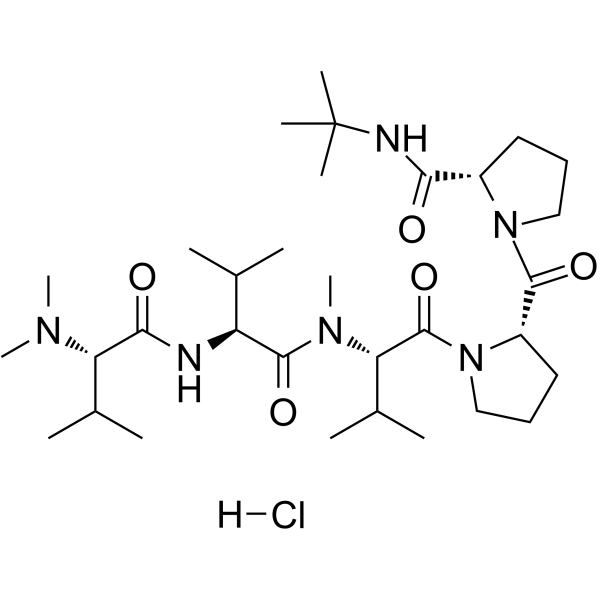
Tasidotin hydrochloride
Tasidotin hydrochloride is a peptide analog of the antimitotic depsipeptide dolastatin 15, as an inhibitor of microtubule assembly and microtubule dynamics.
商品は「研究用試薬」です。人や動物の医療用・臨床診断用・食品用の製品ではありません。
研究用途以外に使用した場合、当社は一切の責任を負いかねます。
- CAS 番号: 623174-20-9
- 分子式: C32H59ClN6O5
- 分子量:643.30
-
保管条件:
Please store the product under the recommended conditions in the Certificate of Analysis.

To place orders, for customer services and technical support, please contact: MedChemExpress USA
Tel: 609-228-6898 E-mail: [email protected] [email protected]


-
 生物活性
生物活性
-
化学情報
- プロトコル
- 純度とドキュメンテーション
- 参考文献
-
 Help & FAQs




生物活性
製品説明
IC50 & Target
Microtubule[1]
体外実験
Compared with other breast carcinoma lines, relatively low amounts of Tasidotin enters NCI/ADR-RES cells, consistent with Tasidotin's also being a P-glycoprotein substrate. Of the remaining lines, the greatest difference in sensitivity to Tasidotin is between the more sensitive MDA-MB-435 line and the less sensitive HS 578-T line. The IC50 values in the two lines are 4 and 200 nM, respectively[1]. The IC50 in Ewing's sarcoma, rhabdomyosarcoma, osteosarcoma, and synovial sarcoma lines ranges from 2 to 320 nM. In the SK-ES1 and RH30 cell lines, Tasidotin induces a G2-M arrest that persists for 48 h after Tasidotin is washed from the cells. In vitro, more than half the cells are in the early or late phase of apoptosis 48 h after treatment with Tasidotin. Following treatment for 24 h with 160 nM Tasidotin, the RH30 line and SK-ES1 line each shows an accumulation of cells in the G2-M phase. At hour 24, nearly all the RH30 cells are in the G2-M phase[2].
MedChemExpress (MCE) has not independently confirmed the accuracy of these methods. They are for reference only.
体内実験
MedChemExpress (MCE) has not independently confirmed the accuracy of these methods. They are for reference only.
臨床実験
| NCT Number | Sponsor | Condition | Start Date |
Phase

|
|---|---|---|---|---|
| NCT01329991 | Plexxikon| | 2011-05 | PHASE1 |


化学情報
-
CAS 番号 623174-20-9
-
分子量 643.30
-
分子式 C32H59ClN6O5
-
SMILES
[H]Cl.O=C(N1CCC[C@H]1C(NC(C)(C)C)=O)[C@H]2N(C([C@H](C(C)C)N(C([C@H](C(C)C)NC([C@H](C(C)C)N(C)C)=O)=O)C)=O)CCC2
-
別名
ILX651
-
輸送条件
Room temperature in continental US; may vary elsewhere.
-
保管条件
Please store the product under the recommended conditions in the Certificate of Analysis.

プロトコル
Kinase Assay[1]
MDA-MB-435 and HS 578-T breast carcinoma cells are grown in 25 mL of medium in Corning 75-cm2 culture flasks. For monolayer cells, when the cells are at near confluence, the medium is exchanged for 15 mL of fresh medium containing the indicated concentration of 0.1 μM [3H]Tasidotin, and the incubation continues for the indicated time. Monolayer cells are harvested by scraping them from the surface of the culture flask. For suspension cells, when the cells are in log phase and at approximately 106 cells/mL, the [3H]Tasidotin is added at the indicated concentration, and the incubation continued for the indicated time as specified in individual experiments. Suspension cells are harvested by centrifugation. Both types of cells are washed twice with PBS, pH 7.2. The cells are resuspended in 0.5 mL of water and disrupted by 10 s periods of sonication at 28 W, followed by 10 s pauses, for a total of 1 min. Protein content and radiolabel of all cell extracts are determined[1].
MedChemExpress (MCE) has not independently confirmed the accuracy of these methods. They are for reference only.
Cell Assay[2]
Growth inhibition is determined by the microculture tetrazolium method. Briefly, cells are seeded in 96 well flat-bottomed microtiter plates at a density of 500 cells per well in 100 μL of medium. After overnight incubation, 100 μL of medium containing Tasidotin are added to achieve specified final concentrations and a final volume of 200 μL/well. At 120 h, the relative metabolic activities of treated and untreated cells are measured by mitochondrial conversion of MTT to formazine. At the completion of the drug treatment, 250 μg of MTT are added to each well and incubated at 37°C, 5% CO2 for 6 h. Formazine crystals are dissolved in DMSO and absorbance at 595 nm is measured on a VERSAmax spectrophotometer. Absorbance values are normalized to the values obtained for the vehicle-treated cells to determine the percentage of survival. The IC50 is defined as the concentration at which absorbance of the treated cells is 50% that of the controls[2].
MedChemExpress (MCE) has not independently confirmed the accuracy of these methods. They are for reference only.
Animal Administration[2]
Mice[2]
CB17 female scid-/- mice are treated with Tasidotin daily for 5 days via i.p. injection starting on day 1 every 21 days for two cycles. Five non–tumor-bearing mice are assigned to each treatment group. Mice are treated with either 70, 80, 90, or 100 mg/kg/d Tasidotin. A toxic event is defined as weight loss ≥20% of the animal's weight at the time of randomization or death. The maximally tolerated dose (MTD) is defined as the highest dose at which no toxicity occurred.
MedChemExpress (MCE) has not independently confirmed the accuracy of these methods. They are for reference only.


純度とドキュメンテーション
参考文献
[1]. Bai R, et al. Intracellular activation and deactivation of Tasidotin, an analog of dolastatin 15: correlation with cytotoxicity. Mol Pharmacol. 2009 Jan;75(1):218-26. [Content Brief]
[2]. Garg V, et al. Preclinical analysis of Tasidotin HCl in Ewing's sarcoma, rhabdomyosarcoma, synovial sarcoma, and osteosarcoma. Clin Cancer Res. 2007 Sep 15;13(18 Pt 1):5446-54. [Content Brief]

Calculators
濃度 (開始) × 体積 (開始) = 濃度 (終了) × 体積 (終了)


Tasidotin hydrochloride 関連分類
HY-13760 関連分類
 Powered by Bioz