



Acid Ceramidase-IN-1
Based on 1 publication(s) in Google Scholar
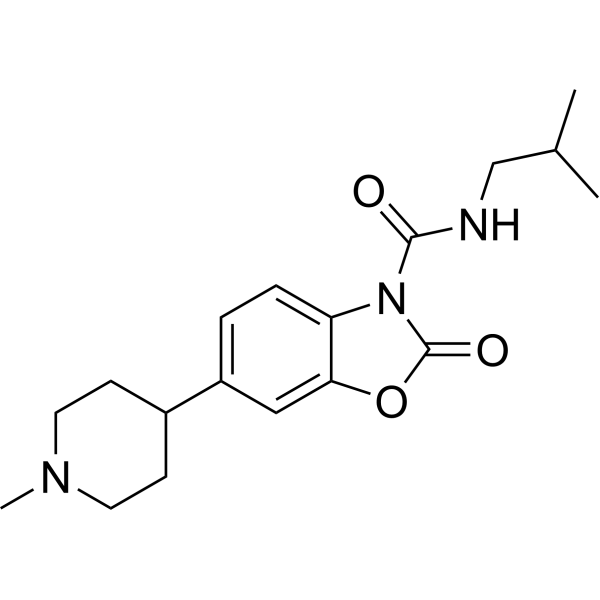
Acid Ceramidase-IN-1 is orally active and blood-brain barrier penetrant acid ceramidase (AC, ASAH-1) inhibitor (hAC IC50=0.166 μM). Acid Ceramidase-IN-1 reduces AC activity, accumulates ceramide species (Cer (d18:0/16:0), Cer (d18:1/16:0)), and decreases sphingosine levels. Acid Ceramidase-IN-1 can be used for the study of severe neurological lysosomal storage diseases (LSDs) such as Gaucher’s disease (GD) and Krabbe’s disease (KD).
Para uso exclusivo en investigación. No vendemos a pacientes.
- Pureza : 99.81%
- No. CAS: 2415225-30-6
- Fòrmula: C18H25N3O3
- Peso molecular:331.41
-
Almacenamiento:Powder -20°C, 3 years , 4°C, 2 years ; In solvent -80°C, 6 months , -20°C, 1 month

To place orders, for customer services and technical support, please contact: MedChemExpress USA
Tel: 609-228-6898 E-mail: [email protected] [email protected]


-
 Actividad biológica
-
Chemical Information
-
Solvente y solubilidad
- Pureza y Documentación
- Referencias
-
 Help & FAQs


Publications Citing Use of MedChemExpress (MCE) Acid Ceramidase-IN-1
More

Actividad biológica
Descripciòn
Cellular Effect
|
Cell Line

|
Type | Value | Description | References |
|---|---|---|---|---|
| HEK293 | IC50 |
0.07 μM
Compound: 22m
|
Inhibition of human FAAH expressed in HEK293 cells using AMC arachidonyl amide as fluorogenic substrate preincubated for 50 mins followed by substrate addition and measured after 45 mins by fluorescence based assay
Inhibition of human FAAH expressed in HEK293 cells using AMC arachidonyl amide as fluorogenic substrate preincubated for 50 mins followed by substrate addition and measured after 45 mins by fluorescence based assay
|
[PMID: 32176488] |
| HEK293 | IC50 |
0.166 μM
Compound: 22m
|
Inhibition of human acid ceramidase expressed in HEK293 cells using Rbm14-12 as substrate preincubated for 10 mins followed by substrate addition and measured after 3 hrs by fluorescence assay
Inhibition of human acid ceramidase expressed in HEK293 cells using Rbm14-12 as substrate preincubated for 10 mins followed by substrate addition and measured after 3 hrs by fluorescence assay
|
[PMID: 32176488] |
| HEK293 | IC50 |
8 μM
Compound: 22m
|
Inhibition of human NAAA expressed in HEK293 cells using PAMCA as fluorogenic substrate preincubated for 30 mins followed by substrate addition and measured after 50 mins by fluorescence based assay
Inhibition of human NAAA expressed in HEK293 cells using PAMCA as fluorogenic substrate preincubated for 30 mins followed by substrate addition and measured after 50 mins by fluorescence based assay
|
[PMID: 32176488] |
In Vitro
Acid Ceramidase-IN-1 (Compound 22m) (1-10 μM, 0.5-6 h) concentration-dependently and time-dependently reduces acid ceramidase (AC) activity in SH-SY5Y cells[1].
Acid Ceramidase-IN-1 shows weak inhibitory effect on human N-acylethanolamine acid amidase (hNAAA) (IC50 = 8.0 μM), inhibitory activity on human fatty acid amide hydrolyase (FAAH) (IC50 = 0.070 μM)[1].
Acid Ceramidase-IN-1 exhibits an EC50 of 0.41 μM in primary fibroblast cells[1].
MedChemExpress (MCE) has not independently confirmed the accuracy of these methods. They are for reference only.
Parmacokinetics
| Species | Dose | Route | Note | Tmax | Cmax | T1/2 | AUC | F | CL | Vdss |
|---|---|---|---|---|---|---|---|---|---|---|
| Mice[1] | 10 mg/kg | p.o. | plasma | 0.5 h | 216 ng/mL | 1.03 h | 412 ng·h/mL | 58.3 % | / | / |
| Mice[1] | 10 mg/kg | p.o. | brain | 1.00 h | 6900 ng/mL | 1.18 h | 14648 ng·h/mL | / | / | / |
| Mice[1] | 10 mg/kg | p.o. | CSF | 1.00 h | 52.2 ng/mL | 1.23 h | 119 ng·h/mL | / | / | / |
| Mice[1] | 3 mg/kg | i.v. | plasma | / | / | 1.26 h | 212 ng·h/mL | / | 14.1 L/h/kg | 12.5 L/kg |
| Mice[1] | 3 mg/kg | i.v. | brain | 0.250 h | 6443 ng/mL | 1.01 h | 10128 μg·h/mL | / | / | / |
| Mice[1] | 3 mg/kg | i.v. | CSF | 0.250 h | 71.6 ng/mL | 0.661 h | 77.8 ng·h/mL | / | / | / |
In Vivo
MedChemExpress (MCE) has not independently confirmed the accuracy of these methods. They are for reference only.
-
Animal Model:4L;C* mice (neuropathic Gaucher’s disease model, C57BL/6 J/129SvEV background) and Twitcher mice (Krabbe’s disease model, GALC⁻/⁻ genotype)[1]
-
Dosage:30, 90 mg/kg
-
Administration:i.p., once daily, 14 days
-
Result:Reduced brain GluSph (d18:1) levels.


Chemical Information
-
No. CAS 2415225-30-6
-
Appearance Solid
-
Peso molecular 331.41
-
Fòrmula C18H25N3O3
-
Color White to yellow
-
SMILES
O=C(N1C(OC2=CC(C3CCN(C)CC3)=CC=C12)=O)NCC(C)C
-
Envío
Room temperature in continental US; may vary elsewhere.
-
Almacenamiento
Powder -20°C 3 years 4°C 2 years In solvent -80°C 6 months -20°C 1 month


Publications (1)
-
Journal Impact Factor
-
Most Recent
-
Hum Mol Genet
Inhibition or genetic reduction of ASAH1/acid ceramidase restore α-synuclein clearance in mutant GBA1 dopamine neurons from Parkinson's patients. [Abstract]2025 Dec 4;34(24):2075-2087. PMID: 41224733


Solvente y solubilidad
In Vitro:
DMSO : 100 mg/mL (301.74 mM; ultrasonic and warming and heat to 80°C; Hygroscopic DMSO has a significant impact on the solubility of product, please use newly opened DMSO)
Please refer to the solubility information to select the appropriate solvent. Once prepared, please aliquot and store the solution to prevent product inactivation from repeated freeze-thaw cycles.
Storage method and period of stock solution: -80°C, 6 months; -20°C, 1 month. When stored at -80°C, please use it within 6 months. When stored at -20°C, please use it within 1 month.
Please refer to the solubility information to select the appropriate solvent. Once prepared, please aliquot and store the solution to prevent product inactivation from repeated freeze-thaw cycles.
Storage method and period of stock solution: -80°C, 6 months; -20°C, 1 month. When stored at -80°C, please use it within 6 months. When stored at -20°C, please use it within 1 month.
Concentration (start) × Volume (start) = Concentration (final) × Volume (final)
In Vivo:
Select the appropriate dissolution method based on your experimental animal and administration route.
- For the following dissolution methods, please ensure to first prepare a clear stock solution using an In Vitro approach and then sequentially add co-solvents:
- To ensure reliable experimental results, the clarified stock solution can be appropriately stored based on storage conditions. As for the working solution for In Vivo experiments, it is recommended to prepare freshly and use it on the same day.
- The percentages shown for the solvents indicate their volumetric ratio in the final prepared solution. If precipitation or phase separation occurs during preparation, heat and/or sonication can be used to aid dissolution.
Add each solvent one by one: 10% DMSO 40% PEG300 5% Tween-80 45% Saline
Solubility: 2.5 mg/mL (7.54 mM); Clear solution; Need ultrasonic
This protocol yields a clear solution of 2.5 mg/mL.
Taking 1 mL working solution as an example, add 100 μL DMSO stock solution (25.0 mg/mL) to 400 μL PEG300, and mix evenly; then add 50 μL Tween-80 and mix evenly; then add 450 μL Saline to adjust the volume to 1 mL.
Preparation of Saline: Dissolve 0.9 g sodium chloride in ddH₂O and dilute to 100 mL to obtain a clear Saline solution.
Add each solvent one by one: 10% DMSO 90% (20% SBE-β-CD in Saline)
Solubility: 2.5 mg/mL (7.54 mM); Clear solution; Need ultrasonic
This protocol yields a clear solution of 2.5 mg/mL.
Taking 1 mL working solution as an example, add 100 μL DMSO stock solution (25.0 mg/mL) to 900 μL 20% SBE-β-CD in Saline, and mix evenly.
Preparation of 20% SBE-β-CD in Saline (4°C, storage for one week): 2 g SBE-β-CD powder is dissolved in 10 mL Saline, completely dissolve until clear.
In Vivo Dissolution Calculator
Please enter the basic information of animal experiments:
-
-
-
-
Recommended: Prepare an additional quantity of animals to account for potential losses during experiments.
Please enter your animal formula composition:
-
%DMSO +
Recommended: Keep the proportion of DMSO in working solution below 2% if your animal is weak.
-
%+
-
+%Tween-80 + +
-
%Saline +
The co-solvents required include: DMSO, . All of co-solvents are available by MedChemExpress (MCE). , Tween 80. All of co-solvents are available by MedChemExpress (MCE).
Working solution concentration: 0.22 mg/mL
Method for preparing stock solution: mg drug dissolved in μL DMSO. Stock solution concentration: mg/mL.
1. Take μL DMSO stock solution;
2. Add μL .
μL , mix evenly;
3. Then add μL Tween 80, mix evenly;
4. Then add μL
Please ensure that the stock solution in the first step is dissolved to a clear state, and add co-solvents in sequence. You can use ultrasonic heating (ultrasonic cleaner, recommended frequency 20-40 kHz), vortexing, etc. to assist dissolution.


Pureza y Documentación
-
Ficha de datos (274 KB)
-
SDS (254 KB)
- English - EN (254 KB)
- Français - FR (254 KB)
- Deutsch - DE (254 KB)
- Norwegian - NO (254 KB)
- Español - ES (254 KB)
- Swedish - SV (254 KB)
- Italian - IT (254 KB)
- Korean - KR (254 KB)
- Portuguese - PT (254 KB)
-
Instrucciones de manejo (2659 KB)
Referencias


Complete Stock Solution Preparation Table
Please refer to the solubility information to select the appropriate solvent. Once prepared, please aliquot and store the solution to prevent product inactivation from repeated freeze-thaw cycles.
Storage method and period of stock solution: -80°C, 6 months; -20°C, 1 month. When stored at -80°C, please use it within 6 months. When stored at -20°C, please use it within 1 month.
| Optional Solvent | Concentration Solvent Mass | 1 mg | 5 mg | 10 mg | 25 mg |
|---|---|---|---|---|---|
| DMSO | 1 mM | 3.0174 mL | 15.0871 mL | 30.1741 mL | 75.4353 mL |
| 5 mM | 0.6035 mL | 3.0174 mL | 6.0348 mL | 15.0871 mL | |
| 10 mM | 0.3017 mL | 1.5087 mL | 3.0174 mL | 7.5435 mL | |
| 15 mM | 0.2012 mL | 1.0058 mL | 2.0116 mL | 5.0290 mL | |
| 20 mM | 0.1509 mL | 0.7544 mL | 1.5087 mL | 3.7718 mL | |
| 25 mM | 0.1207 mL | 0.6035 mL | 1.2070 mL | 3.0174 mL | |
| 30 mM | 0.1006 mL | 0.5029 mL | 1.0058 mL | 2.5145 mL | |
| 40 mM | 0.0754 mL | 0.3772 mL | 0.7544 mL | 1.8859 mL | |
| 50 mM | 0.0603 mL | 0.3017 mL | 0.6035 mL | 1.5087 mL | |
| 60 mM | 0.0503 mL | 0.2515 mL | 0.5029 mL | 1.2573 mL | |
| 80 mM | 0.0377 mL | 0.1886 mL | 0.3772 mL | 0.9429 mL | |
| 100 mM | 0.0302 mL | 0.1509 mL | 0.3017 mL | 0.7544 mL |


Acid Ceramidase-IN-1 Related Classifications
HY-141866 Related Classifications
 Powered by Bioz