



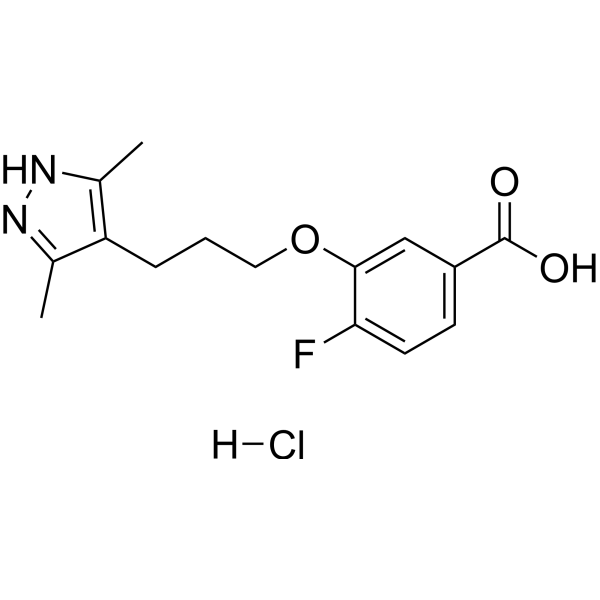
Acoramidis hydrochloride (Standard)
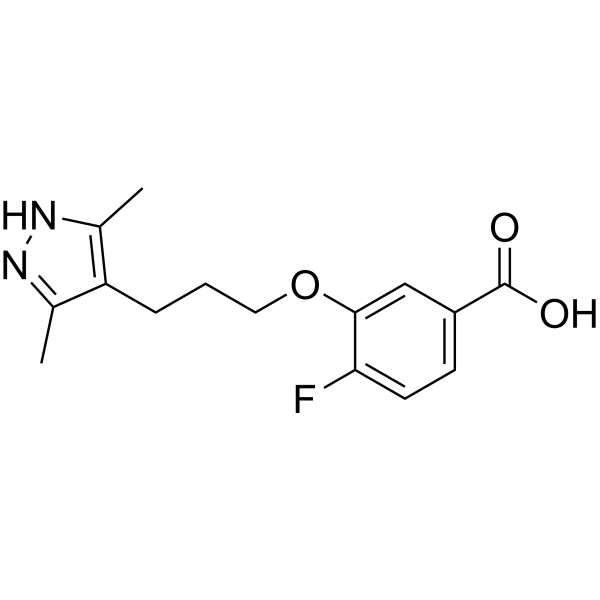
Acoramidis hydrochloride (Standard) is the analytical standard of Acoramidis (hydrochloride) (HY-109165A). This product is intended for research and analytical applications. Acoramidis (AG10) hydrochloride is an orally active and selective Kinetic stabilizer of WT and V122I-TTR (transthyretin). Acoramidis (AG10) hydrochloride is used in the study for transthyretin amyloidosis.
For research use only. We do not sell to patients.
- CAS No.: 2242751-53-5
- Formula: C15H18ClFN2O3
- Molecular Weight:328.77
-
Storage:
Please store the product under the recommended conditions in the Certificate of Analysis.


To place orders, for customer services and technical support, please contact: MedChemExpress USA
Tel: 609-228-6898 E-mail: [email protected] [email protected]


-
 Product Information
-
Chemical Information
- Purity & Documentation
-
 Help & FAQs




Product Information
Information
Application
The compound is the grade of analytical standard, which is the reference standard supplied assay. It is commonly used in qualitative, quantitative and methodological research experiments in HPLC, GC and MS.


Chemical Information
-
CAS No. 2242751-53-5
-
Molecular Weight 328.77
-
Formula C15H18ClFN2O3
-
SMILES
O=C(O)C1=CC=C(F)C(OCCCC2=C(C)NN=C2C)=C1.[H]Cl
-
Synonyms
AG10 hydrochloride (Standard)
-
Shipping
Room temperature in continental US; may vary elsewhere.
-
Storage
Please store the product under the recommended conditions in the Certificate of Analysis.


Purity & Documentation
References
[1]. Sravan C Penchala, et al. AG10 inhibits amyloidogenesis and cellular toxicity of the familial amyloid cardiomyopathy-associated V122I transthyretin. Proc Natl Acad Sci U S A. 2013 Jun 11;110(24):9992-7. [Content Brief]
[2]. Jonathan C Fox, et al. First-in-Human Study of AG10, a Novel, Oral, Specific, Selective, and Potent Transthyretin Stabilizer for the Treatment of Transthyretin Amyloidosis: A Phase 1 Safety, Tolerability, Pharmacokinetic, and Pharmacodynamic Study in Healthy Adult Volunteers. Clin Pharmacol Drug Dev. 2020 Jan;9(1):115-129. [Content Brief]
[3]. Stephen P Soltoff, et al. Evidence that tyrphostins AG10 and AG18 are mitochondrial uncouplers that alter phosphorylation-dependent cell signaling. J Biol Chem. 2004 Mar 19;279(12):10910-8. [Content Brief]

Calculators
Concentration (start) × Volume (start) = Concentration (final) × Volume (final)


Acoramidis hydrochloride (Standard) Related Classifications
HY-109165AR Related Classifications
 Powered by Bioz