



BRG1 Antibody (YA817)
(Synonyms: SMARCA4; BAF190A; BRG1; SNF2B; SNF2L4; Transcription activator BRG1; ATP-dependent helicase SMARCA4; BRG1-associated factor 190A; BAF190A; Mitotic growth and transcription activator; Protein BRG-1; Protein brahma homolog 1; SNF2-beta; SWI/S)Based on 1 Customer Validation
BRG1 Antibody (YA817) is a Mouse-derived and non-conjugated IgG1 monoclonal antibody, targeting to BRG1.
-
Host:
Mouse
-
Isotype:
IgG
-
Application:
WB, ICC/IF, IP
-
Reactivity :
Human, Mouse
-
Formulation:
Supplied in 1*PBS (pH 7.3), 50% glycerol and 0.5% BSA. Preservative: 0.02% sodium azide.
-
Conjugation:
Non-conjugated


To place orders, for customer services and technical support, please contact: MedChemExpress USA
Tel: 609-228-6898 E-mail: [email protected] [email protected]





Applications
| Application |
WB

WB: Western Blot
|
ICC/IF
ICC/IF: Immunocytochemistry/
Immunofluorescence |
IP
IP: Immunoprecipitation
|
|---|---|---|---|
| Dilution Ratio | 1:500-1:1000 | 1:50-1:200 | 1:20 |


Product Details
BRG1 Antibody (YA817) is a Mouse-derived and non-conjugated IgG1 monoclonal antibody, targeting to BRG1.
-
Host Mouse

-
Clonality Monoclonal

-
Species ReactivityHuman, Mouse
-
Observed Molecular WeightObserved band size: 220 kDa
Note: Due to possible protein modifications or aggregation, the molecular weight should be confirmed by actual measurement, and the predicted value is for reference only.

-
Calculated Molecular Weight Predicted band size: 185 kDa

Synthetic peptide corresponding to Human BRG1.The exact sequence is proprietary to MCE.
Endogenous
affinity purified
Non-conjugated
Unmodified
IgG


Product Properties
-
Appearance
Solution
-
Formulation
Supplied in 1*PBS (pH 7.3), 50% glycerol and 0.5% BSA. Preservative: 0.02% sodium azide.
-
Concentration
Batch-dependent, Please check the COA for the concentration of each lot. Check Lot Concentration
-
Storage & Stability
Stored at -20°C for 1 year. Avoid repeated freeze / thaw cycles.
-
Shipping
Shipping with blue ice.


Verification Images
-
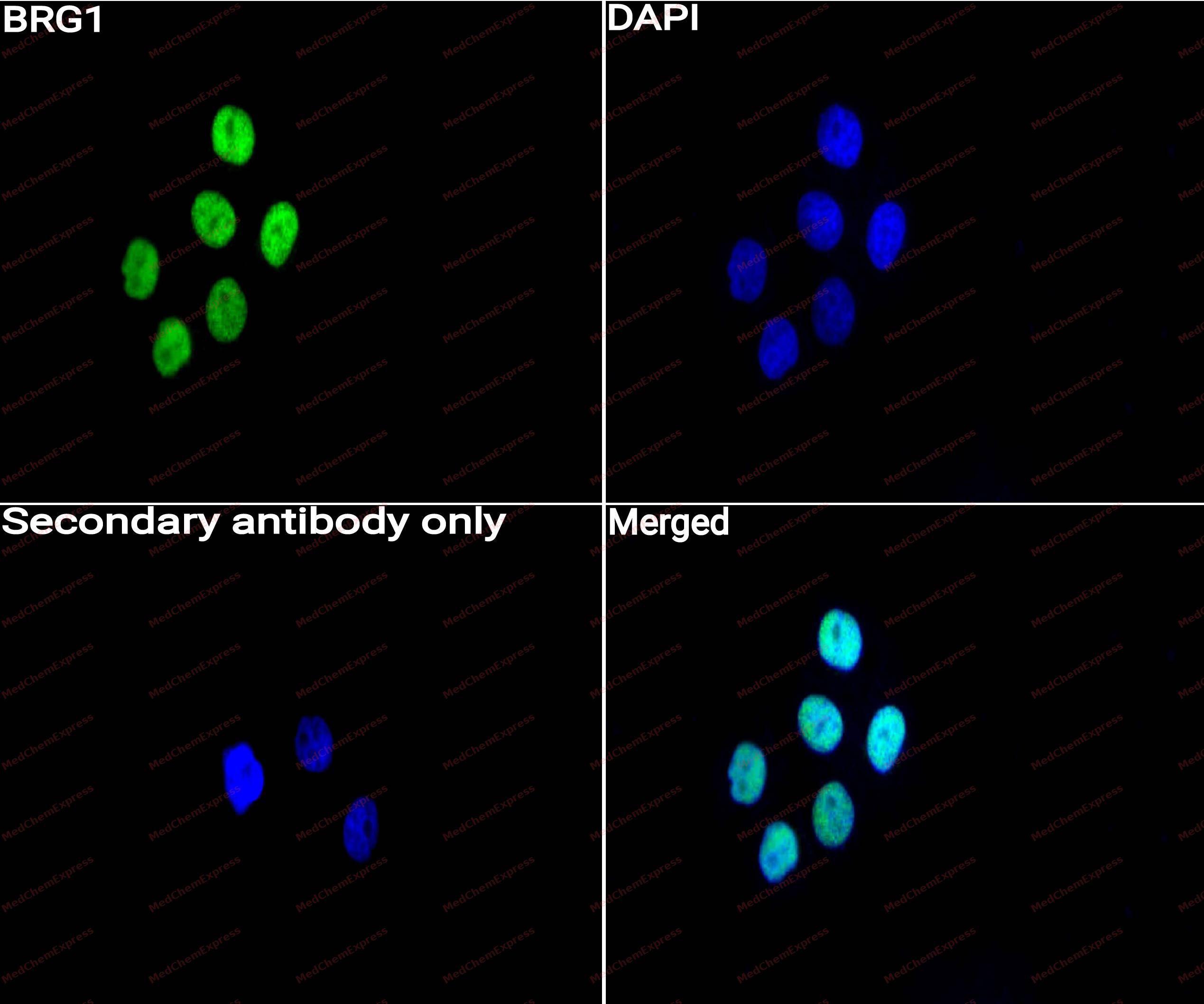 Immunocytochemistry analysis of Hela cells labeling BRG1 with BRG1 Antibody (HY-P80575) at 1/100 dilution. Cells were fixed in 4% paraformaldehyde for 15 minutes at room temperature, permeabilized with 0.1% Triton X-100 for 10 minutes at room temperature, then blocked with QuickBlock™ Blocking Buffer for Immunol Staining for 10 min at room temperature. Cells were then incubated with BRG1 Antibody (HY-P80575)at 1/100 dilution in QuickBlock™ Blocking Buffer for Immunol Staining at 4 ℃. Alexa Fluor® 488-conjugated AffiniPure Goat Anti-Mouse IgG H&L(HY-P8005,Green) was used as the secondary antibody at 1/1,000 dilution. PBS instead of the primary antibody was used as the secondary antibody only control. The Nuclear counterstain was DAPI (Blue).
 -
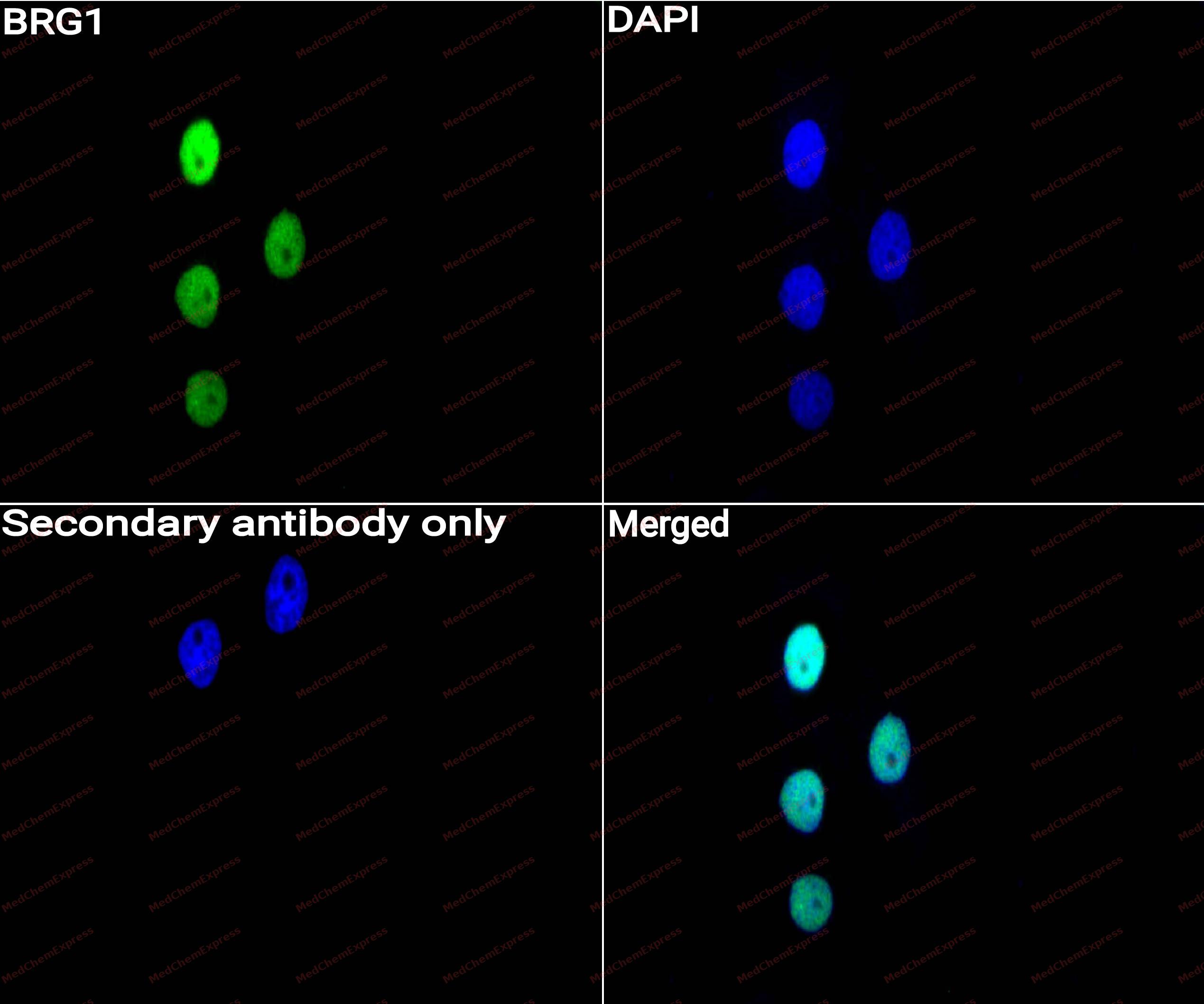 Immunocytochemistry analysis of Hela cells labeling BRG1 with BRG1 Antibody (HY-P80575) at 1/50 dilution. Cells were fixed in 4% paraformaldehyde for 15 minutes at room temperature, permeabilized with 0.1% Triton X-100 for 10 minutes at room temperature, then blocked with QuickBlock™ Blocking Buffer for Immunol Staining for 10 min at room temperature. Cells were then incubated with BRG1 Antibody (HY-P80575) at 1/50 dilution in QuickBlock™ Blocking Buffer for Immunol Staining at 4 ℃. Alexa Fluor® 488-conjugated AffiniPure Goat Anti-Mouse IgG H&L(HY-P8005, Green) was used as the secondary antibody at 1/1,000 dilution. PBS instead of the primary antibody was used as the secondary antibody only control. The Nuclear counterstain was DAPI (Blue).


Background
-
Function
BRG1 is an ATPase involved in transcriptional activation and repression of select genes by chromatin remodeling (alteration of DNA-nucleosome topology). Component of SWI/SNF chromatin remodeling complexes that carry out key enzymatic activities, changing chromatin structure by altering DNA-histone contacts within a nucleosome in an ATP-dependent manner. Component of the CREST-BRG1 complex, a multiprotein complex that regulates promoter activation by orchestrating the calcium-dependent release of a repressor complex and the recruitment of an activator complex. In resting neurons, transcription of the c-FOS promoter is inhibited by SMARCA4-dependent recruitment of a phospho-RB1-HDAC repressor complex. Upon calcium influx, RB1 is dephosphorylated by calcineurin, which leads to release of the repressor complex. At the same time, there is increased recruitment of CREBBP to the promoter by a CREST-dependent mechanism, which leads to transcriptional activation. The CREST-BRG1 complex also binds to the NR2B promoter, and activity-dependent induction of NR2B expression involves the release of HDAC1 and recruitment of CREBBP. Belongs to the neural progenitors-specific chromatin remodeling complex (npBAF complex) and the neuron-specific chromatin remodeling complex (nBAF complex). During neural development, a switch from a stem/progenitor to a postmitotic chromatin remodeling mechanism occurs as neurons exit the cell cycle and become committed to their adult state. The transition from proliferating neural stem/progenitor cells to postmitotic neurons requires a switch in subunit composition of the npBAF and nBAF complexes. As neural progenitors exit mitosis and differentiate into neurons, npBAF complexes which contain ACTL6A/BAF53A and PHF10/BAF45A, are exchanged for homologous alternative ACTL6B/BAF53B and DPF1/BAF45B or DPF3/BAF45C subunits in neuron-specific complexes (nBAF). The npBAF complex is essential for the self-renewal/proliferative capacity of the multipotent neural stem cells. The nBAF complex along with CREST plays a role regulating the activity of genes essential for dendrite growth. SMARCA4/BAF190A may promote neural stem cell self-renewal/proliferation by enhancing Notch-dependent proliferative signals, while concurrently making the neural stem cell insensitive to SHH-dependent differentiating cues. Acts as a corepressor of ZEB1 to regulate E-cadherin transcription and is required for induction of epithelial-mesenchymal transition (EMT) by ZEB1. Binds via DLX1 to enhancers located in the intergenic region between DLX5 and DLX6 and this binding is stabilized by the long non-coding RNA (lncRNA) Evf2. Binds to RNA in a promiscuous manner. In brown adipose tissue, involved in the regulation of thermogenic genes expression[1][2][3][4][5].
-
Subcellular Localization
Nucleus
-
Expression
Tissue_specificity:In established cell lines, ZEB1 colocalizes (at the protein level) with E-cadherin-negative cells, normal colonic matrix, and dedifferentiated epithelial cells at the invasive front of colorectal cancer. -
Isoforms & Post-Translational Modification
P51532 has 5 isomers: P51532-1: 184646 Da (predicted); P51532-2: 181348 Da (predicted); P51532-3: 181603 Da (predicted); P51532-4: 181690 Da (predicted); P51532-5: 181261 Da (predicted).
-
Subunit
Component of the multiprotein chromatin-remodeling complexes SWI/SNF: SWI/SNF-A (BAF), SWI/SNF-B (PBAF) and related complexes. The canonical complex contains a catalytic subunit (either SMARCA4/BRG1/BAF190A or SMARCA2/BRM/BAF190B) and at least SMARCE1, ACTL6A/BAF53, SMARCC1/BAF155, SMARCC2/BAF170, and SMARCB1/SNF5/BAF47. Other subunits specific to each of the complexes may also be present permitting several possible developmental- and tissue-specific combinations (PubMed:22952240, PubMed:26601204). Component of the BAF complex, which includes at least actin (ACTB), ARID1A/BAF250A, ARID1B/BAF250B, SMARCA2/BRM, SMARCA4/BRG1/BAF190A, ACTL6A/BAF53, ACTL6B/BAF53B, SMARCE1/BAF57, SMARCC1/BAF155, SMARCC2/BAF170, SMARCB1/SNF5/INI1, and one or more SMARCD1/BAF60A, SMARCD2/BAF60B, or SMARCD3/BAF60C. In muscle cells, the BAF complex also contains DPF3 (PubMed:18765789). Component of neural progenitors-specific chromatin remodeling complex (npBAF complex) composed of at least, ARID1A/BAF250A or ARID1B/BAF250B, SMARCD1/BAF60A, SMARCD3/BAF60C, SMARCA2/BRM/BAF190B, SMARCA4/BRG1/BAF190A, SMARCB1/BAF47, SMARCC1/BAF155, SMARCE1/BAF57, SMARCC2/BAF170, PHF10/BAF45A, ACTL6A/BAF53A and actin. Component of neuron-specific chromatin remodeling complex (nBAF complex) composed of at least, ARID1A/BAF250A or ARID1B/BAF250B, SMARCD1/BAF60A, SMARCD3/BAF60C, SMARCA2/BRM/BAF190B, SMARCA4/BRG1/BAF190A, SMARCB1/BAF47, SMARCC1/BAF155, SMARCE1/BAF57, SMARCC2/BAF170, DPF1/BAF45B, DPF3/BAF45C, ACTL6B/BAF53B and actin. Component of the SWI/SNF-B (PBAF) chromatin remodeling complex, at least composed of SMARCA4/BRG1, SMARCB1/BAF47/SNF5, ACTL6A/BAF53A or ACTL6B/BAF53B, SMARCE1/BAF57, SMARCD1/BAF60A, SMARCD2/BAF60B, perhaps SMARCD3/BAF60C, SMARCC1/BAF155, SMARCC2/BAF170, PBRM1/BAF180, ARID2/BAF200 and actin (PubMed:26601204). Component of SWI/SNF (GBAF) subcomplex, which includes at least BICRA or BICRAL (mutually exclusive), BRD9, SS18, SMARCA2/BRM, SMARCA4/BRG1/BAF190A, ACTL6A/BAF53, SMARCC1/BAF155, and SMARCD1/BAF60A (PubMed:29374058). Component of the BAF53 complex, at least composed of BAF53A, RUVBL1, SMARCA4/BRG1/BAF190A, and TRRAP, which preferentially acetylates histone H4 (and H2A) within nucleosomes (PubMed:11839798). Component of the CREST-BRG1 complex, at least composed of SMARCA4/BRG1/BAF190A, SS18L1/CREST, HDAC1, RB1 and SP1 (By similarity). Interacts with PHF10/BAF45A (By similarity). Interacts with MYOG (By similarity). Interacts directly with IKFZ1; the interaction associates IKFZ1 with the BAF complex (PubMed:10204490). Interacts with ZEB1 (via N-terminus) (PubMed:20418909). Interacts with NR3C1, PGR, SMARD1, TOPBP1 and ZMIM2/ZIMP7 (PubMed:12917342, PubMed:15075294, PubMed:16051670, PubMed:9590696). Interacts with (via the bromodomain) with TERT; the interaction regulates Wnt-mediated signaling (PubMed:19571879). Interacts with TBX21 in a KDM6B-dependent manner (By similarity). Interacts with KDM6A and KDM6B (By similarity). Interacts with HNRNPU; this interaction occurs in embryonic stem cells and stimulates global Pol II-mediated transcription (By similarity). Interacts with ACTL6A (PubMed:28649782). Interacts with DLX1 (By similarity). Interacts with DPF2 (PubMed:20460684). Interacts with DPF3a (isoform 2 of DPF3/BAF45C) and with HDGFL2 in a DPF3a-dependent manner (PubMed:32459350). May interact with ADNP2 (PubMed:23071114). Interacts with LETMD1 (via C-terminal); the interaction regulates transcriptional expression of thermogenic genes in brown adipose tissue (By similarity). Interacts (via KIKL motif) with BRD3 (via NET domain) (PubMed:29567837)
-
SwissProt ID
-
Synonyms
SMARCA4; BAF190A; BRG1; SNF2B; SNF2L4; Transcription activator BRG1; ATP-dependent helicase SMARCA4; BRG1-associated factor 190A; BAF190A; Mitotic growth and transcription activator; Protein BRG-1; Protein brahma homolog 1; SNF2-beta; SWI/S
-
Research Field
Neuroscience


Documentation
-
Data Sheet (262 KB)
-
SDS (252 KB)
- English - EN (252 KB)
- Français - FR (252 KB)
- Deutsch - DE (252 KB)
- Norwegian - NO (252 KB)
- Español - ES (252 KB)
- Swedish - SV (252 KB)
- Italian - IT (252 KB)
- Korean - KR (252 KB)
- Portuguese - PT (252 KB)
-
User Guide for Antibodies (1077 KB)
References
[1]. Liu K, et al. TopBP1 recruits Brg1/Brm to repress E2F1-induced apoptosis, a novel pRb-independent and E2F1-specific control for cell survival. Genes Dev. 2004 Mar 15;18(6):673-86. [Content Brief]
[2]. Alpsoy A, et al. Glioma tumor suppressor candidate region gene 1 (GLTSCR1) and its paralog GLTSCR1-like form SWI/SNF chromatin remodeling subcomplexes. J Biol Chem. 2018 Mar 16;293(11):3892-3903. [Content Brief]
[3]. Papillon JPN, et al. Discovery of Orally Active Inhibitors of Brahma Homolog (BRM)/SMARCA2 ATPase Activity for the Treatment of Brahma Related Gene 1 (BRG1)/SMARCA4-Mutant Cancers. J Med Chem. 2018 Nov 21;61(22):10155-10172. [Content Brief]
[4]. Zhu X, et al. HRP2-DPF3a-BAF complex coordinates histone modification and chromatin remodeling to regulate myogenic gene transcription. Nucleic Acids Res. 2020 Jul 9;48(12):6563-6582. [Content Brief]
[5]. Sánchez-Tilló E, et al. ZEB1 represses E-cadherin and induces an EMT by recruiting the SWI/SNF chromatin-remodeling protein BRG1. Oncogene. 2010 Jun 17;29(24):3490-500. [Content Brief]

 Powered by Bioz
