



CCR9 Antibody (YA3119)
(Synonyms: G-protein coupled receptor 28; GPR-9-6; CDw199; CCR9)
Based on 1 Customer Validation
CCR9 Antibody (YA3119) is a Rabbit-derived and non-conjugated IgG monoclonal antibody, targeting to CCR9.
-
Host:
Rabbit
-
Isotype:
IgG
-
Application:
WB, ICC/IF, FC
-
Reactivity :
Human, Mouse, Rat
-
Formulation:
Supplied in rabbit IgG in 50mM Tris-Glycine(pH 7.4), 0.15M NaCl, 40%Glycerol, 0.01% sodium azide and 0.05% BSA.
-
Conjugation:
Non-conjugated


To place orders, for customer services and technical support, please contact: MedChemExpress USA
Tel: 609-228-6898 E-mail: [email protected] [email protected]





Applications
| Application |
WB

WB: Western Blot
|
ICC/IF
ICC/IF: Immunocytochemistry/
Immunofluorescence |
FC
FC: Flow Cytometry
|
|---|---|---|---|
| Dilution Ratio | 1:500-1:1000 | 1:50-1:200 | 1:50-1:100 |


Product Details
CCR9 Antibody (YA3119) is a Rabbit-derived and non-conjugated IgG monoclonal antibody, targeting to CCR9.
-
Host Rabbit

-
Clonality Recombinant,Monoclonal

-
Species ReactivityHuman, Mouse, Rat
-
Observed Molecular WeightObserved band size: 45 kDa
Note: Due to possible protein modifications or aggregation, the molecular weight should be confirmed by actual measurement, and the predicted value is for reference only.

-
Calculated Molecular Weight Predicted band size: 42 kDa

Entrez Gene: 10803 Human ; 12769 Mouse ; 282832 Rat
SwissProt: P51686 Human ; Q9WUT7 Mouse ;
OMIM: 604738 Human
A synthesized peptide derived from human CCR9 aa1-48.
Endogenous
Affinity Chromatography
Non-conjugated
Unmodified
IgG


Product Properties
-
Appearance
Solution
-
Formulation
Supplied in rabbit IgG in 50mM Tris-Glycine(pH 7.4), 0.15M NaCl, 40%Glycerol, 0.01% sodium azide and 0.05% BSA.
-
Concentration
Batch-dependent, Please check the COA for the concentration of each lot. Check Lot Concentration
-
Storage & Stability
Stored at -20°C for 1 year. Avoid repeated freeze / thaw cycles.
-
Shipping
Shipping with blue ice.


Verification Images
-
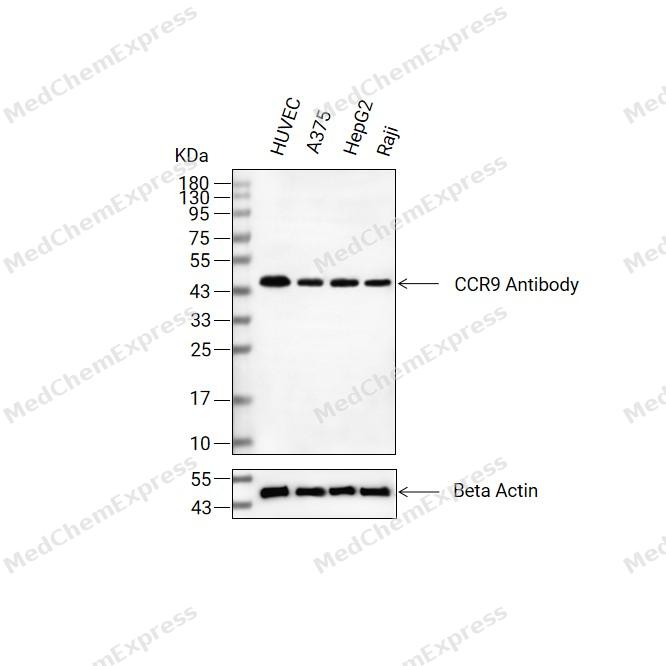 Western blot analysis of extracts from HUVEC(lane 2(20ug) , A375(lane 3(20ug) and HepG2(lane 4(20ug) , Raji(lane 5(20ug) using CCR9 Antibody(HY-P83374) Rabbit mAb. Proteins were transferred to a PVDF membrane and blocked with 5% non-fat milk in TBST for 2 hour at room temperature. The primary antibody (1/1000) and Loading control antibody (Beta Actin, HY-P83730, 1/10000) was used in 5% non-fat milk in TBST at 4°C overnight. Goat Anti-Mouse/Rabbit IgG-HRP Secondary Antibody (1/10000) was used for 1 hour at room temperature.
 -
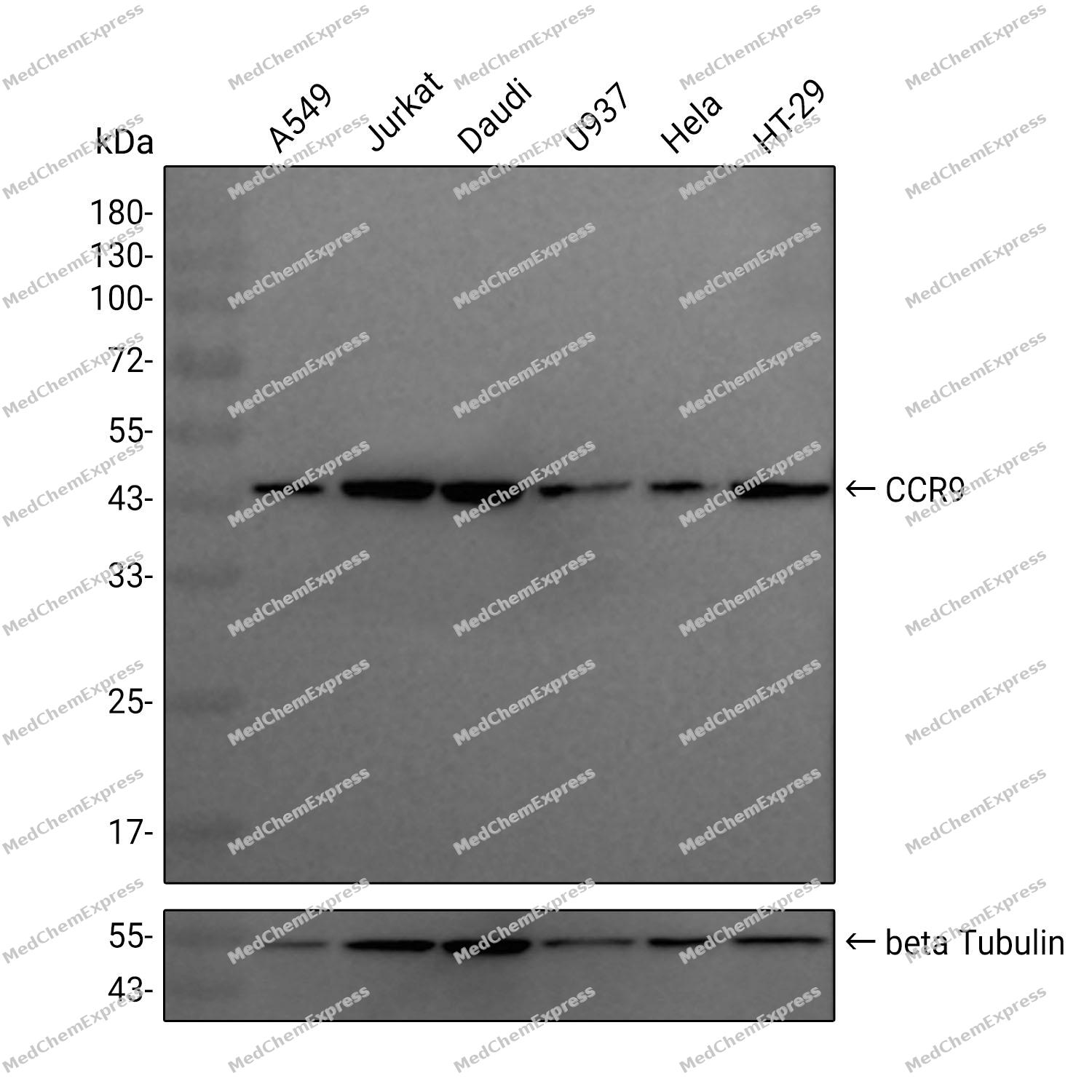 Western blot analysis was performed on extracts from A549 (lane 1, 15 μg), Jurkat (lane 2, 15 μg), Daudi (lane 3, 15 μg), U937 (lane 4, 15 μg), Hela (lane 5, 15 μg), and HT-29 (lane 6, 15 μg) using CCR9 Rabbit mAb. Proteins were transferred to a PVDF membrane and blocked with 5% non - fat milk in TBST at 4°C overnight. The primary antibody (1:1000 dilution) and the loading control antibody (beta-Tubulin(HRP), HY-P80955A, 1:5000 dilution) was incubated in 5% non-fat milk in TBST for 1 hour at 37°C. Goat Anti - Rabbit IgG - HRP Secondary Antibody (1:20000 dilution) was then applied for 40 minutes at 37°C.
 -
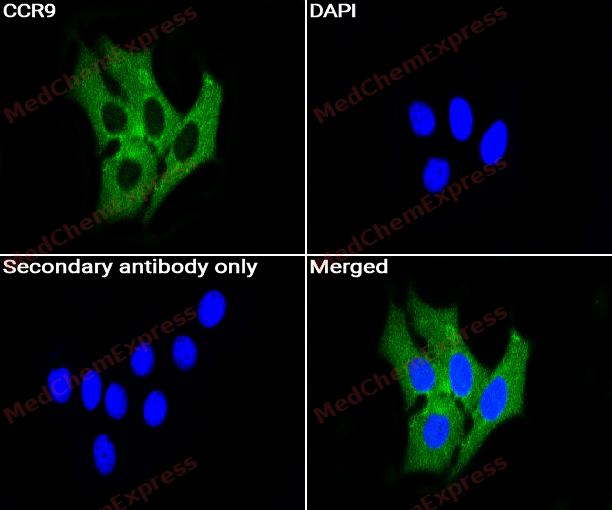 Immunocytochemistry analysis of HeLa cells labeling CCR9 with CCR9 Antibody (HY-P83374) at 1/100 dilution. Cells were fixed in 4% paraformaldehyde for 15 minutes at room temperature, permeabilized with 0.1% Triton X-100 for 10 minutes at room temperature, then blocked with BSA for Immunol Staining for 10 min at room temperature. Cells were then incubated with CCR9 Antibody (HY-P83374) at 1/100 dilution in BSA for Immunol Staining at 4 ℃ overnight. AF488-conjugated AffiniPure Goat Anti-Rabbit IgG H&L(HY-P8002,Green) was used as the secondary antibody at 1/1,000 dilution. PBS instead of the primary antibody was used as the secondary antibody only control. The Nuclear counterstain was DAPI (Blue).
 -
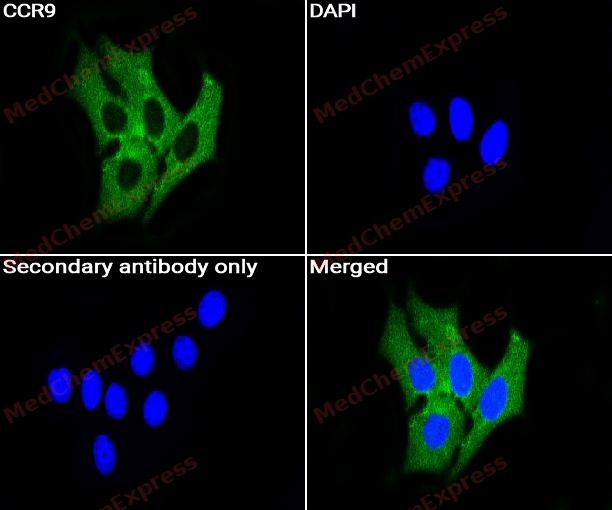 Immunocytochemistry analysis of HeLa cells labeling CCR9 with CCR9 Antibody (HY-P83374) at 1/50 dilution. Cells were fixed in 4% paraformaldehyde for 15 minutes at room temperature, permeabilized with 0.1% Triton X-100 for 10 minutes at room temperature, then blocked with BSA for Immunol Staining for 10 min at room temperature. Cells were then incubated with CCR9 Antibody (HY-P83374) at 1/50 dilution in BSA for Immunol Staining at 4 ℃ overnight. AF488-conjugated AffiniPure Goat Anti-Rabbit IgG H&L(HY-P8002, Green) was used as the secondary antibody at 1/1,000 dilution. PBS instead of the primary antibody was used as the secondary antibody only control. The Nuclear counterstain was DAPI (Blue).


Background
-
Function
CCR9 (C-C chemokine receptor type 9) is a G protein-coupled receptor that mediates the migration and localization of lymphocytes, particularly thymocytes, to the small intestine[1][2]. Mechanistically, CCR9 interacts with its ligand, chemokine ligand 25 (CCL25), to direct effector and regulatory T-cell trafficking, which is critical for maintaining intestinal immune homeostasis[2]. In disease models, CCR9 deficiency or blockade in TNFΔARE mice exacerbates Crohn's-like ileitis due to reduced recruitment of CD4+/CD25+/FOXP3+ and CD8+/CD103+ T regulatory cells, indicating its essential role in controlling intestinal inflammation[2]. Compared with related chemokine receptor isoforms such as CCR2A and CCR2B, CCR9 exhibits tissue-specific expression and a unique gut-homing function, distinguishing it from receptors primarily involved in systemic monocyte recruitment[3][4]. Pharmacologically, selective small-molecule CCR9 antagonists such as vercirnon and CCX507 bind intracellular allosteric sites, preventing G-protein coupling, and have been explored for treating inflammatory bowel disease, although high doses are required to achieve effective receptor blockade[5][6]. CCR9 inhibitors in combination with integrin α4β7 blockade show synergistic protective effects in colitis models, highlighting potential combinatorial therapeutic strategies[5][7].
-
Subcellular Localization
Cell membrane; Multi-pass membrane protein
-
Expression
Tissue_specificity:Highly expressed in the thymus and low in lymph nodes and spleen -
Isoforms & Post-Translational Modification
P51686 has 2 isomers: P51686-1: 42016 Da (predicted); P51686-2: 40713 Da (predicted).
-
SwissProt ID
-
Synonyms
G-protein coupled receptor 28; GPR-9-6; CDw199; CCR9
-
Research Field
Immunology


Documentation
-
Data Sheet (262 KB)
-
SDS (251 KB)
- English - EN (251 KB)
- Français - FR (251 KB)
- Deutsch - DE (251 KB)
- Norwegian - NO (251 KB)
- Español - ES (251 KB)
- Swedish - SV (251 KB)
- Italian - IT (251 KB)
- Korean - KR (251 KB)
- Portuguese - PT (251 KB)
-
User Guide for Antibodies (1077 KB)
References
[1]. Kalindjian SB, et al. A New Series of Orally Bioavailable Chemokine Receptor 9 (CCR9) Antagonists; Possible Agents for the Treatment of Inflammatory Bowel Disease. J Med Chem. 2016 Apr 14;59(7):3098-111. [Content Brief]
[3]. CCR9 (chemokine (C-C motif) receptor 9). Atlas Genet Cytogenet Oncol Haematol. 2009.
[4]. Oswald C, et al. Intracellular allosteric antagonism of the CCR9 receptor. Nature. 2016 Dec 15;540(7633):462-465. [Content Brief]
[5]. Cho ML, et al. Expression of CCR2A, an isoform of MCP-1 receptor, is increased by MCP-1, CD40 ligand and TGF-beta in fibroblast like synoviocytes of patients with RA. Exp Mol Med. 2007 Aug 31;39(4):499-507. [Content Brief]
[6]. Wermers JD, et al. The chemokine receptor CCR9 is required for the T-cell-mediated regulation of chronic ileitis in mice. Gastroenterology. 2011 May;140(5):1526-35.e3. [Content Brief]
[7]. Tanaka S, et al. Differential expression of the isoforms for the monocyte chemoattractant protein-1 receptor, CCR2, in monocytes. Biochem Biophys Res Commun. 2002 Jan 11;290(1):73-80. [Content Brief]

 Powered by Bioz
