



CD16 Antibody
(Synonyms: FCG3A_HUMAN; Low affinity immunoglobulin gamma Fc region receptor III-A; CD16a antigen; Fc-gamma RIII-alpha; Fc-gamma RIII; Fc-gamma RIIIa; FcRIII; FcRIIIa; FcR-10; IgG Fc receptor III-2; CD_antigen: D16a; FCGR3A; CD16A; FCG3; FCGR3; IGFR3.)
Based on 1 Customer Validation
CD16 Antibody is a Rabbit-derived and non-conjugated IgG polyclonal antibody, targeting to CD16.
-
Host:
Rabbit
-
Isotype:
IgG
-
Application:
WB, ELISA, IHC-P, IHC-F, FC, ICC/IF
-
Reactivity :
Human, Mouse, Rat
-
Formulation:
Supplied in 0.01M TBS(pH7.4) with 1% BSA, 0.03% Proclin300 and 50% Glycerol.
-
Conjugation:
Non-conjugated


To place orders, for customer services and technical support, please contact: MedChemExpress USA
Tel: 609-228-6898 E-mail: [email protected] [email protected]





Applications
| Application |
WB

WB: Western Blot
|
ELISA
ELISA: Enzyme Linked Immunosorbent Assay
|
IHC-P
IHC-P: Immunohistochemistry-Paraffin
|
IHC-F
IHC-F: Immunohistochemistry-Frozen
|
FC
FC: Flow Cytometry
|
ICC/IF
ICC/IF: Immunocytochemistry/
Immunofluorescence |
|---|---|---|---|---|---|---|
| Dilution Ratio | 1:500-2000 | 1:5000-10000 | 1:100-500 | 1:100-500 | 1ug:Test | 1:100-500 |


Product Details
CD16 Antibody is a Rabbit-derived and non-conjugated IgG polyclonal antibody, targeting to CD16.
-
Host Rabbit

-
Clonality Polyclonal

-
Species ReactivityHuman, Mouse, Rat Predicted Reactivity: Pig,Cow,Rabbit,Sheep
Note: The predicted reactivity is for reference only and should not be considered a guarantee of product performance.
-
Observed Molecular WeightObserved band size: 50-65 kDa
Note: Due to possible protein modifications or aggregation, the molecular weight should be confirmed by actual measurement, and the predicted value is for reference only.

-
Calculated Molecular Weight Predicted band size: 27kDa

KLH conjugated synthetic peptide derived from human IGFR3/CD16: 131-230/254
Endogenous
affinity purified
Non-conjugated
Unmodified
IgG


Product Properties
-
Appearance
Solution
-
Formulation
Supplied in 0.01M TBS(pH7.4) with 1% BSA, 0.03% Proclin300 and 50% Glycerol.
-
Concentration
Batch-dependent, Please check the COA for the concentration of each lot. Check Lot Concentration
-
Storage & Stability
Stored at -20°C for 1 year. Avoid repeated freeze / thaw cycles.
-
Envío
Shipping with blue ice.


Verification Images
-
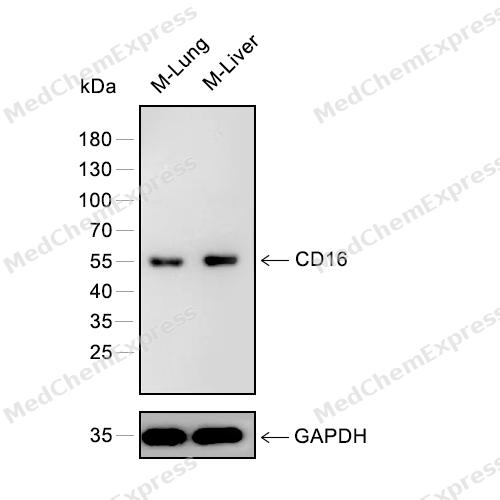 Western blot analysis of extracts from M-Lung (lane 1) and M-Liver (lane 2) using CD16 antibody. Proteins were transferred to a PVDF membrane and blocked with 5% nonfat powdered milk in PBST for 2 hour at room temperature. The primary antibody (1/2000) and Loading control antibody (GAPDH, 1/3000) was diluted with 5% nonfat powdered milk in PBST at 4°C overnight. Goat Anti-Rabbit IgG-HRP Secondary Antibody (1/8,000) was incubated for 45min at room temperature.
 -
 Immunocytochemistry analysis of U2OS cells labeling CD16 with CD16 Antibody (HY-P81202) at 1/100 dilution. Cells were fixed in 4% paraformaldehyde for 15 minutes at room temperature, permeabilized with 0.1% Triton X-100 in PBS for 15 minutes at room temperature, then blocked with quick block buffer for 10 minutes at room temperature. Cells were then incubated with CD16 Antibody (HY-P81202) at 1/100 dilution in quick block buffer overnight at 4 ℃. AF488-conjugated Goat Anti-Rabbit IgG H&L(HY-P8002, Green) was used as the secondary antibody at 1/1,000 dilution. PBS instead of the primary antibody was used as the secondary antibody only control. The Nuclear counterstain was DAPI (Blue).
 -
 Immunocytochemistry analysis of U2OS cells labeling CD16 with CD16 Antibody (HY-P81202) at 1/400 dilution. Cells were fixed in 4% paraformaldehyde for 15 minutes at room temperature, permeabilized with 0.1% Triton X-100 in PBS for 15 minutes at room temperature, then blocked with quick block buffer for 10 minutes at room temperature. Cells were then incubated with CD16 Antibody (HY-P81202) at 1/400 dilution in quick block buffer overnight at 4 ℃. AF488-conjugated Goat Anti-Rabbit IgG H&L(HY-P8002, Green) was used as the secondary antibody at 1/1,000 dilution. PBS instead of the primary antibody was used as the secondary antibody only control. The Nuclear counterstain was DAPI (Blue).


Background
-
Function
CD16 (FcγRIII) is a low-affinity IgG Fc receptor, including two isoforms: CD16A (FCGR3A) and CD16B (FCGR3B). CD16A is mainly expressed on NK cells, monocytes, and macrophages, and mediates ITAM signaling through the FcRγ chain, playing roles such as antibody-dependent cytotoxicity (ADCC), phagocytosis, and inflammatory activation. CD16B is mainly expressed on neutrophils and participates in the binding and clearance of IgG immune complexes. CD16 has important value in tumor immunology, antibody drug development, infection, and autoimmune disease research.
-
Subcellular Localization
Cell membrane; Single-pass type I membrane protein; Secreted
-
Expression
Tissue_specificity:Expression (protein level) in natural killer cells (PubMed: 2526846) . Expression (protein level) in some circulating monocytes (PubMed: 27670158) .
Induction:Up-regulated in a monocyte subset upon exposure to IL10, TGFB and MCSF
Positive sample: Human peripheral blood granulocytes. -
Subunit
Forms a heterooligomeric complex with ITAM-containing signaling subunits, either a homodimer of CD247, a homodimer of FCER1G or a heterodimer of CD247 and FCER1G. Interacts (via transmembrane domain) with signaling subunits; this interaction is a prerequisite for receptor complex expression on the cell surface and intracellular signal transduction. Binds the Fc region of antigen-complexed IgG with a preference for IgG1 and IgG3 isotypes. Interacts with CD2; this interaction is involved in NK cell activation and cytotoxicity. Interacts with S100A4; this interaction inhibits PKC-dependent phosphorylation of FCGR3A.
-
SwissProt ID
-
Synonyms
FCG3A_HUMAN; Low affinity immunoglobulin gamma Fc region receptor III-A; CD16a antigen; Fc-gamma RIII-alpha; Fc-gamma RIII; Fc-gamma RIIIa; FcRIII; FcRIIIa; FcR-10; IgG Fc receptor III-2; CD_antigen: D16a; FCGR3A; CD16A; FCG3; FCGR3; IGFR3.


Documentación
-
Ficha de datos (267 KB)
-
SDS (252 KB)
- English - EN (252 KB)
- Français - FR (252 KB)
- Deutsch - DE (252 KB)
- Norwegian - NO (252 KB)
- Español - ES (252 KB)
- Swedish - SV (252 KB)
- Italian - IT (252 KB)
- Korean - KR (252 KB)
- Portuguese - PT (252 KB)
-
User Guide for Antibodies (1077 KB)
References
[1]. Hezareh M, et al. Effector function activities of a panel of mutants of a broadly neutralizing antibody against human immunodeficiency virus type 1. J Virol. 2001 Dec;75(24):12161-8. [Content Brief]
[2]. Ferrara C, et al. Unique carbohydrate-carbohydrate interactions are required for high affinity binding between FcgammaRIII and antibodies lacking core fucose. Proc Natl Acad Sci U S A. 2011 Aug 2;108(31):12669-74. [Content Brief]
[3]. Mizushima T, et al. Structural basis for improved efficacy of therapeutic antibodies on defucosylation of their Fc glycans. Genes Cells. 2011 Nov;16(11):1071-80. [Content Brief]
[4]. DiLillo DJ, et al. Broadly neutralizing hemagglutinin stalk-specific antibodies require FcγR interactions for protection against influenza virus in vivo. Nat Med. 2014 Feb;20(2):143-51. [Content Brief]
[5]. Lee J, et al. Epigenetic modification and antibody-dependent expansion of memory-like NK cells in human cytomegalovirus-infected individuals. Immunity. 2015 Mar 17;42(3):431-42. [Content Brief]
[6]. Jing Y, et al. Identification of an ADAM17 cleavage region in human CD16 (FcγRIII) and the engineering of a non-cleavable version of the receptor in NK cells. PLoS One. 2015;10(3):e0121788. [Content Brief]
[7]. Blázquez-Moreno A, et al. Transmembrane features governing Fc receptor CD16A assembly with CD16A signaling adaptor molecules. Proc Natl Acad Sci U S A. 2017 Jul 11;114(28):E5645-E5654. [Content Brief]
[8]. de Haas M, et al. A triallelic Fc gamma receptor type IIIA polymorphism influences the binding of human IgG by NK cell Fc gamma RIIIa. J Immunol. 1996 Apr 15;156(8):2948-55. [Content Brief]
[9]. Koene HR, et al. Fc gammaRIIIa-158V/F polymorphism influences the binding of IgG by natural killer cell Fc gammaRIIIa, independently of the Fc gammaRIIIa-48L/R/H phenotype. Blood. 1997 Aug 1;90(3):1109-14. [Content Brief]
[10]. Srpan K, et al. Shedding of CD16 disassembles the NK cell immune synapse and boosts serial engagement of target cells. J Cell Biol. 2018 Sep 3;217(9):3267-3283. [Content Brief]
[11]. Warren HS, et al. Quantitative analysis of the effect of CD16 ligation on human NK cell proliferation. J Immunol. 1999 Jan 15;162(2):735-42. [Content Brief]
[12]. Lanier LL, et al. Analysis of Fc gamma RIII (CD16) membrane expression and association with CD3 zeta and Fc epsilon RI-gamma by site-directed mutation. J Immunol. 1991 Mar 1;146(5):1571-6. [Content Brief]
[13]. Li X, et al. The unique cytoplasmic domain of human FcγRIIIA regulates receptor-mediated function. J Immunol. 2012 Nov 1;189(9):4284-94. [Content Brief]
[14]. Lanier LL, et al. Co-association of CD3 zeta with a receptor (CD16) for IgG Fc on human natural killer cells. Nature. 1989 Dec 14;342(6251):803-5. [Content Brief]
[15]. Mandelboim O, et al. Human CD16 as a lysis receptor mediating direct natural killer cell cytotoxicity. Proc Natl Acad Sci U S A. 1999 May 11;96(10):5640-4. [Content Brief]
[16]. Grier JT, et al. Human immunodeficiency-causing mutation defines CD16 in spontaneous NK cell cytotoxicity. J Clin Invest. 2012 Oct;122(10):3769-80. [Content Brief]
[17]. Yeap WH, et al. CD16 is indispensable for antibody-dependent cellular cytotoxicity by human monocytes. Sci Rep. 2016 Sep 27;6:34310. [Content Brief]
[18]. Mao C, et al. Cross-species higher sensitivities of FcγRIIIA/FcγRIV to afucosylated IgG for enhanced ADCC. Antib Ther. 2021 Jul;4(3):159-170. [Content Brief]

 Powered by Bioz
