



CD4 Antibody (YA3557)
(Synonyms: CD 4 antibody; CD4 (L3T4) antibody; CD4 antibody; CD4 antigen (p55) antibody; CD4_HUMAN antibody; CD4mut antibody; L3T4 antibody; Leu3 antibody; Ly-4 antibody; Lymphocyte antigen CD4 antibody; MGC165891 antibody; OTTHUMP00000238897 antibody; p55 antibody; T cell antigen T4 antibody; W3/25 antibody)Based on 1 publication(s) in Google Scholar
CD4 Antibody (YA3557) is a Rabbit-derived and non-conjugated IgG monoclonal antibody, targeting to CD4.
-
Host:
Rabbit
-
Isotype:
IgG
-
Application:
WB, IHC-P, ICC/IF, mIHC
-
Reactivity :
Mouse
-
Formulation:
Supplied in PBS (pH7.4), 0.1% BSA, 40% Glycerol. Preservative: 0.05% Sodium Azide.
-
Conjugation:
Non-conjugated


To place orders, for customer services and technical support, please contact: MedChemExpress USA
Tel: 609-228-6898 E-mail: [email protected] [email protected]



Publications Citing Use of MedChemExpress (MCE) CD4 Antibody (YA3557)
More

Applications
| Application |
WB

WB: Western Blot
|
ICC/IF
ICC/IF: Immunocytochemistry/
Immunofluorescence |
IHC-P
IHC-P: Immunohistochemistry-Paraffin
|
mIHC
mIHC: Multiplex Immunohistochemical
|
|---|---|---|---|---|
| Dilution Ratio | 1:2000 | 1:250 | 1:1000 | 1:500 |


Product Details
CD4 Antibody (YA3557) is a Rabbit-derived and non-conjugated IgG monoclonal antibody, targeting to CD4.
-
Host Rabbit

-
Clonality Monoclonal,Recombinant

-
Species ReactivityMouse
-
Observed Molecular WeightObserved band size: 51 kDa
Note: Due to possible protein modifications or aggregation, the molecular weight should be confirmed by actual measurement, and the predicted value is for reference only.

-
Calculated Molecular Weight Predicted band size: 51 kDa

Recombinant protein within mouse CD4 aa 27-394.
Protein A affinity purified.
Non-conjugated
Unmodified
IgG


Product Properties
-
Appearance
Liquid
-
Formulation
Supplied in PBS (pH7.4), 0.1% BSA, 40% Glycerol. Preservative: 0.05% Sodium Azide.
-
Concentration
Batch-dependent, Please check the COA for the concentration of each lot. Check Lot Concentration
-
Storage & Stability
Stored at -20°C for 1 year. Avoid repeated freeze / thaw cycles.
-
Shipping
Shipping with blue ice.


Publications (1)
-
Journal Impact Factor
-
Most Recent


Verification Images
-
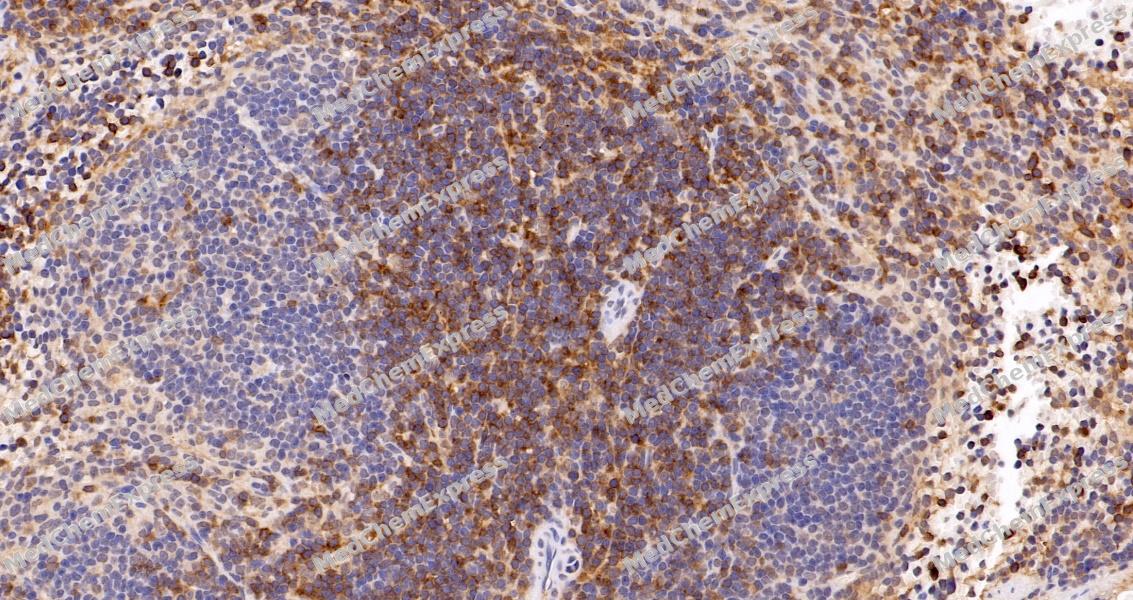 Immunohistochemical analysis of paraffin-embedded mouse spleen tissue using CD4 Antibody. The section was pre-treated using heat mediated antigen retrieval with sodium citrate buffer (pH 6.0) for 8 minutes. The tissues were blocked in QuickBlock for 20 minutes at room temperature, washed with ddH2O and PBS, and then probed with the primary antibody at 1/100 dilution in 4℃ overnight. The detection was performed using an HRP conjugated compact polymer system. DAB was used as the chromogen. Tissues were counterstained with hematoxylin and mounted with DPX.
 -
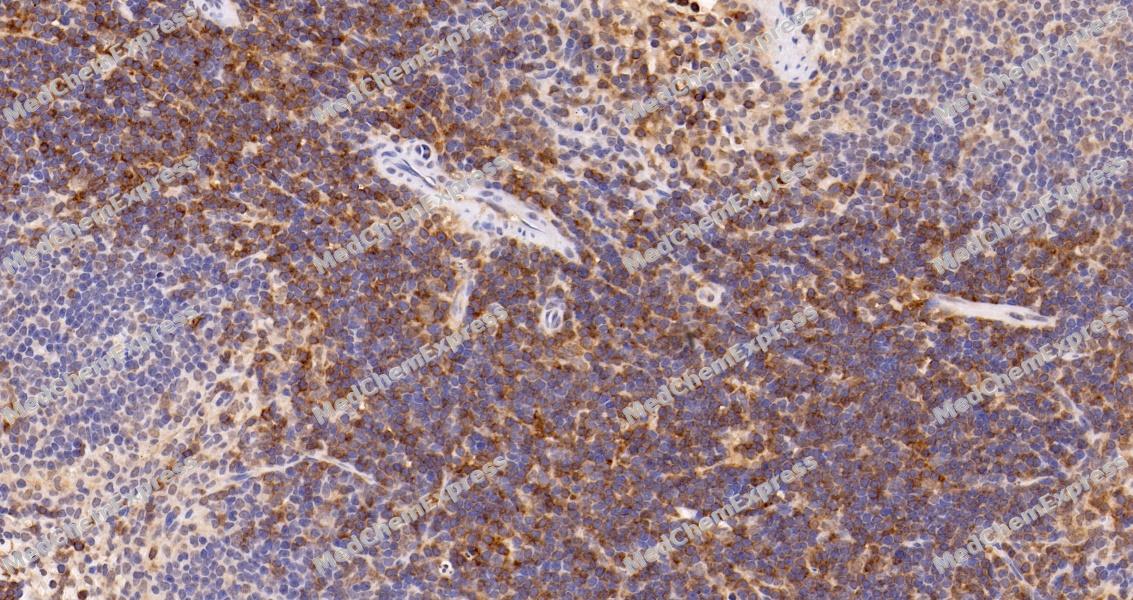 Immunohistochemical analysis of paraffin-embedded mouse spleen tissue using CD4 Antibody. The section was pre-treated using heat mediated antigen retrieval with sodium citrate buffer (pH 6.0) for 8 minutes. The tissues were blocked in QuickBlock for 20 minutes at room temperature, washed with ddH2O and PBS, and then probed with the primary antibody at 1/100 dilution in 4℃ overnight. The detection was performed using an HRP conjugated compact polymer system. DAB was used as the chromogen. Tissues were counterstained with hematoxylin and mounted with DPX.
 -
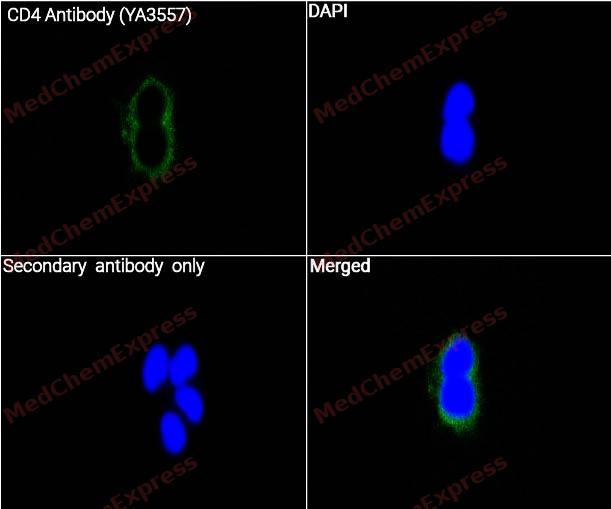 Immunocytochemistry analysis of HepG2 cells labeling CD4 with CD4 Antibody (YA3557) (HY-P83756) at 1/50 dilution. Cells were fixed in 4% paraformaldehyde for 15 minutes at room temperature, permeabilized with 0.1% Triton X-100 for 10 minutes at room temperature, then blocked with QuickBlock™ Blocking Buffer for Immunol Staining for 10 min at room temperature. Cells were then incubated with CD4 Antibody (YA3557) ((HY-P83756) at 1/50 dilution in QuickBlock™ Blocking Buffer for Immunol Staining at 4 ℃. Alexa Fluor® 488-conjugated AffiniPure Goat Anti-Rabbit IgG H&L(HY-P8002, Green) was used as the secondary antibody at 1/1,000 dilution. PBS instead of the primary antibody was used as the secondary antibody only control. The Nuclear counterstain was DAPI (Blue).
 -
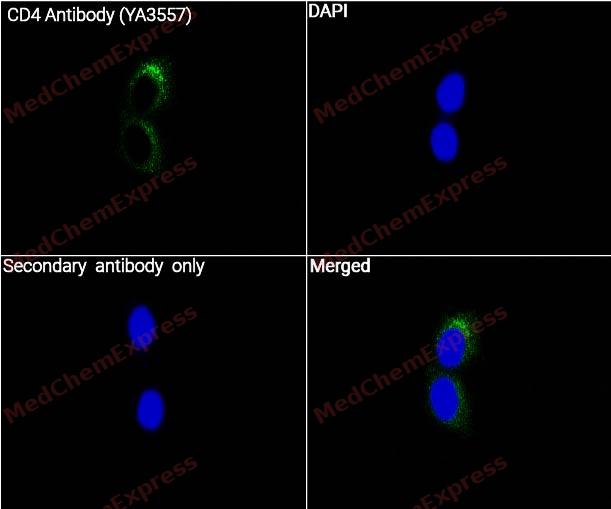 Immunocytochemistry analysis of Hela cells labeling CD4 with CD4 Antibody (YA3557) (HY-P83756) at 1/50 dilution. Cells were fixed in 4% paraformaldehyde for 15 minutes at room temperature, permeabilized with 0.1% Triton X-100 for 10 minutes at room temperature, then blocked with QuickBlock™ Blocking Buffer for Immunol Staining for 10 min at room temperature. Cells were then incubated with CD4 Antibody (YA3557) ((HY-P83756) at 1/50 dilution in QuickBlock™ Blocking Buffer for Immunol Staining at 4 ℃. Alexa Fluor® 488-conjugated AffiniPure Goat Anti-Rabbit IgG H&L(HY-P8002, Green) was used as the secondary antibody at 1/1,000 dilution. PBS instead of the primary antibody was used as the secondary antibody only control. The Nuclear counterstain was DAPI (Blue).


Background
-
Function
Integral membrane glycoprotein that plays an essential role in the immune response and serves multiple functions in responses against both external and internal offenses. In T-cells, functions primarily as a coreceptor for MHC class II molecule:peptide complex. The antigens presented by class II peptides are derived from extracellular proteins while class I peptides are derived from cytosolic proteins. Interacts simultaneously with the T-cell receptor (TCR) and the MHC class II presented by antigen presenting cells (APCs). In turn, recruits the Src kinase LCK to the vicinity of the TCR-CD3 complex. LCK then initiates different intracellular signaling pathways by phosphorylating various substrates ultimately leading to lymphokine production, motility, adhesion and activation of T-helper cells. In other cells such as macrophages or NK cells, plays a role in differentiation/activation, cytokine expression and cell migration in a TCR/LCK-independent pathway. Participates in the development of T-helper cells in the thymus and triggers the differentiation of monocytes into functional mature macrophages
-
Subcellular Localization
Cell membrane; Single-pass type I membrane protein
-
Expression
Tissue_specificity:Highly expressed in T-helper cells. The presence of CD4 is a hallmark of T-helper cells which are specialized in the activation and growth of cytotoxic T-cells, regulation of B cells, or activation of phagocytes. CD4 is also present in other immune cells such as macrophages, dendritic cells or NK cells
Positive sample: Mouse spleen tissue lysate, Mouse thymus tissue lysates, mouse splenocytes, mouse spleen tissue, mouse thymus tissue. -
Isoforms & Post-Translational Modification
P06332 has 2 isomers: P06332-1: 51297 Da (predicted); P06332-2: 24473 Da (predicted).
Palmitoylation and association with LCK contribute to the enrichment of CD4 in lipid rafts;Phosphorylated by PKC; phosphorylation plays an important role for CD4 internalization -
Subunit
Forms disulfide-linked homodimers at the cell surface. Interacts with LCK. Interacts with PTK2/FAK1. Binds to P4HB/PDI. Interacts with IL16; this interaction induces a CD4-dependent signaling in lymphocytes. Interacts (via Ig-like V-type domain) with MHCII alpha chain (via alpha-2 domain) and beta chain (via beta-2 domain); this interaction increases the affinity of TCR for peptide-MHCII. CD4 oligomerization via Ig-like C2-type 2 and 3 domains appears to be required for stable binding to MHCII and adhesion between T cells and APCs
-
SwissProt ID
-
Synonyms
CD 4 antibody; CD4 (L3T4) antibody; CD4 antibody; CD4 antigen (p55) antibody; CD4_HUMAN antibody; CD4mut antibody; L3T4 antibody; Leu3 antibody; Ly-4 antibody; Lymphocyte antigen CD4 antibody; MGC165891 antibody; OTTHUMP00000238897 antibody; p55 antibody; T cell antigen T4 antibody; W3/25 antibody
Documentation
-
Data Sheet (234 KB)
-
SDS (252 KB)
- English - EN (252 KB)
- Français - FR (252 KB)
- Deutsch - DE (252 KB)
- Norwegian - NO (252 KB)
- Español - ES (252 KB)
- Swedish - SV (252 KB)
- Italian - IT (252 KB)
- Korean - KR (252 KB)
- Portuguese - PT (252 KB)
-
User Guide for Antibodies (1077 KB)

 Powered by Bioz
