



E-Cadherin Antibody (YA778)
(Synonyms: CD324, CDHE, UVO, CDH1, Cadherin-1, CAM 120/80, Epithelial cadherin, Uvomorulin, E-cadherin)Based on 1 publication(s) in Google Scholar
E-Cadherin Antibody (YA778) is a Mouse-derived and non-conjugated IgG1 monoclonal antibody, targeting to E-Cadherin.
-
Host:
Mouse
-
Isotype:
IgG
-
Application:
WB, IHC-P
-
Reactivity :
Human, Mouse
-
Formulation:
Supplied in 1*PBS (pH7.4), 0.2% BSA and 40% Glycerol. Preservative: 0.05% Sodium Azide.
-
Conjugation:
Non-conjugated


To place orders, for customer services and technical support, please contact: MedChemExpress USA
Tel: 609-228-6898 E-mail: [email protected] [email protected]



-

HY-P80371
Vimentin Antibody (YA011) -
HY-P80761
N Cadherin Antibody (YA276) -
HY-P8001
HRP-conjugated Goat Anti-Rabbit IgG H&L -
HY-P80488
beta Catenin Antibody (YA584) -
HY-P83694
ZO-1/TJP1 Antibody (YA3430) -
HY-P80268
PCNA Antibody (YA241) -
HY-P80493
Fibronectin Antibody (YA436) -
HY-P80484
alpha smooth muscle Actin Antibody (YA627) -
HY-P80521
TGF beta 1 Antibody (YA036) -
HY-P80425
MMP-9 Antibody (YA285) -
HY-P80121
EpCAM Antibody (YA772)
Publications Citing Use of MedChemExpress (MCE) E-Cadherin Antibody (YA778)
More

Applications
| Application |
WB

WB: Western Blot
|
IHC-P
IHC-P: Immunohistochemistry-Paraffin
|
|---|---|---|
| Dilution Ratio | 1:500-1:1000 | 1:200 |


Product Details
E-Cadherin Antibody (YA778) is a Mouse-derived and non-conjugated IgG1 monoclonal antibody, targeting to E-Cadherin.
-
Host Mouse

-
Clonality Monoclonal

-
Species ReactivityHuman, Mouse
-
Observed Molecular WeightObserved band size: 130 kDa
Note: Due to possible protein modifications or aggregation, the molecular weight should be confirmed by actual measurement, and the predicted value is for reference only.

-
Calculated Molecular Weight Predicted band size: 97 kDa

Synthetic peptide corresponding to Mouse E-Cadherin.AA range:350-550.
Endogenous
Protein A affinity purified.
Non-conjugated
Unmodified
IgG


Product Properties
-
Appearance
Solution
-
Formulation
Supplied in 1*PBS (pH7.4), 0.2% BSA and 40% Glycerol. Preservative: 0.05% Sodium Azide.
-
Concentration
Batch-dependent, Please check the COA for the concentration of each lot. Check Lot Concentration
-
Storage & Stability
Stored at -20°C for 1 year. Avoid repeated freeze / thaw cycles.
-
Envío
Shipping with blue ice.


Publications (1)
-
Journal Impact Factor
-
Most Recent
-
J Inflamm Res
CCL20 Expression via AKT-ERK1/2-AP1 Pathway in Mycoplasma Pneumoniae Infection: Implications for EMT and Cell Migration. [Abstract]2025 Apr 28:18:5727-5739. PMID: 40322529


Verification Images
-
 Western blot analysis of extracts from A431(lane 2(20μg) and A431(lane 3(40μg) using E-Cadherin (HY-P80112) Mouse mAb. Proteins were transferred to a PVDF membrane and blocked with 5% non-fat milk in TBST for 2 hour at room temperature. The primary antibody (1/1000) and Loading control antibody (Beta Actin, HY-P80438, 1/10000) was used in 5% non-fat milk in TBST at 4°C overnight. Goat Anti-Mouse IgG-HRP Secondary Antibody (1/10000) was used for 1 hour at room temperature.
 -
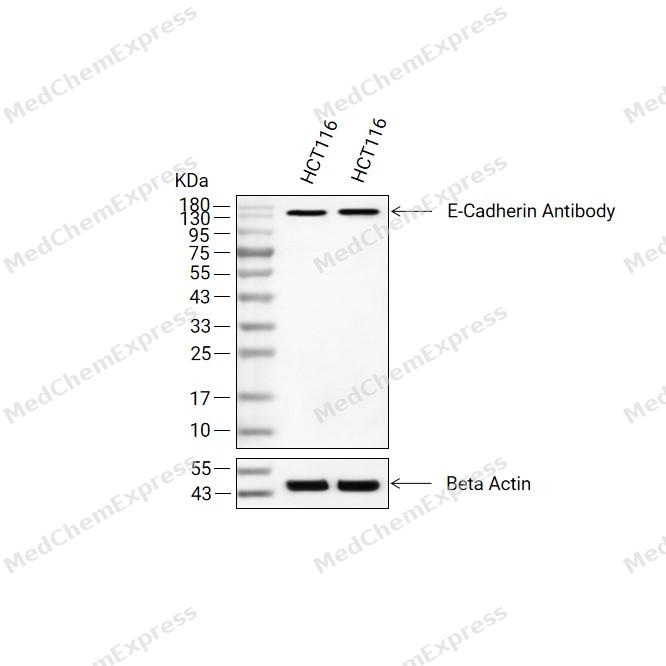 Western blot analysis of extracts from HCT116(lane 2(20ug) , and HCT116(lane 3(40ug) using E-Cadherin Antibody (HY-P80112) Rabbit mAb. Proteins were transferred to a PVDF membrane and blocked with 5% non-fat milk in TBST for 2 hour at room temperature. The primary antibody (1/1000) and Loading control antibody (Beta Actin, HY-P83730, 1/10000) was used in 5% non-fat milk in TBST at 4°C overnight. Goat Anti-Mouse/Rabbit IgG-HRP Secondary Antibody (1/10000) was used for 1 hour at room temperature.
 -
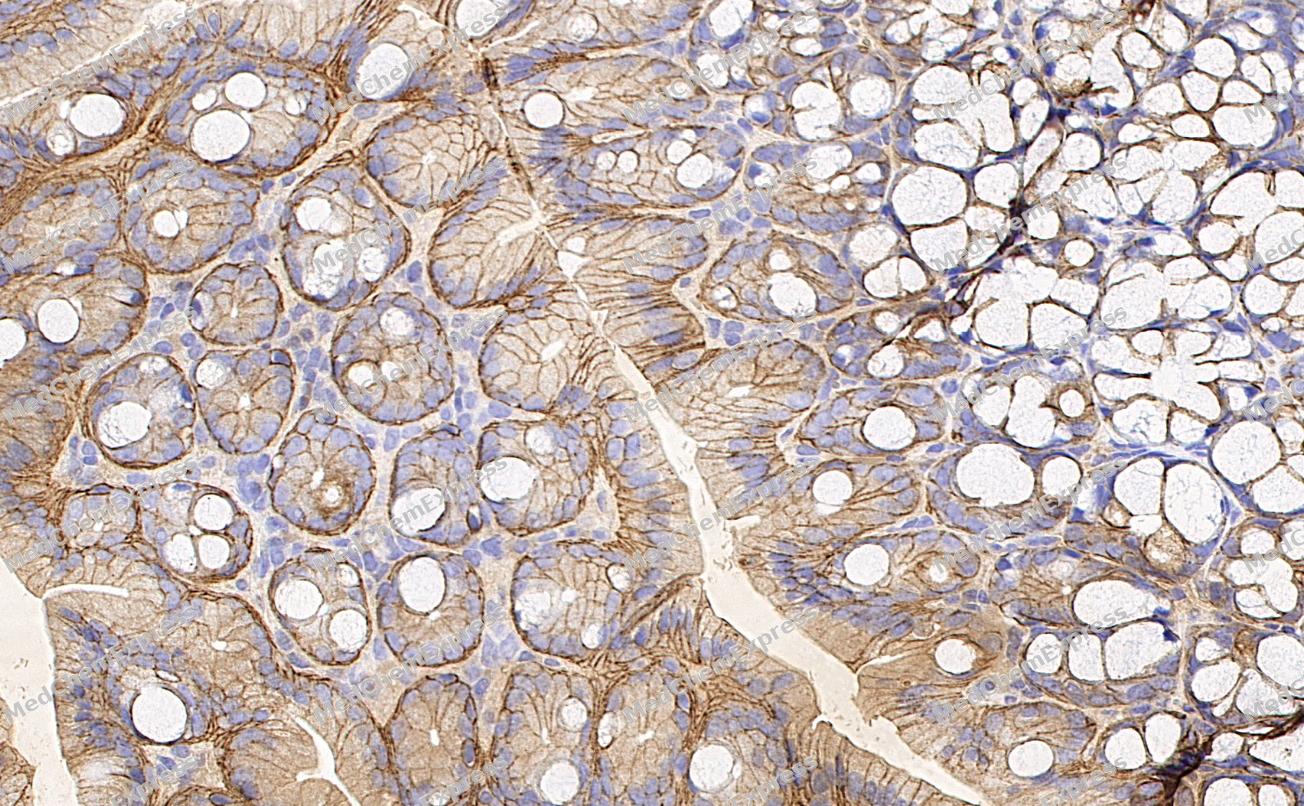 Immunohistochemical analysis of paraffin-embedded Mouse colon tissue using E-Cadherin Antibody (YA778). The section was pre-treated using heat mediated antigen retrieval with Tris-EDTA buffer (pH 9.0) for 8 minutes. The tissues were blocked in QuickBlock for 20 minutes at room temperature, washed with ddH2O and PBS, and then probed with the primary antibody (HY-P80112, 1/500) in 4℃ overnight. The detection was performed using an HRP conjugated compact polymer system. DAB was used as the chromogen. Tissues were counterstained with hematoxylin and mounted with DPX.
 -
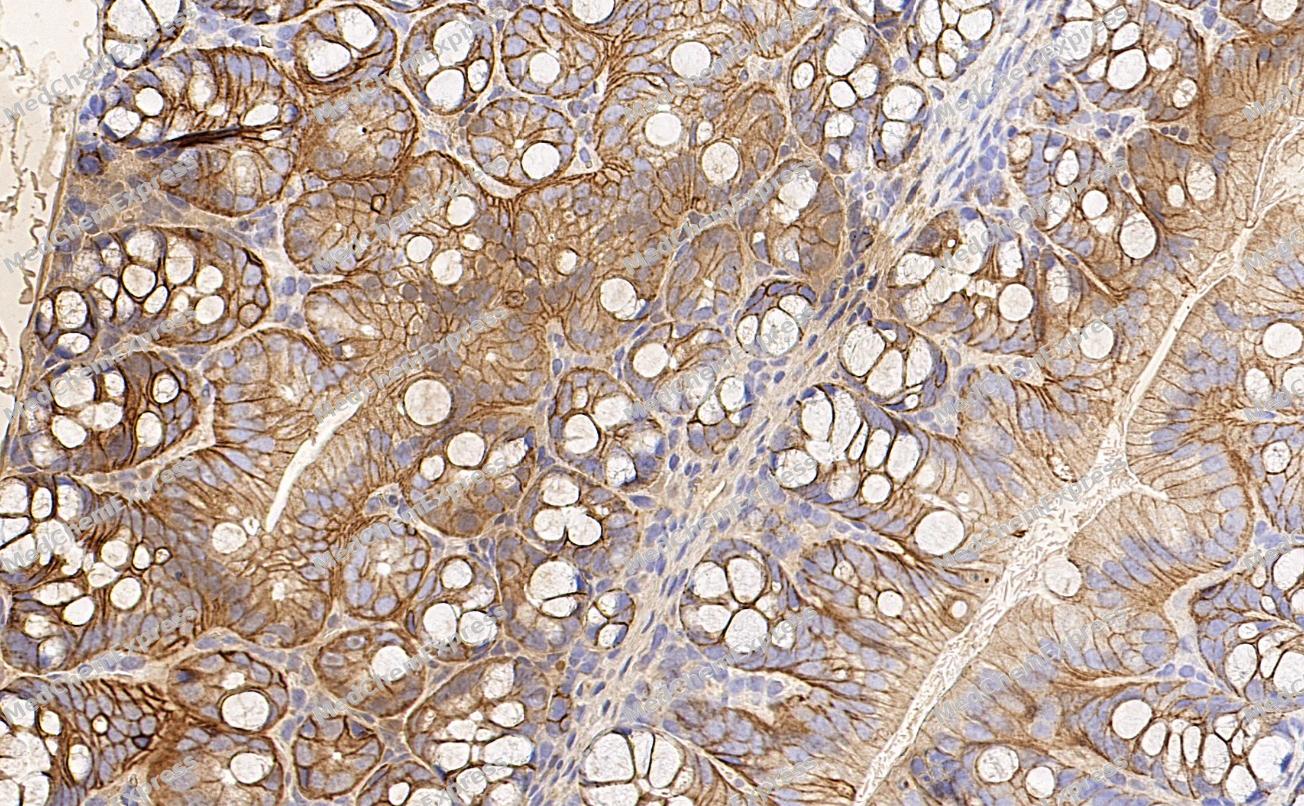 Immunohistochemical analysis of paraffin-embedded Mouse colon tissue using E-Cadherin Antibody (YA778). The section was pre-treated using heat mediated antigen retrieval with Tris-EDTA buffer (pH 9.0) for 8 minutes. The tissues were blocked in QuickBlock for 20 minutes at room temperature, washed with ddH2O and PBS, and then probed with the primary antibody (HY-P80112, 1/500) in 4℃ overnight. The detection was performed using an HRP conjugated compact polymer system. DAB was used as the chromogen. Tissues were counterstained with hematoxylin and mounted with DPX.


Background
-
Function
E-Cadherin is a Cadherins are calcium-dependent cell adhesion proteins. They preferentially interact with themselves in a homophilic manner in connecting cells; cadherins may thus contribute to the sorting of heterogeneous cell types. CDH1 is involved in mechanisms regulating cell-cell adhesions, mobility and proliferation of epithelial cells. Promotes organization of radial actin fiber structure and cellular response to contractile forces, via its interaction with AMOTL2 which facilitates anchoring of radial actin fibers to CDH1 junction complexes at the cell membrane. Plays a role in the early stages of desmosome cell-cell junction formation via facilitating the recruitment of DSG2 and DSP to desmosome plaques. Has a potent invasive suppressor role. It is a ligand for integrin alpha-E/beta-7; E-Cad/CTF2 promotes non-amyloidogenic degradation of Abeta precursors. Has a strong inhibitory effect on APP C99 and C83 production; (Microbial infection) Serves as a receptor for Listeria monocytogenes; internalin A (InlA) binds to this protein and promotes uptake of the bacteria[1][2].
-
Subcellular Localization
Cell junction, adherens junction; Cell membrane; Single-pass type I membrane protein; Endosome; Golgi apparatus, trans-Golgi network; Cytoplasm; Cell junction, desmosome
-
Expression
Tissue_specificity:Expression in granulomatous macrophages (protein level) (PubMed: 27760340) . Expression in skin (protein level) (PubMed: 22294297) . Expression in liver (PubMed: 3263290) .
Induction:Induced in the hours following cyclic mechanical strain in keratinocytes (PubMed:31835537) . Expression is repressed by MACROD1 (PubMed:17893710) -
Subunit
Homodimer; disulfide-linked (PubMed:11856755). Component of an E-cadherin/ catenin adhesion complex composed of at least E-cadherin/CDH1, beta-catenin/CTNNB1 or gamma-catenin/JUP, and potentially alpha-catenin/CTNNA1.
-
SwissProt ID
-
Synonyms
CD324, CDHE, UVO, CDH1, Cadherin-1, CAM 120/80, Epithelial cadherin, Uvomorulin, E-cadherin
-
Research Field
Signal Transduction
Documentación
-
Ficha de datos (261 KB)
-
SDS (252 KB)
- English - EN (252 KB)
- Français - FR (252 KB)
- Deutsch - DE (252 KB)
- Norwegian - NO (252 KB)
- Español - ES (252 KB)
- Swedish - SV (252 KB)
- Italian - IT (252 KB)
- Korean - KR (252 KB)
- Portuguese - PT (252 KB)
-
User Guide for Antibodies (1077 KB)
References

 Powered by Bioz
