



TGF beta 1 Antibody (YA036)
(Synonyms: TGFB, TGFB1, Transforming growth factor beta-1 proprotein)Based on 5 publication(s) in Google Scholar
TGF beta 1 Antibody (YA036) is a Rabbit-derived and non-conjugated IgG monoclonal antibody, targeting to TGF beta 1.
-
Host:
Rabbit
-
Isotype:
IgG
-
Application:
WB, IHC-P
-
Reactivity :
Human, Mouse, Rat
-
Formulation:
Supplied in 1*PBS (pH7.4), 0.1% BSA, 40% Glycerol. Preservative: 0.05% Sodium Azide
-
Conjugation:
Non-conjugated


To place orders, for customer services and technical support, please contact: MedChemExpress USA
Tel: 609-228-6898 E-mail: [email protected] [email protected]



-

HY-P80325
Smad3 Antibody (YA075) -
HY-P80914
TNF alpha Antibody -
HY-P80484
alpha smooth muscle Actin Antibody (YA627) -
HY-10999
Trametinib -
HY-P80720
IL-1 beta Antibody -
HY-P80324
Smad2 Antibody (YA076) -
HY-P99144
Anti-Mouse PD-1 Antibody (RMP1-14) -
HY-P8004
HRP-conjugated Goat Anti-Mouse IgG H&L -
HY-P81227
Collagen I Antibody -
HY-P8001
HRP-conjugated Goat Anti-Rabbit IgG H&L -
HY-P80853
Phospho-Smad2 (Ser250) Antibody (YA152) -
HY-P85909
Collagen I Antibody (YA5601)
Publications Citing Use of MedChemExpress (MCE) TGF beta 1 Antibody (YA036)
More

Applications
| Application |
WB

WB: Western Blot
|
IHC-P
IHC-P: Immunohistochemistry-Paraffin
|
|---|---|---|
| Dilution Ratio | 1:500 | 1:200 |


Product Details
TGF beta 1 Antibody (YA036) is a Rabbit-derived and non-conjugated IgG monoclonal antibody, targeting to TGF beta 1.
-
Host Rabbit

-
Clonality Recombinant,Monoclonal

-
Species ReactivityHuman, Mouse, Rat
-
Observed Molecular WeightObserved band size: 44 kDa
Note: Due to possible protein modifications or aggregation, the molecular weight should be confirmed by actual measurement, and the predicted value is for reference only.

-
Calculated Molecular Weight Predicted band size: 44 kDa

Entrez Gene: 7040 Human ; 21803 Mouse ; 59086 Rat
SwissProt: P01137 Human ; P04202 Mouse ; P17246 Rat
OMIM: 131300 Human
Synthetic peptide (KLH-coupled) corresponding to Human TGF-Beta 1 C-terminal.
Endogenous
Protein A affinity purified.
Non-conjugated
Unmodified
IgG


Product Properties
-
Appearance
Solution
-
Formulation
Supplied in 1*PBS (pH7.4), 0.1% BSA, 40% Glycerol. Preservative: 0.05% Sodium Azide
-
Concentration
Batch-dependent, Please check the COA for the concentration of each lot. Check Lot Concentration
-
Storage & Stability
Stored at -20°C for 1 year. Avoid repeated freeze / thaw cycles.
-
Shipping
Shipping with blue ice.


Publications (5)
-
Journal Impact Factor
-
Most Recent
-
J Ethnopharmacol
Polysaccharide from Campanumoea javanica Bl. accelerate wound healing via moderating TGF-β1/Smad3 pathways and promoting SIRT1-mediated macrophage polarization in rats. [Abstract]2026 Feb 28:357:120851. PMID: 41232631 -
Mol Med Rep
Exosomal SphK1 from colorectal cancer cells promotes cancer cell migration and activates hepatic stellate cells. [Abstract]2025 Mar;31(3):73. PMID: 39930826


Verification Images
-
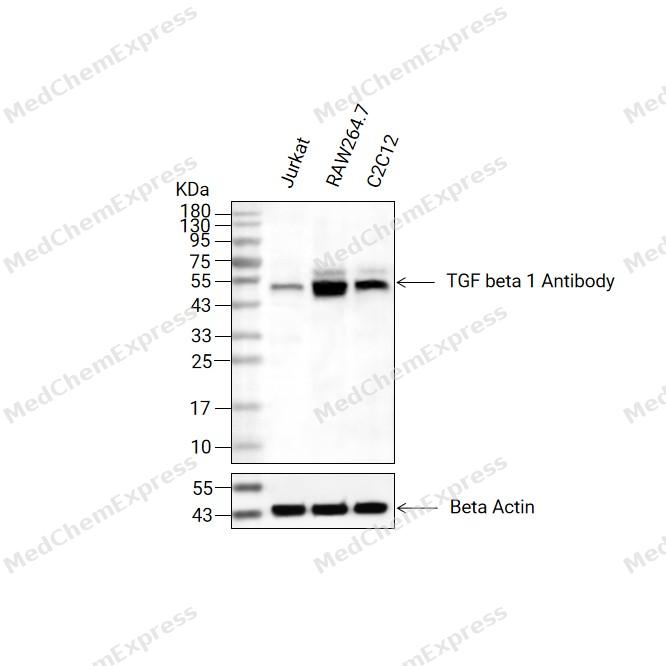 Western blot analysis of extracts from Jurkat(lane 2(20ug) , RAW264.7(lane 3(20ug) and C2C12(lane 4(20ug) using TGF beta 1 Antibody (HY-P80521) Rabbit mAb. Proteins were transferred to a PVDF membrane and blocked with 5% non-fat milk in TBST for 2 hour at room temperature. The primary antibody (1/1000) and Loading control antibody (Beta Actin, HY-P83730, 1/10000) was used in 5% non-fat milk in TBST at 4°C overnight. Goat Anti-Mouse/Rabbit IgG-HRP Secondary Antibody (1/10000) was used for 1 hour at room temperature.
 -
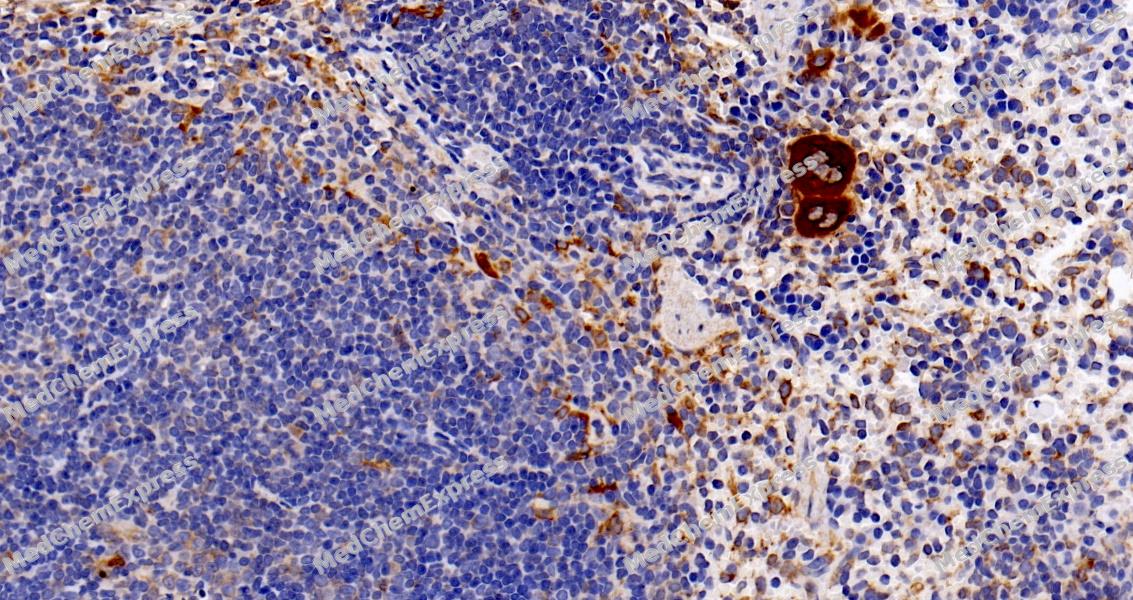 Immunohistochemical analysis of paraffin-embedded mouse spleen tissue using TGF beta 1 Antibody. The section was pre-treated using heat mediated antigen retrieval with sodium citrate buffer (pH 6.0) for 8 minutes. The tissues were blocked in QuickBlock for 20 minutes at room temperature, washed with ddH2O and PBS, and then probed with the primary antibody at 1/100 dilution in 4℃ overnight. The detection was performed using an HRP conjugated compact polymer system. DAB was used as the chromogen. Tissues were counterstained with hematoxylin and mounted with DPX
 -
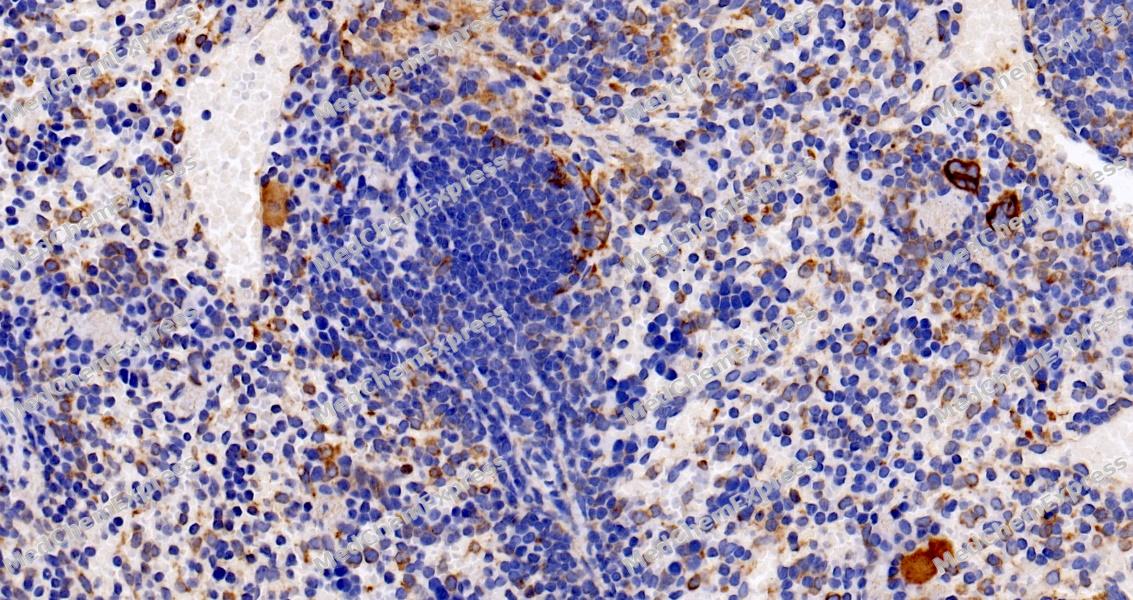 Immunohistochemical analysis of paraffin-embedded mouse spleen tissue using TGF beta 1 Antibody. The section was pre-treated using heat mediated antigen retrieval with sodium citrate buffer (pH 6.0) for 8 minutes. The tissues were blocked in QuickBlock for 20 minutes at room temperature, washed with ddH2O and PBS, and then probed with the primary antibody at 1/100 dilution in 4℃ overnight. The detection was performed using an HRP conjugated compact polymer system. DAB was used as the chromogen. Tissues were counterstained with hematoxylin and mounted with DPX


Background
-
Function
TGF beta 1/TGFB1 Protein (transforming growth factor beta 1) is a multifunctional cytokine, which is synthesized by almost all cells. TGF beta 1/TGFB1 Protein has a high ability to bind with TGFbRII[1]. The sequence of amino acids in TGFB1 proteins from different species is very stable, which leads to the conclusion that in the process of evolution, TGFB has been only slightly altered, and that both in humans and in animals, its function is similar. TGF beta 1/TGFB1 Protein is secreted as an inactive peptide, forming part of a ‘latent complex’ consisting of a mature TGFB1 dimer non-covalently bound to its latency-associated peptide (LAP) and, via LAP, to latent TGFB-binding proteins (LTBPs). Activated TGF beta 1/TGFB1 Protein binds to ubiquitously expressed cell-surface TGFB1 type I receptors (TGFBRI) and type II receptors (TGFBRII), which are transmembrane serine/threonine kinases[2]. TGF beta 1/TGFB1 Protein regulates cell proliferation, growth, differentiation and cells movement. TGFb1 has immunomodulatory effects. TGF beta 1/TGFB1 Protein has profibrogenic effects. TGF beta 1/TGFB1 Protein action can be local and systemic. TGF beta 1/TGFB1 Protein plays a driving role in development, fibrosis and cancer[2].
-
Subcellular Localization
Secreted, extracellular space, extracellular matrix; Secreted
-
Expression
Tissue_specificity:It is highly expressed in bone (PubMed:11746498, PubMed:17827158) . It is also highly expressed in articular cartilage and chondrocytes, with increased expression in osteoarthritis (OA) (PubMed:11746498, PubMed:17827158) . It co-localizes with ASPN in chondrocytes at OA articular cartilage lesions (PubMed:17827158) . -
Subunit
Homodimer; disulfide-linked (PubMed:20207738, PubMed:25209176, PubMed:28117447, PubMed:29109152).
-
SwissProt ID
-
Synonyms
TGFB, TGFB1, Transforming growth factor beta-1 proprotein
-
Research Field
Cardiovascular
Documentation
-
Data Sheet (261 KB)
-
SDS (251 KB)
- English - EN (251 KB)
- Français - FR (251 KB)
- Deutsch - DE (251 KB)
- Norwegian - NO (251 KB)
- Español - ES (251 KB)
- Swedish - SV (251 KB)
- Italian - IT (251 KB)
- Korean - KR (251 KB)
- Portuguese - PT (251 KB)
-
User Guide for Antibodies (1077 KB)
References
[1]. K. Miyazono, et al. A role of the latent TGF-beta 1-binding protein in the assembly and secretion of TGF-beta 1. The EMBO Journal (1991)10:1091-1101. [Content Brief]
[2]. M Selvakumaran, et al. The novel primary response gene MyD118 and the proto-oncogenes myb, myc, and bcl-2 modulate transforming growth factor beta 1-induced apoptosis of myeloid leukemia cells. Mol Cell Biol. 1994 Apr;14(4):2352-60. [Content Brief]

 Powered by Bioz
