



N Cadherin Antibody (YA276)
(Synonyms: CDH2; CDHN; NCAD; Cadherin-2; CDw325; Neural cadherin; N-cadherin; CD antigen CD325)Based on 2 publication(s) in Google Scholar
N Cadherin Antibody (YA276) is a Rabbit-derived and non-conjugated IgG monoclonal antibody, targeting to N Cadherin.
-
Host:
Rabbit
-
Isotype:
IgG
-
Application:
WB, IP
-
Reactivity :
Human, Mouse, Rat
-
Formulation:
Supplied in 50 mM Tris-Glycine (pH 7.4), 0.15 M NaCl, 40% Glycerol and 0.05% BSA. Preservative: 0.01% Sodium azide
-
Conjugation:
Non-conjugated


To place orders, for customer services and technical support, please contact: MedChemExpress USA
Tel: 609-228-6898 E-mail: [email protected] [email protected]



Publications Citing Use of MedChemExpress (MCE) N Cadherin Antibody (YA276)
More

Applications
| Application |
WB

WB: Western Blot
|
IP
IP: Immunoprecipitation
|
|---|---|---|
| Dilution Ratio | 1:500-1:1000 | 1:20 |


Product Details
N Cadherin Antibody (YA276) is a Rabbit-derived and non-conjugated IgG monoclonal antibody, targeting to N Cadherin.
-
Host Rabbit

-
Clonality Recombinant,Monoclonal

-
Species ReactivityHuman, Mouse, Rat
-
Observed Molecular WeightObserved band size: 110-140 kDa
Note: Due to possible protein modifications or aggregation, the molecular weight should be confirmed by actual measurement, and the predicted value is for reference only.

-
Calculated Molecular Weight Predicted band size: 100 kDa;

Entrez Gene: 1000 Human ; 12558 Mouse ; 83501 Rat
SwissProt: P19022 Human ; P15116 Mouse ; Q9Z1Y3 Rat
OMIM: 618920 Human
Synthetic peptide corresponding to Human N Cadherin.The exact sequence is proprietary to MCE.
Endogenous
affinity purified
Non-conjugated
Unmodified
IgG


Product Properties
-
Appearance
Solution
-
Formulation
Supplied in 50 mM Tris-Glycine (pH 7.4), 0.15 M NaCl, 40% Glycerol and 0.05% BSA. Preservative: 0.01% Sodium azide
-
Concentration
Batch-dependent, Please check the COA for the concentration of each lot. Check Lot Concentration
-
Storage & Stability
Stored at -20°C for 1 year. Avoid repeated freeze / thaw cycles.
-
Shipping
Shipping with blue ice.


Publications (2)
-
Journal Impact Factor
-
Most Recent
-
Cell Death Dis
M6A-METTL3-dependent nuclear PANC754/PSPC1/H3K4me1 repression complex regulate immune evasive LGALS7 signal to enhance immunotherapy against colorectal cancer. [Abstract]2025 Jul 9;16(1):506. PMID: 40634299


Verification Images
-
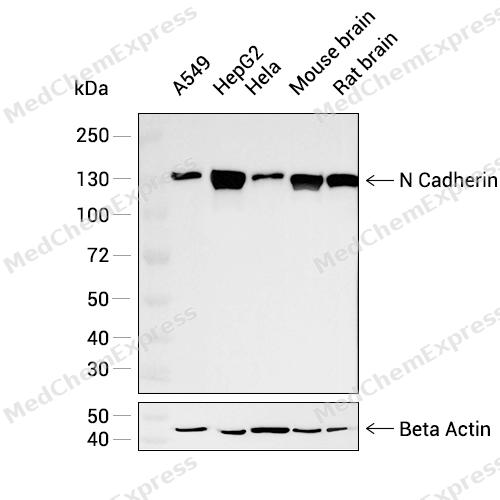
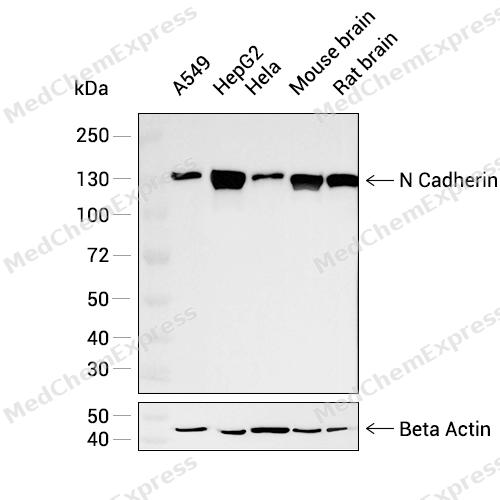 Western blot analysis was performed on extracts from A549 (lane 1, 15 μg), HepG2 (lane 2, 15 μg), HeLa (lane 3, 15 μg), Mouse brain (lane 4, 15 μg), and Rat brain (lane 5, 15 μg) using N Cadherin Rabbit mAb.Proteins were transferred to a PVDF membrane and blocked with 5% non - fat milk in TBST at 4°C overnight.The primary antibody (1:1000 dilution) and the loading control antibody (beta-Actin, HY-P83730, 1:20000 dilution) were incubated in 5% non-fat milk in TBST for 1 hour at 37°C.Goat Anti - Rabbit IgG - HRP Secondary Antibody (1:20000 dilution) was then applied for 40 minutes at 37°C.
 -
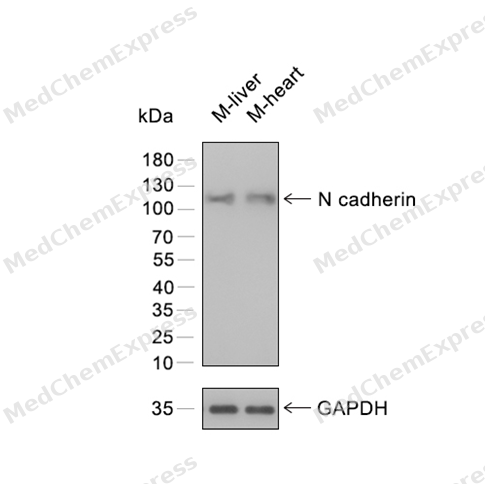 Western blot analysis of extracts from M-liver (lane 1) and M-heart (lane 2) using N cadherin antibody. Proteins were transferred to a PVDF membrane and blocked with 5% nonfat powdered milk in PBST for 2 hour at room temperature. The primary antibody (1/1000) and Loading control antibody (GAPDH, 1/3000) was diluted with 5% nonfat powdered milk in PBST at 4°C overnight. Goat Anti-Rabbit IgG-HRP Secondary Antibody (1/8,000) was incubated for 45min at room temperature.


Background
-
Function
N Cadherin is a Calcium-dependent cell adhesion protein; preferentially mediates homotypic cell-cell adhesion by dimerization with a CDH2 chain from another cell. Cadherins may thus contribute to the sorting of heterogeneous cell types. Acts as a regulator of neural stem cells quiescence by mediating anchorage of neural stem cells to ependymocytes in the adult subependymal zone: upon cleavage by MMP24, CDH2-mediated anchorage is affected, leading to modulate neural stem cell quiescence. Plays a role in cell-to-cell junction formation between pancreatic beta cells and neural crest stem (NCS) cells, promoting the formation of processes by NCS cells. Required for proper neurite branching. Required for pre- and postsynaptic organization. CDH2 may be involved in neuronal recognition mechanism. In hippocampal neurons, may regulate dendritic spine density
-
Subcellular Localization
Cell membrane; Single-pass type I membrane protein; Cell membrane, sarcolemma; Cell junction; Cell surface; Cell junction, desmosome; Cell junction, adherens junction
-
Isoforms & Post-Translational Modification
P19022 has 2 isomers: P19022-1: 99809 Da (predicted); P19022-2: 97040 Da (predicted).
Cleaved by MMP24. Ectodomain cleavage leads to the generation of a soluble 90 kDa N-terminal soluble fragment and a 45 kDa membrane-bound C-terminal fragment 1 (CTF1), which is further cleaved by gamma-secretase into a 35 kDa (By similarity). Cleavage in neural stem cells by MMP24 affects CDH2-mediated anchorage of neural stem cells to ependymocytes in the adult subependymal zone, leading to modulate neural stem cell quiescence (By similarity);May be phosphorylated by OBSCN -
Subunit
Homodimer (via extracellular region). Can also form heterodimers with other cadherins (via extracellular region). Dimerization occurs in trans, i.e. with a cadherin chain from another cell (By similarity). Interacts with CDCP1 (PubMed:16007225). Interacts with PCDH8; this complex may also include TAOK2 (By similarity). The interaction with PCDH8 may lead to internalization through TAOK2/p38 MAPK pathway (By similarity). Identified in a complex containing FGFR4, NCAM1, CDH2, PLCG1, FRS2, SRC, SHC1, GAP43 and CTTN. May interact with OBSCN (via protein kinase domain 2) (By similarity). Interacts with FBXO45 (PubMed:32341084)
-
SwissProt ID
-
Synonyms
CDH2; CDHN; NCAD; Cadherin-2; CDw325; Neural cadherin; N-cadherin; CD antigen CD325
-
Research Field
Cell Biology
Documentation
-
Data Sheet (232 KB)
-
SDS (313 KB)
- English - EN (313 KB)
- Français - FR (313 KB)
- Deutsch - DE (313 KB)
- Norwegian - NO (313 KB)
- Español - ES (313 KB)
- Swedish - SV (313 KB)
- Italian - IT (313 KB)
- Korean - KR (313 KB)
- Portuguese - PT (313 KB)
-
User Guide for Antibodies (1077 KB)

 Powered by Bioz
