



GRP78 BiP Antibody (YA746)
(Synonyms: HSPA5; GRP78; 78 kDa glucose-regulated protein; GRP-78; Endoplasmic reticulum lumenal Ca(2+)-binding protein grp78; Heat shock 70 kDa protein 5; Immunoglobulin heavy chain-binding protein; BiP)
Based on 1 Customer Validation
GRP78 BiP Antibody (YA746) is a Mouse-derived and non-conjugated IgG2b monoclonal antibody, targeting to GRP78 BiP.
-
Host:
Mouse
-
Isotype:
IgG2b
-
Application:
WB, ICC/IF, IP
-
Reactivity :
Human, Mouse, Rat
-
Formulation:
Supplied in 1*PBS (pH 7.3), 50% glycerol and 0.5% BSA. Preservative: 0.02% sodium azide.
-
Conjugation:
Non-conjugated


To place orders, for customer services and technical support, please contact: MedChemExpress USA
Tel: 609-228-6898 E-mail: [email protected] [email protected]





Applications
| Application |
WB

WB: Western Blot
|
ICC/IF
ICC/IF: Immunocytochemistry/
Immunofluorescence |
IP
IP: Immunoprecipitation
|
|---|---|---|---|
| Dilution Ratio | 1:500-1:1000 | 1:50-1:200 | 1:20 |


Product Details
GRP78 BiP Antibody (YA746) is a Mouse-derived and non-conjugated IgG2b monoclonal antibody, targeting to GRP78 BiP.
-
Host Mouse

-
Clonality Monoclonal

-
Species ReactivityHuman, Mouse, Rat
-
Observed Molecular WeightObserved band size: 78 kDa
Note: Due to possible protein modifications or aggregation, the molecular weight should be confirmed by actual measurement, and the predicted value is for reference only.

-
Calculated Molecular Weight Predicted band size: 72 kDa

Entrez Gene: 3309 Human ; 14828 Mouse ; 25617 Rat
SwissProt: P11021 Human ; P20029 Mouse ; P06761 Rat
OMIM: 138120 Human
Synthetic peptide corresponding to Human BiP/GRP78.The exact sequence is proprietary to MCE.
Endogenous
affinity purified
Non-conjugated
Unmodified
IgG2b


Product Properties
-
Appearance
Liquid
-
Formulation
Supplied in 1*PBS (pH 7.3), 50% glycerol and 0.5% BSA. Preservative: 0.02% sodium azide.
-
Concentration
Batch-dependent, Please check the COA for the concentration of each lot. Check Lot Concentration
-
Storage & Stability
Stored at -20°C for 1 year. Avoid repeated freeze / thaw cycles.
-
Shipping
Shipping with blue ice.


Verification Images
-
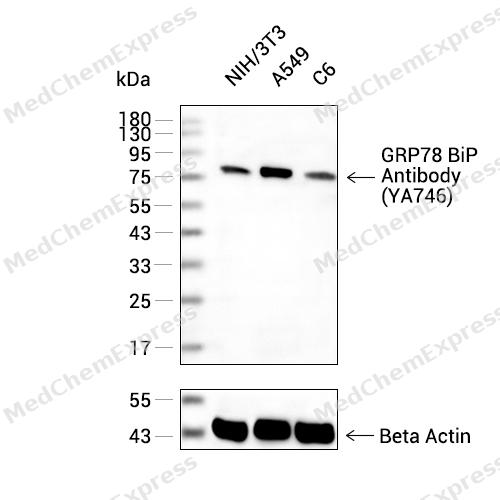 Western blot analysis of extracts from NIH/3T3(lane 2(20μg) ,A549(lane 3(20μg) and C6(lane 4(20ug)using GRP78 BiP Antibody (HY-P80696) Mouse mAb. Proteins were transferred to a PVDF membrane and blocked with 5% non-fat milk in TBST for 2 hour at room temperature. The primary antibody (1/1000) and Loading control antibody (Beta Actin, HY-P80438, 1/10000) was used in 5% non-fat milk in TBST at 4°C overnight. Goat Anti-Mouse IgG-HRP Secondary Antibody (1/10000) was used for 1 hour at room temperature.
 -
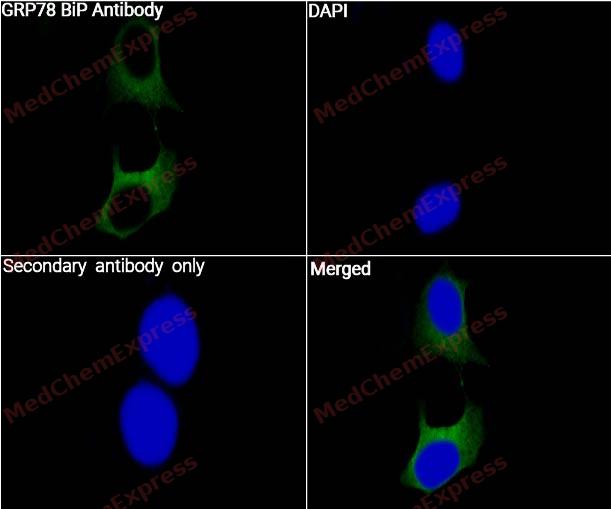 Immunocytochemistry analysis of RAW264.7 cells labeling GRP78 BiP with GRP78 BiP Antibody (YA746) (HY-P80696) at 1/50 dilution. Cells were fixed in 4% paraformaldehyde for 15 minutes at room temperature, permeabilized with 0.1% Triton X-100 for 10 minutes at room temperature, then blocked with BSA for Immunol Staining for 10 min at room temperature. Cells were then incubated with GRP78 BiP Antibody (YA746) (HY-P80696) at 1/50 dilution in BSA for Immunol Staining at 4 ℃,stay overnight. AF488-conjugated AffiniPure Goat Anti-Mouse IgG H&L(HY-P8005, Green) was used as the secondary antibody at 1/1,000 dilution. PBS instead of the primary antibody was used as the secondary antibody only control. The Nuclear counterstain was DAPI (Blue).
 -
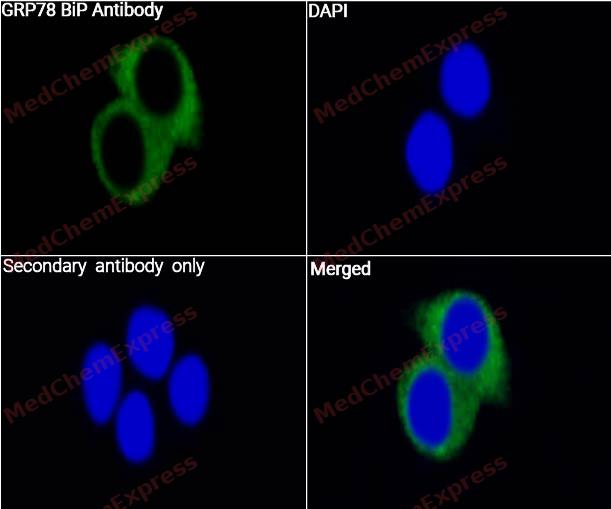 Immunocytochemistry analysis of HepG2 cells labeling GRP78 BiP with GRP78 BiP Antibody (YA746) (HY-P80696) at 1/100 dilution. Cells were fixed in 4% paraformaldehyde for 15 minutes at room temperature, permeabilized with 0.1% Triton X-100 for 10 minutes at room temperature, then blocked with BSA for Immunol Staining for 10 min at room temperature. Cells were then incubated with GRP78 BiP Antibody (YA746) (HY-P80696) at 1/100 dilution in BSA for Immunol Staining at 4 ℃,stay overnight. AF488-conjugated AffiniPure Goat Anti-Mouse IgG H&L(HY-P8005, Green) was used as the secondary antibody at 1/1,000 dilution. PBS instead of the primary antibody was used as the secondary antibody only control. The Nuclear counterstain was DAPI (Blue).


Background
-
Function
GRP78 BiP is an Endoplasmic reticulum chaperone that plays a key role in protein folding and quality control in the endoplasmic reticulum lumen. Involved in the correct folding of proteins and degradation of misfolded proteins via its interaction with DNAJC10/ERdj5, probably to facilitate the release of DNAJC10/ERdj5 from its substrate. Acts as a key repressor of the EIF2AK3/PERK and ERN1/IRE1-mediated unfolded protein response (UPR). In the unstressed endoplasmic reticulum, recruited by DNAJB9/ERdj4 to the luminal region of ERN1/IRE1, leading to disrupt the dimerization of ERN1/IRE1, thereby inactivating ERN1/IRE1. Also binds and inactivates EIF2AK3/PERK in unstressed cells. Accumulation of misfolded protein in the endoplasmic reticulum causes release of HSPA5/BiP from ERN1/IRE1 and EIF2AK3/PERK, allowing their homodimerization and subsequent activation. Plays an auxiliary role in post-translational transport of small presecretory proteins across endoplasmic reticulum (ER). May function as an allosteric modulator for SEC61 channel-forming translocon complex, likely cooperating with SEC62 to enable the productive insertion of these precursors into SEC61 channel. Appears to specifically regulate translocation of precursors having inhibitory residues in their mature region that weaken channel gating. May also play a role in apoptosis and cell proliferation; (Microbial infection) Plays an important role in viral binding to the host cell membrane and entry for several flaviruses such as Dengue virus, Zika virus and Japanese encephalitis virus. Acts as a component of the cellular receptor for Dengue virus serotype 2/DENV-2 on human liver cells; (Microbial infection) Acts as a receptor for CotH proteins expressed by fungi of the order mucorales, the causative agent of mucormycosis, which plays an important role in epithelial cell invasion by the fungi. Acts as a receptor for R.delemar CotH3 in nasal epithelial cells, which may be an early step in rhinoorbital/cerebral mucormycosis (RCM) disease progression[1][2][3][4][5][6][7][8][9][10][11][12][13][14][15].
-
Subcellular Localization
Endoplasmic reticulum lumen; Melanosome; Cytoplasm; Cell surface
-
Expression
Induction:By endoplasmic reticulum stress (PubMed:21289099, PubMed:36739529) . Induced in nasal epithelial cells by high free iron levels (PubMed:20484814, PubMed:27159390, PubMed:32487760) . Induced in nasal epithelial cells in high glucose (PubMed:20484814, PubMed:27159390, PubMed:32487760) . Induced in nasal epithelial cells by 3-hydroxybutyric acid (BHB) (PubMed:27159390, PubMed:32487760) -
Subunit
Monomer and homooligomer; homooligomerization via the interdomain linker inactivates the chaperone activity and acts as a storage of HSPA5/BiP molecules (By similarity). Interacts with DNAJC1 (via J domain) (By similarity). Component of an EIF2 complex at least composed of CELF1/CUGBP1, CALR, CALR3, EIF2S1, EIF2S2, HSP90B1 and HSPA5 (By similarity). Part of a large chaperone multiprotein complex comprising DNAJB11, HSP90B1, HSPA5, HYOU, PDIA2, PDIA4, PDIA6, PPIB, SDF2L1, UGGT1 and very small amounts of ERP29, but not, or at very low levels, CALR nor CANX (By similarity). Interacts with TMEM132A and TRIM21 (PubMed:12699405). May form a complex with ERLEC1, OS9, SEL1L and SYVN1 (PubMed:18264092, PubMed:18502753). Interacts with DNAJC10 (PubMed:12411443, PubMed:23769672). Interacts with DNAJB9/ERdj4; leading to recruit HSPA5/BiP to ERN1/IRE1 (By similarity). Interacts with ERN1/IRE1 (via luminal domain); the interaction takes place following interaction with DNAJB9/ERdj4 and leads to inactivate ERN1/IRE1, the interaction also competitively inhibits ERN1 interaction with MANF (PubMed:36739529). Interacts directly with MANF (via SAP domain); the interaction inhibits ATP binding to HSPA5/BiP and subsequent nucleotide exchange (By similarity). Interacts with EIF2AK3/PERK (via luminal domain); interaction leads to inactivate EIF2AK3/PERK (PubMed:11907036, PubMed:36739529). Interacts with MX1 (By similarity). Interacts with METTL23 (PubMed:23349634). Interacts with CEMIP; the interaction induces calcium leakage from the endoplasmic reticulum and cell migration (PubMed:23990668). Interacts with PCSK4 form; the interaction takes place in the endoplasmic reticulum (PubMed:21080038). Interacts with CIPC (PubMed:26657846). Interacts with CCDC88B (via C-terminus); the interaction opposes ERN1-mediated JNK activation, protecting against apoptosis (PubMed:21289099). Interacts with INPP5K; necessary for INPP5K localization at the endoplasmic reticulum (PubMed:26940976). Interacts with MANF; the interaction is direct (PubMed:22637475). Interacts with LOXL2; leading to activate the ERN1/IRE1-XBP1 pathway of the unfolded protein response (PubMed:28332555). Interacts with CLU under stressed condition; interaction increases CLU protein stability; facilitates its retrotranslocation and redistribution to the mitochondria; cooperatively suppress stress-induced apoptosis by stabilizing mitochondrial membrane integrity (PubMed:22689054). Interacts with CCDC47 (By similarity). Interacts with CLN3 (Probable). Interacts with ELAPOR1; may regulate the function of HSPA5 in apoptosis and cell proliferation (PubMed:26045166). Interacts with CASP7 (PubMed:26045166). Interacts with ILDR2; the interaction stabilizes ILDR2 expression (By similarity). Interacts with ADAM7 (By similarity)
-
SwissProt ID
-
Synonyms
HSPA5; GRP78; 78 kDa glucose-regulated protein; GRP-78; Endoplasmic reticulum lumenal Ca(2+)-binding protein grp78; Heat shock 70 kDa protein 5; Immunoglobulin heavy chain-binding protein; BiP
-
Research Field
Tags & Cell Markers


Documentation
-
Data Sheet (259 KB)
-
SDS (252 KB)
- English - EN (252 KB)
- Français - FR (252 KB)
- Deutsch - DE (252 KB)
- Norwegian - NO (252 KB)
- Español - ES (252 KB)
- Swedish - SV (252 KB)
- Italian - IT (252 KB)
- Korean - KR (252 KB)
- Portuguese - PT (252 KB)
-
User Guide for Antibodies (1077 KB)

 Powered by Bioz
