



Phospho-IRE1 (Ser724) Antibody (YA182)
(Synonyms: ERN1; IRE1; Serine/threonine-protein kinase/endoribonuclease IRE1; Endoplasmic reticulum-to-nucleus signaling 1; Inositol-requiring protein 1; hIRE1p; Ire1-alpha; IRE1a)Based on 1 publication(s) in Google Scholar
Phospho-IRE1 (Ser724) Antibody (YA182) is a Rabbit-derived and non-conjugated IgG monoclonal antibody, targeting to Phospho-IRE1 (Ser724).
-
Host:
Rabbit
-
Isotype:
IgG
-
Application:
WB, IP
-
Reactivity :
Human
-
Formulation:
Supplied in 50 mM Tris-Glycine (pH 7.4), 0.15 M NaCl, 40% Glycerol and 0.05% BSA. Preservative: 0.01% Sodium azide
-
Conjugation:
Non-conjugated


To place orders, for customer services and technical support, please contact: MedChemExpress USA
Tel: 609-228-6898 E-mail: [email protected] [email protected]



-

HY-P81190
Phospho-PERK (Thr980) Antibody -
HY-P80781
PERK Antibody (YA233) -
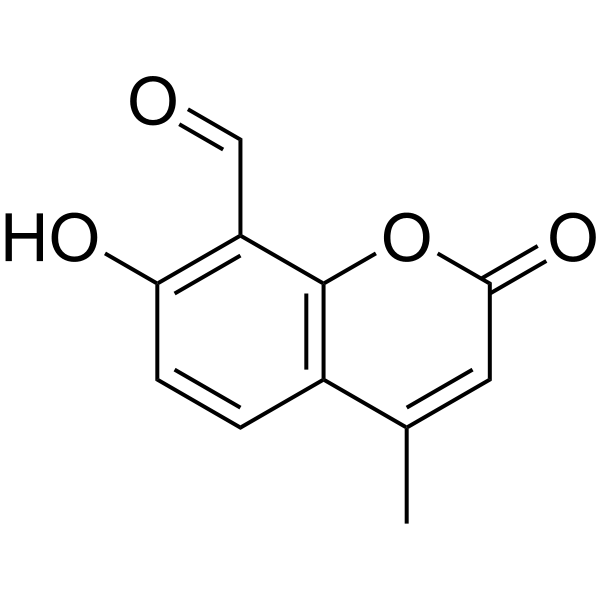
HY-19707
4μ8C -
HY-P80811
Phospho-EIF2S1 (Ser51) Antibody (YA203) -
HY-P80379
ATF6 Antibody (YA831) -
HY-P80492
EIF2A Antibody (YA465) -
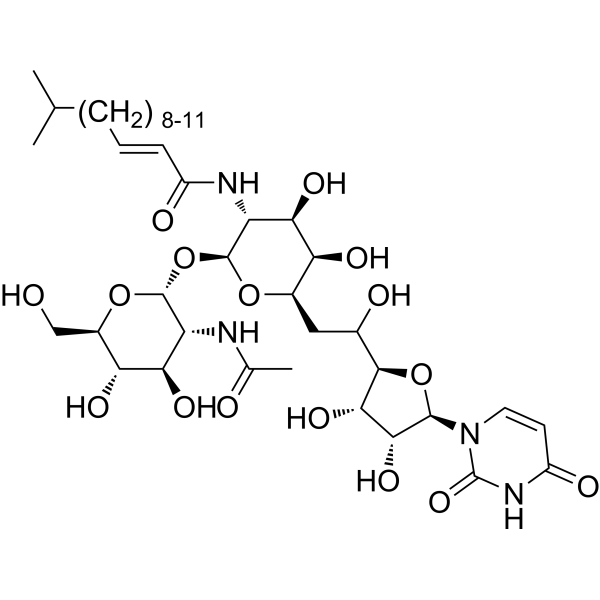
HY-A0098
Tunicamycin -
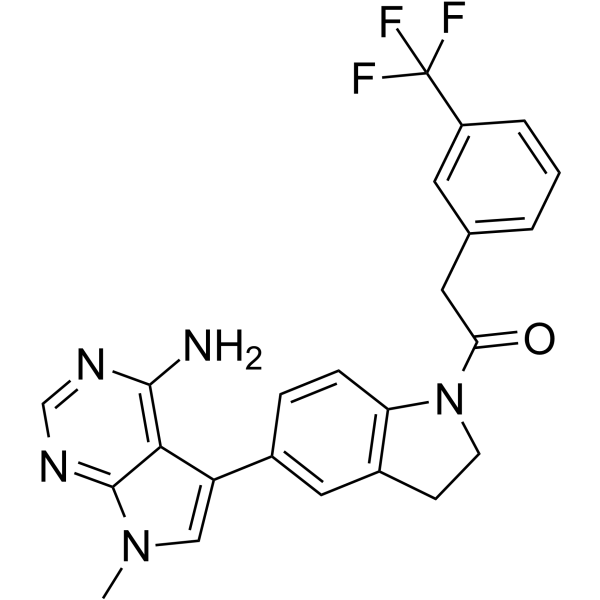
HY-18072
GSK2606414 -
HY-P86330
IRE1 alpha Antibody (YA6022) -

HY-K0010
Protease Inhibitor Cocktail (EDTA-Free, 100× in DMSO) -
HY-P81679
XBP1 Antibody (YA1424) -
HY-P80554
ATF6 Antibody (YA604)
Publications Citing Use of MedChemExpress (MCE) Phospho-IRE1 (Ser724) Antibody (YA182)
More

Applications
| Application |
WB

WB: Western Blot
|
IP
IP: Immunoprecipitation
|
|---|---|---|
| Dilution Ratio | 1:500-1:1000 | 1:20 |


Product Details
Phospho-IRE1 (Ser724) Antibody (YA182) is a Rabbit-derived and non-conjugated IgG monoclonal antibody, targeting to Phospho-IRE1 (Ser724).
-
Host Rabbit

-
Clonality Recombinant,Monoclonal

-
Species ReactivityHuman
-
Observed Molecular WeightObserved band size: 110 kDa
Note: Due to possible protein modifications or aggregation, the molecular weight should be confirmed by actual measurement, and the predicted value is for reference only.

-
Calculated Molecular Weight Predicted band size: 110 kDa

Synthetic phosphopeptide corresponding to residues surrounding Ser724 of Human IRE1.The exact sequence is proprietary to MCE.
Endogenous
affinity purified
Non-conjugated
Phosphorylated
IgG


Product Properties
-
Appearance
Solution
-
Formulation
Supplied in 50 mM Tris-Glycine (pH 7.4), 0.15 M NaCl, 40% Glycerol and 0.05% BSA. Preservative: 0.01% Sodium azide
-
Concentration
Batch-dependent, Please check the COA for the concentration of each lot. Check Lot Concentration
-
Storage & Stability
Stored at -20°C for 1 year. Avoid repeated freeze / thaw cycles.
-
Shipping
Shipping with blue ice.


Publications (1)
-
Journal Impact Factor
-
Most Recent
-
J Photochem Photobiol B
Blue light irradiation suppresses oral squamous cell carcinoma through induction of endoplasmic reticulum stress and mitochondrial dysfunction. [Abstract]2024 Aug:257:112963. PMID: 38908147


Verification Images
-
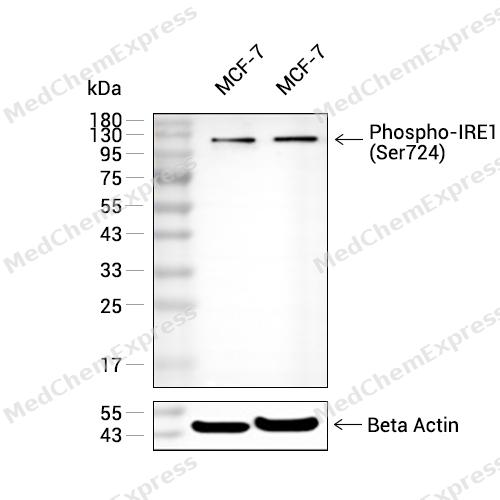 Western blot analysis of extracts from MCF-7 (lane 2(20μg) and MCF-7 (lane 3(40μg) using Phospho-IRE1 (Ser724) (HY-P80828) Rabbit mAb. Proteins were transferred to a PVDF membrane and blocked with 5% non-fat milk in TBST for 2 hour at room temperature. The primary antibody (1/1000) and Loading control antibody (Beta Actin, HY-P80438, 1/10000) was used in 5% non-fat milk in TBST at 4°C overnight. Goat Anti-Mouse IgG-HRP Secondary Antibody (1/10000) was used for 1 hour at room temperature.


Background
-
Function
Inositol-requiring enzyme 1 (IRE1) is a bifunctional serine/threonine kinase and endoribonuclease that is a major mediator of the unfolded protein response (UPR) during endoplasmic reticulum (ER) stress. It represents a potential therapeutic target for a number of diseases associated with endoplasmic reticulum stress.
IRE1 is the only identified ER stress sensor in yeast and essential for UPR in animals and plants. As an ER transmembrane protein, IRE1 monitors ER homeostasis through an ER luminal stress-sensing domain and triggers UPR through a cytoplasmic kinase domain and an RNase domain. Upon ER stress, IRE1 RNase is activated through conformational change, autophosphorylation, and higher order oligomerization. Mammalian IRE1 initiates diverse downstream signaling of the UPR either through unconventional splicing of the transcription factor Xbp-1 or and through posttranscriptional modifications via Regulated IRE1-Dependent Decay (RIDD) of multiple substrates.
-
Subcellular Localization
Endoplasmic reticulum membrane; Single-pass type I membrane protein
-
Expression
Tissue_specificity:Widely expressed. High expression levels are observed in pancreatic tissue.
Induction:Induced by the ER stressor tunicamycin -
Isoforms & Post-Translational Modification
O75460 has 2 isomers: O75460-1: 109735 Da (predicted); O75460-2: 6649 Da (predicted).
Autophosphorylated following homodimerization. Autophosphorylation promotes activation of the endoribonuclease domain (PubMed:12637535, PubMed:21317875, PubMed:28128204, PubMed:9637683). In response to ER stress, phosphorylated at Ser-724, Ser-729 and possibly Ser-726; phosphorylation promotes oligomerization and endoribonuclease activity (PubMed:30118681). Dephosphorylated at Ser-724, Ser-729 and possibly Ser-726 by RPAP2 to abort failed ER-stress adaptation and trigger apoptosis (PubMed:30118681). Phosphorylated at Ser-724; in response to the ER stressor tunicamycin (PubMed:36739529);ADP-ribosylated by PARP16 upon ER stress, which increases both kinase and endonuclease activities -
Subunit
Monomer (PubMed:16973740, PubMed:29198525). Homodimer; disulfide-linked; homodimerization takes place in response to endoplasmic reticulum stress and promotes activation of the kinase and endoribonuclease activities (PubMed:12637535, PubMed:16973740, PubMed:21317875, PubMed:24508390, PubMed:30118681). Dimer formation is driven by hydrophobic interactions within the N-terminal luminal domains and stabilized by disulfide bridges (PubMed:12637535). Interacts (via the luminal region) with DNAJB9/ERdj4; interaction takes place in unstressed cells and promotes recruitment of HSPA5/BiP (PubMed:29198525). Interacts (via the luminal region) with HSPA5/BiP; HSPA5/BiP is a negative regulator of the unfolded protein response (UPR) that prevents homodimerization of ERN1/IRE1 and subsequent activation of the protein (PubMed:12637535, PubMed:29198525, PubMed:36739529). Interaction with HSPA5 also competitively inhibits ERN1 interaction with MANF (PubMed:36739529). Interacts with PDIA6, a negative regulator of the UPR; the interaction is direct and disrupts homodimerization (PubMed:24508390). Interacts with DAB2IP (via PH domain); the interaction occurs in a endoplasmic reticulum stress-induced dependent manner and is required for subsequent recruitment of TRAF2 to ERN1/IRE1 (By similarity). Interacts with TAOK3 and TRAF2 (PubMed:11278723). Interacts with RNF13 (PubMed:23378536). Interacts with LACC1 (PubMed:31875558). Interacts (when unphosphorylated) with DDRGK1; interaction is dependent on UFM1 and takes place in response to endoplasmic reticulum stress, regulating ERN1/IRE1-alpha stability (PubMed:28128204). Interacts (via N-terminus) with P4HB/PDIA1; the interaction is enhanced by phosphorylation of P4HB by FAM20C in response to endoplasmic reticulum stress and results in attenuation of ERN1 activity (PubMed:32149426). Interacts with TMBIM6; this interaction inhibits ERN1 activity (PubMed:19328063). Interacts (via luminal domain) with MANF (via C-terminus); the interaction is decreased in the presence of increasing concentrations of Ca(2+) (PubMed:36739529)
-
SwissProt ID
-
Synonyms
ERN1; IRE1; Serine/threonine-protein kinase/endoribonuclease IRE1; Endoplasmic reticulum-to-nucleus signaling 1; Inositol-requiring protein 1; hIRE1p; Ire1-alpha; IRE1a
-
Research Field
Signal Transduction
Documentation
-
Data Sheet (234 KB)
-
SDS (252 KB)
- English - EN (252 KB)
- Français - FR (252 KB)
- Deutsch - DE (252 KB)
- Norwegian - NO (252 KB)
- Español - ES (252 KB)
- Swedish - SV (252 KB)
- Italian - IT (252 KB)
- Korean - KR (252 KB)
- Portuguese - PT (252 KB)
-
User Guide for Antibodies (1077 KB)

 Powered by Bioz
