



HLA E Antibody (YA3437)
(Synonyms: HLA class I histocompatibility antigen E alpha chain antibody; EA1.2 antibody; EA2.1 antibody; HLA 6.2 antibody; HLA class I histocompatibility antigen alpha chain E antibody; HLA class I histocompatibility antigen E alpha chain precursor antibody; HLA class I histocompatibility antigen E alpha chain precursor antibody; HLA6.2 antibody; HLAE antibody; Lymphocyte antigen antibody; Major histocompatibility complex class I E antibody; MHC antibody; MHC class I antigen E antibody; MHC HLA E alpha 1 antibody; MHC HLA E alpha 2.1 antibody; QA1 antibody; )
Based on 1 Customer Validation
HLA E Antibody (YA3437) is a Mouse-derived and non-conjugated IgG1 monoclonal antibody, targeting to HLA E.
-
Host:
Mouse
-
Isotype:
IgG1
-
Application:
WB, IP, FC
-
Reactivity :
Human
-
Formulation:
Supplied in PBS with < 0.1% sodium azide and 0.1% gelatin.
-
Conjugation:
Non-conjugated


To place orders, for customer services and technical support, please contact: MedChemExpress USA
Tel: 609-228-6898 E-mail: [email protected] [email protected]





Applications
| Application |
WB

WB: Western Blot
|
IP
IP: Immunoprecipitation
|
FC
FC: Flow Cytometry
|
|---|---|---|---|
| Dilution Ratio | 1:100-1:1000 | 1-2 μg per 100-500 μg of total protein(1 ml of cell lysate) | 1 μg per 1 x 10⁶ cells |


Product Details
HLA E Antibody (YA3437) is a Mouse-derived and non-conjugated IgG1 monoclonal antibody, targeting to HLA E.
-
Host Mouse

-
Clonality Monoclonal

-
Species ReactivityHuman
-
Observed Molecular WeightObserved band size: 40 kDa
Note: Due to possible protein modifications or aggregation, the molecular weight should be confirmed by actual measurement, and the predicted value is for reference only.

-
Calculated Molecular Weight Predicted band size: 40 kDa

Recombinant HLA-E of human origin.
Protein A affinity purified.
Non-conjugated
Unmodified
IgG1


Product Properties
-
Appearance
Liquid
-
Formulation
Supplied in PBS with < 0.1% sodium azide and 0.1% gelatin.
-
Concentration
Batch-dependent, Please check the COA for the concentration of each lot. Check Lot Concentration
-
Storage & Stability
Stored at 2-8°C for 1 year, do not freeze.
-
Shipping
Shipping with blue ice.


Verification Images
-
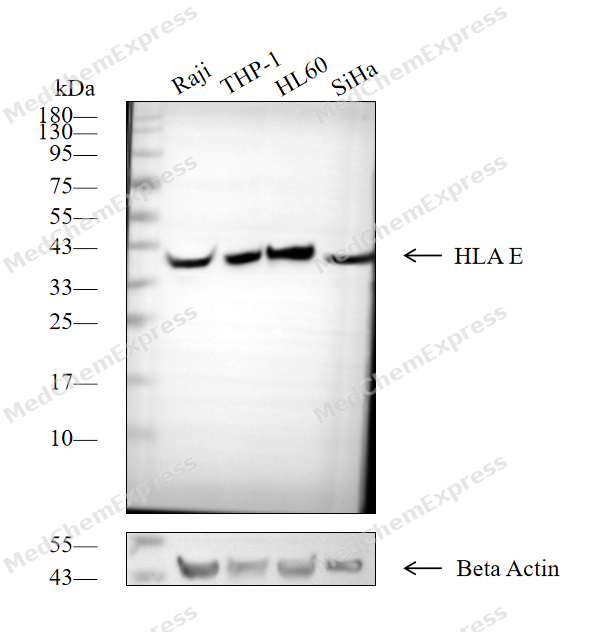 Western blot analysis of extracts from RaJi (lane 2(20μg), THP-1 (lane 3(20μg), HL60 (lane 4(20μg) and SiHa (lane 5(20μg) usingHLA E Antibody (HY-P83701). Proteins were transferred to a PVDF membrane and blocked with 5% non-fat milk in TBST for 2 hour at room temperature. The primary antibody (1/1000) and Loading control antibody (Beta Actin, HY-P80993, 1/10000) was used in 5% non-fat milk in TBST at 4°C overnight. Goat Anti-Mouse IgG-HRP Secondary Antibody (1/10000) was used for 1 hour at room temperature.


Background
-
Function
HLA E is a Non-classical major histocompatibility class Ib molecule involved in immune self-nonself discrimination. In complex with B2M/beta-2-microglobulin binds nonamer self-peptides derived from the signal sequence of classical MHC class Ia molecules (VL9 peptides - VMAPRT[V/L][L/V/I/F]L). Peptide-bound HLA-E-B2M heterotrimeric complex primarily functions as a ligand for natural killer (NK) cell inhibitory receptor KLRD1-KLRC1, enabling NK cells to monitor the expression of other MHC class I molecules in healthy cells and to tolerate self. Upon cellular stress, preferentially binds signal sequence-derived peptides from stress-induced chaperones and is no longer recognized by NK cell inhibitory receptor KLRD1-KLRC1, resulting in impaired protection from NK cells. Binds signal sequence-derived peptides from non-classical MHC class Ib HLA-G molecules and acts as a ligand for NK cell activating receptor KLRD1-KLRC2, likely playing a role in the generation and effector functions of adaptive NK cells and in maternal-fetal tolerance during pregnancy. Besides self-peptides, can also bind and present pathogen-derived peptides conformationally similar to VL9 peptides to alpha-beta T cell receptor (TCR) on unconventional CD8-positive cytotoxic T cells, ultimately triggering antimicrobial immune response. Presents HIV gag peptides (immunodominant KAFSPEVIPMF and subdominant KALGPAATL epitopes) predominantly to CD8-positive T cell clones expressing a TRAV17-containing TCR, triggering HLA-E-restricted T cell responses. Presents mycobacterial peptides to HLA-E-restricted CD8-positive T cells eliciting both cytotoxic and immunoregulatory functions; (Microbial infection) Viruses like human cytomegalovirus have evolved an escape mechanism whereby virus-induced down-regulation of host MHC class I molecules is coupled to the binding of viral peptides to HLA-E, restoring HLA-E expression and inducing HLA-E-dependent NK cell immune tolerance to infected cells; (Microbial infection) May bind HIV-1 gag/Capsid protein p24-derived peptide (AISPRTLNA) on infected cells and may inhibit NK cell cytotoxicity, a mechanism that allows HIV-1 to escape immune recognition; (Microbial infection) Upon SARS-CoV-2 infection, may contribute to functional exhaustion of cytotoxic NK cells and CD8-positive T cells. Binds SARS-CoV-2 S/Spike protein S1-derived peptide (LQPRTFLL) expressed on the surface of lung epithelial cells, inducing NK cell exhaustion and dampening of antiviral immune surveillance[1][2][3][4][5][6][7][8][9][10][11][12][13][14].
-
Subcellular Localization
Cell membrane; Single-pass type I membrane protein; Golgi apparatus membrane; Secreted
-
Expression
Tissue_specificity:Expressed in secretory endometrial cells during pregnancy (at protein level) . The expression in nonlymphoid tissues is restricted to endothelial cells from all types of vessels, including arteries, veins, capillaries, and lymphatics (at protein level) . In lymphoid organs, it is mainly expressed in endothelial venules, B and T cells, monocytes, macrophages, NK cells and megakaryocytes (at protein level)
Induction:Pro-inflammatory cytokines including TNF, IL1B and IFNG up-regulate membrane bound HLA-E expression on endothelial and NK cells and induce the release of soluble HLA-E (sHLA-E) in the extracellular compartment
Positive sample: PBL, BJAB, CCRF- CEM, AML-193. -
Subunit
Forms a heterotrimer with B2M and a self- or a pathogen-derived peptide (peptide-bound HLA-E-B2M) (PubMed:18339401, PubMed:30087334, PubMed:35705051).
-
SwissProt ID
-
Synonyms
HLA class I histocompatibility antigen E alpha chain antibody; EA1.2 antibody; EA2.1 antibody; HLA 6.2 antibody; HLA class I histocompatibility antigen alpha chain E antibody; HLA class I histocompatibility antigen E alpha chain precursor antibody; HLA class I histocompatibility antigen E alpha chain precursor antibody; HLA6.2 antibody; HLAE antibody; Lymphocyte antigen antibody; Major histocompatibility complex class I E antibody; MHC antibody; MHC class I antigen E antibody; MHC HLA E alpha 1 antibody; MHC HLA E alpha 2.1 antibody; QA1 antibody;


Documentation
-
Data Sheet (236 KB)
-
SDS (254 KB)
- English - EN (254 KB)
- Français - FR (254 KB)
- Deutsch - DE (254 KB)
- Norwegian - NO (254 KB)
- Español - ES (254 KB)
- Swedish - SV (254 KB)
- Italian - IT (254 KB)
- Korean - KR (254 KB)
- Portuguese - PT (254 KB)
-
User Guide for Antibodies (1077 KB)

 Powered by Bioz
