



Integrin alpha V Antibody (YA338)
(Synonyms: CD51, MSK8, VNRA, VTNR, ITGAV, Integrin alpha-V, Vitronectin receptor, Vitronectin receptor subunit alpha)
Based on 1 Customer Validation
Integrin alpha V Antibody (YA338) is a Rabbit-derived and non-conjugated IgG monoclonal antibody, targeting to Integrin alpha V.
-
Host:
Rabbit
-
Isotype:
IgG
-
Application:
WB, IHC-P, ICC/IF, FC
-
Reactivity :
Human, Mouse, Rat
-
Formulation:
Supplied in 1*TBS (pH7.4), 0.05% BSA and 40% Glycerol. Preservative: 0.05% Sodium Azide.
-
Conjugation:
Non-conjugated


To place orders, for customer services and technical support, please contact: MedChemExpress USA
Tel: 609-228-6898 E-mail: [email protected] [email protected]





Applications
| Application |
WB

WB: Western Blot
|
IHC-P
IHC-P: Immunohistochemistry-Paraffin
|
ICC/IF
ICC/IF: Immunocytochemistry/
Immunofluorescence |
FC
FC: Flow Cytometry
|
|---|---|---|---|---|
| Dilution Ratio | 1:1000-1:2000 | 1:1000 | 1:50-1:100 | 1:50-1:100 |


Product Details
Integrin alpha V Antibody (YA338) is a Rabbit-derived and non-conjugated IgG monoclonal antibody, targeting to Integrin alpha V.
-
Host Rabbit

-
Clonality Recombinant,Monoclonal

-
Species ReactivityHuman, Mouse, Rat
-
Observed Molecular WeightObserved band size: 125-130 kDa
Note: Due to possible protein modifications or aggregation, the molecular weight should be confirmed by actual measurement, and the predicted value is for reference only.

-
Calculated Molecular Weight Predicted band size: 116 kDa

Synthetic peptide corresponding to Human Integrin alpha V.AA range:1000-1048.
Endogenous
Protein A affinity purified.
Non-conjugated
Unmodified
IgG


Product Properties
-
Appearance
Solution
-
Formulation
Supplied in 1*TBS (pH7.4), 0.05% BSA and 40% Glycerol. Preservative: 0.05% Sodium Azide.
-
Concentration
Batch-dependent, Please check the COA for the concentration of each lot. Check Lot Concentration
-
Storage & Stability
Stored at -20°C for 1 year. Avoid repeated freeze / thaw cycles.
-
Shipping
Shipping with blue ice.


Verification Images
-
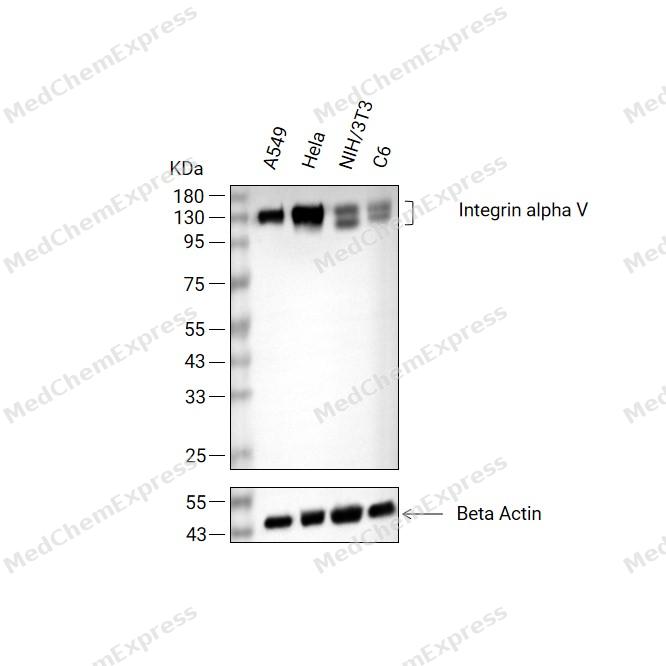 Western blot analysis of extracts from A549 (lane2(20μg), Hela (lane3(20μg), NIH/3T3 (lane4(20μg) and C6 (lane5(20μg) using Integrin alpha V Antibody (HY-P80417). Proteins were transferred to a PVDF membrane and blocked with 5% non-fat milk in TBST at 4°C overnight. The primary antibody (1/1000) and Loading control antibody (Beta Actin, HY-P80993, 1/10,000) was used in 5% non-fat milk in TBST for 2 hour at room temperature. Goat Anti-Rabbit IgG-HRP Secondary Antibody (HY-P8001, 1/10,000) was used for 1 hour at room temperature.
 -
 Flow cytometric analysis of 1X10⁶ NIH-3T3 cells labeling Integrin alpha V Antibody(HY-P80417, red). Cells were fixed with 4% paraformaldehyde. Then stained with the primary antibody at 1/100 dilution for an hour at 4℃. AF488-conjugated Goat Anti-Rabbit IgG H&L (HY-P8002) was used as the secondary antibody at 1/1,000 dilution for 30 minutes at 4℃. Rabbit IgG Isotype Control (HY-P80879, blue) was used as the isotype control, cells without incubation with primary antibody were used as the unlabeled control (black).
 -
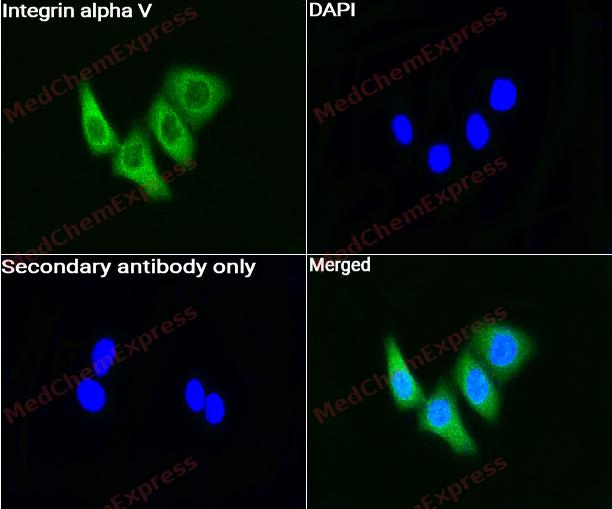 Immunocytochemistry analysis of HeLa cells labeling Integrin alpha V with Integrin alpha V Antibody (HY-P80417) at 1/50 dilution. Cells were fixed in 4% paraformaldehyde for 15 minutes at room temperature, permeabilized with 0.1% Triton X-100 for 10 minutes at room temperature, then blocked with BSA for Immunol Staining for 10 min at room temperature. Cells were then incubated with Integrin alpha V Antibody (HY-P80417) at 1/50 dilution in BSA for Immunol Staining at 4 ℃ overnight. AF488-conjugated AffiniPure Goat Anti-Rabbit IgG H&L(HY-P8002, Green) was used as the secondary antibody at 1/1,000 dilution. PBS instead of the primary antibody was used as the secondary antibody only control. The Nuclear counterstain was DAPI (Blue).
 -
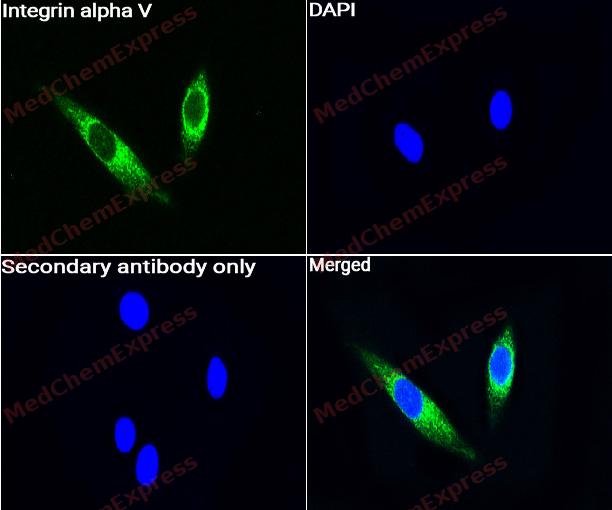 Immunocytochemistry analysis of Siha cells labeling Integrin alpha V with Integrin alpha V Antibody (HY-P80417) at 1/50 dilution. Cells were fixed in 4% paraformaldehyde for 15 minutes at room temperature, permeabilized with 0.1% Triton X-100 for 10 minutes at room temperature, then blocked with BSA for Immunol Staining for 10 min at room temperature. Cells were then incubated with Integrin alpha V Antibody (HY-P80417) at 1/50 dilution in BSA for Immunol Staining at 4 ℃ overnight. AF488-conjugated AffiniPure Goat Anti-Rabbit IgG H&L(HY-P8002,Green) was used as the secondary antibody at 1/1,000 dilution. PBS instead of the primary antibody was used as the secondary antibody only control. The Nuclear counterstain was DAPI (Blue).


Background
-
Function
Integrin alpha V is a The alpha-V (ITGAV) integrins are receptors for vitronectin, cytotactin, fibronectin, fibrinogen, laminin, matrix metalloproteinase-2, osteopontin, osteomodulin, prothrombin, thrombospondin and vWF. They recognize the sequence R-G-D in a wide array of ligands. ITGAV:ITGB3 binds to fractalkine (CX3CL1) and may act as its coreceptor in CX3CR1-dependent fractalkine signaling. ITGAV:ITGB3 binds to NRG1 (via EGF domain) and this binding is essential for NRG1-ERBB signaling. ITGAV:ITGB3 binds to FGF1 and this binding is essential for FGF1 signaling. ITGAV:ITGB3 binds to FGF2 and this binding is essential for FGF2 signaling. ITGAV:ITGB3 binds to IGF1 and this binding is essential for IGF1 signaling. ITGAV:ITGB3 binds to IGF2 and this binding is essential for IGF2 signaling. ITGAV:ITGB3 binds to IL1B and this binding is essential for IL1B signaling. ITGAV:ITGB3 binds to PLA2G2A via a site (site 2) which is distinct from the classical ligand-binding site (site 1) and this induces integrin conformational changes and enhanced ligand binding to site 1. ITGAV:ITGB3 and ITGAV:ITGB6 act as receptors for fibrillin-1 (FBN1) and mediate R-G-D-dependent cell adhesion to FBN1. Integrin alpha-V/beta-6 or alpha-V/beta-8 (ITGAV:ITGB6 or ITGAV:ITGB8) mediates R-G-D-dependent release of transforming growth factor beta-1 (TGF-beta-1) from regulatory Latency-associated peptide (LAP), thereby playing a key role in TGF-beta-1 activation. ITGAV:ITGB3 acts as a receptor for CD40LG. ITGAV:ITGB3 acts as a receptor for IBSP and promotes cell adhesion and migration to IBSP; (Microbial infection) Integrin ITGAV:ITGB5 acts as a receptor for Adenovirus type C; (Microbial infection) Integrin ITGAV:ITGB5 and ITGAV:ITGB3 act as receptors for Coxsackievirus A9 and B1; (Microbial infection) Integrin ITGAV:ITGB3 acts as a receptor for Herpes virus 8/HHV-8; (Microbial infection) Integrin ITGAV:ITGB6 acts as a receptor for herpes simplex 1/HHV-1; (Microbial infection) Integrin ITGAV:ITGB3 acts as a receptor for Human parechovirus 1; (Microbial infection) Integrin ITGAV:ITGB3 acts as a receptor for West nile virus; (Microbial infection) In case of HIV-1 infection, the interaction with extracellular viral Tat protein seems to enhance angiogenesis in Kaposi's sarcoma lesions[1][2][3][4][5][6][7][8][9][10][11][12][13][14][15][16].
-
Subcellular Localization
Cell membrane; Single-pass type I membrane protein; Cell junction, focal adhesion
-
Isoforms & Post-Translational Modification
P06756 has 3 isomers: P06756-1: 116038 Da (predicted); P06756-2: 112258 Da (predicted); P06756-3: 111132 Da (predicted).
-
Subunit
Heterodimer of an alpha and a beta subunit. The alpha subunit is composed of a heavy and a light chain linked by a disulfide bond. Alpha-V (ITGAV) associates with either beta-1 (ITGB1), beta-3 (ITGB3), beta-5 (ITGB5), beta-6 (ITGB6) or beta-8 (ITGB8).
-
SwissProt ID
-
Synonyms
CD51, MSK8, VNRA, VTNR, ITGAV, Integrin alpha-V, Vitronectin receptor, Vitronectin receptor subunit alpha
-
Research Field
Cardiovascular


Documentation
-
Data Sheet (264 KB)
-
SDS (252 KB)
- English - EN (252 KB)
- Français - FR (252 KB)
- Deutsch - DE (252 KB)
- Norwegian - NO (252 KB)
- Español - ES (252 KB)
- Swedish - SV (252 KB)
- Italian - IT (252 KB)
- Korean - KR (252 KB)
- Portuguese - PT (252 KB)
-
User Guide for Antibodies (1077 KB)
References
[1]. Fujita M, et al. Integrins αvβ3 and α4β1 act as coreceptors for fractalkine, and the integrin-binding defective mutant of fractalkine is an antagonist of CX3CR1. J Immunol. 2012 Dec 15;189(12):5809-19. [Content Brief]
[2]. Ieguchi K, et al. Direct binding of the EGF-like domain of neuregulin-1 to integrins ({alpha}v{beta}3 and {alpha}6{beta}4) is involved in neuregulin-1/ErbB signaling. J Biol Chem. 2010 Oct 8;285(41):31388-98. [Content Brief]
[3]. Mori S, et al. Direct binding of integrin alphavbeta3 to FGF1 plays a role in FGF1 signaling. J Biol Chem. 2008 Jun 27;283(26):18066-75. [Content Brief]
[4]. Mori S, et al. The integrin-binding defective FGF2 mutants potently suppress FGF2 signalling and angiogenesis. Biosci Rep. 2017 Apr 28;37(2):. [Content Brief]
[5]. Saegusa J, et al. The direct binding of insulin-like growth factor-1 (IGF-1) to integrin alphavbeta3 is involved in IGF-1 signaling. J Biol Chem. 2009 Sep 4;284(36):24106-14. [Content Brief]
[6]. Cedano Prieto DM, et al. Direct integrin binding to insulin-like growth factor-2 through the C-domain is required for insulin-like growth factor receptor type 1 (IGF1R) signaling. PLoS One. 2017;12(9):e0184285. [Content Brief]
[7]. Takada YK, et al. Direct binding to integrins and loss of disulfide linkage in interleukin-1β (IL-1β) are involved in the agonistic action of IL-1β. J Biol Chem. 2017 Dec 8;292(49):20067-20075. [Content Brief]
[8]. Saegusa J, et al. Pro-inflammatory secretory phospholipase A2 type IIA binds to integrins alphavbeta3 and alpha4beta1 and induces proliferation of monocytic cells in an integrin-dependent manner. J Biol Chem. 2008 Sep 19;283(38):26107-15. [Content Brief]
[9]. Fujita M, et al. Proinflammatory secreted phospholipase A2 type IIA (sPLA-IIA) induces integrin activation through direct binding to a newly identified binding site (site 2) in integrins αvβ3, α4β1, and α5β1. J Biol Chem. 2015 Jan 2;290(1):259-71. [Content Brief]
[10]. Bax DV, et al. Cell adhesion to fibrillin-1 molecules and microfibrils is mediated by alpha 5 beta 1 and alpha v beta 3 integrins. J Biol Chem. 2003 Sep 5;278(36):34605-16. [Content Brief]
[11]. Jovanovic J, et al. alphaVbeta6 is a novel receptor for human fibrillin-1. Comparative studies of molecular determinants underlying integrin-rgd affinity and specificity. J Biol Chem. 2007 Mar 2;282(9):6743-51. [Content Brief]
[12]. Annes JP, et al. Integrin alphaVbeta6-mediated activation of latent TGF-beta requires the latent TGF-beta binding protein-1. J Cell Biol. 2004 Jun 7;165(5):723-34. [Content Brief]
[13]. Wang R, et al. GARP regulates the bioavailability and activation of TGFβ. Mol Biol Cell. 2012 Mar;23(6):1129-39. [Content Brief]
[14]. Dong X, et al. Force interacts with macromolecular structure in activation of TGF-β. Nature. 2017 Feb 2;542(7639):55-59. [Content Brief]
[15]. Takada YK, et al. Integrin Binding to the Trimeric Interface of CD40L Plays a Critical Role in CD40/CD40L Signaling. J Immunol. 2019 Sep 1;203(5):1383-1391. [Content Brief]
[16]. Byzova TV, et al. Activation of integrin alpha(V)beta(3) regulates cell adhesion and migration to bone sialoprotein. Exp Cell Res. 2000 Feb 1;254(2):299-308. [Content Brief]

 Powered by Bioz
