



LOXL2 Antibody (YA1606)
(Synonyms: LOR2; LOX L2; LOXL2; Lysyl oxidase homolog 2; Lysyl oxidase like 2; WS9 14)
Based on 1 Customer Validation
LOXL2 Antibody (YA1606) is a Rabbit-derived and non-conjugated IgG monoclonal antibody, targeting to LOXL2.
-
Host:
Rabbit
-
Isotype:
IgG
-
Application:
WB, ICC/IF, FC
-
Reactivity :
Human, Mouse, Rat
-
Formulation:
Supplied in Rabbit IgG in 10mM phosphate buffered saline , pH 7.4, 150mM sodium chloride, 0.05% BSA, 0.02% sodium azide and 50% glycerol.
-
Conjugation:
Non-conjugated


To place orders, for customer services and technical support, please contact: MedChemExpress USA
Tel: 609-228-6898 E-mail: [email protected] [email protected]





Applications
| Application |
WB

WB: Western Blot
|
ICC/IF
ICC/IF: Immunocytochemistry/
Immunofluorescence |
FC
FC: Flow Cytometry
|
|---|---|---|---|
| Dilution Ratio | 1:500-1:1000 | 1:50-1:200 | 1:50-1:100 |


Product Details
LOXL2 Antibody (YA1606) is a Rabbit-derived and non-conjugated IgG monoclonal antibody, targeting to LOXL2.
-
Host Rabbit

-
Clonality Recombinant,Monoclonal

-
Species ReactivityHuman, Mouse, Rat
-
Observed Molecular WeightObserved band size: 53/106 kDa
Note: Due to possible protein modifications or aggregation, the molecular weight should be confirmed by actual measurement, and the predicted value is for reference only.

-
Calculated Molecular Weight Predicted band size: 87 kDa

Entrez Gene: 4017 Human ; 94352 Mouse ; 290350 Rat
SwissProt: Q9Y4K0 Human ; P58022 Mouse ; B5DF27 Rat
OMIM: 606663 Human
A synthesized peptide derived from human LOXL2 aa711-774/774.
Endogenous
Affinity Chromatography
Non-conjugated
Unmodified
IgG


Product Properties
-
Appearance
Solution
-
Formulation
Supplied in Rabbit IgG in 10mM phosphate buffered saline , pH 7.4, 150mM sodium chloride, 0.05% BSA, 0.02% sodium azide and 50% glycerol.
-
Concentration
Batch-dependent, Please check the COA for the concentration of each lot. Check Lot Concentration
-
Storage & Stability
Stored at -20°C for 1 year. Avoid repeated freeze / thaw cycles.
-
Shipping
Shipping with blue ice.


Verification Images
-
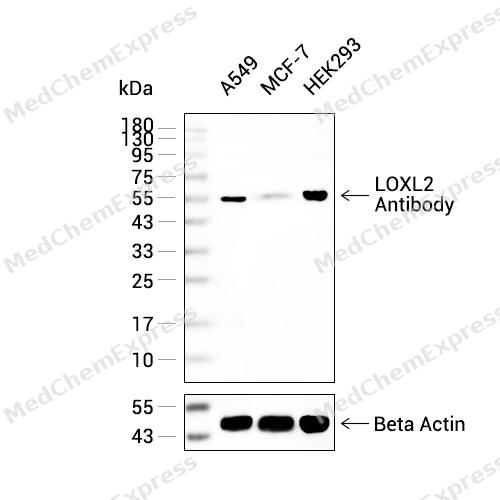 Western blot analysis of extracts from A549(lane 2(20ug) , MCF-7(lane 3(20ug)and HEK293(lane 4(20ug) using LOXL2 Antibody (HY-P81861) Rabbit mAb. Proteins were transferred to a PVDF membrane and blocked with 5% non-fat milk in TBST for 2 hour at room temperature. The primary antibody (1/1000) and Loading control antibody (Beta Actin, HY-P80438, 1/10000) was used in 5% non-fat milk in TBST at 4°C overnight. Goat Anti-Mouse/Rabbit IgG-HRP Secondary Antibody (1/10000) was used for 1 hour at room temperature.
 -
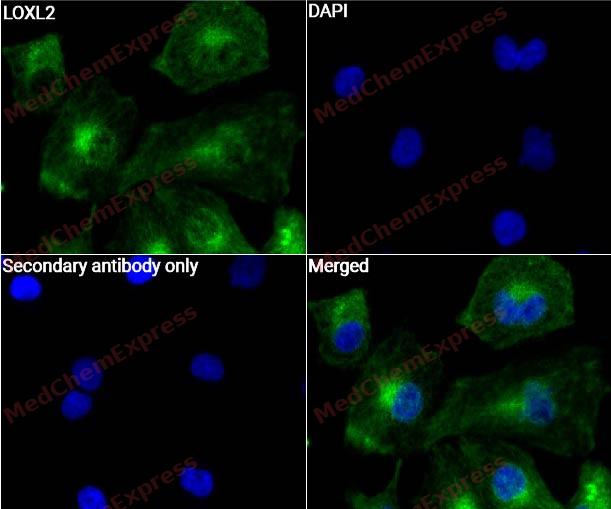 Immunocytochemistry analysis of A549 cells labeling LOXL2 with LOXL2 Antibody (HY-P81861) at 1/50 dilution. Cells were fixed in 4% paraformaldehyde for 15 minutes at room temperature, permeabilized with 0.1% Triton X-100 for 10 minutes at room temperature, then blocked with QuickBlock™ Blocking Buffer for Immunol Staining for 10 min at room temperature. Cells were then incubated with LOXL2 Antibody (HY-P81861) at 1/50 dilution in QuickBlock™ Blocking Buffer for Immunol Staining at 4 ℃. Alexa Fluor® 488-conjugated AffiniPure Goat Anti-Rabbit IgG H&L(HY-P8002, Green) was used as the secondary antibody at 1/1,000 dilution. PBS instead of the primary antibody was used as the secondary antibody only control. The Nuclear counterstain was DAPI (Blue).
 -
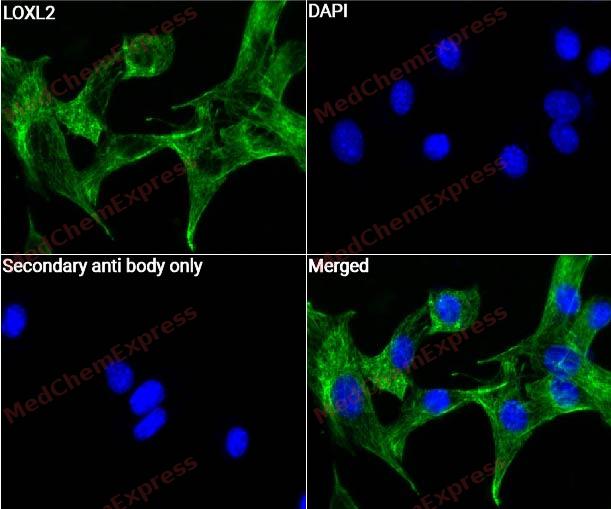 Immunocytochemistry analysis of HUVEC cells labeling LOXL2 with LOXL2 Antibody (HY-P81861) at 1/50 dilution. Cells were fixed in 4% paraformaldehyde for 15 minutes at room temperature, permeabilized with 0.1% Triton X-100 for 10 minutes at room temperature, then blocked with QuickBlock™ Blocking Buffer for Immunol Staining for 10 min at room temperature. Cells were then incubated with LOXL2 Antibody (HY-P81861) at 1/50 dilution in QuickBlock™ Blocking Buffer for Immunol Staining at 4 ℃. Alexa Fluor® 488-conjugated AffiniPure Goat Anti-Rabbit IgG H&L(HY-P8002, Green) was used as the secondary antibody at 1/1,000 dilution. PBS instead of the primary antibody was used as the secondary antibody only control. The Nuclear counterstain was DAPI (Blue).
 -
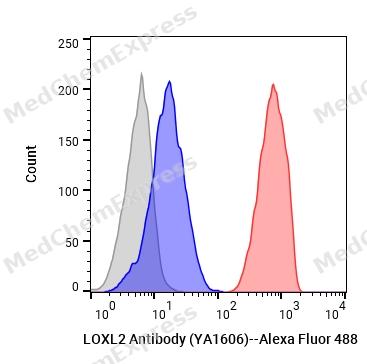 Flow cytometric analysis of 1X10^6 A549 cells labeling LOXL2 Antibody (YA1606) (HY-P80861, red). Cells were fixed with 4% paraformaldehyde. Then stained with the primary antibody at 1/50 dilution for an hour at 4℃. Alexa Fluor® 488-conjugated AffiniPure Goat Anti-Rabbit IgG H&L (HY-P8002) was used as the secondary antibody at 1/1,000 dilution for 30 minutes at 4℃. Rabbit IgG Isotype Control (HY-P80879, blue) was used as the isotype control, cells without incubation with primary antibody were used as the unlabeled control (black).


Background
-
Function
LOXL2 mediates the post-translational oxidative deamination of lysine residues on target proteins leading to the formation of deaminated lysine (allysine). Acts as a transcription corepressor and specifically mediates deamination of trimethylated 'Lys-4' of histone H3 (H3K4me3), a specific tag for epigenetic transcriptional activation. Shows no activity against histone H3 when it is trimethylated on 'Lys-9' (H3K9me3) or 'Lys-27' (H3K27me3) or when 'Lys-4' is monomethylated (H3K4me1) or dimethylated (H3K4me2). Also mediates deamination of methylated TAF10, a member of the transcription factor IID (TFIID) complex, which induces release of TAF10 from promoters, leading to inhibition of TFIID-dependent transcription. LOXL2-mediated deamination of TAF10 results in transcriptional repression of genes required for embryonic stem cell pluripotency including POU5F1/OCT4, NANOG, KLF4 and SOX2. Involved in epithelial to mesenchymal transition (EMT) via interaction with SNAI1 and participates in repression of E-cadherin CDH1, probably by mediating deamination of histone H3. During EMT, involved with SNAI1 in negatively regulating pericentromeric heterochromatin transcription. SNAI1 recruits LOXL2 to pericentromeric regions to oxidize histone H3 and repress transcription which leads to release of heterochromatin component CBX5/HP1A, enabling chromatin reorganization and acquisition of mesenchymal traits. Interacts with the endoplasmic reticulum protein HSPA5 which activates the IRE1-XBP1 pathway of the unfolded protein response, leading to expression of several transcription factors involved in EMT and subsequent EMT induction. Involved in E-cadherin repression following hypoxia, a hallmark of EMT believed to amplify tumor aggressiveness, suggesting that it may play a role in tumor progression. When secreted into the extracellular matrix, promotes cross-linking of extracellular matrix proteins by mediating oxidative deamination of peptidyl lysine residues in precursors to fibrous collagen and elastin. Acts as a regulator of sprouting angiogenesis, probably via collagen IV scaffolding. Acts as a regulator of chondrocyte differentiation, probably by regulating expression of factors that control chondrocyte differentiation[1][2][3][4][5][6][7][8][9].
-
Subcellular Localization
Secreted, extracellular space, extracellular matrix, basement membrane; Nucleus; Chromosome; Endoplasmic reticulum
-
Expression
Tissue_specificity:Expressed in many tissues (PubMed:10212285) . Highest expression in reproductive tissues, placenta, uterus and prostate (PubMed:10212285) . In esophageal epithelium, expressed in the basal, prickle and granular cell layers (PubMed:22204712) . Up-regulated in a number of cancers cells and tissues
Induction:Strongly induced in hypoxia. Direct transcriptional target of HIF1A -
Subunit
Component of some chromatin repressor complex. Interacts with SNAI1 (PubMed:16096638). Interacts with TAF10 (PubMed:25959397). Interacts with HSPA5 (PubMed:28332555). Interacts with EFEMP2 (PubMed:27339457)
-
SwissProt ID
-
Synonyms
LOR2; LOX L2; LOXL2; Lysyl oxidase homolog 2; Lysyl oxidase like 2; WS9 14
-
Research Field
Signal Transduction


Documentation
-
Data Sheet (262 KB)
-
SDS (252 KB)
- English - EN (252 KB)
- Français - FR (252 KB)
- Deutsch - DE (252 KB)
- Norwegian - NO (252 KB)
- Español - ES (252 KB)
- Swedish - SV (252 KB)
- Italian - IT (252 KB)
- Korean - KR (252 KB)
- Portuguese - PT (252 KB)
-
User Guide for Antibodies (1077 KB)
References
[1]. Herranz N, et al. Lysyl oxidase-like 2 (LOXL2) oxidizes trimethylated lysine 4 in histone H3. FEBS J. 2016 Dec;283(23):4263-4273. [Content Brief]
[2]. Iturbide A, et al. LOXL2 Oxidizes Methylated TAF10 and Controls TFIID-Dependent Genes during Neural Progenitor Differentiation. Mol Cell. 2015 Jun 4;58(5):755-66. [Content Brief]
[3]. Peinado H, et al. A molecular role for lysyl oxidase-like 2 enzyme in snail regulation and tumor progression. EMBO J. 2005 Oct 5;24(19):3446-58. [Content Brief]
[4]. Cuevas EP, et al. LOXL2 catalytically inactive mutants mediate epithelial-to-mesenchymal transition. Biol Open. 2014 Feb 15;3(2):129-37. [Content Brief]
[5]. Millanes-Romero A, et al. Regulation of heterochromatin transcription by Snail1/LOXL2 during epithelial-to-mesenchymal transition. Mol Cell. 2013 Dec 12;52(5):746-57. [Content Brief]
[6]. Cuevas EP, et al. LOXL2 drives epithelial-mesenchymal transition via activation of IRE1-XBP1 signalling pathway. Sci Rep. 2017 Mar 23;7:44988. [Content Brief]
[7]. Schietke R, et al. The lysyl oxidases LOX and LOXL2 are necessary and sufficient to repress E-cadherin in hypoxia: insights into cellular transformation processes mediated by HIF-1. J Biol Chem. 2010 Feb 26;285(9):6658-69. [Content Brief]
[8]. Kim YM, et al. The human lysyl oxidase-like 2 protein functions as an amine oxidase toward collagen and elastin. Mol Biol Rep. 2011 Jan;38(1):145-9. [Content Brief]
[9]. Bignon M, et al. Lysyl oxidase-like protein-2 regulates sprouting angiogenesis and type IV collagen assembly in the endothelial basement membrane. Blood. 2011 Oct 6;118(14):3979-89. [Content Brief]

 Powered by Bioz
