



PRMT5 Antibody (YA1853)
(Synonyms: HRMT1L5; IBP72; JBP1; SKB1; SKB1Hs; PRMT5; Skb1Hs Methyltransferase)
Based on 1 Customer Validation
PRMT5 Antibody (YA1853) is a Rabbit-derived and non-conjugated IgG monoclonal antibody, targeting to PRMT5.
-
Host:
Rabbit
-
Isotype:
IgG
-
Application:
WB, IHC-P, ICC/IF, FC
-
Reactivity :
Human, Mouse, Rat
-
Formulation:
Supplied in 50mM Tris-Glycine(pH 7.4), 0.15M NaCl, 40%Glycerol, 0.01% sodium azide and 0.05% BSA.
-
Conjugation:
Non-conjugated


To place orders, for customer services and technical support, please contact: MedChemExpress USA
Tel: 609-228-6898 E-mail: [email protected] [email protected]





Applications
| Application |
WB

WB: Western Blot
|
IHC-P
IHC-P: Immunohistochemistry-Paraffin
|
ICC/IF
ICC/IF: Immunocytochemistry/
Immunofluorescence |
FC
FC: Flow Cytometry
|
|---|---|---|---|---|
| Dilution Ratio | 1:500-1:1000 | 1:50-1:100 | 1:50-1:200 | 1:50-1:100 |


Product Details
PRMT5 Antibody (YA1853) is a Rabbit-derived and non-conjugated IgG monoclonal antibody, targeting to PRMT5.
-
Host Rabbit

-
Clonality Recombinant,Monoclonal

-
Species ReactivityHuman, Mouse, Rat
-
Observed Molecular WeightObserved band size: 72 kDa
Note: Due to possible protein modifications or aggregation, the molecular weight should be confirmed by actual measurement, and the predicted value is for reference only.

-
Calculated Molecular Weight Predicted band size: 73 kDa

Entrez Gene: 10419 Human ; 27374 Mouse ; 364382 Rat
SwissProt: O14744 Human ; Q8CIG8 Mouse ;
OMIM: 604045 Human
A synthesized peptide derived from human PRMT5 aa40-92.
Endogenous
Affinity Chromatography
Non-conjugated
Unmodified
IgG


Product Properties
-
Appearance
Solution
-
Formulation
Supplied in 50mM Tris-Glycine(pH 7.4), 0.15M NaCl, 40%Glycerol, 0.01% sodium azide and 0.05% BSA.
-
Concentration
Batch-dependent, Please check the COA for the concentration of each lot. Check Lot Concentration
-
Storage & Stability
Stored at -20°C for 1 year. Avoid repeated freeze / thaw cycles.
-
Shipping
Shipping with blue ice.


Verification Images
-
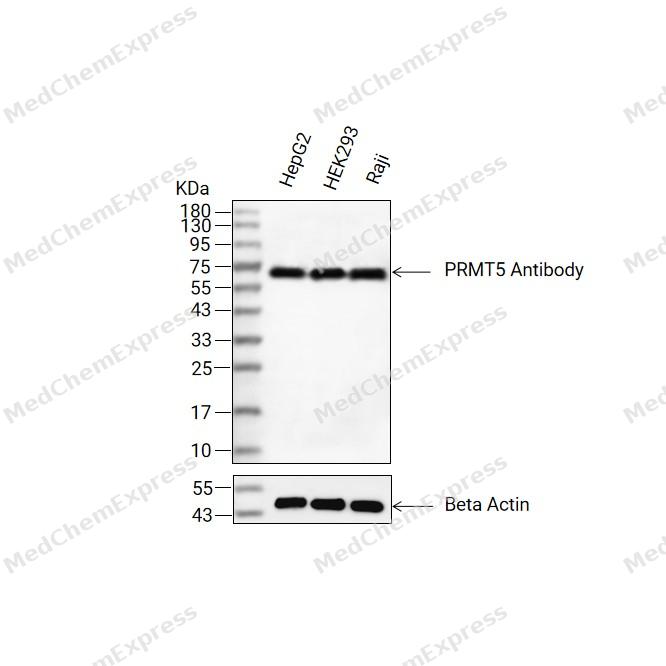 Western blot analysis of extracts from HepG2(lane 2(20ug) , HEK293(lane 3(20ug) and Raji(lane 4(20ug)using PRMT5 Antibody (HY-P82108) Rabbit mAb. Proteins were transferred to a PVDF membrane and blocked with 5% non-fat milk in TBST for 2 hour at room temperature. The primary antibody (1/1000) and Loading control antibody (Beta Actin, HY-P83730, 1/10000) was used in 5% non-fat milk in TBST at 4°C overnight. Goat Anti-Mouse/Rabbit IgG-HRP Secondary Antibody (1/10000) was used for 1 hour at room temperature.
 -
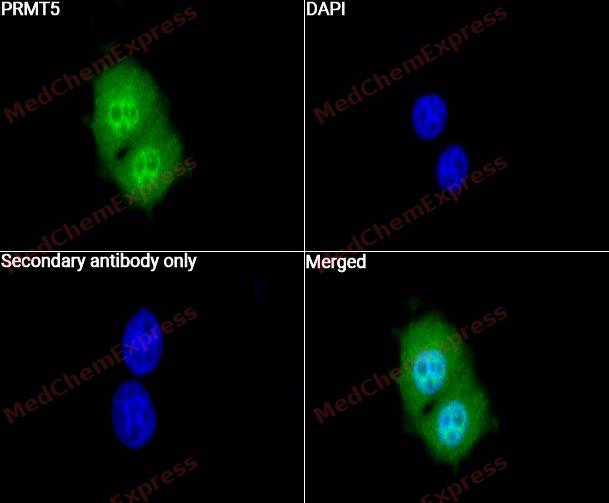 Immunocytochemistry analysis of HepG2 cells labeling PRMT5 with PRMT5 Antibody (HY-P82108) at 1/50 dilution. Cells were fixed in 4% paraformaldehyde for 15 minutes at room temperature, permeabilized with 0.1% Triton X-100 for 10 minutes at room temperature, then blocked with QuickBlock™ Blocking Buffer for Immunol Staining for 10 min at room temperature. Cells were then incubated with PRMT5 Antibody (HY-P82108) at 1/50 dilution in QuickBlock™ Blocking Buffer for Immunol Staining at 4 ℃. Alexa Fluor® 488-conjugated AffiniPure Goat Anti-Rabbit IgG H&L(HY-P8002, Green) was used as the secondary antibody at 1/1,000 dilution. PBS instead of the primary antibody was used as the secondary antibody only control. The Nuclear counterstain was DAPI (Blue).
 -
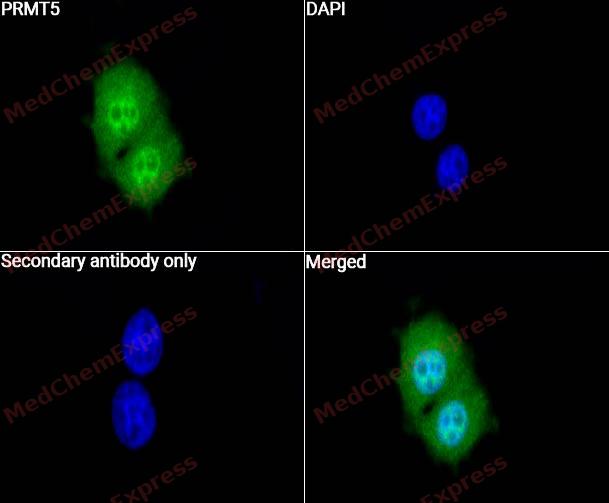 Immunocytochemistry analysis of Neuro-2a cells labeling PRMT5 with PRMT5 Antibody (HY-P82108) at 1/50 dilution. Cells were fixed in 4% paraformaldehyde for 15 minutes at room temperature, permeabilized with 0.1% Triton X-100 for 10 minutes at room temperature, then blocked with QuickBlock™ Blocking Buffer for Immunol Staining for 10 min at room temperature. Cells were then incubated with PRMT5 Antibody (HY-P82108) at 1/50 dilution in QuickBlock™ Blocking Buffer for Immunol Staining at 4 ℃. Alexa Fluor® 488-conjugated AffiniPure Goat Anti-Rabbit IgG H&L(HY-P8002, Green) was used as the secondary antibody at 1/1,000 dilution. PBS instead of the primary antibody was used as the secondary antibody only control. The Nuclear counterstain was DAPI (Blue).
 -
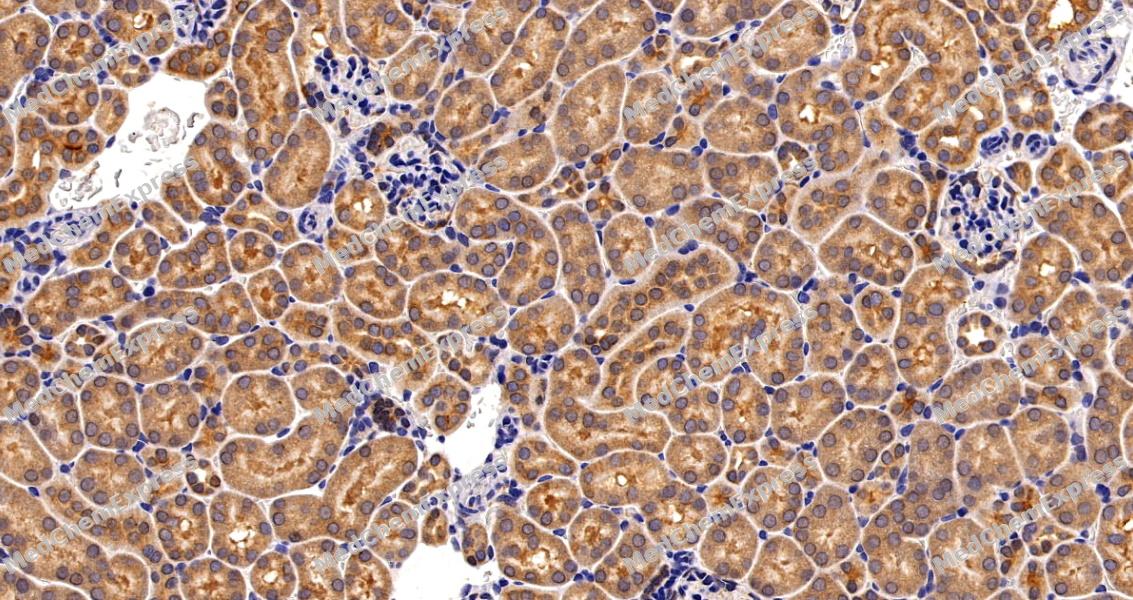 Immunohistochemical analysis of paraffin-embedded mouse kidney tissue using PRMT5 Antibody. The section was pre-treated using heat mediated antigen retrieval with sodium citrate buffer (pH 6.0) for 8 minutes. The tissues were blocked in QuickBlock for 20 minutes at room temperature, washed with ddH2O and PBS, and then probed with the primary antibody at 1/100 dilution in 4℃ overnight. The detection was performed using an HRP conjugated compact polymer system. DAB was used as the chromogen. Tissues were counterstained with hematoxylin and mounted with DPX.
 -
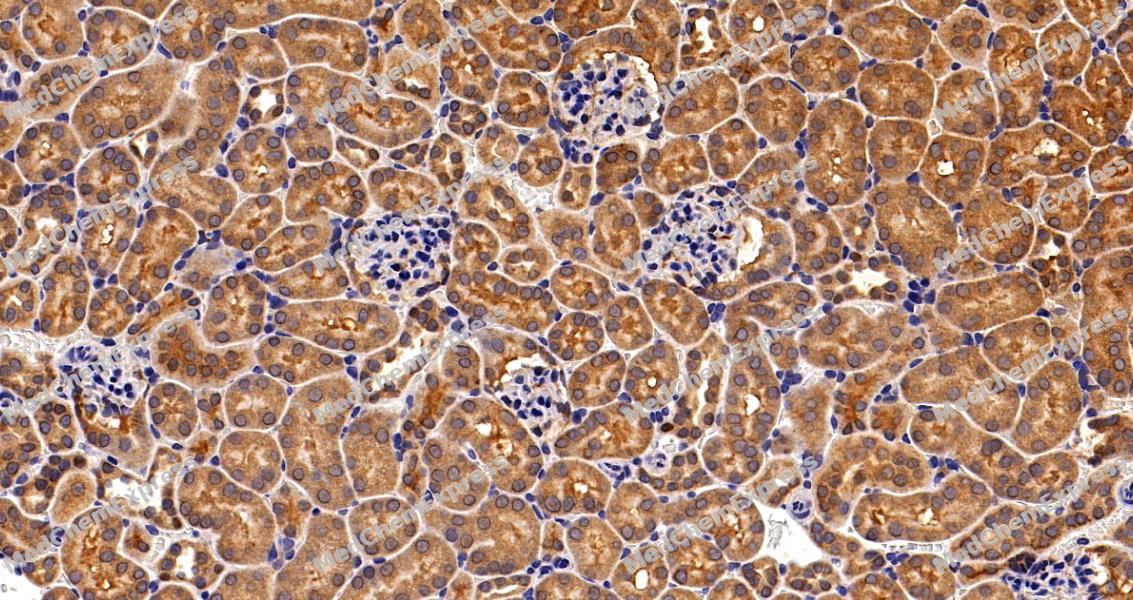 Immunohistochemical analysis of paraffin-embedded mouse kidney tissue using PRMT5 Antibody. The section was pre-treated using heat mediated antigen retrieval with sodium citrate buffer (pH 6.0) for 8 minutes. The tissues were blocked in QuickBlock for 20 minutes at room temperature, washed with ddH2O and PBS, and then probed with the primary antibody at 1/100 dilution in 4℃ overnight. The detection was performed using an HRP conjugated compact polymer system. DAB was used as the chromogen. Tissues were counterstained with hematoxylin and mounted with DPX.
 -
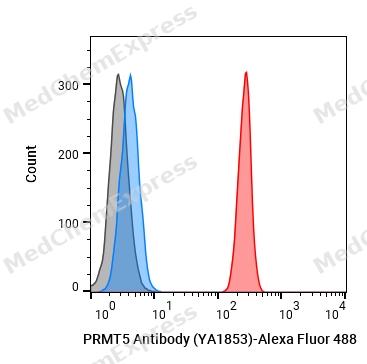 Flow cytometric analysis of 1X10^6 HepG2 cells labeling PRMT5 Antibody (YA1853) (HY-P82108, red). Cells were fixed with 4% paraformaldehyde and permeabilised with 90% methanol. Then stained with the primary antibody at 1/50 dilution for an hour at 4℃. Alexa Fluor® 488-conjugated AffiniPure Goat Anti-Rabbit IgG H&L (HY-P8002) was used as the secondary antibody at 1/1,000 dilution for 30 minutes at 4℃. Rabbit IgG Isotype Control (HY-P80879, blue) was used as the isotype control, cells without incubation with primary antibody were used as the unlabeled control (black).


Background
-
Function
Protein arginine methyltransferase 5 (PRMT5) is a type II arginine methyltransferase that catalyzes symmetric dimethylation of arginine residues on histone and non-histone substrates, thereby regulating chromatin organization, transcriptional control, and cellular development[1][2]. PRMT5 functions as a major epigenetic regulator through symmetric methylation marks such as H3R8me2s and H4R3me2s, which influence gene expression programs and growth-regulatory pathways[1][3]. Mechanistically, PRMT5 plays a central role in RNA processing and alternative splicing, and has been identified as a master regulator of mammalian splicing networks, linking arginine methylation to transcriptome regulation[4][5]. Therefore, PRMT5 integrates transcriptional and post-transcriptional regulation to control cell proliferation, differentiation, survival, and genome maintenance[1][5]. In disease settings, PRMT5 is frequently overexpressed or hyperactivated in multiple cancers, where it supports tumor cell growth, metastasis, and therapeutic resistance through regulation of oncogenic signaling, transcription, and RNA metabolism[2][5][6]. Compared with related isoforms, PRMT5 belongs to the type II PRMT family and primarily generates symmetric dimethylarginine, whereas PRMT1 is the major type I enzyme responsible for asymmetric dimethylarginine formation, highlighting distinct but partially overlapping biological functions[3][7]. For experimental applications, PRMT5 has emerged as a therapeutic target, and pharmacological inhibition disrupts methyltransferase-dependent signaling and splicing pathways; recent MTA-cooperative inhibitors further exploit vulnerabilities in MTAP-deleted tumors[5][6]. These characteristics make PRMT5 an important model for studying epigenetic regulation, RNA splicing, and targeted cancer therapy[1][4][6].
-
Subcellular Localization
Cytoplasm; Nucleus; Chromosome; Golgi apparatus
-
Expression
Tissue_specificity:Ubiquitous -
Isoforms & Post-Translational Modification
O14744 has 5 isomers: O14744-1: 72684 Da (predicted); O14744-2: 71320 Da (predicted); O14744-4: 53580 Da (predicted); O14744-5: 67674 Da (predicted); O14744-3: 66311 Da (predicted).
-
Subunit
Forms, at least, homodimers and homotetramers (PubMed:11152681). Component of the methylosome complex, composed of PRMT5, WDR77 and CLNS1A (PubMed:21081503, PubMed:23071334, PubMed:33376131).
-
SwissProt ID
-
Synonyms
HRMT1L5; IBP72; JBP1; SKB1; SKB1Hs; PRMT5; Skb1Hs Methyltransferase
-
Research Field
Epigenetics and Nuclear Signaling


Documentation
-
Data Sheet (261 KB)
-
SDS (251 KB)
- English - EN (251 KB)
- Français - FR (251 KB)
- Deutsch - DE (251 KB)
- Norwegian - NO (251 KB)
- Español - ES (251 KB)
- Swedish - SV (251 KB)
- Italian - IT (251 KB)
- Korean - KR (251 KB)
- Portuguese - PT (251 KB)
-
User Guide for Antibodies (1077 KB)
References
[1]. Stopa N, et al. The PRMT5 arginine methyltransferase: many roles in development, cancer and beyond. Cell Mol Life Sci. 2015 Jun;72(11):2041-59. [Content Brief]
[2]. Lee J, et al. Targeting PRMT5 in cancer: Mechanistic insights and clinical progress. Biomed Pharmacother. 2025 Dec;193:118754. [Content Brief]
[3]. Shailesh H, et al. Protein arginine methyltransferase 5 (PRMT5) dysregulation in cancer. Oncotarget. 2018 Nov 30;9(94):36705-36718. [Content Brief]
[4]. Bezzi M, et al. Regulation of constitutive and alternative splicing by PRMT5 reveals a role for Mdm4 pre-mRNA in sensing defects in the spliceosomal machinery. Genes Dev. 2013 Sep 1;27(17):1903-16. [Content Brief]
[5]. Kim H, et al. PRMT5 function and targeting in cancer. Cell Stress. 2020 Jul;4(8):199-215. [Content Brief]
[6]. Hwang JW, et al. Protein arginine methyltransferases: promising targets for cancer therapy. Exp Mol Med. 2021 May;53(5):788-808. [Content Brief]
[7]. Gao G, et al. PRMT1 loss sensitizes cells to PRMT5 inhibition. Nucleic Acids Res. 2019 Jun 4;47(10):5038-5048. [Content Brief]

 Powered by Bioz
