



SGK1 Antibody (YA1525)
(Synonyms: SGK1; SGK; Serine/threonine-protein kinase Sgk1; Serum/glucocorticoid-regulated kinase 1)
Based on 1 Customer Validation
SGK1 Antibody (YA1525) is a Rabbit-derived and non-conjugated IgG monoclonal antibody, targeting to SGK1.
-
Host:
Rabbit
-
Isotype:
IgG
-
Application:
WB, IHC-P, IP, FC
-
Reactivity :
Human, Mouse, Rat
-
Formulation:
Supplied in Rabbit IgG in 10mM phosphate buffered saline , pH 7.4, 150mM sodium chloride, 0.05% BSA, 0.02% sodium azide and 50% glycerol.
-
Conjugation:
Non-conjugated


To place orders, for customer services and technical support, please contact: MedChemExpress USA
Tel: 609-228-6898 E-mail: [email protected] [email protected]





Applications
| Application |
WB

WB: Western Blot
|
IHC-P
IHC-P: Immunohistochemistry-Paraffin
|
IP
IP: Immunoprecipitation
|
FC
FC: Flow Cytometry
|
|---|---|---|---|---|
| Dilution Ratio | 1:500-1:1000 | 1:50-1:100 | 1:50 | 1:50-1:100 |


Product Details
SGK1 Antibody (YA1525) is a Rabbit-derived and non-conjugated IgG monoclonal antibody, targeting to SGK1.
-
Host Rabbit

-
Clonality Recombinant,Monoclonal

-
Species ReactivityHuman, Mouse, Rat
-
Observed Molecular WeightObserved band size: 57 kDa
Note: Due to possible protein modifications or aggregation, the molecular weight should be confirmed by actual measurement, and the predicted value is for reference only.

-
Calculated Molecular Weight Predicted band size: 49 kDa

Entrez Gene: 6446 Human ; 20393 Mouse ;
SwissProt: O00141 Human ; Q9WVC6 Mouse ; Q06226 Rat
OMIM: 602958 Human
A synthesized peptide derived from human SGK1 aa30-75.
Endogenous
Affinity Chromatography
Non-conjugated
Unmodified
IgG


Product Properties
-
Appearance
Solution
-
Formulation
Supplied in Rabbit IgG in 10mM phosphate buffered saline , pH 7.4, 150mM sodium chloride, 0.05% BSA, 0.02% sodium azide and 50% glycerol.
-
Concentration
Batch-dependent, Please check the COA for the concentration of each lot. Check Lot Concentration
-
Storage & Stability
Stored at -20°C for 1 year. Avoid repeated freeze / thaw cycles.
-
Shipping
Shipping with blue ice.


Verification Images
-
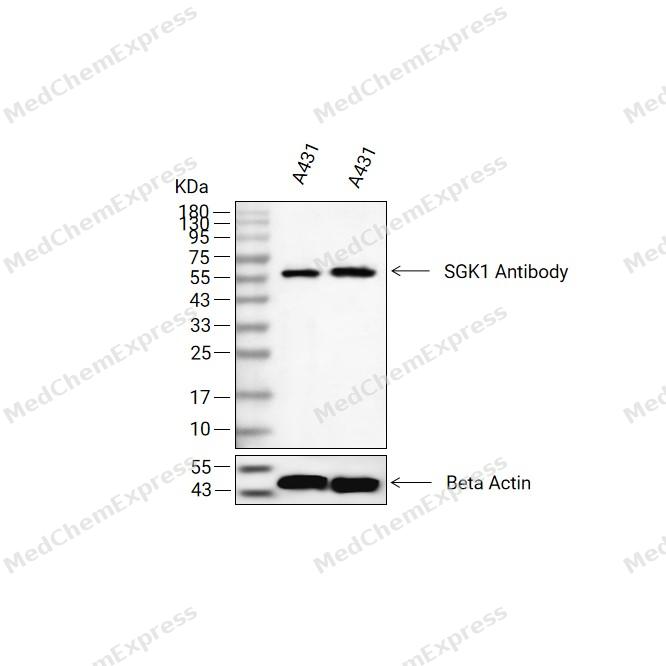 Western blot analysis of extracts from A431(lane 2(20ug) and A431(lane 3(40ug) using SGK1 Antibody (HY-P81780) Rabbit mAb. Proteins were transferred to a PVDF membrane and blocked with 5% non-fat milk in TBST for 2 hour at room temperature. The primary antibody (1/1000) and Loading control antibody (Beta Actin, HY-P83730, 1/10000) was used in 5% non-fat milk in TBST at 4°C overnight. Goat Anti-Mouse/Rabbit IgG-HRP Secondary Antibody (1/10000) was used for 1 hour at room temperature.
 -
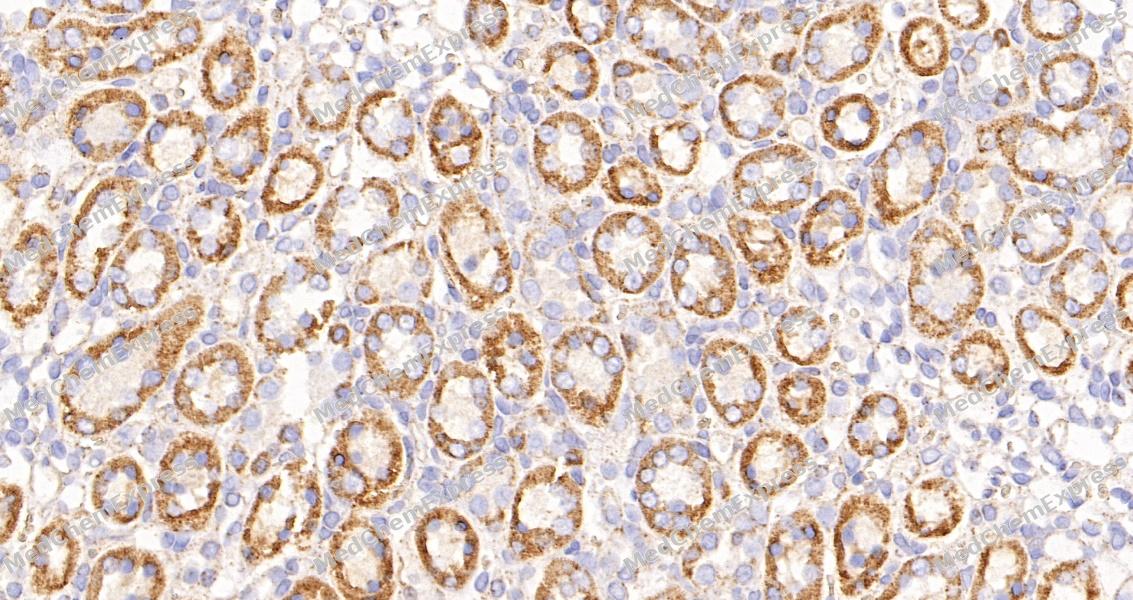 Immunohistochemical analysis of paraffin-embedded rat kidney tissue using SGK1 Antibody. The section was pre-treated using heat mediated antigen retrieval with sodium citrate buffer (pH 6.0) for 8 minutes. The tissues were blocked in QuickBlock for 20 minutes at room temperature, washed with ddH2O and PBS, and then probed with the primary antibody at 1/100 dilution in 4℃ overnight. The detection was performed using an HRP conjugated compact polymer system. DAB was used as the chromogen. Tissues were counterstained with hematoxylin and mounted with DPX.
 -
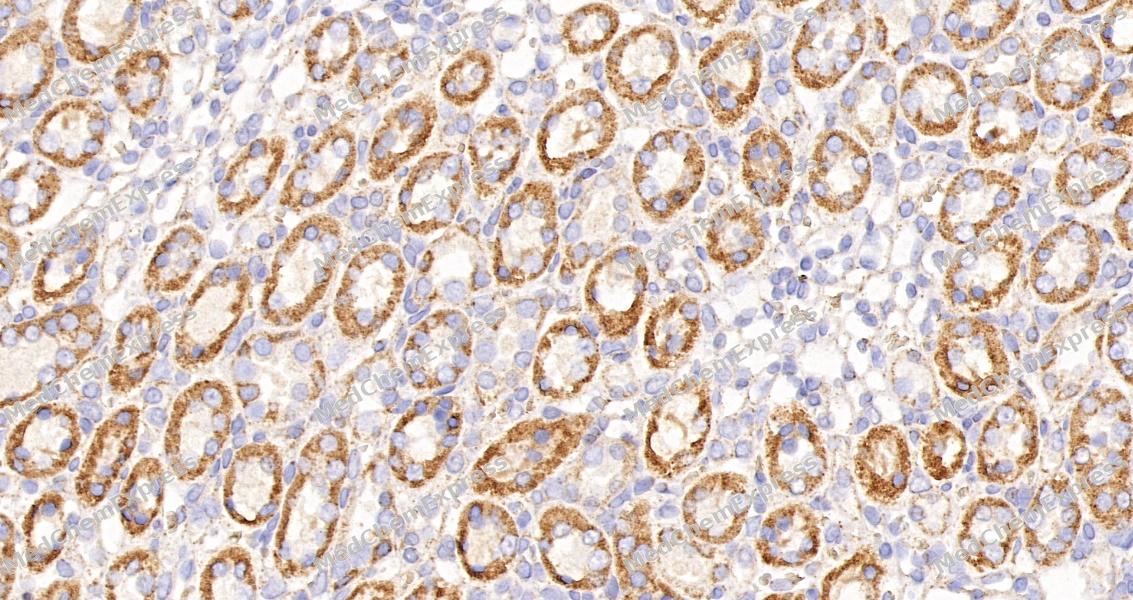 Immunohistochemical analysis of paraffin-embedded rat kidney tissue using SGK1 Antibody. The section was pre-treated using heat mediated antigen retrieval with sodium citrate buffer (pH 6.0) for 8 minutes. The tissues were blocked in QuickBlock for 20 minutes at room temperature, washed with ddH2O and PBS, and then probed with the primary antibody at 1/100 dilution in 4℃ overnight. The detection was performed using an HRP conjugated compact polymer system. DAB was used as the chromogen. Tissues were counterstained with hematoxylin and mounted with DPX.


Background
-
Function
SGK1 is a serum- and glucocorticoid-regulated AGC serine/threonine kinase that regulates membrane sodium channel expression and hormonal control of renal Na+ retention[1][2]. Mechanistically, SGK1 acts downstream of PI3K, PDK1, and mTORC2, while also functioning as an AKT-parallel PI3K effector with distinct SGK1-dependent pathways[3][4]. In immune models, mTORC2-activated SGK1 promotes TH2 differentiation through NEDD4-2-JunB regulation and represses IFN-γ through TCF-1, linking SGK1 signaling to asthma, viral infection, and tumor rejection models[1]. In cancer models, SGK1 sustains AKT-independent mTORC1 activation through TSC2 phosphorylation and supports PI3K-driven tumor development, proliferation, and survival[5][4]. Compared with related isoforms, SGK family kinases share PI3K regulation, but SGK3 contains a PX domain, whereas SGK1 lacks this lipid-binding module[6]. For experimental applications, SGK1 inhibition with GSK650394 reduced mantle cell lymphoma proliferation, invasion, migration, and xenograft growth, supporting SGK1 inhibitors as tools for pathway and disease-model studies[7].
-
Subcellular Localization
Cytoplasm; Nucleus; Endoplasmic reticulum membrane; Cell membrane; Mitochondrion; Cell membrane
-
Expression
Tissue_specificity:This gene is expressed in most tissues, with the highest expression level in the pancreas, followed by the placenta, kidneys, and lungs. Isomer 2 is expressed strongly in the brain and pancreas, and weakly in the heart, placenta, lungs, liver, and skeletal muscle.
Induction:Induced by a very large spectrum of stimuli distinct from glucocorticoids and serum. -
Isoforms & Post-Translational Modification
O00141 has 5 isomers: O00141-1: 48942 Da (predicted); O00141-2: 59904 Da (predicted); O00141-3: 50623 Da (predicted); O00141-4: 47910 Da (predicted); O00141-5: 52119 Da (predicted).
Regulated by phosphorylation (PubMed:10191262, PubMed:11096081, PubMed:18925875, PubMed:20338997, PubMed:36373794). Activated by phosphorylation on Ser-422 by mTORC2, transforming it into a substrate for PDPK1 which phosphorylates it on Thr-256 (PubMed:10191262, PubMed:18925875, PubMed:20338997, PubMed:36373794). Phosphorylation on Ser-397 and Ser-401 are also essential for its activity (PubMed:19068477). Phosphorylation on Ser-78 by MAPK7 is required for growth factor-induced cell cycle progression (PubMed:11254654);Ubiquitinated by NEDD4L; which promotes proteasomal degradation. Ubiquitinated by SYVN1 at the endoplasmic reticulum; which promotes rapid proteasomal degradation and maintains a high turnover rate in resting cells. Isoform 2 shows enhanced stability -
Subunit
Homodimer; disulfide-linked. Forms a trimeric complex with FBXW7 and NOTCH1. Interacts with MAPK3/ERK1, MAPK1/ERK2, MAP2K1/MEK1, MAP2K2/MEK2, NEDD4, NEDD4L, MAPT/TAU, MAPK7, CREB1, SLC9A3R2/NHERF2 and KCNJ1/ROMK1. Associates with the mammalian target of rapamycin complex 2 (mTORC2) via an interaction with MAPKAP1/SIN1
-
SwissProt ID
-
Synonyms
SGK1; SGK; Serine/threonine-protein kinase Sgk1; Serum/glucocorticoid-regulated kinase 1
-
Research Field
Signal Transduction


Documentation
-
Data Sheet (261 KB)
-
SDS (252 KB)
- English - EN (252 KB)
- Français - FR (252 KB)
- Deutsch - DE (252 KB)
- Norwegian - NO (252 KB)
- Español - ES (252 KB)
- Swedish - SV (252 KB)
- Italian - IT (252 KB)
- Korean - KR (252 KB)
- Portuguese - PT (252 KB)
-
User Guide for Antibodies (1077 KB)
References
[1]. Heikamp EB, et al. The AGC kinase SGK1 regulates TH1 and TH2 differentiation downstream of the mTORC2 complex. Nat Immunol. 2014 May;15(5):457-64. [Content Brief]
[2]. Mansley MK, et al. Dexamethasone and insulin activate serum and glucocorticoid-inducible kinase 1 (SGK1) via different molecular mechanisms in cortical collecting duct cells. Physiol Rep. 2016 May;4(10):e12792. [Content Brief]
[3]. Di Cristofano A. SGK1: The Dark Side of PI3K Signaling. Curr Top Dev Biol. 2017;123:49-71. doi: 10.1016/bs.ctdb.2016.11.006. Epub 2016 Dec 15. PMID: 28236975; PMCID: PMC5658788. et al. SGK1: The Dark Side of PI3K Signaling. Curr Top Dev Biol. 2017;123:49-71. [Content Brief]
[4]. Castel P, et al. PDK1-SGK1 Signaling Sustains AKT-Independent mTORC1 Activation and Confers Resistance to PI3Kα Inhibition. Cancer Cell. 2016 Aug 8;30(2):229-242. [Content Brief]
[5]. Orlacchio A, et al. SGK1 Is a Critical Component of an AKT-Independent Pathway Essential for PI3K-Mediated Tumor Development and Maintenance. Cancer Res. 2017 Dec 15;77(24):6914-6926. [Content Brief]
[6]. Tessier M, et al. Serum and glucocorticoid-regulated protein kinases: variations on a theme. J Cell Biochem. 2006 Aug 15;98(6):1391-407. [Content Brief]
[7]. Li J, et al. The Serum- and Glucocorticoid-Inducible Kinase 1 (SGK1) as a Novel Therapeutic Target in Mantle Cell Lymphoma. Cancer Control. 2022 Jan-Dec;29:10732748221143881. [Content Brief]

 Powered by Bioz
