



SHP1 Antibody (YA1045)
(Synonyms: PTPN6; HCP; PTP1C; Tyrosine-protein phosphatase non-receptor type 6; Hematopoietic cell protein-tyrosine phosphatase; Protein-tyrosine phosphatase 1C; PTP-1C; Protein-tyrosine phosphatase SHP-1; SH-PTP1)
Based on 1 Customer Validation
SHP1 Antibody (YA1045) is a Rabbit-derived and non-conjugated IgG monoclonal antibody, targeting to SHP1.
-
Host:
Rabbit
-
Isotype:
IgG
-
Application:
WB, IHC-P, ICC/IF, FC
-
Reactivity :
Human
-
Formulation:
Supplied in 50mM Tris-Glycine(pH 7.4), 0.15M NaCl, 40% Glycerol, 0.01% Sodium azide and 0.05% BSA
-
Conjugation:
Non-conjugated


To place orders, for customer services and technical support, please contact: MedChemExpress USA
Tel: 609-228-6898 E-mail: [email protected] [email protected]





Applications
| Application |
WB

WB: Western Blot
|
IHC-P
IHC-P: Immunohistochemistry-Paraffin
|
ICC/IF
ICC/IF: Immunocytochemistry/
Immunofluorescence |
FC
FC: Flow Cytometry
|
|---|---|---|---|---|
| Dilution Ratio | 1:1000-1:5000 | 1:500-1:2000 | 1:200-1:500 | 1:10-1:100 |


Product Details
SHP1 Antibody (YA1045) is a Rabbit-derived and non-conjugated IgG monoclonal antibody, targeting to SHP1.
-
Host Rabbit

-
Clonality Recombinant,Monoclonal

-
Species ReactivityHuman
-
Observed Molecular WeightObserved band size: 68 kDa
Note: Due to possible protein modifications or aggregation, the molecular weight should be confirmed by actual measurement, and the predicted value is for reference only.

-
Calculated Molecular Weight Predicted band size: 68 kDa

A synthetic peptide of human SHP1
Endogenous
Affinity Purified
Non-conjugated
Unmodified
IgG


Product Properties
-
Appearance
Solution
-
Formulation
Supplied in 50mM Tris-Glycine(pH 7.4), 0.15M NaCl, 40% Glycerol, 0.01% Sodium azide and 0.05% BSA
-
Concentration
Batch-dependent, Please check the COA for the concentration of each lot. Check Lot Concentration
-
Storage & Stability
Stored at -20°C for 1 year. Avoid repeated freeze / thaw cycles.
-
Shipping
Shipping with blue ice.


Verification Images
-
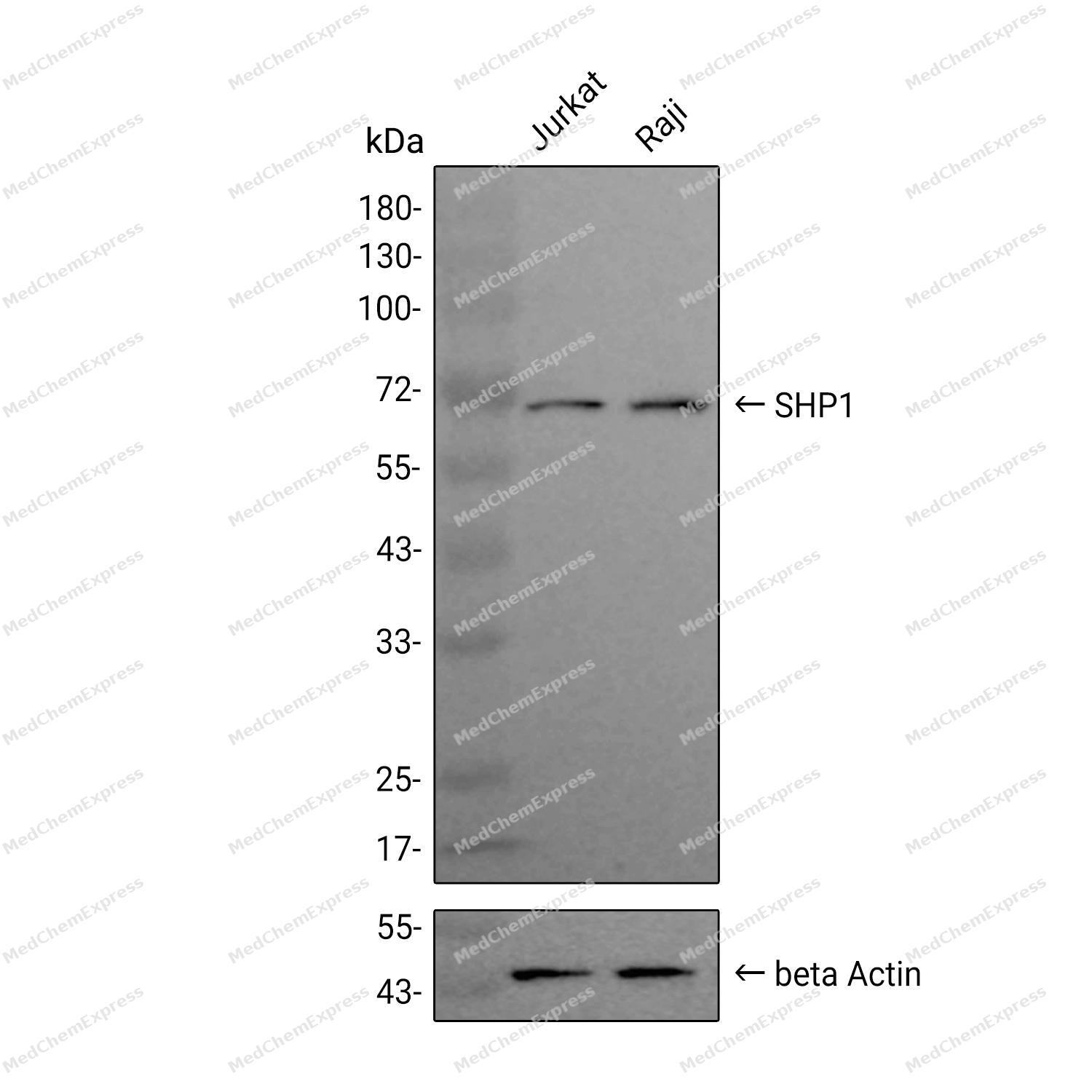 Western blot analysis was performed on extracts from Jurkat (lane 1, 15 μg), and Raji (lane 2, 15 μg) using SHP1 Rabbit mAb. Proteins were transferred to a PVDF membrane and blocked with 5% non - fat milk in TBST at 4°C overnight. The primary antibody (1:1000 dilution) and the loading control antibody (beta-Actin(HRP), HY-P80993, 1:5000 dilution) was incubated in 5% non-fat milk in TBST for 1 hour at 37°C. Goat Anti - Rabbit IgG - HRP Secondary Antibody (1:20000 dilution) was then applied for 40 minutes at 37°C.
 -
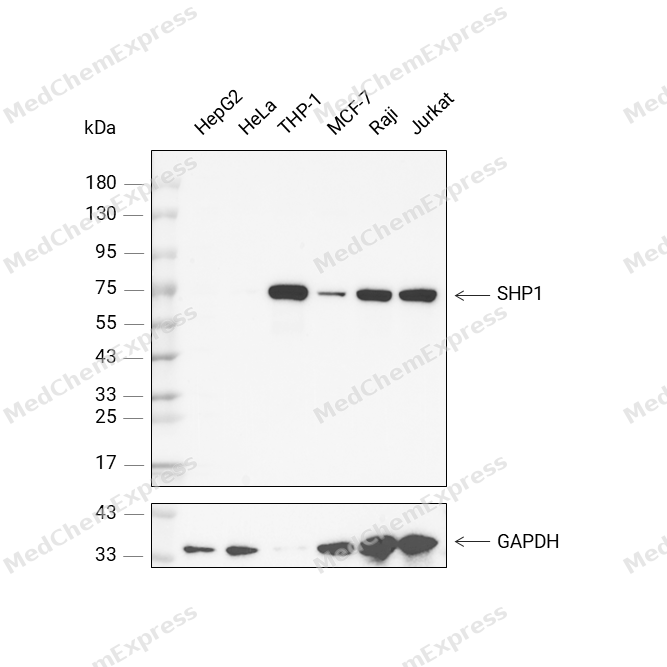 Western blot analysis was performed on protein extracts (25 μg) from HepG2 (lane 2, Negative), HeLa (lane 3, Negative), THP-1 (lane 4), MCF-7 (lane 5), Raji (lane 6), and Jurkat (lane 7) using SHP1 antibody. Proteins were transferred onto a 0.45 μm PVDF membrane using the Trans-Blot® Turbo™ system for 13 min. The membrane was then blocked with 5% nonfat milk in TBST (HY-K1025) for 1 h at room temperature. Thhe primary antibody (1:1000) and loading control antibody GAPDH Antibody (HRP) (HY-P80954A) (1:2500) were diluted in 5% nonfat milk in TBST and incubated with the membrane overnight at 4°C. After washing, the membrane of primary antibody was incubated with HRP-conjugated goat anti-rabbit/mouse IgG secondary antibody (HY-P8001/HY-P8004) (1:5000) diluted in 5% nonfat milk in TBST for 1 h at room temperature. Protein bands were visualized using an Ultra High Sensitivity ECL detection kit (HY-K1005).


Background
-
Function
SHP1 is a protein tyrosine phosphatase (PTP) that plays a crucial role in regulating various signaling pathways, particularly in hematopoietic cells and the immune system. This is particularly apparent in motheaten (me) mice that have a spontaneous mutation in Ptpn6, resulting in loss of SHP1, and develop a broad array of inflammatory and autoimmune symptoms.
-
Subcellular Localization
Cytoplasm; Nucleus
-
Expression
Tissue_specificity:Isomer 1 is expressed in hematopoietic cells. Isomer 2 is expressed in non-hematopoietic cells. -
Isoforms & Post-Translational Modification
P29350 has 4 isomers: P29350-1: 67561 Da (predicted); P29350-3: 67719 Da (predicted); P29350-2: 63125 Da (predicted); P29350-4: 70131 Da (predicted).
Phosphorylated on tyrosine residues. Binding of KITLG/SCF to KIT increases tyrosine phosphorylation (By similarity). Phosphorylation at Tyr-564 by LYN enhances phosphatase activity. Phosphorylation at Thr-394 by TAOK3 leads to polyubiquitination and subsequent proteasomal degradation (PubMed:38166031);Ubiquitinated after phosphorylation by TAOK3 (PubMed:38166031). Ubiquitinated by a cooperation between ITCH and WWP2 via 'Lys-27'-mediated polyubiquitin chains resulting in the reduction of its association with LCK (PubMed:29925997) -
Subunit
Monomer. Interacts with MTUS1 (By similarity). Interacts with MILR1 (tyrosine-phosphorylated) (By similarity). Interacts with KIT (By similarity). Interacts with SIRPA/PTPNS1 (PubMed:9712903). Interacts with LILRB1 and LILRB2 (PubMed:9285411, PubMed:9842885). Interacts with LILRB4 (PubMed:16493035, PubMed:9151699). Interacts with FCRL2 and FCRL4 (PubMed:11162587, PubMed:14597715). Interacts with FCRL3 and FCRL6 (tyrosine phosphorylated form) (PubMed:11162587, PubMed:19843936, PubMed:20933011). Interacts with CD84 (PubMed:11414741). Interacts with CD300LF (PubMed:15184070). Interacts with CDK2 (PubMed:21262353). Interacts with KIR2DL1; the interaction is enhanced by ARRB2 (PubMed:18604210). Interacts (via SH2 1 domain) with ROS1; the interaction is direct and promotes ROS1 dephosphorylation (PubMed:11266449). Interacts with EGFR; inhibits EGFR-dependent activation of MAPK/ERK (PubMed:21258366). Interacts with the tyrosine phosphorylated form of PDPK1 (PubMed:19591923). Interacts with CEACAM1 (via cytoplasmic domain); this interaction depends on the monomer/dimer equilibrium and is phosphorylation-dependent (By similarity). Interacts with MPIG6B (via ITIM motif) (PubMed:23112346). Interacts with KLRI1 and KLRI2 (By similarity). Interacts with moesin/MSN. Interacts with CLEC12B (via ITIM motif). Interacts with polymerase II components POLR2C and POLR2J; these interactions recruit RNA polymerase II to the PCK1 promoter (PubMed:37595871). Interacts with TNFRSF10A; this interaction enables the inhibition of T-cell receptor signaling via LCK (PubMed:38532423)
-
SwissProt ID
-
Synonyms
PTPN6; HCP; PTP1C; Tyrosine-protein phosphatase non-receptor type 6; Hematopoietic cell protein-tyrosine phosphatase; Protein-tyrosine phosphatase 1C; PTP-1C; Protein-tyrosine phosphatase SHP-1; SH-PTP1
-
Research Field
Cell Biology


Documentation
-
Data Sheet (259 KB)
-
SDS (252 KB)
- English - EN (252 KB)
- Français - FR (252 KB)
- Deutsch - DE (252 KB)
- Norwegian - NO (252 KB)
- Español - ES (252 KB)
- Swedish - SV (252 KB)
- Italian - IT (252 KB)
- Korean - KR (252 KB)
- Portuguese - PT (252 KB)
-
User Guide for Antibodies (1077 KB)
References

 Powered by Bioz
