



SIRT3 Antibody (YA6205)
(Synonyms: SIRT3; SIR2L3; NAD-dependent protein deacetylase sirtuin-3; mitochondrial; hSIRT3; Regulatory protein SIR2 homolog 3; SIR2-like protein 3)
Based on 1 Customer Validation
SIRT3 Antibody (YA6205) is a Rabbit-derived and non-conjugated IgG monoclonal antibody, targeting to SIRT3.
-
Host:
Rabbit
-
Isotype:
IgG
-
Application:
WB, IHC-P, ICC/IF, ELISA
-
Reactivity :
Human, Mouse, Rat
-
Formulation:
Supplied in PBS, 50% glycerol, 0.05% Proclin 300, 0.05%BSA
-
Conjugation:
Non-conjugated


To place orders, for customer services and technical support, please contact: MedChemExpress USA
Tel: 609-228-6898 E-mail: [email protected] [email protected]





Applications
| Application |
IHC-P

IHC-P: Immunohistochemistry-Paraffin
|
WB
WB: Western Blot
|
ICC/IF
ICC/IF: Immunocytochemistry/
Immunofluorescence |
ELISA
ELISA: Enzyme Linked Immunosorbent Assay
|
|---|---|---|---|---|
| Dilution Ratio | 1:200-1:1000 | 1:1000-1:5000 | 1:200-1:1000 | 1:5000-1:20000 |


Product Details
SIRT3 Antibody (YA6205) is a Rabbit-derived and non-conjugated IgG monoclonal antibody, targeting to SIRT3.
-
Host Rabbit

-
Clonality Monoclonal

-
Species ReactivityHuman, Mouse, Rat
-
Observed Molecular WeightObserved band size: 28 kDa
Note: Due to possible protein modifications or aggregation, the molecular weight should be confirmed by actual measurement, and the predicted value is for reference only.

-
Calculated Molecular Weight Predicted band size: 44 kDa

Protein A
Non-conjugated
Unmodified
IgG


Product Properties
-
Appearance
Solution
-
Formulation
Supplied in PBS, 50% glycerol, 0.05% Proclin 300, 0.05%BSA
-
Concentration
Batch-dependent, Please check the COA for the concentration of each lot. Check Lot Concentration
-
Storage & Stability
Stored at -20°C for 1 year. Avoid repeated freeze / thaw cycles.
-
Shipping
Shipping with blue ice.


Verification Images
-
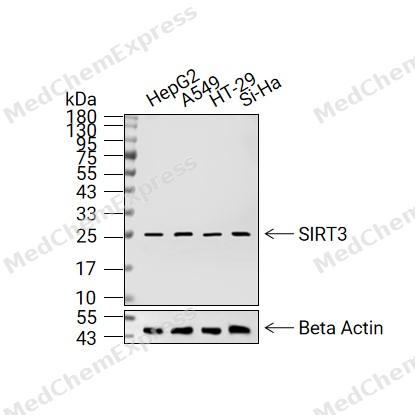 Western blot analysis of extracts from HepG2 (lane 2(20μg), A549 (lane 3(20μg), HT-29 (lane 4(20μg) and Si-Ha (lane 5(20μg) using SIRT3 Antibody (HY-P86513) Rabbit mAb. Proteins were transferred to a PVDF membrane and blocked with 5% non-fat milk in TBST for 2 hour at room temperature. The primary antibody (1/1000) and Loading control antibody (Beta Actin, HY-P80993, 1/10000) was used in 5% non-fat milk in TBST at 4°C overnight. Goat Anti-Rabbit IgG-HRP Secondary Antibody (1/10000) was used for 1 hour at room temperature.
 -
 Immunocytochemistry analysis of HepG2 cells labeling SIRT3 with SIRT3 Antibody (HY-P86513) at 1/50 dilution. Cells were fixed in 4% paraformaldehyde for 15 minutes at room temperature, permeabilized with 0.1% Triton X-100 for 10 minutes at room temperature, then blocked with BSA for Immunol Staining for 10 min at room temperature. Cells were then incubated with SIRT3 Antibody (HY-P86513) at 1/50 dilution in BSA for Immunol Staining at 4 ℃, Stay overnight. AF488-conjugated AffiniPure Goat Anti-Rabbit IgG H&L(HY-P8002, Green) was used as the secondary antibody at 1/1,000 dilution. PBS instead of the primary antibody was used as the secondary antibody only control. The Nuclear counterstain was DAPI (Blue).
 -
 Immunocytochemistry analysis of HeLa cells labeling SIRT3 with SIRT3 Antibody (HY-P86513) at 1/100dilution. Cells were fixed in 4% paraformaldehyde for 15 minutes at room temperature, permeabilized with 0.1% Triton X-100 for 10 minutes at room temperature, then blocked with BSA for Immunol Staining for 10 min at room temperature. Cells were then incubated with SIRT3 Antibody (HY-P86513) at 1/100dilution in BSA for Immunol Staining at 4℃, Stay overnight. AF488-conjugated AffiniPure Goat Anti-Rabbit IgG H&L(HY-P8002, Green) was used as the secondary antibody at 1/1,000 dilution. PBS instead of the primary antibody was used as the secondary antibody only control. The Nuclear counterstain was DAPI (Blue).


Background
-
Function
SIRT3 is the major mitochondrial protein lysine deacetylase and regulates mitochondrial homeostasis by deacetylating proteins involved in energy metabolism, antioxidant defense, and redox adaptation[1][2]. Mechanistically, SIRT3 limits mitochondrial oxidative damage through targets including SOD2, PRDX3, COX4I2, and ALDH2, thereby linking lysine acetylation to reactive oxygen species control, respiratory-chain function, and aldehyde detoxification[3][4][5][6]. In disease models, SIRT3 deletion promotes endothelial dysfunction, vascular inflammation, vascular hypertrophy, and age-dependent hypertension, whereas SIRT3 overexpression reduces vascular oxidative stress and attenuates angiotensin II- and deoxycorticosterone acetate-salt-induced hypertension[3]. In intestinal ischemia/reperfusion injury, SIRT3-mediated PRDX3 deacetylation reduces mitochondrial oxidative damage and apoptosis; in osteoarthritis models, SIRT3 deacetylates COX4I2 to maintain mitochondrial respiratory-chain homeostasis and protect cartilage integrity[4][5]. Compared with related isoforms, SIRT3 differs experimentally because it localizes to mitochondria, whereas structurally similar SIRT1 and SIRT2 localize primarily to the nucleus and cytosol[1]. For experimental applications, honokiol activates SIRT3 in osteoarthritis models, while mitochondria-targeted SIRT3 inhibitors increase MnSOD acetylation with limited effects on known SIRT1 and SIRT2 targets[5][1].
-
Subcellular Localization
Mitochondrion matrix
-
Expression
Tissue_specificity:Broad expression -
Isoforms & Post-Translational Modification
Q9NTG7 has 2 isomers: Q9NTG7-1: 43573 Da (predicted); Q9NTG7-2: 28567 Da (predicted).
Processed by mitochondrial processing peptidase (MPP) to give a 28 kDa product. Such processing is probably essential for its enzymatic activity -
Subunit
Upon metabolic stress, forms a complex composed of FOXO3, SIRT3 and mitochondrial RNA polymerase POLRMT; the complex is recruited to mtDNA in a SIRT3-dependent manner (PubMed:23283301). Also forms a complex composed of FOXO3, SIRT3, TFAM and POLRMT (PubMed:29445193). Interacts with NDUFA9, ACSS1, IDH2 and GDH (PubMed:16788062, PubMed:18680753, PubMed:18794531, PubMed:19535340). Interacts with PCCA (PubMed:23438705)
-
SwissProt ID
-
Synonyms
SIRT3; SIR2L3; NAD-dependent protein deacetylase sirtuin-3; mitochondrial; hSIRT3; Regulatory protein SIR2 homolog 3; SIR2-like protein 3


Documentation
-
Data Sheet (263 KB)
-
SDS (252 KB)
- English - EN (252 KB)
- Français - FR (252 KB)
- Deutsch - DE (252 KB)
- Norwegian - NO (252 KB)
- Español - ES (252 KB)
- Swedish - SV (252 KB)
- Italian - IT (252 KB)
- Korean - KR (252 KB)
- Portuguese - PT (252 KB)
-
User Guide for Antibodies (1077 KB)
References
[1]. Troelsen KS, Bæk M, Nielsen AL, Madsen AS, Rajabi N, Olsen CA. Mitochondria-targeted inhibitors of the human SIRT3 lysine deacetylase. RSC Chem Biol. 2021 Feb 1;2(2):627-635. [Content Brief]
[2]. Sack MN. The role of SIRT3 in mitochondrial homeostasis and cardiac adaptation to hypertrophy and aging. J Mol Cell Cardiol. 2012 Mar;52(3):520-5. doi: 10.1016/j.yjmcc.2011.11.004. Epub 2011 Nov 19. PMID: 22119802; PMCID: PMC3294048. et al. The role of SIRT3 in mitochondrial homeostasis and cardiac adaptation to hypertrophy and aging. J Mol Cell Cardiol. 2012 Mar;52(3):520-5. [Content Brief]
[3]. Dikalova AE, et al. Mitochondrial Deacetylase Sirt3 Reduces Vascular Dysfunction and Hypertension While Sirt3 Depletion in Essential Hypertension Is Linked to Vascular Inflammation and Oxidative Stress. Circ Res. 2020 Feb 14;126(4):439-452. [Content Brief]
[4]. Wang Z, et al. SIRT3-mediated deacetylation of PRDX3 alleviates mitochondrial oxidative damage and apoptosis induced by intestinal ischemia/reperfusion injury. Redox Biol. 2020 Jan;28:101343. [Content Brief]
[5]. Zhang Y, et al. Reprogramming of Mitochondrial Respiratory Chain Complex by Targeting SIRT3-COX4I2 Axis Attenuates Osteoarthritis Progression. Adv Sci (Weinh). 2023 Apr;10(10):e2206144. [Content Brief]
[6]. Harris PS, et al. Characterizing Sirtuin 3 Deacetylase Affinity for Aldehyde Dehydrogenase 2. Chem Res Toxicol. 2017 Mar 20;30(3):785-793. [Content Brief]

 Powered by Bioz
