



AR antagonist 4
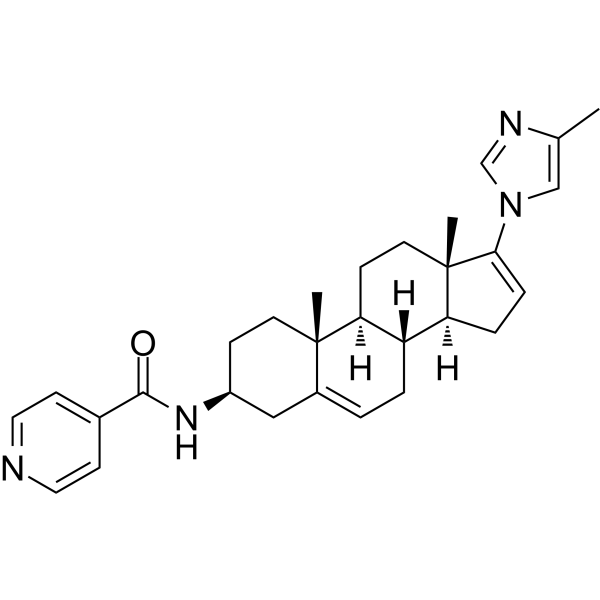
AR antagonist 4 is an orally active androgen receptor (AR) antagonist with a DC50 of 2.84 μM in LNCaP human prostate cancer cells. AR antagonist 4 inhibits dihydrotestosterone-induced AR transcriptional activity, promotes proteasome-dependent AR degradation, and dose-dependently promotes AR-V7 degradation. AR antagonist 4 can be used for the research of metastatic castration-resistant prostate cancer.
연구목적의 판매만을 진행합니다. 환자를 대상으로 한 판매는 하지 않습니다.
- CAS No.: 2883447-45-6
- 화학식: C29H36N4O
- 분자량:456.62
-
보관:
Please store the product under the recommended conditions in the Certificate of Analysis.

To place orders, for customer services and technical support, please contact: MedChemExpress USA
Tel: 609-228-6898 E-mail: [email protected] [email protected]


-
 Biological Activity
-
Chemical Information
- Protocol
- 순도&문서
- References
-
 Help & FAQs




Biological Activity
제품 설명
IC50 & Target
[1]|
AR 2.84 μM (DC50) |
AR-V7 |
Cellular Effect
|
Cell Line

|
Type | Value | Description | References |
|---|---|---|---|---|
| LNCaP | IC50 |
205.1 nM
|
Antiproliferative activity against human LNCaP prostate cancer cells assessed as reduction in cell viability incubated for 6 days by CellTiter-Glo assay.
Antiproliferative activity against human LNCaP prostate cancer cells assessed as reduction in cell viability incubated for 6 days by CellTiter-Glo assay.
|
36070471 |
| HEK293 | IC50 |
246.6 nM
|
Inhibition of wild-type AR transcriptional activity in human HEK293 cells treated with 10 nM dihydrotestosterone and incubated for 24 h, measured via ARE-luciferase reporter assay.
Inhibition of wild-type AR transcriptional activity in human HEK293 cells treated with 10 nM dihydrotestosterone and incubated for 24 h, measured via ARE-luciferase reporter assay.
|
36070471 |
| HEK293 | IC50 |
490.2 nM
|
Inhibition of AR(W741L) mutant transcriptional activity in human HEK293 cells treated with 10 nM dihydrotestosterone and incubated for 24 h, measured via ARE-luciferase reporter assay.
Inhibition of AR(W741L) mutant transcriptional activity in human HEK293 cells treated with 10 nM dihydrotestosterone and incubated for 24 h, measured via ARE-luciferase reporter assay.
|
36070471 |
| HEK293 | IC50 |
208.8 nM
|
Inhibition of AR(T877A) mutant transcriptional activity in human HEK293 cells treated with 10 nM dihydrotestosterone and incubated for 24 h, measured via ARE-luciferase reporter assay.
Inhibition of AR(T877A) mutant transcriptional activity in human HEK293 cells treated with 10 nM dihydrotestosterone and incubated for 24 h, measured via ARE-luciferase reporter assay.
|
36070471 |
| HEK293 | IC50 |
268.2 nM
|
Inhibition of AR(F876L) mutant transcriptional activity in human HEK293 cells treated with 10 nM dihydrotestosterone and incubated for 24 h, measured via ARE-luciferase reporter assay.
Inhibition of AR(F876L) mutant transcriptional activity in human HEK293 cells treated with 10 nM dihydrotestosterone and incubated for 24 h, measured via ARE-luciferase reporter assay.
|
36070471 |
In Vitro
AR antagonist 4 (6 days) potently inhibits 22RV1 human prostate cancer cell proliferation with an IC50 of 590 nM[1].
AR antagonist 4 (24 h) potently degrades AR in LNCaP human prostate cancer cells with a DC50 of 2.84 μM[1].
AR antagonist 4 (20 μM; 24 h) induces proteasome-dependent AR degradation in LNCaP human prostate cancer cells[1].
AR antagonist 4 (20 μM; 0-24 h) degrades AR in LNCaP human prostate cancer cells in a time-dependent manner, with maximal degradation observed after 24 h[1].
AR antagonist 4 (1-20 μM; 24 h) degrades AR-V7 in 22RV1 human prostate cancer cells in a dose-dependent manner, with the greatest reduction observed at 20 μM[1].
AR antagonist 4 (24 h) potently inhibits transcriptional activity of ARW741L, ART877A, and ARF876L mutant ARs in HEK293 cells with IC50 values of 490.2 nM, 208.8 nM, and 268.2 nM, respectively[1].
AR antagonist 4 (5 min) weakly inhibits recombinant human CYP17A1 enzyme activity with an IC50 of 2.59 μM[1].
AR antagonist 4 moderately inhibits hERG K+ channel activity with an IC50 of 6.47 μM[1].
MedChemExpress (MCE) has not independently confirmed the accuracy of these methods. They are for reference only.
-
Cell Line:LNCaP human prostate cancer cells
-
Concentration:20 μM; 5 μM MG-132 (HY-13259) (co-incubated)
-
Incubation Time:24 h
-
Result:Reduced AR protein levels to 0.71-fold of control at 20 μM.
Restored AR levels to 0.83-fold of control when co-incubated with 5 μM MG-132.
Confirmed proteasome-dependent degradation.
-
Cell Line:LNCaP human prostate cancer cells
-
Concentration:20 μM
-
Incubation Time:0, 2, 4, 8, 16, 24 h
-
Result:Reduced AR levels to 0.36-fold of control at 2 h.
Reduced AR levels to 0.34-fold of control at 4 h.
Reduced AR levels to 0.28-fold of control at 8 h.
Reduced AR levels to 0.24-fold of control at 16 h.
Reduced AR levels to 0.16-fold of control at 24 h.
Degraded AR in a time-dependent manner.
-
Cell Line:22RV1 human prostate cancer cells
-
Concentration:1 μM; 5 μM; 10 μM; 20 μM
-
Incubation Time:24 h
-
Result:Reduced AR-V7 levels to 0.68-fold of control at 1 μM.
Reduced AR-V7 levels to 0.52-fold of control at 5 μM.
Reduced AR-V7 levels to 0.30-fold of control at 10 μM.
Reduced AR-V7 levels to 0.20-fold of control at 20 μM.
Degraded AR-V7 in a dose-dependent manner.
Parmacokinetics
| Species | Dose | Route | T1/2 | Tmax | Cmax | AUC0-t |
|---|---|---|---|---|---|---|
| Rat[1] | 10 mg/kg | p.o. | 2.80 h | 2.17 h | 2670 ng/mL | 24800 ng·h/mL |
In Vivo
MedChemExpress (MCE) has not independently confirmed the accuracy of these methods. They are for reference only.
-
Animal Model:Sprague-Dawley (male, castrated)[1]
-
Dosage:20 mg/kg
-
Administration:p.o.; daily; 10 days
-
Result:Reduced seminal vesicle weight by 62% compared to testosterone propionate-only controls.
Reduced ventral prostate weight by 66% compared to testosterone propionate-only controls.
-
Animal Model:BALB/c nude (male, castrated, 6 weeks old)[1]
-
Dosage:30 mg/kg
-
Administration:p.o.; daily; 28 days
-
Result:Induced remarkable tumor regression with a ΔT/ΔC% = -14% after 28 days of treatment.
Caused no associated animal weight loss.


Chemical Information
-
CAS No. 2883447-45-6
-
분자량 456.62
-
화학식 C29H36N4O
-
SMILES
C[C@@]12[C@](CC=C2N3C=NC(C)=C3)([H])[C@@]4([H])[C@]([C@@]5(C(C[C@H](CC5)NC(C6=CC=NC=C6)=O)=CC4)C)([H])CC1
-
선적
Room temperature in continental US; may vary elsewhere.
-
보관
Please store the product under the recommended conditions in the Certificate of Analysis.


순도&문서
References

Calculators
Concentration (start) × Volume (start) = Concentration (final) × Volume (final)


AR antagonist 4 Related Classifications
HY-151266 Related Classifications
 Powered by Bioz