



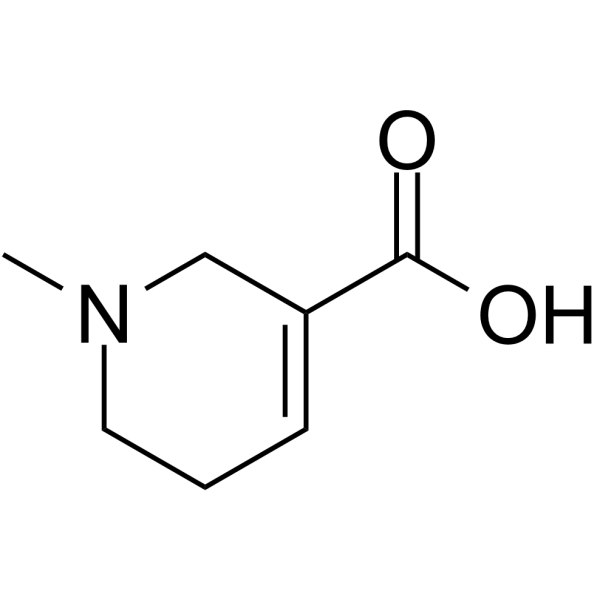
Arecaidine
Based on 1 publication(s) in Google Scholar
Arecaidine is a GABA transport system inhibitor. Arecaidine inhibits the proliferation of oral mucosal fibroblasts, increases the secretion of IL-6, TGF-β and TNF-α in cells, downregulates the expression of PPAR-γ and PCK1 in cells, and upregulates the expression of TGF-β1. Arecaidine inhibits the uptake of γ-aminobutyric acid and β-alanine by the central nervous system of cats. Arecaidine inhibits hPAT1-mediated L-[3H]proline uptake in cells. Arecaidine can be used in research related to neurological diseases.
연구목적의 판매만을 진행합니다. 환자를 대상으로 한 판매는 하지 않습니다.
- Purity : 99.63%
- CAS No.: 499-04-7
- 화학식: C7H11NO2
- 분자량:141.17
-
보관:
4°C, protect from light
* In solvent : -80°C, 6 months; -20°C, 1 month (protect from light)

To place orders, for customer services and technical support, please contact: MedChemExpress USA
Tel: 609-228-6898 E-mail: [email protected] [email protected]


-
 Biological Activity
-
Chemical Information
-
용액&용해도
- Protocol
- 순도&문서
- References
-
 Help & FAQs


Publications Citing Use of MedChemExpress (MCE) Arecaidine
More

Biological Activity
제품 설명
In Vitro
Arecaidine exhibits strong binding affinity for PPAR-γ, PCK1 and TGF-β1 proteins, with binding energies of -5.1 kJ/mol, -5.6 kJ/mol and -5.6 kJ/mol[1].
Arecaidine (0-120 μg/mL; 24-48 h) inhibits the proliferation of human oral mucosal fibroblasts (hOMF) and increases the secretion of IL-6, TGF-β and TNF-α in cells[1].
Arecaidine (100-120 μg/mL; 48 h) downregulates the mRNA and protein expression of PPAR-γ and PCK1, while upregulates the mRNA and protein expression of TGF-β1, in human oral mucosal fibroblasts (hOMF)[1].
Arecaidine (10 min) inhibits the uptake of GABA and β-alanine, but not that of glycine, in cat spinal cord slices, with an IC50 of 89 μM for GABA and 193 μM for β-alanine[2].
Arecaidine (10 min) inhibits the uptake of GABA and β-alanine in cat cerebellar slices, with an IC50 value of 76 μM for GABA and 354 μM for β-alanine[2].
Arecaidine (10 min) inhibits the uptake of GABA and β-alanine in rat cerebral cortex slices, with an IC50 value of 122 μM for GABA and 208 μM for β-alanine[2].
Arecaidine (0.1-100 mM; 10 min) competitively inhibits hPAT1-mediated uptake of L-[3H]proline in Caco-2 cells, with a Ki value of 7.3 mM[3].
Arecaidine (0.1-100 mM; 10 min) inhibits hPAT1-mediated L-[3H]proline uptake in transiently transfected HeLa cells, with a Ki value of 3.8 mM[3].
MedChemExpress (MCE) has not independently confirmed the accuracy of these methods. They are for reference only.
-
Cell Line:human oral mucosal fibroblasts (hOMF)
-
Concentration:0, 40, 60, 80, 100, 120 μg/mL
-
Incubation Time:24 h; 48 h
-
Result:Did not significantly alter hOMF cell viability after 24 h of treatment across all tested concentrations.
Significantly inhibited hOMF cell proliferation at 100 μg/mL and 120 μg/mL after 48 h of treatment.
-
Cell Line:human oral mucosal fibroblasts (hOMF)
-
Concentration:100, 120 μg/mL
-
Incubation Time:48 h
-
Result:Significantly elevated IL-6, TGF-β, TNF-α levels.
-
Cell Line:human oral mucosal fibroblasts (hOMF)
-
Concentration:100, 120 μg/mL
-
Incubation Time:48 h
-
Result:Significantly downregulated PPAR-γ, PCK1, TGF-β1 mRNA expression.
-
Cell Line:human oral mucosal fibroblasts (hOMF)
-
Concentration:100 μg/mL
-
Incubation Time:48 h
-
Result:Significantly reduced PPAR-γ, PCK1, TGF-β1 protein expression.
In Vivo
Arecaidine (0.2 M solution; electrophoretic) selectively potentiates the inhibitory effects of GABA and β-alanine on cat spinal cord neurons, and enhances the effect of GABA on cat cerebellar Purkinje cells[2].
MedChemExpress (MCE) has not independently confirmed the accuracy of these methods. They are for reference only.
-
Animal Model:Sprague-Dawley (SD) (male, 6-8 weeks old, 200 g)[1]
-
Dosage:1 mg/mL
-
Administration:topical application to buccal mucosa; once daily; 16 weeks
-
Result:Reduced passive mouth opening to 23.97 mm, a statistically significant reduction compared to the control group.
Increased collagen volume fraction significantly higher than the control group.
Increased TGF-β protein expression statistically significantly compared to the control group.
Identified 100 significantly differentially expressed genes, including downregulation of PPAR-γ, PCK1, pdk4, plin5, Hmgcs2, UCP3, and Angptl4, and upregulation of TGF-β1 and FOS.
Demonstrated binding energies < -5.0 kJ/mol with PPAR-γ, PCK1, and TGF-β1, indicating strong binding affinity.
-
Animal Model:unspecified strain (anaesthetised with pentobarbitone sodium)[2]
-
Dosage:0.2M solution
-
Administration:electrophoretic; variable duration
-
Result:Selectively potentiated the inhibitory effects of GABA and β-alanine on cat spinal cord neurons, and enhanced the effect of GABA on cat cerebellar Purkinje cells.


Chemical Information
-
CAS No. 499-04-7
-
Appearance Solid
-
분자량 141.17
-
화학식 C7H11NO2
-
Color White to off-white
-
SMILES
O=C(C1=CCCN(C)C1)O
-
Structure Classification
-
Initial Source
-
선적
Room temperature in continental US; may vary elsewhere.
-
보관
4°C, protect from light
* In solvent : -80°C, 6 months; -20°C, 1 month (protect from light)


Publications (1)
-
Journal Impact Factor
-
Most Recent
-
Int J Mol Sci
Oxidative Stress and Endoplasmic Reticulum Stress Contributes to Arecoline and Its Secondary Metabolites-Induced Dyskinesia in Zebrafish Embryos. [Abstract]2023 Mar 28;24(7):6327. PMID: 37047326


용액&용해도
In Vitro:
H2O : 250 mg/mL (1770.91 mM; Need ultrasonic)
Please refer to the solubility information to select the appropriate solvent. Once prepared, please aliquot and store the solution to prevent product inactivation from repeated freeze-thaw cycles.
Storage method and period of stock solution: -80°C, 6 months; -20°C, 1 month (protect from light). When stored at -80°C, please use it within 6 months. When stored at -20°C, please use it within 1 month.
* Note: If you choose water as the stock solution, please dilute it to the working solution, then filter and sterilize it with a 0.22 μm filter before use.
Please refer to the solubility information to select the appropriate solvent. Once prepared, please aliquot and store the solution to prevent product inactivation from repeated freeze-thaw cycles.
Storage method and period of stock solution: -80°C, 6 months; -20°C, 1 month (protect from light). When stored at -80°C, please use it within 6 months. When stored at -20°C, please use it within 1 month.
* Note: If you choose water as the stock solution, please dilute it to the working solution, then filter and sterilize it with a 0.22 μm filter before use.
Concentration (start) × Volume (start) = Concentration (final) × Volume (final)
In Vivo:
For the following dissolution methods, please prepare the working solution directly:
It is recommended to prepare fresh solutions and use them promptly within a short period of time.
The percentages shown for the solvents indicate their volumetric ratio in the final prepared solution. If precipitation or phase separation occurs during preparation, heat and/or sonication can be used to aid dissolution.
Add each solvent one by one: PBS
Solubility: 100 mg/mL (708.37 mM); Clear solution; Need ultrasonic


순도&문서
-
Data Sheet (279 KB)
-
SDS (393 KB)
- English - EN (393 KB)
- Français - FR (393 KB)
- Deutsch - DE (393 KB)
- Norwegian - NO (393 KB)
- Español - ES (393 KB)
- Swedish - SV (393 KB)
- Italian - IT (393 KB)
- Korean - KR (393 KB)
- Portuguese - PT (393 KB)
-
Handling Instructions (2659 KB)
References
[1]. Zeng F, et al. Inhibitory role of arecaidine on PPARγ signaling in oral mucosa: Mechanistic insights from transcriptome and experimental analysis. Toxicon. 2025;262:108403. [Content Brief]
[2]. Lodge D, et al. Effects of the Areca nut constituents arecaidine and guvacine on the action of GABA in the cat central nervous system. Brain Res. 1977;136(3):513-522. [Content Brief]
[3]. Voigt V, et al. Transport of the areca nut alkaloid arecaidine by the human proton-coupled amino acid transporter 1 (hPAT1). J Pharm Pharmacol. 2013;65(4):582-590. [Content Brief]


Complete Stock Solution Preparation Table
Please refer to the solubility information to select the appropriate solvent. Once prepared, please aliquot and store the solution to prevent product inactivation from repeated freeze-thaw cycles.
Storage method and period of stock solution: -80°C, 6 months; -20°C, 1 month (protect from light). When stored at -80°C, please use it within 6 months. When stored at -20°C, please use it within 1 month.
| Optional Solvent | Concentration Solvent Mass | 1 mg | 5 mg | 10 mg | 25 mg |
|---|---|---|---|---|---|
| H2O | 1 mM | 7.0837 mL | 35.4183 mL | 70.8366 mL | 177.0915 mL |
| 5 mM | 1.4167 mL | 7.0837 mL | 14.1673 mL | 35.4183 mL | |
| 10 mM | 0.7084 mL | 3.5418 mL | 7.0837 mL | 17.7091 mL | |
| 15 mM | 0.4722 mL | 2.3612 mL | 4.7224 mL | 11.8061 mL | |
| 20 mM | 0.3542 mL | 1.7709 mL | 3.5418 mL | 8.8546 mL | |
| 25 mM | 0.2833 mL | 1.4167 mL | 2.8335 mL | 7.0837 mL | |
| 30 mM | 0.2361 mL | 1.1806 mL | 2.3612 mL | 5.9030 mL | |
| 40 mM | 0.1771 mL | 0.8855 mL | 1.7709 mL | 4.4273 mL | |
| 50 mM | 0.1417 mL | 0.7084 mL | 1.4167 mL | 3.5418 mL | |
| 60 mM | 0.1181 mL | 0.5903 mL | 1.1806 mL | 2.9515 mL | |
| 80 mM | 0.0885 mL | 0.4427 mL | 0.8855 mL | 2.2136 mL | |
| 100 mM | 0.0708 mL | 0.3542 mL | 0.7084 mL | 1.7709 mL |
* Note: If you choose water as the stock solution, please dilute it to the working solution, then filter and sterilize it with a 0.22 μm filter before use.


Arecaidine Related Classifications
HY-N2368 Related Classifications
 Powered by Bioz