



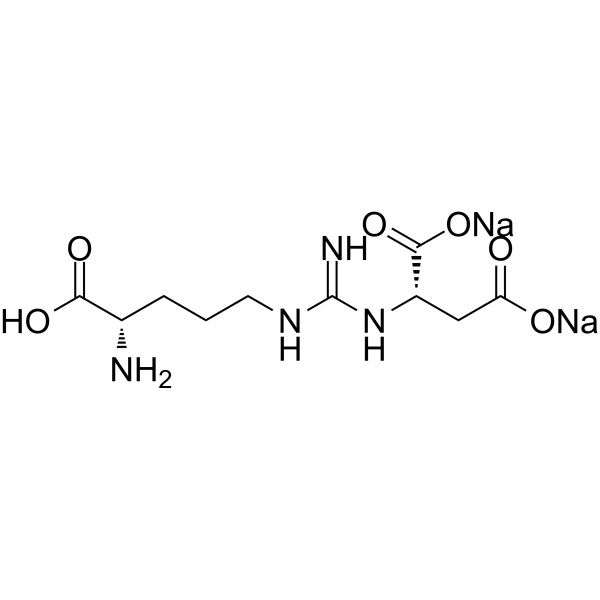
Argininosuccinic acid disodium
Based on 1 publication(s) in Google Scholar
Argininosuccinic acid disodium is an intermediate metabolite in the urea cycle, and its level is associated with argininosuccinic aciduria. Argininosuccinic acid disodium can induce oxidative stress, leading to lipid and protein oxidation, reduction of glutathione, and decrease in antioxidant enzyme activity. Argininosuccinic acid disodium can be converted into guanidinosuccinic acid, a nitric oxide mimic, under the action of nitric oxide-derived free radicals. Argininosuccinic acid disodium can be used in the research of metabolic diseases, renal failure, nervous system diseases, etc.
For research use only. We do not sell to patients.
- Purity : 96.93%
- CAS No.: 918149-29-8
- Formula: C10H16N4Na2O6
- Molecular Weight:334.24
-
Storage:
-20°C, sealed storage, away from moisture
* In solvent : -80°C, 6 months; -20°C, 1 month (sealed storage, away from moisture)

To place orders, for customer services and technical support, please contact: MedChemExpress USA
Tel: 609-228-6898 E-mail: [email protected] [email protected]


-
 Biological Activity
-
Chemical Information
-
Solvent & Solubility
- Purity & Documentation
- References
-
 Help & FAQs


Publications Citing Use of MedChemExpress (MCE) Argininosuccinic acid disodium
MoreAll Endogenous Metabolite Isoforms
More

Biological Activity
Description
In Vitro
Argininosuccinic acid (250-1000 μM; 1 h) disodium can reduce the concentration of reduced glutathione (GSH) and sulfhydryl content, increase the levels of malondialdehyde and carbonyl formation, induce protein oxidative damage, and promote the production of ROS in the cerebral cortex and striatum of rats in vitro[1].
MedChemExpress (MCE) has not independently confirmed the accuracy of these methods. They are for reference only.
In Vivo
MedChemExpress (MCE) has not independently confirmed the accuracy of these methods. They are for reference only.
-
Animal Model:30-day-old male Wistar rats[1]
-
Dosage:2 μL of a 1.0 M concentration (2 μM in 2 μL)
-
Administration:Intrastriatal administration; single dose
-
Result:Significantly induced lipid oxidation (MDA levels) and protein oxidation (carbonyl formation), increased ROS and RNS generation (DCFH oxidation).
Significantly decreased GSH concentrations.


Chemical Information
-
CAS No. 918149-29-8
-
Appearance Solid
-
Molecular Weight 334.24
-
Formula C10H16N4Na2O6
-
Color White to off-white
-
SMILES
OC([C@@H](N)CCCNC(N[C@H](C(O[Na])=O)CC(O[Na])=O)=N)=O
-
Structure Classification
-
Initial Source
-
Shipping
Room temperature in continental US; may vary elsewhere.
-
Storage
-20°C, sealed storage, away from moisture
* In solvent : -80°C, 6 months; -20°C, 1 month (sealed storage, away from moisture)


Publications (1)
-
Journal Impact Factor
-
Most Recent


Solvent & Solubility
In Vitro:
H2O : 50 mg/mL (149.59 mM; Need ultrasonic)
Please refer to the solubility information to select the appropriate solvent. Once prepared, please aliquot and store the solution to prevent product inactivation from repeated freeze-thaw cycles.
Storage method and period of stock solution: -80°C, 6 months; -20°C, 1 month (sealed storage, away from moisture). When stored at -80°C, please use it within 6 months. When stored at -20°C, please use it within 1 month.
* Note: If you choose water as the stock solution, please dilute it to the working solution, then filter and sterilize it with a 0.22 μm filter before use.
Please refer to the solubility information to select the appropriate solvent. Once prepared, please aliquot and store the solution to prevent product inactivation from repeated freeze-thaw cycles.
Storage method and period of stock solution: -80°C, 6 months; -20°C, 1 month (sealed storage, away from moisture). When stored at -80°C, please use it within 6 months. When stored at -20°C, please use it within 1 month.
* Note: If you choose water as the stock solution, please dilute it to the working solution, then filter and sterilize it with a 0.22 μm filter before use.
Concentration (start) × Volume (start) = Concentration (final) × Volume (final)


Purity & Documentation
-
Data Sheet (272 KB)
-
SDS (252 KB)
- English - EN (252 KB)
- Français - FR (252 KB)
- Deutsch - DE (252 KB)
- Norwegian - NO (252 KB)
- Español - ES (252 KB)
- Swedish - SV (252 KB)
- Italian - IT (252 KB)
- Korean - KR (252 KB)
- Portuguese - PT (252 KB)
-
Handling Instructions (2659 KB)
References
[1]. Seminotti B, et al. Free Radical Scavengers Prevent Argininosuccinic Acid-Induced Oxidative Stress in the Brain of Developing Rats: a New Adjuvant Therapy for Argininosuccinate Lyase Deficiency? Mol Neurobiol. 2020 Feb;57(2):1233-1244. [Content Brief]
[2]. Erez A, et al. Argininosuccinate lyase deficiency-argininosuccinic aciduria and beyond. Am J Med Genet C Semin Med Genet. 2011 Feb 15;157C(1):45-53. [Content Brief]
[3]. Aoyagi K, et al. Formation of guanidinosuccinic acid, a stable nitric oxide mimic, from argininosuccinic acid and nitric oxide-derived free radicals. Free Radic Res. 1999 Jul;31(1):59-65. [Content Brief]


Complete Stock Solution Preparation Table
Please refer to the solubility information to select the appropriate solvent. Once prepared, please aliquot and store the solution to prevent product inactivation from repeated freeze-thaw cycles.
Storage method and period of stock solution: -80°C, 6 months; -20°C, 1 month (sealed storage, away from moisture). When stored at -80°C, please use it within 6 months. When stored at -20°C, please use it within 1 month.
| Optional Solvent | Concentration Solvent Mass | 1 mg | 5 mg | 10 mg | 25 mg |
|---|---|---|---|---|---|
| H2O | 1 mM | 2.9919 mL | 14.9593 mL | 29.9186 mL | 74.7966 mL |
| 5 mM | 0.5984 mL | 2.9919 mL | 5.9837 mL | 14.9593 mL | |
| 10 mM | 0.2992 mL | 1.4959 mL | 2.9919 mL | 7.4797 mL | |
| 15 mM | 0.1995 mL | 0.9973 mL | 1.9946 mL | 4.9864 mL | |
| 20 mM | 0.1496 mL | 0.7480 mL | 1.4959 mL | 3.7398 mL | |
| 25 mM | 0.1197 mL | 0.5984 mL | 1.1967 mL | 2.9919 mL | |
| 30 mM | 0.0997 mL | 0.4986 mL | 0.9973 mL | 2.4932 mL | |
| 40 mM | 0.0748 mL | 0.3740 mL | 0.7480 mL | 1.8699 mL | |
| 50 mM | 0.0598 mL | 0.2992 mL | 0.5984 mL | 1.4959 mL | |
| 60 mM | 0.0499 mL | 0.2493 mL | 0.4986 mL | 1.2466 mL | |
| 80 mM | 0.0374 mL | 0.1870 mL | 0.3740 mL | 0.9350 mL | |
| 100 mM | 0.0299 mL | 0.1496 mL | 0.2992 mL | 0.7480 mL |
* Note: If you choose water as the stock solution, please dilute it to the working solution, then filter and sterilize it with a 0.22 μm filter before use.


Argininosuccinic acid disodium Related Classifications
HY-113149A Related Classifications
 Powered by Bioz