



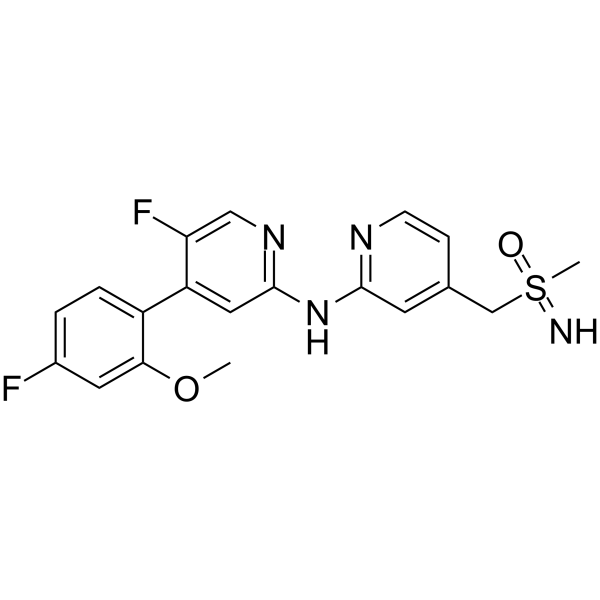
Atuveciclib
Based on 10 publication(s) in Google Scholar
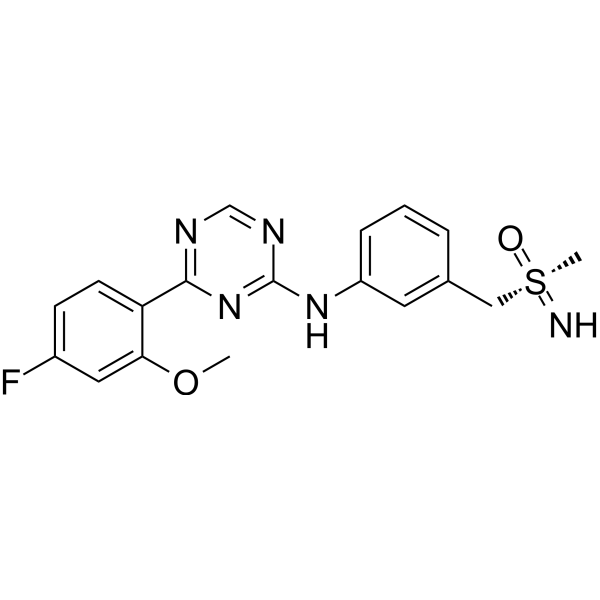
Atuveciclib (BAY-1143572) is a potent and highly selective, oral PTEFb/CDK9 inhibitor. Atuveciclib (BAY-1143572) inhibits CDK9/CycT1 with an IC50 of 13 nM.
Nur für Forschungszwecke. Wir verkaufen nicht an Patienten.
- Reinheit: 99.75%
- CAS. Nr.: 2923012-24-0
- Formel: C18H18FN5O2S
- Molecular Weight:387.43
-
Speicherung:Powder -20°C, 3 years , 4°C, 2 years ; In solvent -80°C, 2 years , -20°C, 1 year

To place orders, for customer services and technical support, please contact: MedChemExpress USA
Tel: 609-228-6898 E-mail: [email protected] [email protected]


-
 Biologische Aktivität
-
Chemical Information
-
Lösungsmittel & Löslichkeit
- Protokoll
- Reinheit & Dokumentation
- Verweise
-
 Help & FAQs


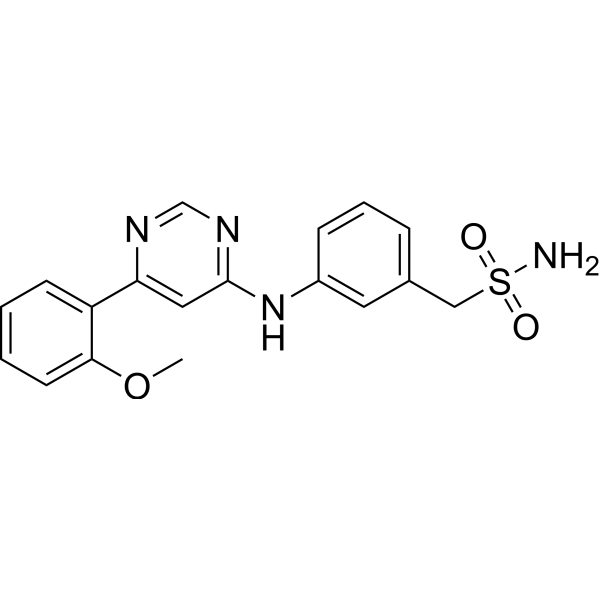
Publications Citing Use of MedChemExpress (MCE) Atuveciclib
More- Nature. 2024 Apr;628(8007):408-415. [Abstract]
- Cell Death Dis. 2020 Sep 15;11(9):754. [Abstract]
- Cell Rep. 2020 Apr 7;31(1):107485. [Abstract]
- Breast Cancer Res. 2023 May 5;25(1):51. [Abstract]
- Breast Cancer Res. 2019 Jul 1;21(1):77. [Abstract]
- Commun Biol. 2021 Mar 25;4(1):399. [Abstract]
- Biomolecules. 2019 Sep 16;9(9):494. [Abstract]
- Anticancer Res. 2021 Dec;41(12):5973-5985. [Abstract]
- Res Sq. 2025 Dec 18.
- Ulm University. 2024 Apr 5.


Biologische Aktivität
Beschreibung
IC50 & Target
[1]|
CDK9/CycT1 13 nM (IC50) |
CDK9/CycT1(h) 6 nM (IC50) |
CDK3/CycE(h) 890 nM (IC50) |
CDK2/CycE(h) 1000 nM (IC50) |
CDK1/CycB(h) 1100 nM (IC50) |
CDK5/p35(h) 1600 nM (IC50) |
Cellular Effect
|
Cell Line

|
Type | Value | Description | References |
|---|---|---|---|---|
| A-431 | IC50 |
0.34 μM
Compound: BAY-1143572
|
Antiproliferative activity against human A-431 cells assessed as cell growth inhibition measured after 72 hrs by MTT assay
Antiproliferative activity against human A-431 cells assessed as cell growth inhibition measured after 72 hrs by MTT assay
|
[PMID: 36332552] |
| A549 | IC50 |
3.29 μM
Compound: BAY-1143572
|
Antiproliferative activity against human A549 cells incubated for 72 hrs by MTT assay
Antiproliferative activity against human A549 cells incubated for 72 hrs by MTT assay
|
[PMID: 33338869] |
| B16 | IC50 |
1.47 μM
Compound: BAY-1143572
|
Antiproliferative activity against mouse B16 cells incubated for 72 hrs by MTT assay
Antiproliferative activity against mouse B16 cells incubated for 72 hrs by MTT assay
|
[PMID: 33338869] |
| BT-549 | IC50 |
2.01 μM
Compound: (+)-BAY-1143572
|
Antiproliferative activity against human BT-549 cells assessed as inhibition of cell growth
Antiproliferative activity against human BT-549 cells assessed as inhibition of cell growth
|
[PMID: 37837671] |
| HCT-116 | IC50 |
0.26 μM
Compound: BAY-1143572
|
Antiproliferative activity against human HCT-116 cells assessed as cell growth inhibition measured after 72 hrs by MTT assay
Antiproliferative activity against human HCT-116 cells assessed as cell growth inhibition measured after 72 hrs by MTT assay
|
[PMID: 36332552] |
| HCT-116 | IC50 |
2.94 μM
Compound: BAY-1143572
|
Antiproliferative activity against human HCT-116 cells incubated for 72 hrs by MTT assay
Antiproliferative activity against human HCT-116 cells incubated for 72 hrs by MTT assay
|
[PMID: 33338869] |
| HeLa | IC50 |
1500 nM
Compound: 50; BAY-1143572
|
Antiproliferative activity against human HeLa cells incubated for 96 hrs by crystal violet staining assay
Antiproliferative activity against human HeLa cells incubated for 96 hrs by crystal violet staining assay
|
[PMID: 32870008] |
| HepG2 | IC50 |
2.7 μM
Compound: BAY-1143572
|
Antiproliferative activity against human HepG2 cells incubated for 72 hrs by MTT assay
Antiproliferative activity against human HepG2 cells incubated for 72 hrs by MTT assay
|
[PMID: 33338869] |
| L02 | IC50 |
2.55 μM
Compound: BAY-1143572
|
Antiproliferative activity against human L02 cells assessed as cell growth inhibition measured after 72 hrs by MTT assay
Antiproliferative activity against human L02 cells assessed as cell growth inhibition measured after 72 hrs by MTT assay
|
[PMID: 36332552] |
| MCF7 | IC50 |
5.52 μM
Compound: BAY-1143572
|
Antiproliferative activity against human MCF7 cells incubated for 72 hrs by MTT assay
Antiproliferative activity against human MCF7 cells incubated for 72 hrs by MTT assay
|
[PMID: 33338869] |
| MDA-MB-231 | IC50 |
1.32 μM
Compound: (+)-BAY-1143572
|
Antiproliferative activity against human MDA-MB-231 cells assessed as inhibition of cell growth
Antiproliferative activity against human MDA-MB-231 cells assessed as inhibition of cell growth
|
[PMID: 37837671] |
| MDA-MB-436 | IC50 |
0.63 μM
Compound: (+)-BAY-1143572
|
Antiproliferative activity against human MDA-MB-436 cells assessed as inhibition of cell growth
Antiproliferative activity against human MDA-MB-436 cells assessed as inhibition of cell growth
|
[PMID: 37837671] |
| MOLM-13 | IC50 |
0.2 μM
Compound: BAY-1143572
|
Antiproliferative activity against human MOLM-13 cells incubated for 72 hrs by MTT assay
Antiproliferative activity against human MOLM-13 cells incubated for 72 hrs by MTT assay
|
[PMID: 33338869] |
| MOLM-13 | IC50 |
310 nM
Compound: 3
|
Antiproliferative activity against human MOLM-13 cells assessed as reduction in cell viability incubated for 96 hrs by Cell Titer-Glo reagent assay
Antiproliferative activity against human MOLM-13 cells assessed as reduction in cell viability incubated for 96 hrs by Cell Titer-Glo reagent assay
|
[PMID: 38564299] |
| MV4-11 | IC50 |
0.56 μM
Compound: BAY-1143572
|
Antiproliferative activity against human MV4-11 cells incubated for 72 hrs by MTT assay
Antiproliferative activity against human MV4-11 cells incubated for 72 hrs by MTT assay
|
[PMID: 33338869] |
| NCI-H1975 | IC50 |
0.72 μM
Compound: BAY-1143572
|
Antiproliferative activity against human NCI-H1975 cells assessed as cell growth inhibition measured after 72 hrs by MTT assay
Antiproliferative activity against human NCI-H1975 cells assessed as cell growth inhibition measured after 72 hrs by MTT assay
|
[PMID: 36332552] |
| NCI-H1975 | IC50 |
1.08 μM
Compound: BAY1143572
|
Antiproliferative activity against human Osimertinib-resistant NCI-H1975 cell incubated for 72 hrs by MTT assay
Antiproliferative activity against human Osimertinib-resistant NCI-H1975 cell incubated for 72 hrs by MTT assay
|
[PMID: 37870244] |
| PANC-1 | IC50 |
0.11 μM
Compound: BAY-1143572
|
Antiproliferative activity against human PANC-1 cells assessed as cell growth inhibition measured after 72 hrs by MTT assay
Antiproliferative activity against human PANC-1 cells assessed as cell growth inhibition measured after 72 hrs by MTT assay
|
[PMID: 36332552] |
| Sf9 | IC50 |
1000 nM
Compound: BAY-1143572
|
Inhibition of recombinant GST-tagged human CDK2/cyclin-E expressed in sf9 cels using biotin-Ttds-YISPLKSPYKISEG as substrate preincubated for 15 mins followed by substrate addition and measured after 25 mins in presence of ATP by TR-FRET assay
Inhibition of recombinant GST-tagged human CDK2/cyclin-E expressed in sf9 cels using biotin-Ttds-YISPLKSPYKISEG as substrate preincubated for 15 mins followed by substrate addition and measured after 25 mins in presence of ATP by TR-FRET assay
|
[PMID: 31238183] |
In Vitro
Positive transcription elongation factor b (PTEFb) is a heterodimer of CDK9 and one of four cyclin partners, cyclin T1, cyclin K, cyclin T2a or cyclin T2b. Atuveciclib (BAY-1143572) demonstrates potent antiproliferative activity against HeLa cells (IC50=920 nM) and MOLM-13 cells (IC50=310 nM)[1].
MedChemExpress (MCE) has not independently confirmed the accuracy of these methods. They are for reference only.
In Vivo
MedChemExpress (MCE) has not independently confirmed the accuracy of these methods. They are for reference only.
Clinical Trial
| NCT Number | Sponsor | Condition | Start Date |
Phase
|
|---|---|---|---|---|
| NCT01329991 | Plexxikon| | 2011-05 | PHASE1 |


Chemical Information
-
CAS. Nr. 2923012-24-0
-
Appearance Solid
-
Molecular Weight 387.43
-
Formel C18H18FN5O2S
-
Color White to off-white
-
SMILES
N=[S@](CC1=CC(NC2=NC(C3=CC=C(F)C=C3OC)=NC=N2)=CC=C1)(C)=O
-
Synonyms
BAY-1143572
-
Versand
Room temperature in continental US; may vary elsewhere.
-
Speicherung
Powder -20°C 3 years 4°C 2 years In solvent -80°C 2 years -20°C 1 year


Publications (10)
-
Journal Impact Factor
-
Most Recent
-
Nature
2024 Apr;628(8007):408-415. PMID: 38480883 -
Cell Death Dis
2020 Sep 15;11(9):754. PMID: 32934219 -
Cell Rep
2020 Apr 7;31(1):107485. PMID: 32268092 -
Breast Cancer Res
Systematic screening identifies ABCG2 as critical factor underlying synergy of kinase inhibitors with transcriptional CDK inhibitors. [Abstract]2023 May 5;25(1):51. PMID: 37147730 -
Breast Cancer Res
A kinase inhibitor screen identifies a dual cdc7/CDK9 inhibitor to sensitise triple-negative breast cancer to EGFR-targeted therapy. [Abstract]2019 Jul 1;21(1):77. PMID: 31262335 -
Commun Biol
A genome-scale CRISPR Cas9 dropout screen identifies synthetically lethal targets in SRC-3 inhibited cancer cells. [Abstract]2021 Mar 25;4(1):399. PMID: 33767353 -
Biomolecules
Crinamine Induces Apoptosis and Inhibits Proliferation, Migration, and Angiogenesis in Cervical Cancer SiHa Cells. [Abstract]2019 Sep 16;9(9):494. PMID: 31527550 -
Anticancer Res
The Novel, Orally Bioavailable CDK9 Inhibitor Atuveciclib Sensitises Pancreatic Cancer Cells to TRAIL-induced Cell Death. [Abstract]2021 Dec;41(12):5973-5985. PMID: 34848451 -
-


Lösungsmittel & Löslichkeit
In Vitro:
DMSO : 100 mg/mL (258.11 mM; Need ultrasonic; Hygroscopic DMSO has a significant impact on the solubility of product, please use newly opened DMSO)
Please refer to the solubility information to select the appropriate solvent. Once prepared, please aliquot and store the solution to prevent product inactivation from repeated freeze-thaw cycles.
Storage method and period of stock solution: -80°C, 2 years; -20°C, 1 year. When stored at -80°C, please use it within 2 years. When stored at -20°C, please use it within 1 year.
Please refer to the solubility information to select the appropriate solvent. Once prepared, please aliquot and store the solution to prevent product inactivation from repeated freeze-thaw cycles.
Storage method and period of stock solution: -80°C, 2 years; -20°C, 1 year. When stored at -80°C, please use it within 2 years. When stored at -20°C, please use it within 1 year.
Konzentration (Stammlösung) × Volumen (Stammlösung) = Konzentration (Ziellösung) × Volumen (Ziellösung)
In Vivo:
Select the appropriate dissolution method based on your experimental animal and administration route.
- For the following dissolution methods, please ensure to first prepare a clear stock solution using an In Vitro approach and then sequentially add co-solvents:
- To ensure reliable experimental results, the clarified stock solution can be appropriately stored based on storage conditions. As for the working solution for In Vivo experiments, it is recommended to prepare freshly and use it on the same day.
- The percentages shown for the solvents indicate their volumetric ratio in the final prepared solution. If precipitation or phase separation occurs during preparation, heat and/or sonication can be used to aid dissolution.
Add each solvent one by one: 10% DMSO 40% PEG300 5% Tween-80 45% Saline
Solubility: ≥ 2.5 mg/mL (6.45 mM); Clear solution
This protocol yields a clear solution of ≥ 2.5 mg/mL (saturation unknown).
Taking 1 mL working solution as an example, add 100 μL DMSO stock solution (25.0 mg/mL) to 400 μL PEG300, and mix evenly; then add 50 μL Tween-80 and mix evenly; then add 450 μL Saline to adjust the volume to 1 mL.
Preparation of Saline: Dissolve 0.9 g sodium chloride in ddH₂O and dilute to 100 mL to obtain a clear Saline solution.
In Vivo Dissolution Calculator
Please enter the basic information of animal experiments:
-
-
-
-
Recommended: Prepare an additional quantity of animals to account for potential losses during experiments.
Please enter your animal formula composition:
-
%DMSO +
Recommended: Keep the proportion of DMSO in working solution below 2% if your animal is weak.
-
%+
-
+%Tween-80 + +
-
%Saline +
The co-solvents required include: DMSO, . All of co-solvents are available by MedChemExpress (MCE). , Tween 80. All of co-solvents are available by MedChemExpress (MCE).
Working solution concentration: 0.22 mg/mL
Method for preparing stock solution: mg drug dissolved in μL DMSO. Stock solution concentration: mg/mL.
1. Take μL DMSO stock solution;
2. Add μL .
μL , mix evenly;
3. Then add μL Tween 80, mix evenly;
4. Then add μL
Please ensure that the stock solution in the first step is dissolved to a clear state, and add co-solvents in sequence. You can use ultrasonic heating (ultrasonic cleaner, recommended frequency 20-40 kHz), vortexing, etc. to assist dissolution.

Protokoll
Cell Assay[1]
HeLa human cervical tumor cells (CCL-2) and MOLM-13 human acute myeloid leukemia cells (ACC 554) are propagated under the suggested growth conditions in a humidified 37°C incubator. Proliferation assays are conducted in 96-well plates at densities of 3000 (HeLa) and 5000 (MOLM-13) cells per well in the growth medium containing 10 % fetal calf serum (FCS). Cells are treated in quadruplicate with serial dilutions of test compounds (e.g., Atuveciclib (BAY-1143572)) for 96 h. Relative cell numbers are quantified by crystal violet staining (HeLa) or CellTitre-Glo Luminescent Cell Viability Assay (MOLM-13). IC50 values are determined by means of a four-parameter fit on measurement data which are normalized to vehicle (DMSO) treated cells (=100 %) and measurement readings taken immediately before compound exposure (=0 %)[1].
MedChemExpress (MCE) has not independently confirmed the accuracy of these methods. They are for reference only.
Animal Administration[1]
Mice and Rats[1]
For the acute myeloid leukemia (AML) mouse model, 2×10⁶ MOLM-13 human AML cells are inoculated subcutaneously to the left flank of female NMRI nu/nu mice (18-21 g, 5-6 weeks). For the AML model in rats, 2×10⁶ MV4-11 human AML cells are inoculated subcutaneously to the left flank of female athymic nude rats (160-200 g, 5-6 weeks). Animals are stratified into treatment and control groups (n=8-13/group for mice, n=12/group for rats) based on primary tumor size. Treatments are started 3-13 days after tumor cell inoculation when the average tumor sizes are 23-38 mm2 and 43 mm2 for mice and rats, respectively. The 20 and 25 mg/kg once daily dose is for nude mice. Furthermore, Atuveciclib (BAY-1143572) administered at 25 or 35 mg/kg, three days on/two days off. BAY-1143572 is administered daily oral administration of Atuveciclib (BAY-1143572) at 12 mg/kg for rats. Unless otherwise indicated, all treatments are administered orally (p.o.) and are continued until the end of the experiment. Body weight and tumor areas (longest diameter multiplied by its perpendicular) measured by caliper are determined at least twice weekly. T/C ratios are calculated by dividing the mean tumor area of the treatment group by the mean tumor area of the vehicle group at the time point when the vehicle group is sacrificed[1].
MedChemExpress (MCE) has not independently confirmed the accuracy of these methods. They are for reference only.


Reinheit & Dokumentation
-
Data Sheet (286 KB)
-
SDS (252 KB)
- English - EN (252 KB)
- Français - FR (252 KB)
- Deutsch - DE (252 KB)
- Norwegian - NO (252 KB)
- Español - ES (252 KB)
- Swedish - SV (252 KB)
- Italian - IT (252 KB)
- Korean - KR (252 KB)
- Portuguese - PT (252 KB)
-
Handling Instructions (2659 KB)
Verweise


Complete Stock Solution Preparation Table
Please refer to the solubility information to select the appropriate solvent. Once prepared, please aliquot and store the solution to prevent product inactivation from repeated freeze-thaw cycles.
Storage method and period of stock solution: -80°C, 2 years; -20°C, 1 year. When stored at -80°C, please use it within 2 years. When stored at -20°C, please use it within 1 year.
| Optional Solvent | Concentration Solvent Mass | 1 mg | 5 mg | 10 mg | 25 mg |
|---|---|---|---|---|---|
| DMSO | 1 mM | 2.5811 mL | 12.9056 mL | 25.8111 mL | 64.5278 mL |
| 5 mM | 0.5162 mL | 2.5811 mL | 5.1622 mL | 12.9056 mL | |
| 10 mM | 0.2581 mL | 1.2906 mL | 2.5811 mL | 6.4528 mL | |
| 15 mM | 0.1721 mL | 0.8604 mL | 1.7207 mL | 4.3019 mL | |
| 20 mM | 0.1291 mL | 0.6453 mL | 1.2906 mL | 3.2264 mL | |
| 25 mM | 0.1032 mL | 0.5162 mL | 1.0324 mL | 2.5811 mL | |
| 30 mM | 0.0860 mL | 0.4302 mL | 0.8604 mL | 2.1509 mL | |
| 40 mM | 0.0645 mL | 0.3226 mL | 0.6453 mL | 1.6132 mL | |
| 50 mM | 0.0516 mL | 0.2581 mL | 0.5162 mL | 1.2906 mL | |
| 60 mM | 0.0430 mL | 0.2151 mL | 0.4302 mL | 1.0755 mL | |
| 80 mM | 0.0323 mL | 0.1613 mL | 0.3226 mL | 0.8066 mL | |
| 100 mM | 0.0258 mL | 0.1291 mL | 0.2581 mL | 0.6453 mL |


Atuveciclib Related Classifications
HY-12871B Related Classifications
 Powered by Bioz