



Bismuth subcitrate potassium (Standard)
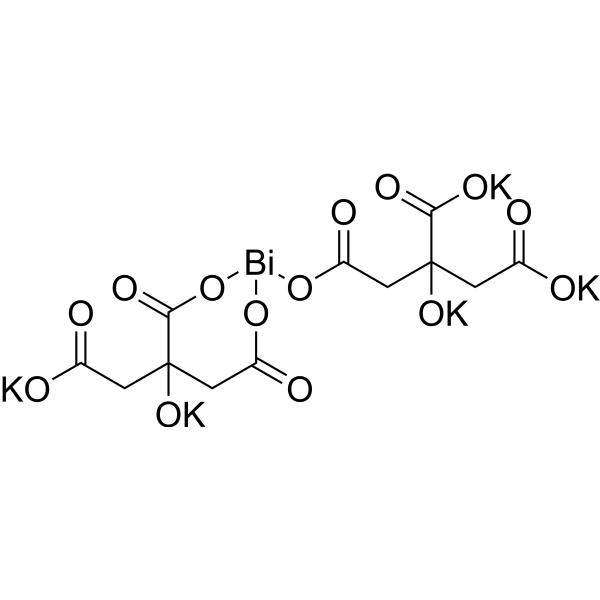
Bismuth subcitrate potassium (Standard) is the analytical standard of Bismuth subcitrate potassium (HY-16102). This product is intended for research and analytical applications. Bismuth subcitrate potassium is a compound bismuth salt with oral activity. Bismuth subcitrate potassium has antibacterial activity and can inhibit the growth of Campylobacter pyloridis with a MIC50 of 8 μg/mL. Bismuth subcitrate potassium can be used in the study of gastrointestinal diseases infected by Campylobacter pyloridis.
For research use only. We do not sell to patients.
- CAS No.: 880149-29-1
- Formula: C12H8BiK5O14
- Molecular Weight:780.66
-
Storage:
Please store the product under the recommended conditions in the Certificate of Analysis.


To place orders, for customer services and technical support, please contact: MedChemExpress USA
Tel: 609-228-6898 E-mail: [email protected] [email protected]


-
 Product Information
-
Chemical Information
- Purity & Documentation
-
 Help & FAQs




Product Information
Information
Application
The compound is the grade of analytical standard, which is the reference standard supplied assay. It is commonly used in qualitative, quantitative and methodological research experiments in HPLC, GC and MS.


Chemical Information
-
CAS No. 880149-29-1
-
Molecular Weight 780.66
-
Formula C12H8BiK5O14
-
SMILES
O=C(O[Bi](OC(CC(C(O[K])=O)(O[K])CC(O[K])=O)=O)OC1=O)C(C1)(O[K])CC(O[K])=O
-
Shipping
Room temperature in continental US; may vary elsewhere.
-
Storage
Please store the product under the recommended conditions in the Certificate of Analysis.


Purity & Documentation
References
[1]. Van Caekenberghe DL, et al. In vitro synergistic activity between bismuth subcitrate and various antimicrobial agents against Campylobacter pyloridis (C. pylori). Antimicrob Agents Chemother. 1987 Sep;31(9):1429-30. [Content Brief]
[2]. Malfertheiner P, et al. Helicobacter pylori eradication with a capsule containing bismuth subcitrate potassium, metronidazole, and tetracycline given with omeprazole versus clarithromycin-based triple therapy: a randomised, open-label, non-inferiority, phase 3 trial. Lancet. 2011 Mar 12;377(9769):905-13. [Content Brief]
[3]. Hussar DA. New drugs: retapamulin, bismuth subcitrate potassium, and rotigotine. J Am Pharm Assoc (2003). 2007 Jul-Aug;47(4):539-43. [Content Brief]

Calculators
Concentration (start) × Volume (start) = Concentration (final) × Volume (final)


Bismuth subcitrate potassium (Standard) Related Classifications
HY-16102R Related Classifications
 Powered by Bioz